The African grey parrot species number two, talking parrots of the African rainforest, and they are among the most intelligent birds on Earth, able to learn hundreds of words and solve puzzles that stump young children. If you are asking how many African grey parrot species there are, the answer is two: there are two recognised African grey parrot species in the world, the Congo African grey and the Timneh African grey, and every African grey parrot alive today belongs to one of them.
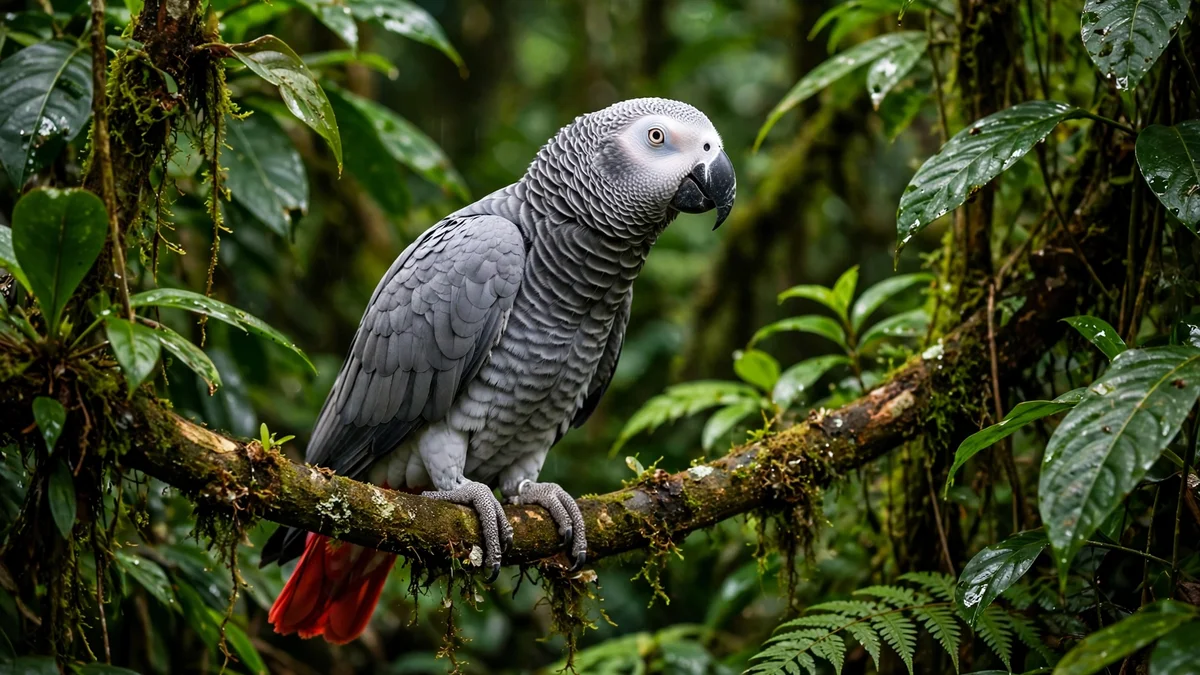
The African grey parrot belongs to the family Psittacidae, the true parrots, and it lives in the rainforests of West and Central Africa, from the Ivory Coast to Kenya. Its grey feathers, its white face, its red tail and its black beak make it one of the most recognisable parrots in the world.
Key takeaways
- There are two African grey parrot species, and the Congo African grey is the larger and better known of them.
- African grey parrots are among the best mimics in the animal kingdom, and one famous parrot, Alex, learned more than 100 words.
- African grey parrots are as intelligent as a five-year-old child, and they can count, sort shapes and understand the meaning of words.
- African grey parrots live in flocks of hundreds in the wild, and they gather at clay licks and fruiting trees each morning.
- African grey parrots are listed as Endangered, and trapping for the pet trade is the main threat.
What makes an African grey parrot an African grey parrot
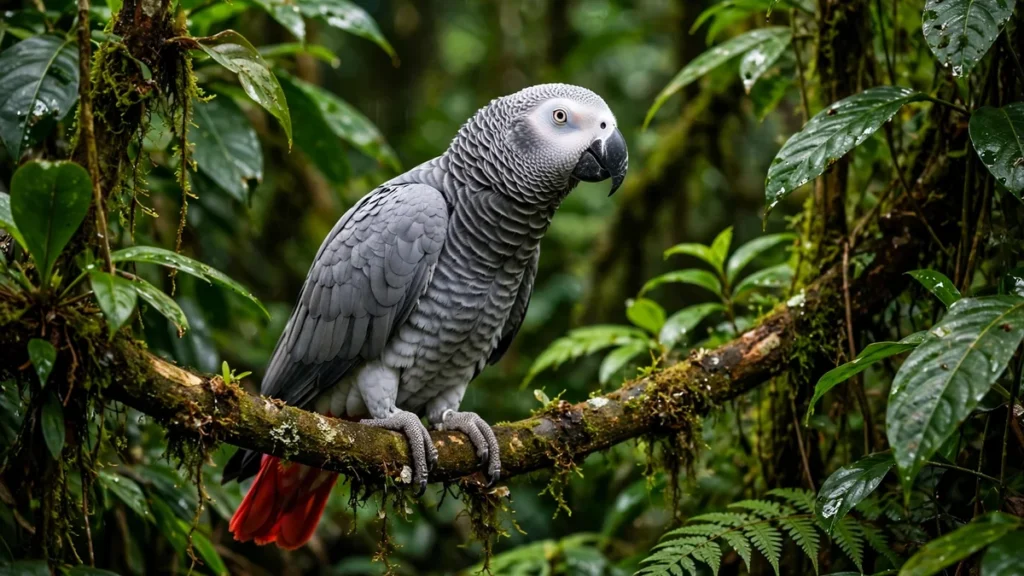
An African grey parrot is a medium-sized parrot with grey feathers, a white face, a red tail and a large black beak, and it measures roughly 33 centimetres long and usually weighs between 400 and 550 grammes, depending on the species. The Congo African grey is the larger of the two, at about 33 centimetres and 400 to 550 grammes, with a bright red tail, while the Timneh African grey is smaller and darker, with a maroon tail and a pale upper beak.
The voice defines the African grey parrot: a mimic that can learn hundreds of words and sounds, from human speech to phone rings and dog barks, and use them in the right context. Its brain is one of the largest of any bird relative to its body, and in tests it has shown the intelligence of a five-year-old child, able to count, sort shapes by colour and understand the meaning of words like bigger, smaller and same. Like other macaws, the African grey has a strong beak for cracking nuts and zygodactyl feet, with two toes pointing forwards and two backwards, which grip branches and hold food.
The African grey parrot species and their relatives
There are two African grey parrot species. The Congo African grey lives in the rainforests of Central Africa, from the Ivory Coast to Kenya and Angola, and it is the best-known African grey, kept as a pet around the world. The Timneh African grey lives in the rainforests of West Africa, from Guinea to the Ivory Coast, and it is smaller, darker and slightly less well known, though it is often said to be calmer and to learn to talk earlier.
The scarlet macaw is the African grey parrot’s most colourful relative, a red, yellow and blue parrot of the American rainforest, while the blue-and-yellow macaw is a blue and gold parrot of the Amazon. The cockatoo is a white crested parrot of Australia, the budgerigar is a small green parrot that is the most popular pet bird in the world, and the cockatiel is a small grey parrot with orange cheeks. The Senegal parrot is a small green parrot that shares the African grey’s forests, and the lovebird is a tiny parrot that pairs for life.

| Type | Animal | Where it lives | Best-known food | Length or Weight |
|---|---|---|---|---|
| Species | Congo African grey parrot (Psittacus erithacus) | Rainforests of Central Africa | Fruit, nuts and seeds | 33 cm, 400 to 550 g |
| Close relative | Timneh African grey parrot | Rainforests of West Africa | Fruit, nuts and seeds | 28 to 33 cm, 300 to 400 g |
| Close relative | Scarlet macaw | Central and South American forests | Fruit, nuts and seeds | 81 to 96 cm, about 1 kg |
| Close relative | Blue-and-yellow macaw | Amazon and Orinoco basins | Fruit, nuts and seeds | 76 to 86 cm, 900 g to 1.3 kg |
| Close relative | Cockatoo | Australia and Indonesia | Seeds, nuts and fruit | 30 to 70 cm, 300 g to 1.2 kg |
| Close relative | Senegal parrot | West African savanna and forest | Seeds, fruit and nuts | 23 cm, 120 to 170 g |
| Close relative | Budgerigar | Australian grassland | Grass seeds | 18 cm, 30 to 40 g |
How African grey parrots live
African grey parrots are creatures of the rainforest canopy. An African grey parrot lives in a flock, a group of hundreds of birds that feed, fly and roost together, and the flocks gather at clay licks and fruiting trees each morning. Like other African animals, it follows the fruiting seasons, moving through the forest as different trees come into fruit.
Fruit makes up most of the diet, along with nuts, seeds, leaves and bark, and an African grey parrot eats by cracking nuts with its powerful beak and holding the kernel in its foot. It visits clay licks, eating mineral-rich clay that neutralises the toxins in the seeds it eats, and it gathers there in noisy flocks, one of the great wildlife sights of the African forest.
Breeding happens in the dry season, when food is plentiful, and the pair nests in a tree cavity, often in a dead tree, laying 2 to 4 white eggs, of which usually only one or two chicks survive. Both parents incubate the eggs for about 30 days, and the chicks are born naked and blind, fed by both parents for about 12 weeks before they fledge. African grey parrots live for around 40 to 60 years in the wild, and up to 80 years in captivity.
Where African grey parrots live
The African grey parrot lives in the rainforests of West and Central Africa, from the Ivory Coast through Ghana, Nigeria, Cameroon and Gabon to the Congo and Kenya, and it is most common in the lowland rainforest, where fruiting trees are thickest. The Congo African grey lives across Central Africa, while the Timneh African grey lives only in the forests of Guinea, Sierra Leone, Liberia and the Ivory Coast.
Rainforest is the key requirement. An African grey parrot needs tall trees to nest in, fruiting trees to feed from and clay licks to visit, so it follows the fruit as it ripens, and when the forest is cleared the parrot has nowhere to live.
The species is listed as Endangered, and its numbers are falling fast. The main pressures are trapping for the pet trade, which takes hundreds of thousands of birds from the wild, and the loss of rainforest to farming and logging. In 2016 the African grey was moved to CITES Appendix I, which bans all international trade in wild-caught birds, but illegal trapping continues, and the population has fallen by up to 99 per cent in some countries, including Ghana.
Best seasons for African grey parrot watching
There is no closed season, because African grey parrots are active all year, but the best time to look for them depends on where you go. In Gabon the best months are often the dry season, when the birds gather at the clay licks each morning. In Ghana the best months are often December to April, when the birds are breeding and easy to find near their nests.
Staying safe around African grey parrots
An African grey parrot is a wild bird with a powerful beak and sharp claws, and it can hurt a person, though parrots almost never attack people. Keep your distance, never approach a parrot nest, and never try to catch a parrot, because a frightened bird may bite hard enough to break a finger. If you see parrots feeding, stay on the path and watch with binoculars, because parrots that are disturbed may abandon their clay lick.
African grey parrot watching checklist
A little preparation turns a rainforest visit into a real chance of seeing an African grey parrot, so pack for heat, humidity and long quiet hours.
- Binoculars with good low-light performance, for picking a grey bird out of the green canopy.
- A camera with a long lens, because parrots should always be watched from a distance.
- Sun cream and a hat, because the best watching is in the bright morning sun.
- Water and snacks for long days, because the best sightings come after hours of waiting.
- A field guide to parrots, for telling a Congo grey from a Timneh at a glance.
- A plan to be out at dawn, when the parrots fly to the clay licks to feed.
- Patience and silence, because parrots are shy birds and a noisy group will send them away.
Frequently asked questions
How many African grey parrot species are there?
There are two African grey parrot species: the Congo African grey and the Timneh African grey. The Timneh was long thought to be a subspecies of the Congo grey, but it is now recognised as a separate species, smaller and darker, with a maroon tail.
Can African grey parrots really talk?
Yes. African grey parrots are among the best mimics in the animal kingdom, and they can learn hundreds of words and use them in the right context. The most famous African grey, Alex, learned more than 100 words, and he could count, sort shapes and tell the difference between colours.
How intelligent are African grey parrots?
African grey parrots are as intelligent as a five-year-old child. They can count, sort shapes by colour and size, understand the meaning of words like bigger, smaller and same, and solve puzzles that stump young children. Their brains are among the largest of any bird relative to their body.
Can you keep an African grey parrot as a pet?
No. An African grey parrot is a wild bird that needs rainforest, eats fruit and nuts by the kilogramme, and is fully protected by international law, which bans the trade in wild-caught birds. Parrots in zoos need huge aviaries with trees and climbing frames, and they are not pets.
How is this guide different from the barn owl species guide?
This guide covers two African grey parrot species, talking parrots that live in flocks in the African rainforest, while our barn owl species guide covers the single barn owl species, a pale ghost owl that hunts mice by sound in the dark. The parrot mimics human speech and lives for 60 years, and the owl screeches and hunts in silence.
Are African grey parrots endangered?
Yes. African grey parrots are listed as Endangered, and their numbers are falling fast. Trapping for the pet trade is the main threat, and the population has fallen by up to 99 per cent in some countries, including Ghana.
Conclusion
The African grey parrot species show how much intelligence one bird can hold: two species of talking parrot, with brains like a child’s, voices that copy human speech, and lives spent flying in flocks through the African rainforest.
If you go looking for one, go in the dry season to the clay licks of Gabon or the forests of the Congo, go quietly, and go with patience. Watch a flock of African grey parrots landing on the clay and you will understand why it has earned its place as the talking bird of the rainforest, and why keeping its forest matters most.