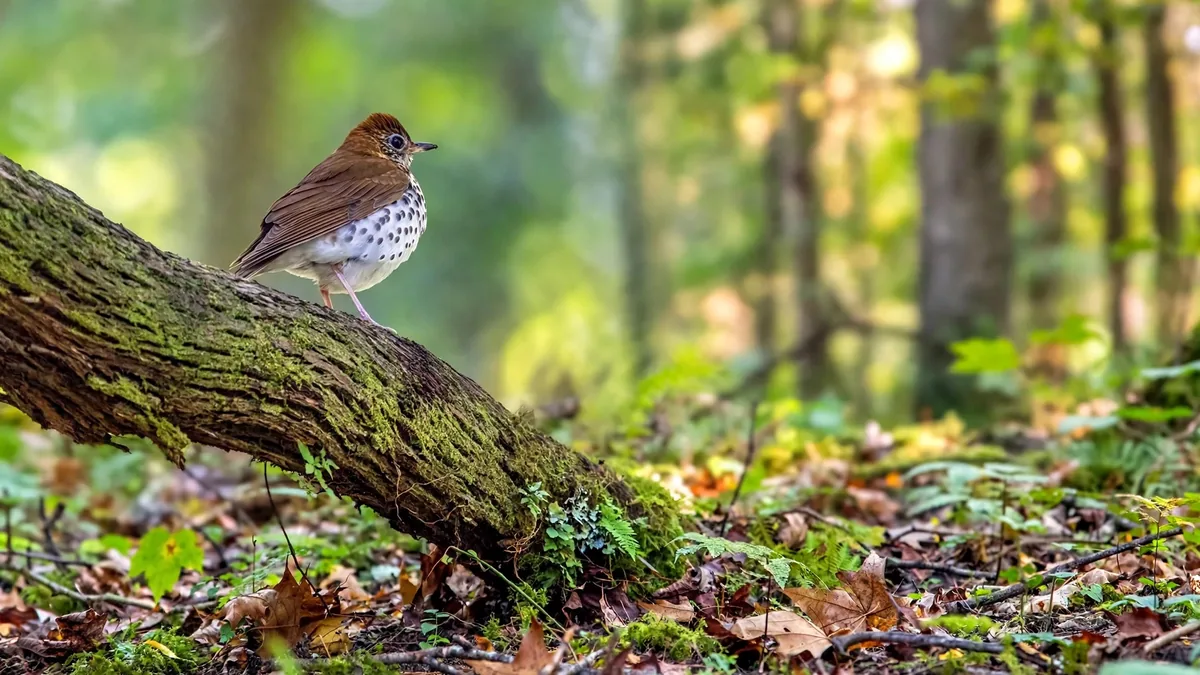
The wood thrush species is a single species, Hylocichla mustelina, the flute-voiced thrush of the deciduous forests of eastern North America. If you are asking how many wood thrush species there are, the answer is one, a rusty-capped songbird with a boldly spotted white breast that is the only member of its genus.
On a still summer evening in a mature woodland, the wood thrush sings one of the finest songs of any North American bird, a series of clear, flute-like phrases that seem to echo through the trees. It is a shy bird of the forest floor, more often heard than seen.
Key takeaways
- The wood thrush species is Hylocichla mustelina, a single species with no recognised subspecies, and the only member of the genus Hylocichla.
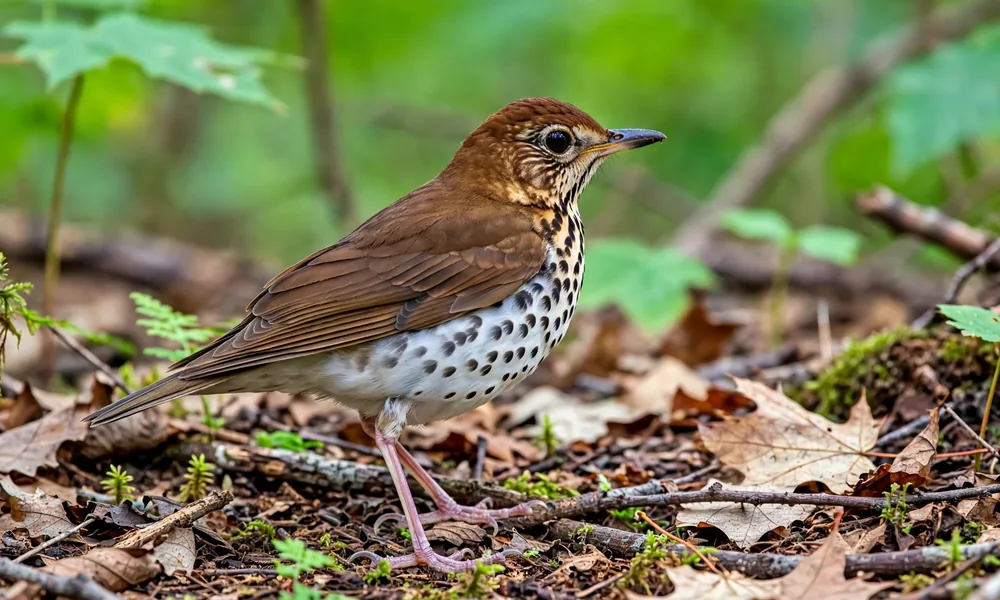
- Adults have a warm rusty-brown crown, olive-brown upperparts and a white breast boldly spotted with large black spots, with pink legs and a white eye-ring.
- It sings a flute-like song of clear phrases, often at dawn and dusk, and can sing two notes at once.
- Wood thrushes feed mainly on the forest floor, eating insects and other invertebrates in summer and fruit in autumn.
- The breeding population has fallen by about half since 1966, yet the current IUCN assessment lists the bird as Least Concern, a point on which older sources disagree.
What makes a wood thrush a wood thrush
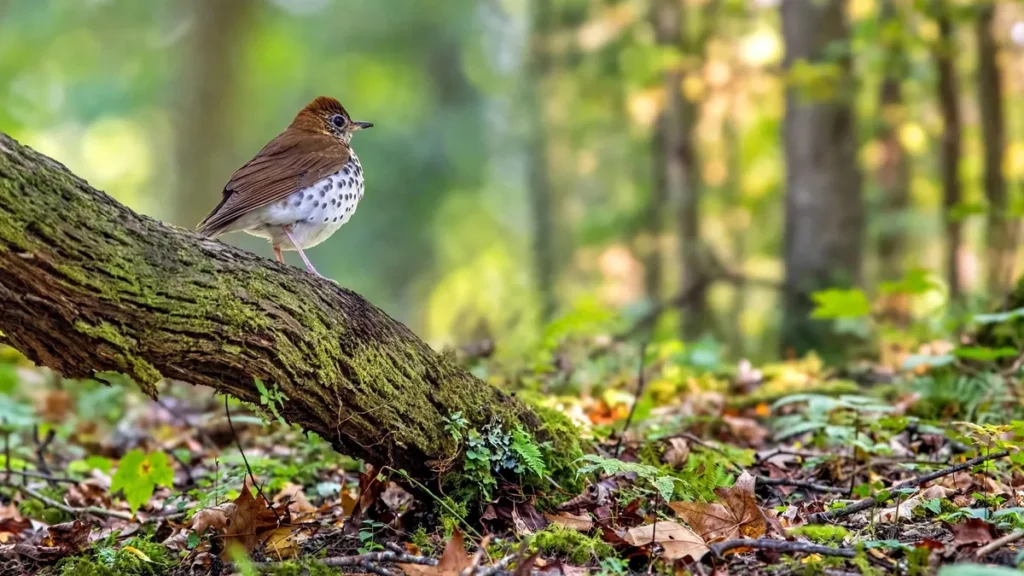
A wood thrush is a medium-sized thrush, 18 to 21 centimetres long, with a wingspan of 30 to 40 centimetres and a weight of 40 to 50 grammes. It is the largest of the brown North American thrushes of its group, with a round belly, a fairly short tail and an upright posture. The crown and nape are a warm rusty brown, the back and tail a cooler olive-brown, and the underparts are white with large, round, black spots spread across the breast, flanks and belly. A distinct white eye-ring, cheeks streaked black and white, and pink legs complete the picture, and the sexes look alike in every season.
The song is what sets the wood thrush apart. The male sings a series of clear, flute-like phrases, each one ending in a soft trill, often described as a low, liquid ee-oh-lay. Remarkably, the wood thrush can sing two notes at the same time, using the two sides of its voice box independently, which gives its song a haunting, harmonising quality.
The wood thrush species and their relatives
The wood thrush belongs to the thrush family Turdidae, and it is a single species with no recognised subspecies: it is monotypic. It is also the only species placed in the genus Hylocichla, a genus introduced by the American naturalist Spencer Baird in 1864. The name Hylocichla comes from Greek words meaning woodland and thrush, while mustelina is Latin for weasel-like, a reference to the warm tawny-brown upperparts.
Its closest relatives are the other thrushes of North America, including the veery, the hermit thrush and the Swainson’s thrush, all smaller, slimmer birds in the genus Catharus, with smaller and fewer spots confined to the breast and an almost unspotted belly. The wood thrush also appears to be fairly closely related to the large thrushes of the genus Turdus, such as the American robin, a familiar garden bird that shares the same family but not the same shy forest habits. The wood thrush is the official bird of the District of Columbia.
| Type | Animal | Where it lives | Best-known food | Length or Weight |
|---|---|---|---|---|
| Genus | Thrushes of genus Hylocichla | Eastern North America | Insects and fruit | About 18 to 21 cm long |
| Species | Wood thrush (Hylocichla mustelina) | Eastern North America to Central America | Insects, snails and fruit | 18 to 21 cm, 40 to 50 g |
| Species | Veery (Catharus fuscescens) | Northern forests of North America | Insects and fruit | About 18 cm, 28 to 35 g |
| Species | Hermit thrush (Catharus guttatus) | Northern and western North America | Insects and berries | About 17 cm, 27 to 35 g |
| Species | Swainson’s thrush (Catharus ustulatus) | Boreal forests of North America | Insects and fruit | About 18 cm, 30 to 40 g |
| Species | American robin (Turdus migratorius) | Across North America | Earthworms and fruit | About 25 cm, 70 to 85 g |
How wood thrushes live
Wood thrushes feed mainly on the forest floor, hopping through the leaf litter and tossing leaves aside with the bill to uncover insects, beetles, ants, caterpillars, millipedes, snails and earthworms. They also take small fruit, and in late summer and autumn fruit becomes a large part of the diet, including the berries of dogwood, spicebush, pokeweed and wild cherry.
The female builds a cup-shaped nest of twigs, grasses, leaves and mud, lined with fine rootlets, usually placed in the fork of a small tree or shrub, one to five metres above the ground. She lays three to five pale blue eggs, sometimes with a few brown spots, and incubates them for 12 to 14 days. Both parents feed the chicks, which leave the nest after 12 to 14 days, before they can fly well, and hide in the undergrowth while the parents bring them food. Wild birds usually live for about eight years, though some have reached more than 14 years.
Where wood thrushes live
Wood thrushes breed in the deciduous and mixed forests of eastern North America, from Manitoba, Ontario and Nova Scotia in southern Canada south to northern Florida, and from the Atlantic coast west to the Missouri River and the eastern Great Plains. They favour mature woodland with tall trees, a well-developed shrub layer and a damp leaf litter, and they are most common in large, unbroken tracts of forest. They also use wooded parks and gardens where the trees are old and the undergrowth is thick, but they avoid small, isolated woodlots.
They are long-distance migrants. In autumn they fly south to winter in the humid lowland and foothill forests of southern Mexico and Central America, from southern Mexico to Panama, with most birds wintering in Mexico, Guatemala, Belize, Honduras and Nicaragua. There they live in old secondary forest and shady gardens with dense undergrowth. They return north in spring, arriving in the southern United States in March and April and reaching Canada by May.
The wood thrush has become a symbol of the decline of the Neotropical songbirds of eastern North America, having declined by approximately half since 1966. Forest fragmentation has increased nest predation and parasitism by brown-headed cowbirds, which lay their eggs in thrush nests, while the destruction of primary forest in Central America has removed much of its winter habitat. In spite of this, the current IUCN assessment, published by BirdLife International in 2020, lists the wood thrush as Least Concern, a change from the Near Threatened listing it held in 2014, and the older label still appears in many sources, including National Geographic’s profile, which is drawn from a 2006 book. The bird is listed as Threatened in Canada, and it is protected in the United States under the Migratory Bird Treaty Act.
Best seasons for wood thrush watching
Wood thrushes are easiest to watch from late April to August, when the males are singing on their breeding territories. In the southern United States look for them from late March, and in Canada from May, when the migrants return. Dawn and dusk are the best times, when the song carries through the forest and the birds are most active, though on overcast days they may sing for much of the day.
Staying safe around wood thrushes
A wood thrush is a shy, gentle bird, and the main risk is to the bird rather than to you. Never approach a nest closely, since a disturbed pair may abandon it, and keep dogs on a lead in woodland during the breeding season. Watch from the path with binoculars, and let the song lead you to the bird rather than crashing through the undergrowth. Like the nightingale, the wood thrush is a singer that rewards a quiet listener, and like the scarlet tanager, it needs large, unbroken forest to breed successfully, so the best help you can give is to support the protection of mature woodland.
Keep cats indoors during the breeding season, since cats take many ground-feeding birds and their fledglings, and avoid using pesticides in gardens near woodland, since the thrushes depend on the insects and snails that pesticides remove.
Wood thrush watching checklist
A little preparation turns a quiet walk in mature woodland into a real chance of hearing, and seeing, a wood thrush.
- A visit from late April to August in the breeding range, when the males are singing on territory.
- An early-morning or evening start, when the flute-like song carries furthest through the trees.
- A large, mature deciduous woodland with tall trees, a thick shrub layer and damp leaf litter.
- Binoculars, since the bird is shy and often sings from a perch in the mid-storey.
- An ear for the clear, flute-like phrases, each ending in a soft trill, and the sharp pit-pit-pit call.
- A slow scan of the forest floor, where the bird hops through the leaf litter tossing leaves aside.
- Respect for nests and fledglings, keeping to the path and keeping dogs on a lead.
Frequently asked questions
How many wood thrush species are there?
There is one wood thrush species, Hylocichla mustelina, and it has no recognised subspecies: it is monotypic, and the only member of its genus. Every wood thrush, from Canada to Panama, belongs to the same form.
What does a wood thrush eat?
A wood thrush eats insects and other invertebrates, including beetles, ants, caterpillars, millipedes, snails and earthworms, taken mainly from the forest floor. In late summer and autumn it also eats a great deal of fruit, including the berries of dogwood, spicebush, pokeweed and wild cherry.
Where do wood thrushes spend the winter?
Wood thrushes spend the winter in the humid lowland and foothill forests of southern Mexico and Central America, from southern Mexico to Panama, with most birds in Mexico, Guatemala, Belize, Honduras and Nicaragua. They return north in spring, arriving in the southern United States in March and April.
Why is the wood thrush declining?
The breeding population has fallen by about half since 1966, mainly because forest fragmentation increases nest predation and parasitism by brown-headed cowbirds, while the loss of primary forest in Central America has removed much of its winter habitat.
Are wood thrushes endangered?
Not officially at the global level. The current IUCN assessment, published in 2020, lists the wood thrush as Least Concern, although it was listed as Near Threatened in 2014 and that older label still appears in many sources. It is listed as Threatened in Canada, and it is protected in the United States under the Migratory Bird Treaty Act.
How is this guide different from the wood duck guide?
This guide covers the wood thrush, a shy, flute-voiced songbird of the forest floor that breeds in eastern North American woodland and winters in Central America, while our wood duck species guide covers the wood duck, a colourful perching duck of wooded wetlands that nests in tree holes and drops its ducklings to the water below. One sings from the trees; the other swims beneath them.
Conclusion
The wood thrush species needs no introduction once you have heard it: one species, Hylocichla mustelina, a rusty-capped thrush with a boldly spotted breast and a flute-like song that is the sound of the eastern woodlands in summer.
If you go looking for one, go at dawn or dusk, go to a large, mature woodland, and listen first. Find the song drifting through the trees, follow it quietly to the singer, and you will have met a bird that asks for very little: a patch of unbroken forest, a floor of damp leaves, and a little peace in which to sing.