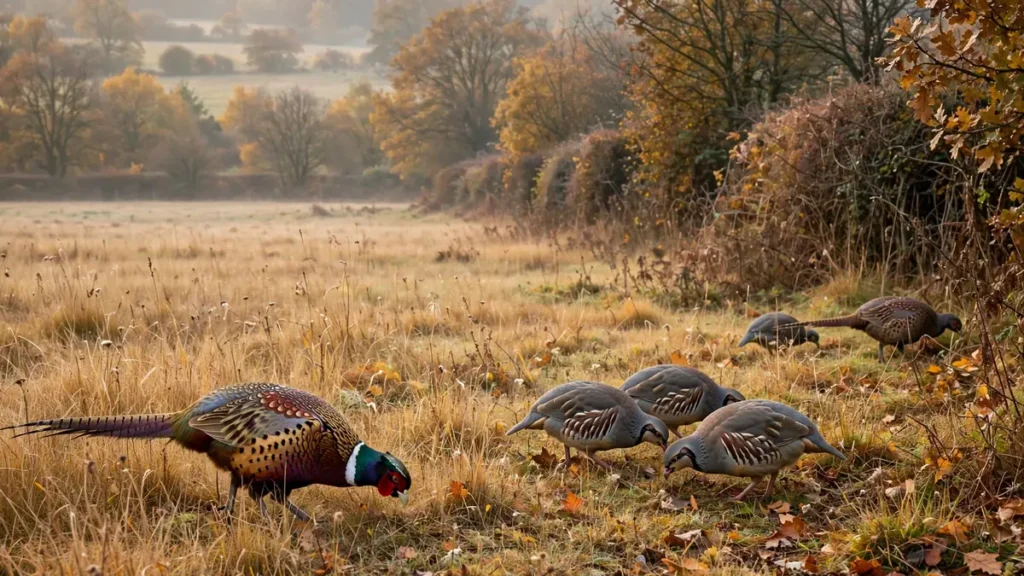
Game birds are the ground-dwelling birds traditionally hunted for sport and food: pheasants, partridges, quail, grouse and wild turkeys, along with woodcock and snipe. If you are asking what counts as a game bird, the answer is a matter of law as much as biology: a game bird is any bird species that may legally be hunted in season, and most of them belong to the order Galliformes, the heavy-bodied, ground-feeding birds.
You are more likely to hear a game bird than to see one. A pheasant bursts from cover with a clatter of wings, a grouse drums on a log in the spring woods, and a covey of quail whistles from a hedgerow at dawn. They are shy, fast and superbly camouflaged.
Key takeaways
- Game birds are birds legally hunted for sport and food, mostly Galliformes: pheasants, partridges, quail, grouse and wild turkeys, plus woodcock and snipe.
- They are ground-dwelling birds with strong legs for scratching and running, short rounded wings and explosive flight when flushed.
- Most nest on the ground and raise precocial chicks that can feed themselves within hours of hatching.
- They eat seeds, buds, leaves, berries and insects, scratching in soil and leaf litter for much of the day.
- Many populations are declining through habitat loss and intensive farming, and hunting licences now fund much of their conservation.
What makes a game bird a game bird
A game bird is defined by use, not by a single family tree. The core group is the order Galliformes, which holds the pheasants, partridges, quail, grouse, turkeys and guineafowl, and a smaller group comes from the order Charadriiformes, the woodcock and snipe, which are hunted in damp woodland and marsh. Waterfowl such as ducks and geese are sometimes counted as game birds too, but they are usually managed separately, as wildfowl rather than upland game.
Whatever their family, game birds share a body built for life on the ground. They are heavy-bodied, with strong legs and feet for scratching soil and leaf litter, and short, rounded wings that trade sustained flight for an explosive take-off. Most are superbly camouflaged in browns, greys and buffs, the males often brighter than the females, and most walk or run rather than fly when they can. They nest on the ground, in a shallow scrape hidden in grass or heather, and their chicks are precocial, leaving the nest within hours of hatching and feeding themselves from the first day.
The game birds and their relatives
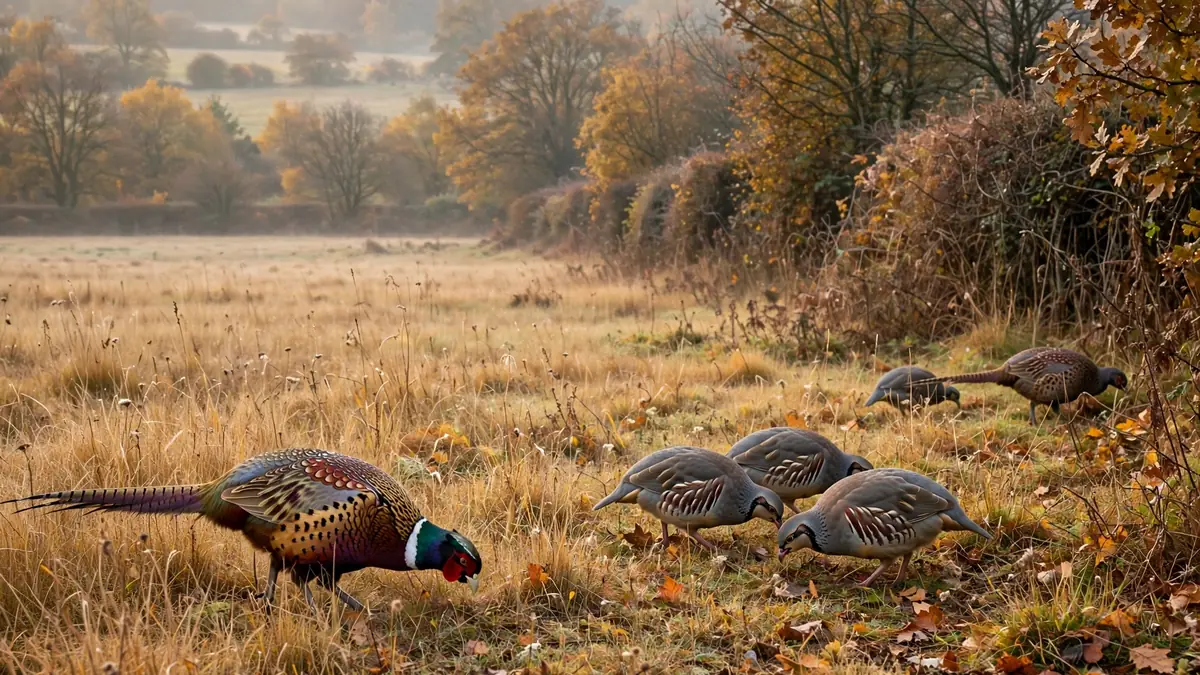
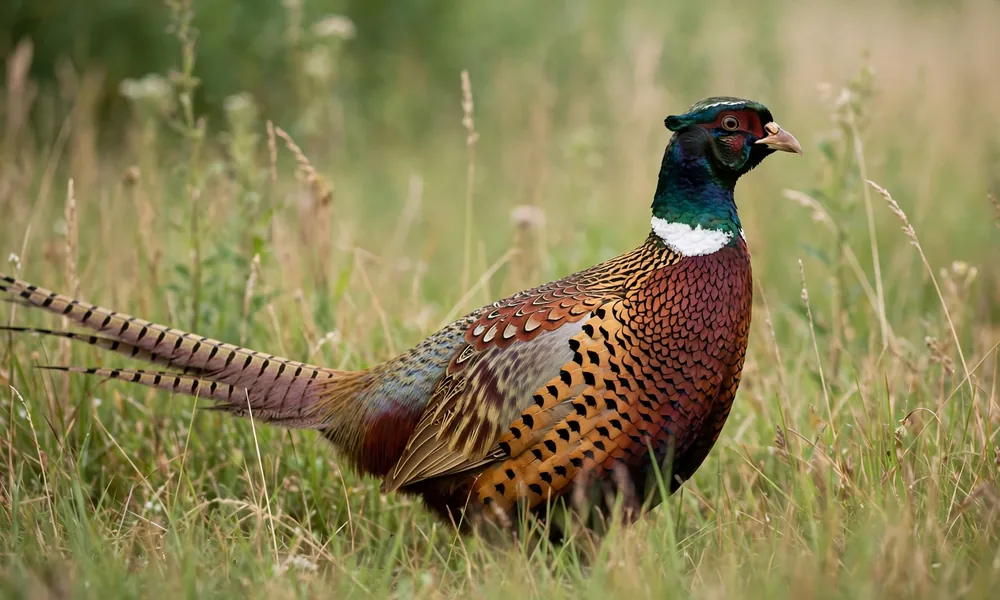
The best-known game bird in much of the world is the ring-necked pheasant, Phasianus colchicus, a large, long-tailed bird from Asia that was introduced to Europe and North America for hunting and is now one of the most familiar farmland birds in both. The male is unmistakable, with an iridescent green head, a white neck ring and a chestnut body, while the female is mottled brown and far harder to spot. The wild turkey, Meleagris gallopavo, is the largest game bird of North America, a forest bird hunted almost to extinction in the early twentieth century and then restored by careful management.
The grouse are the forest and moorland game birds: the ruffed grouse, Bonasa umbellus, of North American woods, famous for the male’s spring drumming on a hollow log, and the red grouse, Lagopus lagopus scotica, of the Scottish moors. The partridges are smaller farmland birds, the grey partridge, Perdix perdix, of European fields and the red-legged partridge of the Mediterranean, while the quail are the smallest of all, the northern bobwhite, Colinus virginianus, of the south-eastern United States calling its own name from the hedgerows.
| Type | Animal | Where it lives | Best-known food | Length or Weight |
|---|---|---|---|---|
| Group | Game birds of order Galliformes | Worldwide, on the ground | Seeds, buds, insects | About 15 to 120 cm long |
| Species | Ring-necked pheasant (Phasianus colchicus) | Asia, introduced worldwide | Seeds, grain, insects | 60 to 90 cm, 0.9 to 1.4 kg |
| Species | Wild turkey (Meleagris gallopavo) | North American forests | Acorns, nuts, insects | About 100 to 125 cm, 4 to 11 kg |
| Species | Ruffed grouse (Bonasa umbellus) | North American forests | Buds, leaves, berries | About 40 to 50 cm, 0.5 to 0.8 kg |
| Species | Grey partridge (Perdix perdix) | European farmland | Seeds, leaves, insects | About 30 cm, 0.4 to 0.5 kg |
| Species | Northern bobwhite (Colinus virginianus) | South-eastern United States | Seeds, insects, berries | About 25 cm, 0.15 to 0.2 kg |
How game birds live
Game birds feed mostly on the ground, scratching in soil and leaf litter for seeds, buds, leaves, berries and insects. The diet changes with the season: insects and green shoots in summer, seeds, grain and berries in winter.
Breeding is a ground-level affair. The male pheasant gathers a harem of hens, the male grouse drums on a log to impress the females, and the male bobwhite calls his own name from a fence post at dawn. The female lays a large clutch, often ten or more eggs, in a scrape lined with grass, and she incubates them alone for three to four weeks. The chicks hatch covered in down and leave the nest within hours, following their mother and pecking at insects from the first day. Many young die in the first weeks, taken by foxes, hawks and bad weather, and a hen may lay a second clutch if the first is lost.
Outside the breeding season, game birds gather in coveys and flocks. Quail form tight coveys that roost in a circle on the ground, tails together and heads outwards, so that every bird faces a different direction and the group stays warm. Pheasants gather in loose flocks in winter stubble, and turkeys roost in trees at night. They are wary birds, freezing at the first alarm and bursting into flight only when danger is close, and they are strong runners, often slipping away through cover on foot.
Where game birds live
Game birds live wherever there is cover and food on the ground, from lowland farmland to high moorland and deep forest. Pheasants favour field edges, hedgerows and damp woodland, partridges favour open arable fields with weedy margins, grouse favour young forest and heather moor, and quail favour grassland and scrub. The wild turkey lives in oak and pine forest across North America, feeding on acorns and nuts, while the ptarmigan lives on Arctic tundra and high mountains, turning white in winter to match the snow.
The conservation picture is mixed. The wild turkey is a famous success, restored from a few tens of thousands of birds to several million by habitat work and careful hunting limits, and the ring-necked pheasant is secure where it has been introduced. But the northern bobwhite has declined sharply across the south-eastern United States as grassland has been lost to intensive farming, and the grey partridge has fallen steeply in Europe for the same reason. Like the snow goose and the sandhill crane, game birds are managed species, and their future depends on hedgerows, field margins and native grassland being left in place. Hunting licences and taxes on firearms and ammunition fund much of this work in the United States, under the Pittman-Robertson Act of 1937.
Best seasons for game bird watching
Game birds are easiest to watch in spring, when the males display and call, and in autumn, when the harvest leaves stubble fields full of feeding birds. Spring mornings are best for grouse drumming and turkey gobbling, when the males are loudest at dawn, while autumn is best for pheasants and partridges in the field edges. Winter is the hardest season, when the birds sit tight in cover and flush only at your feet.
Staying safe around game birds
Game birds are harmless to watchers, but they share their ground with hunters, so the main rule is to know the season. During the hunting season, wear bright colours, keep to paths and keep dogs on a lead, and never approach a bird that is sitting tight on a nest in spring. Do not disturb a covey in cold weather, when the birds need every scrap of energy to survive the night. Like the owl, a game bird is a bird that rewards a quiet approach: move slowly, stop often, and let it come to you.
Game bird watching checklist
A little preparation turns a walk through farmland or moorland into a real chance of watching game birds in the open.
- A visit in spring or autumn, when the males display and call, or the harvest leaves stubble fields full of feeding birds.
- A dawn start, when grouse drum, turkeys gobble and quail call from the hedgerows.
- Binoculars, since a pheasant in a field edge or a grouse on a moor is often far away and well camouflaged.
- An ear for the pheasant’s harsh crow, the grouse’s drumming and the bobwhite’s whistled name, which give the birds away before you see them.
- A scan of field edges, hedgerows and stubble, where game birds feed on seeds and grain through the day.
- Bright clothing in the hunting season, so that you are easy to see and safe to be around.
- Respect for nests and coveys, keeping your distance in spring and never flushing a bird in cold weather.
Frequently asked questions
What counts as a game bird?
A game bird is any bird species that may legally be hunted for sport or food in season. Most belong to the order Galliformes, pheasants, partridges, quail, grouse and wild turkeys, with woodcock and snipe from the order Charadriiformes, while ducks and geese are usually managed separately.
Are pheasants native to Europe and North America?
No. The ring-necked pheasant comes from Asia and was introduced to Europe by the Romans and to North America in the nineteenth century for hunting. It is now one of the most familiar farmland birds on both continents, though it still depends on released birds in many places.
What do game birds eat?
Game birds eat seeds, buds, leaves, berries and insects, scratching in soil and leaf litter for much of the day. Chicks eat mostly insects in their first weeks, and adults turn to seeds, grain, acorns and berries in autumn and winter.
Why do game birds fly so suddenly?
Game birds have short, rounded wings built for an explosive take-off, a burst of speed that carries them out of danger and into cover. They prefer to run or freeze when they can, and they flush only when danger is close, which is why they seem to appear from nowhere at your feet.
Are game birds endangered?
Most are not, but the picture is mixed. The wild turkey was restored from near extinction to several million birds, while the northern bobwhite and the grey partridge have declined sharply through the loss of grassland and field margins to intensive farming. Hunting licences and taxes fund much of their conservation.
How is this guide different from the crow guide?
This guide covers game birds as a group, ground-dwelling Galliformes such as pheasants, partridges, quail, grouse and wild turkeys that nest on the ground and are hunted in season, while our crow species guide covers the crow, a single all-black corvid that lives in family groups, caches food and recognises human faces. One group hides in the stubble; the other watches from the rooftops.
Conclusion
Game birds are the birds of the field edge and the moor: pheasants, partridges, quail, grouse and wild turkeys, heavy-bodied, ground-nesting and superbly camouflaged, defined as much by the law that governs their hunting as by the biology that shapes their lives.
If you go looking for them, go at dawn in spring, go quietly, and listen first. Hear a grouse drumming in the woods, a bobwhite calling its name from a hedgerow, or a pheasant bursting from the stubble at your feet, and you will understand why these birds have been watched, and hunted, for centuries.