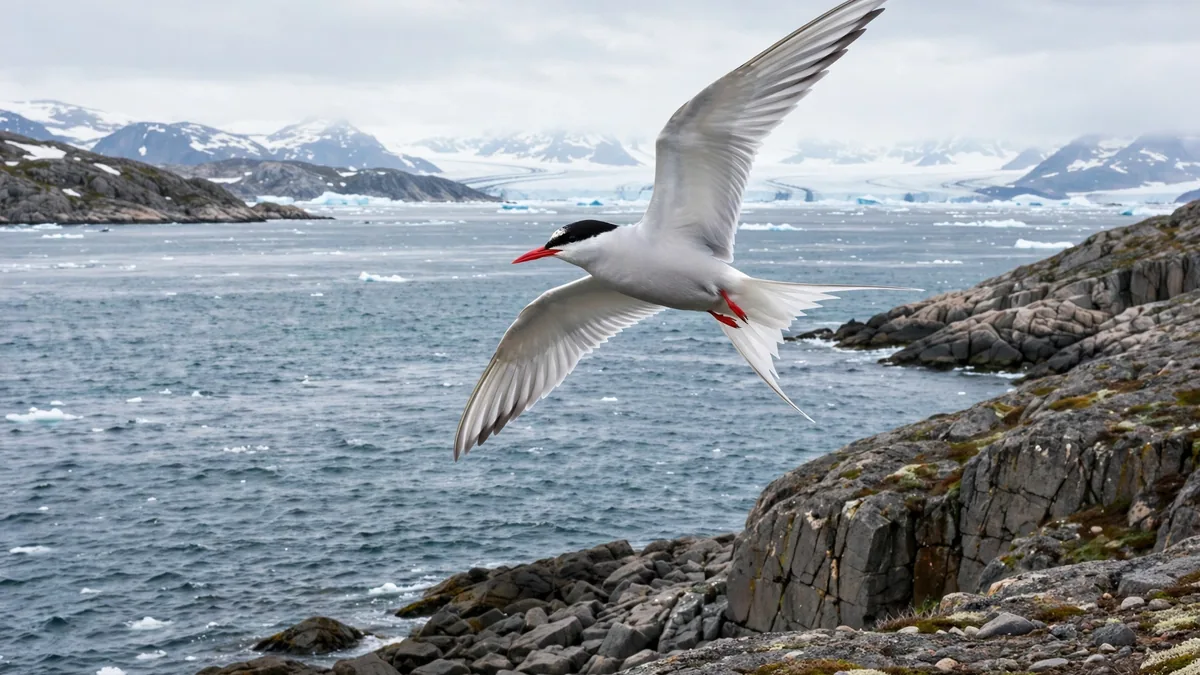
The arctic tern species is a single species, Sterna paradisaea, a small, pale seabird with no recognised subspecies at all. If you are asking how many arctic tern species there are, the answer is one, a monotypic bird that breeds in the far north and winters at the far south, seeing two summers every year.
That single species holds the longest migration of any animal known. Tracked birds from Greenland and Iceland average about 70,900 kilometres a year, flying from Arctic breeding grounds to the Antarctic coast and back again, and one bird from the Farne Islands covered 96,000 kilometres in ten months. It does all of this on a body weighing little more than 100 grammes.
Key takeaways
- The arctic tern species is Sterna paradisaea, a monotypic species with no recognised subspecies, in the gull and tern family Laridae.
- Adults are pale grey and white with a black cap, a blood-red bill and legs, and long tail streamers, and measure 33 to 39 centimetres long.
- It makes the longest annual migration of any animal, averaging about 70,900 kilometres a year for birds from Greenland and Iceland.
- Arctic terns eat small fish and crustaceans, caught by plunge-diving into the sea or picked from the surface.
- Listed as Least Concern, with a global population of about 2 million birds, though some populations are declining.
What makes an arctic tern an arctic tern
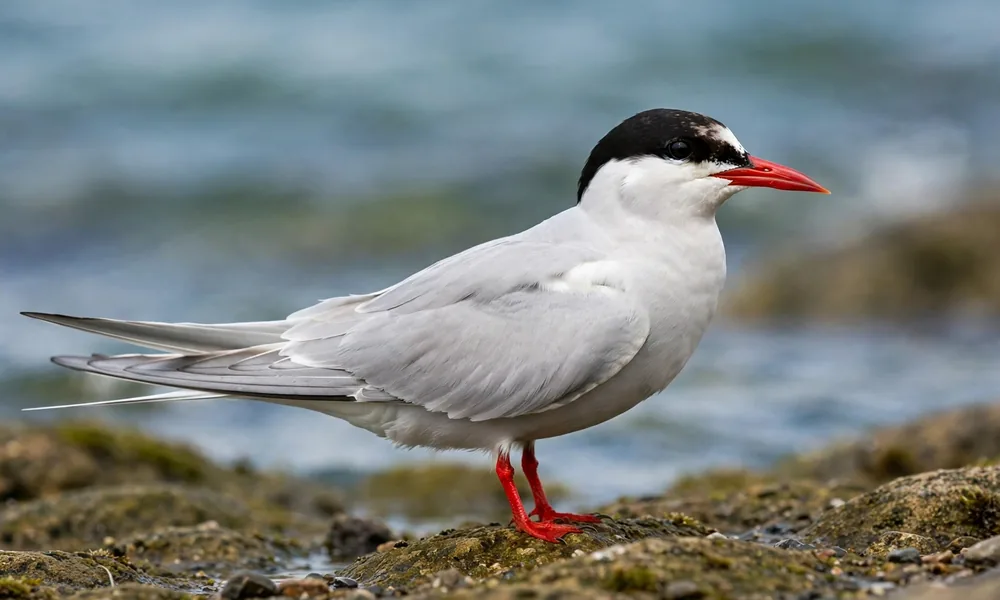
An arctic tern is a slender, graceful seabird, 33 to 39 centimetres long, with a wingspan of 76 to 85 centimetres and a weight of 86 to 127 grammes. Its plumage is pale grey above and white below, with a jet-black cap that reaches below the eye, a blood-red bill and short red legs. The tail is long and deeply forked, with two white streamers that trail behind the bird in flight, and the wings are narrow and pointed, with a dark edge along the trailing edge of the primaries.
In flight the arctic tern is light and buoyant, with slow, graceful wingbeats and sudden, sharp turns as it hunts over the sea. It hovers briefly before plunge-diving, and it can hang almost still in a strong wind. Its call is a sharp, high-pitched kee-arr, and breeding colonies are noisy places, full of screaming birds wheeling over the nests.
The arctic tern species and their relatives
The arctic tern belongs to Sterna, a genus of typical terns in the family Laridae, and it is a monotypic species with no recognised subspecies. Its breeding range is continuous and circumpolar, stretching around the Arctic and subarctic coasts of Europe, Asia and North America, from Brittany and Massachusetts in the south to the high Arctic islands in the north, and birds from one end of that range look the same as birds from the other.
Its closest relatives are the other terns of Sterna, above all the common tern and the Antarctic tern, and telling them apart takes care. The common tern has a longer bill with a black tip, longer legs and a less deeply forked tail, while the Antarctic tern has longer legs and a longer bill and less black in the wings. Like the northern gannet, the arctic tern is a plunge-diver, but it is a far smaller and lighter bird, built for endurance rather than power.
| Type | Animal | Where it lives | Best-known food | Length or Weight |
|---|---|---|---|---|
| Genus | Terns of genus Sterna | Coasts worldwide | Small fish | About 33 to 40 cm long |
| Species | Arctic tern (Sterna paradisaea) | Arctic to Antarctica | Small fish and crustaceans | 33 to 39 cm, 86 to 127 g |
| Species | Common tern (Sterna hirundo) | Temperate coasts worldwide | Small fish | 31 to 35 cm, 110 to 145 g |
| Species | Antarctic tern (Sterna vittata) | Southern Ocean islands | Small fish and krill | 31 to 38 cm, 140 to 200 g |
| Species | Roseate tern (Sterna dougallii) | Atlantic and Indo-Pacific coasts | Small fish | 33 to 36 cm, 90 to 130 g |
| Species | Forster’s tern (Sterna forsteri) | North American marshes | Small fish and insects | 33 to 36 cm, 130 to 190 g |
How arctic terns live
Arctic terns eat small fish, above all sand eels and young herring and capelin, and small crustaceans such as krill and shrimps, with insects taken on the breeding grounds. They hunt by flying low over the sea, hovering briefly, then plunge-diving to snatch prey just below the surface, and they also pick food from the surface while in flight. They rarely dive deep, and they often follow whales and dolphins, catching the small fish driven to the surface by the larger animals.
They breed in colonies, sometimes thousands of birds together, on low islands, rocky shores, shingle beaches and tundra near the sea, and they defend their nests fiercely, dive-bombing intruders, including people, and striking them on the head with the bill. The nest is a simple scrape in the ground, lined with a little grass or seaweed, and the female lays one to three eggs, usually two, which are speckled olive or brown. Both parents incubate for 21 to 24 days, and the chicks are fed by both parents and fledge after 21 to 24 days, though they depend on their parents for some weeks more.
Arctic terns are long-lived birds, with many reaching 15 to 30 years of age and a record of 34 years, so a single bird may travel more than 2.4 million kilometres in its lifetime, the equivalent of three round trips to the Moon. Outside the breeding season they are birds of the open ocean, resting on floating ice and driftwood, and they moult their flight feathers on the wintering grounds.
Where arctic terns live
Arctic terns breed circumpolarly, on Arctic and subarctic coasts and islands from Alaska and Canada through Greenland, Iceland, Scandinavia, the British Isles and Russia to the far east, as far south as Brittany in Europe and Massachusetts in North America. They nest on low, open ground near the sea, on islands, shingle beaches, rocky shores and tundra, where the lack of trees gives them a clear view of approaching predators and room to take off into the wind.
In the northern autumn they leave for the Southern Ocean, spending the austral summer among the pack ice around Antarctica, and then they fly north again to breed. The route is a great figure of eight through the Atlantic, with long stopovers in rich feeding areas: first a staging area in the central North Atlantic, then the cool waters west of South Africa, then east across the Southern Ocean to the Antarctic pack ice off Wilkes Land.
The arctic tern is listed as Least Concern on the IUCN Red List, with a global population estimated at about 2 million birds, more than half of them in Europe. The trend is not uniform: some populations, including those in Britain and Ireland, are declining, while others are stable. The main threats are climate change, which shifts the fish the terns depend on, overfishing of sand eels, predation by rats, mink and large gulls at colonies, and disturbance of nesting beaches.
Best seasons for arctic tern watching
Arctic terns are easiest to watch on their breeding grounds from May to August, when the colonies are noisy and the birds are coming and going with food for their chicks. In Britain and Ireland, the Farne Islands off Northumberland and the Shetland and Orkney islands hold large colonies, and in Iceland and Norway they nest in huge numbers along the coast. Look for them from late April, when the first birds return, to early September, when the last young birds leave.
Staying safe around arctic terns
An arctic tern is a small bird, but a breeding colony is not a place to walk through carelessly. The birds dive-bomb intruders and will strike your head with their sharp bill, so keep to marked paths, wear a hat, and watch from a distance with binoculars. Never approach a nest or a chick, since a disturbed colony may desert its eggs, and a chick that leaves the nest early is easy prey for gulls.
On the coast, watch the tides and the weather, because tern colonies are on low islands and shingle beaches that flood quickly.
Arctic tern watching checklist
A little preparation turns a summer visit to a northern coast into a real chance of watching arctic terns at their best.
- A visit from May to August, when the breeding colonies are full and the birds are feeding chicks.
- A northern coast or island colony, such as the Farne Islands, Shetland, Orkney, Iceland or coastal Norway.
- Binoculars, since the birds are small and often hunt well offshore over the open sea.
- A hat, because breeding terns dive-bomb intruders and strike the head with a sharp bill.
- An eye for the black cap, red bill and long tail streamers, which separate it from the common tern.
- Patience at the water’s edge, watching for the hover and the sudden plunge-dive after small fish.
- Respect for the colony, keeping to marked paths and never approaching a nest or a chick.
Frequently asked questions
How many arctic tern species are there?
There is one arctic tern species, Sterna paradisaea, and it is monotypic, with no recognised subspecies. Its breeding range is continuous and circumpolar, and birds from one end of the range look the same as birds from the other.
How far does an arctic tern migrate?
Arctic terns from Greenland and Iceland average about 70,900 kilometres a year, flying from Arctic breeding grounds to the Antarctic coast and back, and one bird from the Farne Islands covered 96,000 kilometres in ten months. It is the longest annual migration of any known animal.
What does an arctic tern eat?
An arctic tern eats small fish, above all sand eels and young herring and capelin, and small crustaceans such as krill and shrimps, with insects taken on the breeding grounds. It catches them by plunge-diving or picking them from the surface.
Why do arctic terns attack people?
Breeding arctic terns dive-bomb intruders to protect their nests and chicks, and they will strike the head with their sharp bill. The behaviour is defence, not aggression, and it stops once you leave the colony.
Are arctic terns endangered?
Not officially. The arctic tern is listed as Least Concern on the IUCN Red List, with a global population of about 2 million birds, though some populations, including those in Britain and Ireland, are declining. Climate change, overfishing of sand eels and predators at colonies are the main threats.
How is this guide different from the yellow warbler guide?
This guide covers the arctic tern, a pale seabird that flies from pole to pole each year on the longest migration of any animal, while our yellow warbler species guide covers the yellow warbler, a small bright-yellow songbird of North American woodlands and gardens that migrates only as far as Central America. One lives on the open ocean; the other lives in the trees.
Conclusion
The arctic tern species needs no introduction once you know its journey: one species, Sterna paradisaea, with no subspecies, a small grey-and-white seabird that flies from the Arctic to Antarctica and back every year, covering some 70,000 kilometres in the process.
If you go looking for one, go in summer, go north, and look over the sea. Find one hovering over the waves, red bill pointing down, and you will see the greatest traveller in the animal kingdom at work: a bird that weighs little more than 100 grammes and still crosses the planet twice a year.