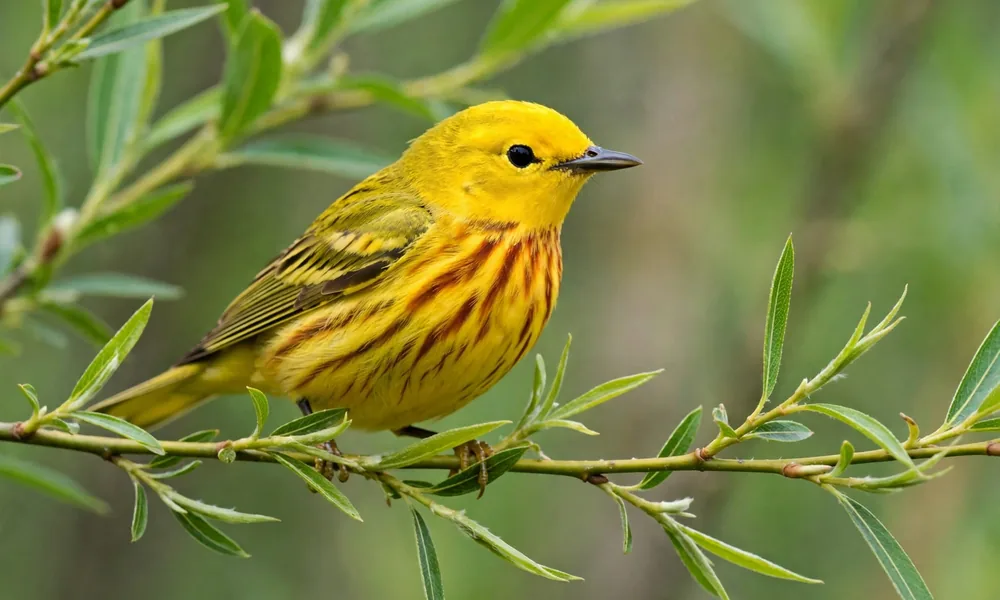
The yellow warbler species is Setophaga petechia, a small, brilliant yellow songbird of willow thickets and streamsides across the Americas. If you are asking how many yellow warbler species there are, the answer is one wide-ranging species, although it is divided into dozens of subspecies, and some authorities would split it into two.
On a bright spring morning beside a stream, the yellow warbler sings a sweet, cheerful song that seems to match its plumage, a rising sweet-sweet-sweet, I am so sweet. It is one of the most familiar warblers of North America, a flash of yellow in the willows.
Key takeaways
- The yellow warbler species is Setophaga petechia, one wide-ranging species in the New World warbler family Parulidae.
- Thirty-four subspecies are recognised by Birds of the World and AviList, while older counts run as high as 43, and some authorities split the group into two species.
- Breeding males are brilliant yellow with fine reddish streaks on the breast, while females and young birds are a softer yellow-green.
- Yellow warblers eat mainly insects and spiders, gleaned from leaves and twigs, and they are among the earliest warblers to return in spring.
- Listed as Least Concern, with a large and widespread population, although local numbers fall where riverside thickets are cleared.
What makes a yellow warbler a yellow warbler
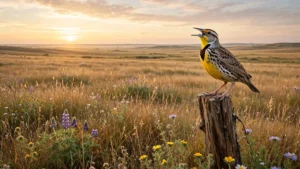
A yellow warbler is a small songbird, 12 to 13 centimetres long, with a wingspan of about 20 centimetres and a weight of about 9 to 10 grammes in most breeding adults of the United States, although birds on migration and in the tropics can weigh considerably more. The breeding male is brilliant yellow all over, with a yellow-green back, yellow wing feathers edged with black, and fine reddish-brown streaks across the breast and flanks. The female is a softer yellow, greener above and paler below, with faint streaks or none at all, and young birds are a dull yellow-green.
The song is a sweet, cheerful series of notes, often written as sweet-sweet-sweet, I am so sweet, delivered from a perch in a shrub or small tree.
The yellow warbler species and their relatives
The yellow warbler belongs to the New World warbler family Parulidae, and it is one wide-ranging species with an unusually large number of subspecies. Birds of the World and AviList recognise 34 subspecies, while older authorities, including the Clements checklist, have counted as many as 43, with some names later treated as synonyms. The subspecies fall into three main groups: the aestiva group, the American yellow warblers, with about nine migratory subspecies breeding in temperate North America; the erithachorides group, the mangrove warblers, with about a dozen resident subspecies in the mangroves of Middle America and northern South America; and the petechia group, the golden warblers, with about 17 resident subspecies in the West Indies.
The three groups were once treated as separate species, and the split is still debated. Some authorities now divide the group into two species, the American yellow warbler, Setophaga aestiva, and the mangrove warbler, Setophaga petechia in the narrow sense, which would keep the golden warblers with the mangrove birds. The International Ornithological Congress keeps them as one species, Setophaga petechia, and this guide follows that arrangement, noting the dispute where it matters. Its closest relatives are the other warblers of the genus Setophaga, including the American redstart and the chestnut-sided warbler, all small, active insect-eaters of trees and shrubs.
| Type | Animal | Where it lives | Best-known food | Length or Weight |
|---|---|---|---|---|
| Genus | Warblers of genus Setophaga | The Americas | Insects and spiders | About 12 to 13 cm long |
| Species | Yellow warbler (Setophaga petechia) | Alaska to northern South America | Insects, spiders and caterpillars | 12 to 13 cm, about 9 to 10 g |
| Group | American yellow warbler (aestiva group) | Temperate North America | Insects in willow thickets | About 13 cm, 9 to 11 g |
| Group | Mangrove warbler (erithachorides group) | Mangroves of Middle America | Insects in mangrove swamps | About 13 cm, 10 to 12 g |
| Group | Golden warbler (petechia group) | West Indies and Caribbean islands | Insects in coastal scrub | About 12 cm, 9 to 11 g |
| Species | American redstart (Setophaga ruticilla) | North American woodlands | Flying insects | About 13 cm, 8 to 9 g |
How yellow warblers live
Yellow warblers eat mainly insects and spiders, gleaned from leaves and twigs, and they also take caterpillars, beetles, aphids, leafhoppers, flies and moths. They hop through the foliage, hover briefly to pick insects from the undersides of leaves, and sometimes catch flying insects in the air.
Yellow warblers are monogamous for the season, and the pair builds a neat cup-shaped nest of plant fibres, grasses, bark strips and spider webs, lined with feathers and plant down, usually placed in the fork of a shrub or small tree, one to three metres above the ground. The female lays three to six pale blue-white eggs speckled with brown, and incubates them for 11 to 12 days. Both parents feed the chicks, which leave the nest after 9 to 12 days.
Yellow warblers are famous for their defence against the brown-headed cowbird, a brood parasite that lays its eggs in warbler nests. When a warbler finds a cowbird egg in its nest, it often builds a new floor over the egg and lays a fresh clutch on top, sometimes building as many as six layers in a single season.
Where yellow warblers live
Yellow warblers breed across a huge range, from Alaska east across Canada to Newfoundland and south through the United States to southern California, northern Oklahoma and northern Georgia. The migratory American yellow warblers breed in moist thickets, especially along streams and in swampy areas, in gardens, overgrown pastures and woodland edges. The resident mangrove warblers live year-round in coastal mangrove forests from southern Mexico through Central America to northern Colombia and Venezuela, while the golden warblers live on the islands of the West Indies, from Cuba and the Bahamas to Barbados.
In winter the migratory birds fly south to Mexico, Central America and northern South America, wintering in lowland thickets, mangroves and gardens. They are among the first warblers to leave in autumn, with many birds departing from July onwards, and they return north in spring, arriving in the southern United States in March and April and reaching Canada by May.
The yellow warbler is listed as Least Concern on the IUCN Red List, with a large global population estimated in the tens of millions and a very wide range. Numbers are stable across most of the range, and the birds have shown resilience where riverside habitat is allowed to recover. Local declines have been noted where thickets are cleared, where grazing removes the shrub layer, and where pesticides reduce the insects they depend on, and the Barbados subspecies has been listed as endangered foreign wildlife. The North American populations are protected by the Migratory Bird Treaty Act.
Best seasons for yellow warbler watching
Yellow warblers are easiest to watch from April to July, when the males are singing on their breeding territories and the birds are at their brightest. In the southern United States look for them from March, and in Canada from May, when the migrants return. Early morning is best, when the birds are singing and feeding actively in the willows, and a walk along a stream, a pond edge or a damp thicket is the surest way to find them.
Staying safe around yellow warblers
A yellow warbler is a small, harmless bird, and the main risk is to the bird rather than to you. Never approach a nest closely, since a disturbed pair may abandon it, and keep to the path beside streams and thickets during the breeding season. Watch from a distance with binoculars, and let the song lead you to the bird rather than pushing through the shrubs. Like the American robin, the yellow warbler is a familiar garden visitor that rewards a quiet watcher, and like the nightingale, it is a singer whose song is best enjoyed without disturbance.
Keep cats indoors during the breeding season, since cats take many small birds and their fledglings, and avoid using pesticides in gardens near streams, since the warblers depend on the insects that pesticides remove.
Yellow warbler watching checklist
A little preparation turns a bright spring walk beside a stream into a real chance of watching yellow warblers.
- A visit from April to July in the breeding range, when the males are singing on territory.
- An early-morning start, when the birds are singing and feeding actively in the willows.
- A streamside, pond edge or damp thicket with willows, alders and dense shrubs.
- Binoculars, since the bird is small and often feeds deep in the foliage.
- An ear for the sweet-sweet-sweet, I am so sweet song, and the sharp chip call.
- An eye for a flash of brilliant yellow in the willows, and the reddish streaks on the breast of the male.
- Respect for nests and fledglings, keeping to the path and keeping cats indoors.
Frequently asked questions
How many yellow warbler species are there?
There is one yellow warbler species, Setophaga petechia, in the arrangement followed here, with 34 recognised subspecies according to Birds of the World and AviList, although older counts run as high as 43. Some authorities split the group into two species, the American yellow warbler and the mangrove warbler, so the count depends on the authority you follow.
What does a yellow warbler eat?
A yellow warbler eats mainly insects and spiders, including caterpillars, beetles, aphids, leafhoppers, flies and moths, gleaned from leaves and twigs. It sometimes catches flying insects in the air, and in winter it adds a few berries to the diet.
Where do yellow warblers spend the winter?
The migratory American yellow warblers spend the winter in Mexico, Central America and northern South America, in lowland thickets, mangroves and gardens. The mangrove and golden warblers are resident all year in the mangroves of Middle America and on the islands of the West Indies.
How do yellow warblers deal with cowbirds?
When a yellow warbler finds a brown-headed cowbird egg in its nest, it often builds a new floor over the egg and lays a fresh clutch on top. A single nest may gain as many as six layers in one season, a defence that few other songbirds use so regularly.
Are yellow warblers endangered?
Not officially. The yellow warbler is listed as Least Concern on the IUCN Red List, with a large global population in the tens of millions and a very wide range. Local numbers fall where riverside thickets are cleared, and the Barbados subspecies has been listed as endangered foreign wildlife.
How is this guide different from the wood thrush guide?
This guide covers the yellow warbler, a small, brilliant yellow songbird of willow thickets and streamsides that winters in Mexico and Central America, while our wood thrush species guide covers the wood thrush, a shy, rusty-capped thrush of the forest floor with a flute-like song and a boldly spotted breast. One flashes yellow in the willows; the other sings from the deep woodland.
Conclusion
The yellow warbler species needs no introduction once you have seen it: one species, Setophaga petechia, a brilliant yellow songbird with reddish streaks on the breast and a sweet, cheerful song that returns to the willows every spring.
If you go looking for one, go in spring, go early in the morning, and go to a stream. Find the willows, listen for the sweet-sweet-sweet song, and watch for a flash of yellow in the green: a small bird that asks for very little, a thicket beside the water, and a summer of insects in which to raise its young.