The western meadowlark species is a single species, Sturnella neglecta, the yellow-breasted songbird of the North American prairies. If you are asking how many western meadowlark species there are, the answer is one, a grassland bird with two recognised subspecies and a flute-like song that carries for a kilometre across open country.
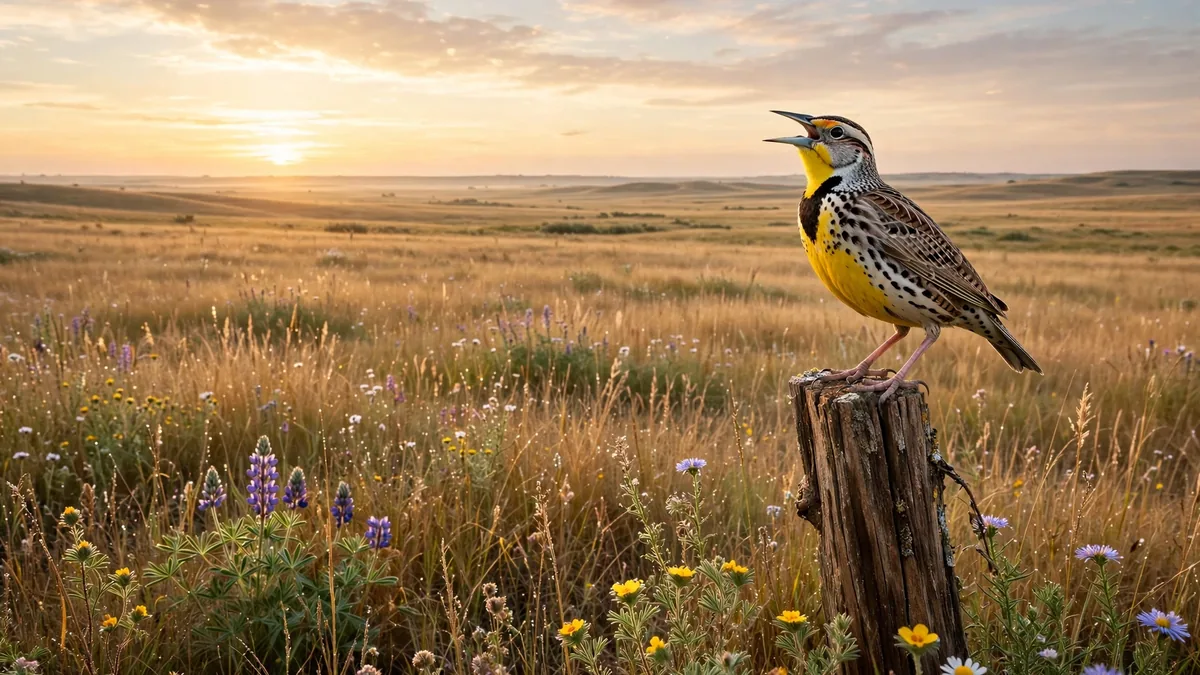
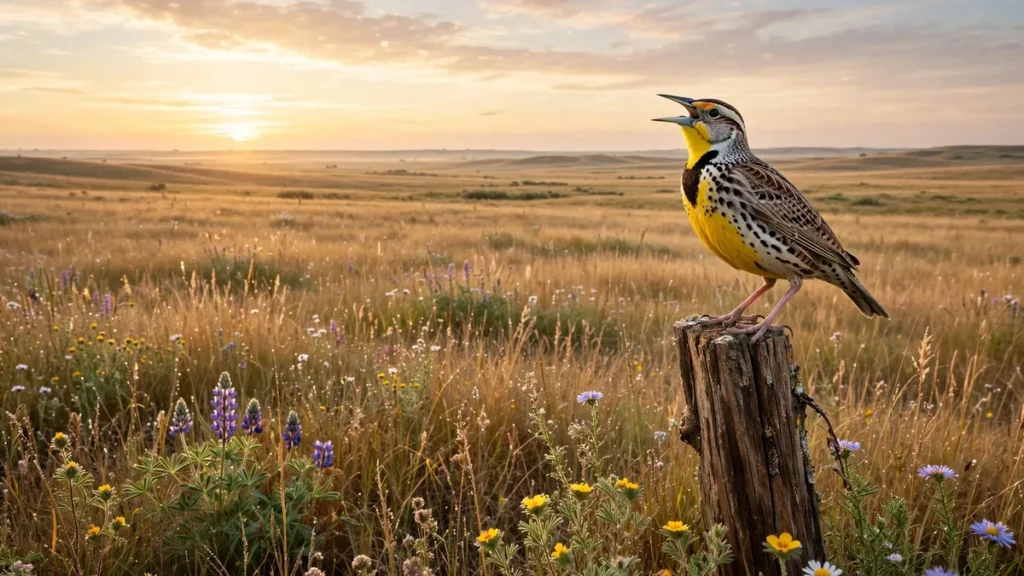
On a spring morning you can hear a western meadowlark before you see it, singing from the top of a fence post with its bill wide open, a rich, clear whistle that rises and falls like water over stones. For many people it is the sound of the prairie itself.
Key takeaways
- The western meadowlark species is Sturnella neglecta, a single species with two recognised subspecies, S. n. neglecta and S. n. confluenta.
- Adults have a bright yellow breast with a black V-shaped band, a streaked brown back, and a pale face marked with a dark stripe through the eye.
- It lives in grassland and prairie across western and central North America, from southern Canada to central Mexico, and is the state bird of six states.
- Western meadowlarks eat insects in summer and seeds in winter, nest on the ground in a grass dome, and sing a rich, flute-like song.
- Listed as Least Concern, with about 100 million birds, but numbers are falling as grassland is lost.
What makes a western meadowlark a western meadowlark
A western meadowlark is a medium-sized songbird, about 20 centimetres long, with a wingspan of about 40 centimetres and a weight of 89 to 115 grammes. Its upperparts are streaked brown, black and buff, perfect camouflage in dry grass, while its underparts are bright yellow, with a bold black V across the breast. The face is pale with a dark stripe through the eye and a pale stripe above it, and the bill is long, straight and pointed, built for probing the soil.
The song is the best way to know one. A western meadowlark sings a rich, flute-like whistle of seven to ten notes, clear and unhurried, often from a fence post, a rock or a shrub, and it can be heard for a kilometre across open ground. In flight it is a strong, direct flier, with quick, stiff wingbeats and short glides.
The western meadowlark species and their relatives
The western meadowlark belongs to Sturnella, a small genus of meadowlarks in the blackbird family Icteridae, and it is a single species with two recognised subspecies. The nominate race, S. n. neglecta, is the widespread bird of the interior, ranging from south-western and south-central Canada through the western United States to central Mexico. The north-western race, S. n. confluenta, is darker, with dark bars on the tail feathers and coverts that widen at the centre of each feather, and it lives along the Pacific coast from south-western British Columbia to Oregon.
Its closest relative is the eastern meadowlark, Sturnella magna, a bird so similar that the two are often impossible to tell apart by sight, even in the hand, and are usually separated by their songs and by range. A third meadowlark, the Chihuahuan meadowlark, Sturnella lilianae, was long treated as a form of the eastern meadowlark, but the American Ornithological Society now recognises it as a separate species, a split some authorities still dispute. The wider family holds the blackbirds, orioles and grackles, all of them strong-voiced birds of open country.

| Type | Animal | Where it lives | Best-known food | Length or Weight |
|---|---|---|---|---|
| Family | Blackbirds (Icteridae) | The Americas | Insects, seeds and fruit | About 16 to 28 cm long |
| Genus | Meadowlarks (Sturnella) | North and Central America | Insects and seeds | About 20 to 28 cm long |
| Species | Western meadowlark (Sturnella neglecta) | Western and central North America | Insects in summer, seeds in winter | About 20 cm, 89 to 115 g |
| Species | Eastern meadowlark (Sturnella magna) | Eastern North America | Insects and seeds | About 21 to 26 cm, 90 to 150 g |
| Species | Chihuahuan meadowlark (Sturnella lilianae) | South-western United States and Mexico | Insects and seeds | About 20 cm, 85 to 115 g |
| Species | Red-winged blackbird (Agelaius phoeniceus) | North America | Insects, seeds and grain | About 17 to 23 cm, 40 to 70 g |
How western meadowlarks live
Western meadowlarks feed mostly on the ground, walking through the grass and probing the soil with their long bills for insects, spiders and other small creatures. In summer they eat mainly insects, including grasshoppers, beetles, caterpillars and ants, and in winter they switch to seeds and grain, picking them from the ground or from low plants.
They are diurnal, active in daylight, and they spend much of the day on the ground, walking or running through the grass, and only fly up to a perch to sing or to escape danger. In winter they gather in flocks, sometimes with other grassland birds, and roost together on the ground in sheltered hollows. The song is given by the male, mainly in spring and early summer, to defend a territory and to attract a mate.
Breeding birds nest on the ground, in a hollow scraped into the soil and lined with grass, often roofed with a dome of woven grass with a side entrance, hidden in dense vegetation. The female lays three to six eggs, usually five, white with brown spots, and incubates them alone for 13 to 14 days. The chicks hatch naked and helpless, are fed by both parents, and leave the nest after 10 to 12 days, before they can fly properly, hiding in the grass while their parents bring them food.
Where western meadowlarks live
Western meadowlarks live across western and central North America, from southern Canada to central Mexico, in grassland, prairie, meadow, sagebrush and open farmland. They favour wide, open country with short to medium grass and scattered shrubs or fence posts to sing from, and they avoid forest, dense scrub and built-up areas. They are common on ranches and farms, where hayfields and pastures give them the open ground they need, and they often feed along roadsides and field edges.
Northern birds are migratory, moving south when the cold arrives, and winter numbers are highest in the southern United States and Mexico, while southern birds stay put all year. They are the state bird of six states, Kansas, Montana, Nebraska, North Dakota, Oregon and Wyoming, more than any other bird, a mark of how deeply they belong to the grassland. Like the snow goose and the sandhill crane, it is a bird of open country.
The western meadowlark is listed as Least Concern on the IUCN Red List, with a population estimated at about 100 million birds, but the population trend is decreasing. Grassland is the most threatened habitat in North America, and meadowlarks have lost ground as prairie is ploughed for crops, built over, or planted with trees, and as pesticides reduce the insects they feed their chicks.
Best seasons for western meadowlark watching
Western meadowlarks are easiest to watch from spring to early summer, when the males sing from fence posts and the birds are busy around their nests. In the northern United States and Canada, look for them from April to July, when the migrants return and the song is at its best. In the southern United States and Mexico they are present all year.
Staying safe around western meadowlarks
A western meadowlark is a shy, harmless bird, and the main risk is to the bird rather than to you. Never approach a nest closely, since the female may abandon it if she is flushed too often, and keep your distance from singing males so they are not driven off their territories. Watch from a distance with binoculars, and stay on paths and roadsides rather than trampling through the grass. Like the red-tailed hawk and the scarlet tanager, the western meadowlark is protected by law in the United States under the Migratory Bird Treaty Act.
Slow down on roads through grassland, because meadowlarks feeding along the verge are slow to take off and are often killed by cars. If you find a chick in the grass, leave it alone: it has probably left the nest on purpose, and its parents are nearby.
Western meadowlark watching checklist
A little preparation turns a spring morning on the prairie into a real chance of hearing and seeing a western meadowlark.
- A visit from spring to early summer in the north, or at any time of year in the south, when the birds are present and singing.
- An early-morning start, when the song carries furthest across the open grassland.
- Binoculars, since a meadowlark on a fence post is often some way off and hard to see with the naked eye.
- An ear for the rich, flute-like whistle, which separates it from the eastern meadowlark better than any field mark.
- A scan of fence posts, rocks and shrubs, where the males perch to sing and watch their territories.
- Patience and a wide sky, because a meadowlark may sing for minutes from one post before dropping back into the grass.
- Respect for nests and territories, keeping to paths and never approaching a singing bird or a nest.
Frequently asked questions
How many western meadowlark species are there?
There is one western meadowlark species, Sturnella neglecta, with two recognised subspecies: the nominate S. n. neglecta of the interior, from Canada to central Mexico, and the darker S. n. confluenta of the Pacific coast, from south-western British Columbia to Oregon.
What is the difference between a western and an eastern meadowlark?
Western and eastern meadowlarks look almost identical, with the same yellow breast, black V and streaked back, and they are usually told apart by their songs and by where they live. The western meadowlark sings a rich, flute-like whistle, while the eastern meadowlark sings a clear, slurred whistle of two to four notes.
What does a western meadowlark eat?
A western meadowlark eats insects in summer, including grasshoppers, beetles, caterpillars and ants, and seeds and grain in winter. It feeds mostly on the ground, probing the soil with its long bill.
Why is the western meadowlark the state bird of six states?
The western meadowlark is the state bird of Kansas, Montana, Nebraska, North Dakota, Oregon and Wyoming, more than any other bird, because it is the most familiar bird of the grassland in all of them. Its song is the sound of the prairie, so it was a natural choice.
Are western meadowlarks endangered?
Not officially. The western meadowlark is listed as Least Concern on the IUCN Red List, with a population estimated at about 100 million birds. Numbers have fallen by about a third since 1970, as grassland is lost to farming and development and pesticides reduce the insects they feed their chicks.
How is this guide different from the vulture guide?
This guide covers the western meadowlark, a small, yellow-breasted songbird of the North American prairies that sings a flute-like song from a fence post, while our vulture species guide covers all 23 vulture species, huge soaring scavengers that clean up the dead across four continents. One fills the morning with song; the other cleans up after the day is done.
Conclusion
The western meadowlark species needs no introduction once you have heard it: one species, Sturnella neglecta, a yellow-breasted grassland bird with a black V across its chest and a song that carries for a kilometre across the prairie.
If you go looking for one, go on a spring morning, go early, and listen first. Find one singing from a fence post above the open grass, and you will hear the sound of the prairie itself.