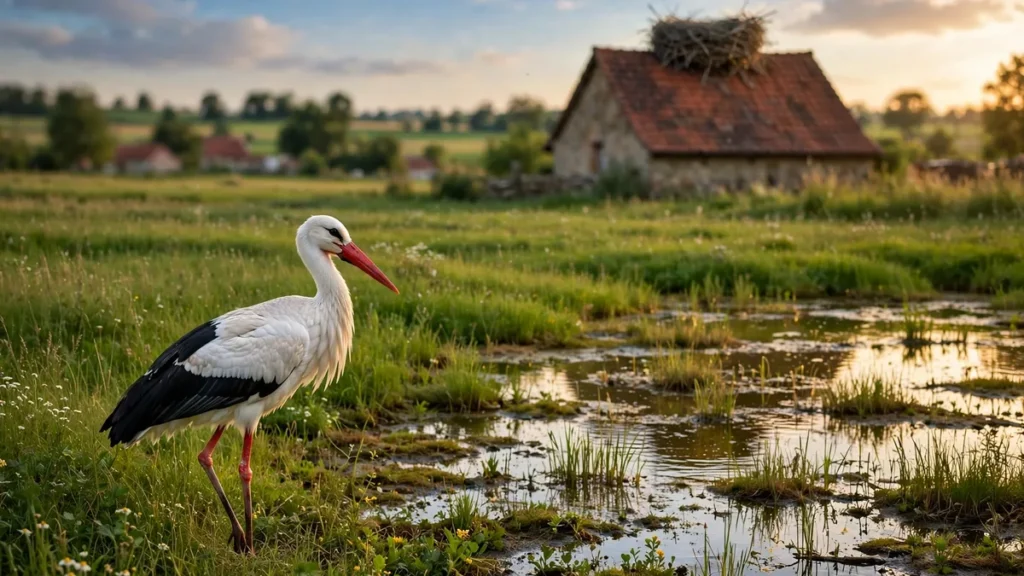
The white stork species is Ciconia ciconia, a tall black-and-white bird with a long red bill and long red legs, famous for nesting on European rooftops and chimneys. If you are asking how many white stork species there are, the answer is one, with two recognised subspecies.
White storks migrate thousands of kilometres between breeding grounds in Europe and western Asia and wintering grounds in Africa. They are symbols of good luck and new life in many cultures, and their huge stick nests, used year after year, are a familiar sight in villages across Poland, Spain and Germany.
Key takeaways
- The white stork species is Ciconia ciconia, one species with two recognised subspecies in the stork family Ciconiidae.
- Adults are 100 to 115 centimetres tall, with a wingspan of 155 to 215 centimetres and a weight of 2.3 to 4.4 kilogrammes.
- White storks eat frogs, insects, small mammals, reptiles, fish and carrion, hunting on foot in meadows and wetlands.
- They migrate thousands of kilometres to Africa each autumn, soaring on thermals and avoiding long sea crossings.
- Listed as Least Concern, with a large and increasing population of about 700,000 birds.
What makes a white stork a white stork
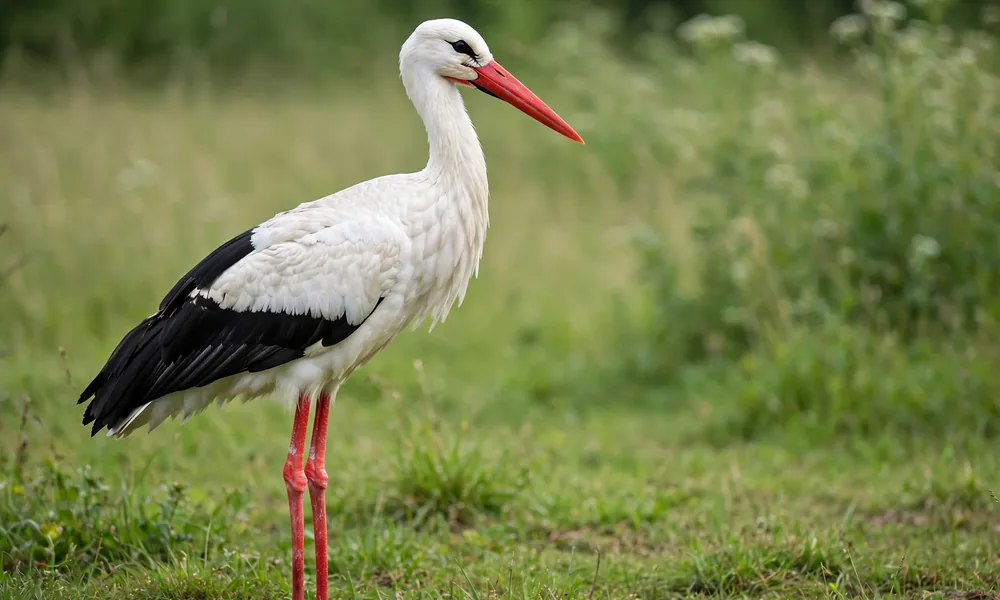
A white stork is a large, long-legged wading bird, 100 to 115 centimetres long, with a wingspan of 155 to 215 centimetres and weighing 2.3 to 4.4 kilogrammes. Its plumage is mostly white, with black flight feathers, and its long, pointed bill and long, thin legs are bright red in the adult. The neck is held straight out in flight, unlike a heron, which folds its neck back, and the legs trail behind. Young birds have a dark bill and brownish legs that turn red as they mature.
White storks are mostly silent birds, with no real song. Instead, they communicate by clattering their bills together, a loud, rapid rattling made by opening and closing the bill, often with the head thrown back. Pairs clatter together at the nest as a greeting. In flight they are strong, steady soarers, circling high on rising thermals with hardly a wingbeat, and they walk with a slow, deliberate stride when hunting.
The white stork species and their relatives
The white stork belongs to Ciconia, a genus of large storks in the family Ciconiidae, and it is one species with two recognised subspecies. The nominate race, C. c. ciconia, breeds across Europe, north-west Africa and western Asia, and winters mainly in sub-Saharan Africa. The Central Asian race, C. c. asiatica, breeds in Turkestan, mainly Uzbekistan and southern Kazakhstan, and winters from Iran to the Indian subcontinent. It is slightly larger, and far scarcer, with only about 1,250 breeding pairs, fewer than 2,000 birds in total.
Its closest relative is the Oriental white stork, Ciconia boyciana, of East Asia. It was once treated as a subspecies of the white stork, but most authorities now recognise it as a separate species, and it is endangered. The wider stork family also holds the black stork, a shy forest bird of Europe and Asia, and the marabou stork of Africa. Like the grey crowned crane, the white stork is a tall, long-legged bird of open wetlands, but the crane is grey with a golden crown, while the stork is white with black wings and a red bill.
| Type | Animal | Where it lives | Best-known food | Length or Weight |
|---|---|---|---|---|
| Genus | Storks of genus Ciconia | Europe, Asia and Africa | Frogs and insects | About 100 to 115 cm long |
| Species | White stork (Ciconia ciconia) | Europe to Africa and India | Frogs and small mammals | 100 to 115 cm, 2.3 to 4.4 kg |
| Species | Oriental white stork (Ciconia boyciana) | East Asia | Fish and frogs | About 110 to 115 cm, 2.8 to 5.9 kg |
| Species | Black stork (Ciconia nigra) | Europe and Asia | Fish and frogs | About 95 to 100 cm, about 3 kg |
| Species | Marabou stork (Leptoptilos crumenifer) | Sub-Saharan Africa | Carrion | About 120 to 130 cm, 4.5 to 8 kg |
| Species | Saddle-billed stork (Ephippiorhynchus senegalensis) | Sub-Saharan Africa | Fish and frogs | About 140 to 150 cm, 5 to 7.5 kg |
How white storks live
White storks feed on the ground, walking slowly through meadows, marshes and shallow water. Their diet is broad: frogs and toads, grasshoppers and beetles, earthworms, mice and voles, lizards and snakes, small fish, and the occasional dead animal. They hunt by sight, stabbing down with the bill, and often follow tractors to catch creatures they stir up.
White storks nest in pairs, often staying together for life and returning to the same nest year after year. The nest is a huge pile of sticks, sometimes more than a metre across and a metre deep, built on a rooftop, chimney, pole, tree or platform, and it grows larger each year. The female lays three to five white eggs, and both parents take turns incubating them for 33 to 34 days. The chicks hatch in white down, are fed by both parents, and fledge after about 58 to 64 days.
In late summer the birds gather in flocks and set off south, travelling thousands of kilometres to Africa. They ride thermals over land and avoid long sea crossings, funnelling through Gibraltar in the west and the Bosphorus in the east. Western birds winter in the Sahel and East Africa, while eastern birds travel down the Nile valley. Some now stay in Europe all winter, feeding at rubbish tips and in mild farmland.
Where white storks live
White storks breed across Europe, from Iberia to Russia, with the largest numbers in Poland, Spain, Ukraine and Germany, and also in north-west Africa and western Asia. They favour open country with wetlands nearby: wet meadows, marshes, river floodplains and farmland with ditches and damp fields. They need open ground to hunt and tall structures to nest on, and they have always lived close to people, nesting on houses, churches and barns.
In winter most white storks live in Africa, from the Sahel south to South Africa, in grassland, savanna, wetlands and farmland, often in large flocks. The Central Asian birds winter from Iran to India. Like the sandhill crane, the white stork is a bird of open wetlands and farmland, but the crane winters mainly in North America, while the stork crosses to Africa.
The white stork is listed as Least Concern on the IUCN Red List, with an increasing population trend. The global population is about 700,000 birds, with roughly 502,000 to 563,000 mature birds in Europe alone, and about 263,000 to 294,000 breeding pairs worldwide. Numbers fell sharply in the twentieth century, when wetlands were drained, pesticides were widely used and many birds were shot on migration, and the species vanished from Sweden, Switzerland, Belgium and the Netherlands. Reintroduction, nest platforms and protection have brought it back, though power lines, illegal shooting and drought in Africa remain threats. The Central Asian subspecies, with fewer than 2,000 birds, is far more fragile.
Best seasons for white stork watching
White storks are easiest to watch from spring to autumn in Europe, when the breeding birds are back on their nests. From March to August, look for them on rooftops and chimneys, and hunting in wet meadows nearby. Late summer is the best time to see migration, when large flocks circle up on thermals before setting off south, and the bottlenecks at Gibraltar and the Bosphorus can hold thousands of birds in a day. In winter, look for them in Africa, or for the growing number that now stay in southern Europe all year.
Staying safe around white storks
A white stork is a large, wild bird, best watched from a distance with binoculars. Never approach a nest closely, especially in the breeding season, since a disturbed pair may abandon the nest or attack with the bill. Keep dogs on a lead near nesting sites, and do not climb onto roofs or platforms to reach a nest. Like the mute swan, the white stork is protected in much of Europe.
White storks are harmless to people, but they can be a hazard near airports, where large flocks crossing runways have caused bird strikes. If you find an injured stork, do not handle it yourself: its bill is long and sharp. Call a local wildlife rescue group instead.
White stork watching checklist
A little preparation turns a spring morning in open country into a real chance of watching white storks on their nests.
- A visit from March to August in Europe, when the breeding birds are back on their nests.
- A look at rooftops, chimneys and nest platforms in villages, where the huge stick nests are easy to spot.
- Binoculars, since a stork on a distant roof is hard to see clearly with the naked eye.
- A scan of wet meadows and marshes, where the birds walk slowly, hunting frogs and insects.
- An ear for the loud bill-clattering of a pair greeting each other at the nest.
- A late-summer visit to a migration bottleneck, where hundreds of storks may circle up on one thermal.
- Respect for nests, keeping your distance and never climbing up to a nest or disturbing a breeding pair.
Frequently asked questions
How many white stork species are there?
There is one white stork species, Ciconia ciconia, with two recognised subspecies: the nominate C. c. ciconia of Europe, north-west Africa and western Asia, and the Central Asian C. c. asiatica of Uzbekistan and southern Kazakhstan. The Oriental white stork of East Asia was once treated as a third subspecies, but it is now a separate species, Ciconia boyciana.
What does a white stork eat?
A white stork eats frogs, toads, insects, earthworms, mice and voles, lizards, snakes, small fish and carrion. It hunts on foot in meadows and shallow wetlands, stabbing down with its long red bill.
Where do white storks go in winter?
Most white storks migrate to Africa for the winter, travelling thousands of kilometres from Europe and western Asia to the Sahel, East Africa and South Africa. The Central Asian subspecies winters from Iran to India. A growing number now stay in southern Europe all winter, feeding at rubbish tips and in mild farmland.
Why do white storks nest on rooftops?
White storks nest on rooftops, chimneys and poles because they need a high, safe platform for their huge stick nests, and human buildings provide exactly that. The nests are used year after year and grow larger each season, and in many villages people build special platforms to welcome the birds back.
Are white storks endangered?
Not officially. The white stork is listed as Least Concern on the IUCN Red List, with a large and increasing population of about 700,000 birds. Numbers fell sharply in the twentieth century, but reintroduction and protection have brought it back to many countries. The Central Asian subspecies, with fewer than 2,000 birds, is far more vulnerable.
How is this guide different from the western meadowlark guide?
This guide covers the white stork, a tall, black-and-white, long-legged wader of Europe and Africa that nests on rooftops and migrates thousands of kilometres on soaring wings, while our western meadowlark species guide covers the western meadowlark, a small yellow-breasted songbird of North American grasslands that sings from fence posts. One is a rooftop giant of two continents; the other is a grassland singer of one.
Conclusion
The white stork species needs little introduction: one species, Ciconia ciconia, a tall white bird with black wings and a red bill, nesting on rooftops, hunting frogs in wet meadows and flying thousands of kilometres to Africa each year.
If you go looking for one, go in spring, to a village with old rooftops and wet meadows nearby, and listen for the clatter. Find a pair greeting each other on a nest of sticks above the street, and you will see why this bird has been a symbol of good luck for centuries.