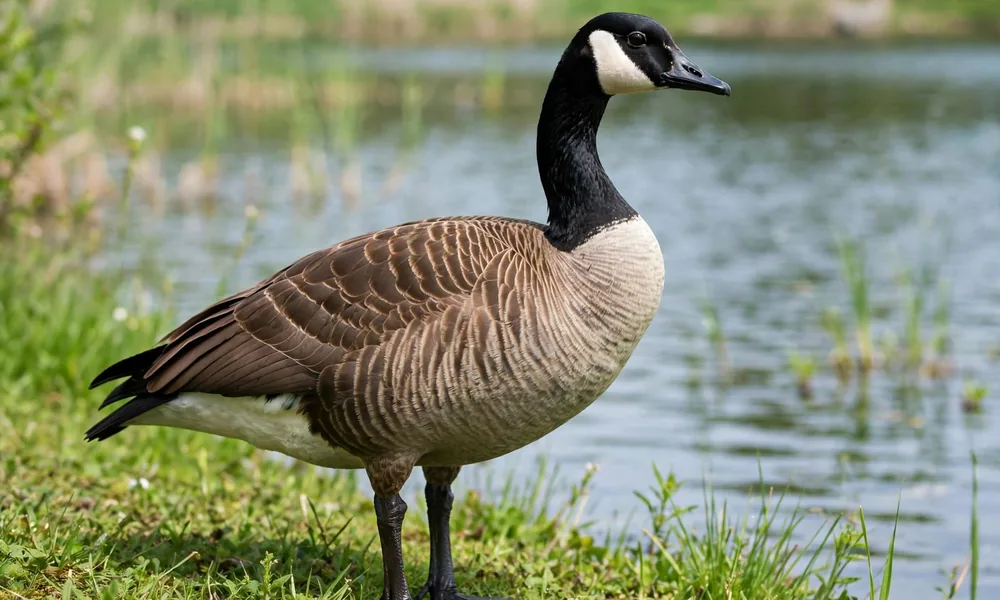
The canada goose species is a single species, Branta canadensis, a large goose with a black head and neck, white cheek patches and a brown body. If you are asking how many canada goose species there are, the answer is one, with seven recognised subspecies that vary widely in size, from the giant Canada goose to the small lesser Canada goose.
That single species is one of the most familiar wild birds in North America, and one of the most successful. It breeds across Canada and Alaska, winters across the United States and Mexico, and has been introduced to Britain, Ireland, Scandinavia and New Zealand, where it now lives all year round.
Key takeaways
- The canada goose species is Branta canadensis, a single species with seven recognised subspecies in the black goose genus Branta.
- Adults have a black head and neck, a white cheek patch, a brown body and a black bill, and measure 75 to 110 centimetres long.
- The cackling goose, Branta hutchinsii, was split off as a separate species in 2004, and the split is still debated by birdwatchers.
- Canada geese eat grasses, sedges, leaves, seeds and grain, grazing on land and dabbling in shallow water.
- Listed as Least Concern, with a population of about 5 million to 6 million birds in North America, and numbers still rising.
What makes a canada goose a canada goose
A canada goose is a large goose, 75 to 110 centimetres long, with a wingspan of 127 to 185 centimetres and a weight of 2.6 to 6.5 kilogrammes, though the smallest subspecies weigh under 2 kilogrammes and the largest over 6. Its head and neck are black, with a broad white patch on each cheek that meets under the chin, and its body is brown above and paler below, with a white undertail. The bill is black, the legs are dark, and the sexes look alike, though the male is usually a little larger.
In flight the canada goose is heavy and powerful, with slow, deep wingbeats and a steady, direct course, often in a V formation with the birds calling as they fly. Its call is a loud, honking ah-honk, deeper in the large subspecies and higher in the small ones, and a flock in flight can be heard from far away.
The canada goose species and their relatives
The canada goose belongs to Branta, the genus of black geese in the duck, goose and swan family Anatidae, and it is a single species with seven recognised subspecies. The Atlantic Canada goose, B. c. canadensis, is the nominate race, breeding in eastern Canada and wintering on the Atlantic coast. The interior Canada goose, B. c. interior, breeds around Hudson Bay, and the giant Canada goose, B. c. maxima, the largest of all, breeds in the prairies and the Great Lakes region. Moffitt’s Canada goose, B. c. moffitti, breeds in the western interior, the Vancouver Canada goose, B. c. fulva, on the Pacific coast, the dusky Canada goose, B. c. occidentalis, in Alaska, and the lesser Canada goose, B. c. parvipes, the smallest, on the Arctic tundra.
The seven subspecies vary widely in size and in the shade of the body, but all are recognisable as Canada geese, and where their ranges meet they interbreed freely, so the boundaries between them are blurred. The cackling goose, Branta hutchinsii, was once counted among them, but in July 2004 the American Ornithologists’ Union split it off as a full species, a decision the British Ornithologists’ Union followed in June 2005. The split is still debated, because the smallest Canada geese overlap in size with the largest cackling geese, and telling them apart in the field takes care.
| Type | Animal | Where it lives | Best-known food | Length or Weight |
|---|---|---|---|---|
| Genus | Geese of genus Branta | Northern hemisphere | Grasses and leaves | About 60 to 110 cm long |
| Species | Canada goose (Branta canadensis) | North America, introduced elsewhere | Grasses, seeds and grain | 75 to 110 cm, 2.6 to 6.5 kg |
| Species | Cackling goose (Branta hutchinsii) | Arctic North America | Grasses and sedges | 60 to 70 cm, 1.4 to 2.5 kg |
| Species | Barnacle goose (Branta leucopsis) | Arctic coasts of Europe | Grasses and leaves | 58 to 71 cm, 1.4 to 2.2 kg |
| Species | Brant (Branta bernicla) | High Arctic tundra | Eelgrass and seaweed | 55 to 66 cm, 1.2 to 2.2 kg |
| Species | Hawaiian goose (Branta sandvicensis) | Hawaii | Grasses and berries | 56 to 71 cm, 1.5 to 2.5 kg |
How canada geese live
Canada geese eat grasses, sedges, leaves, stems, seeds and grain, and they feed mostly on land, grazing in meadows, fields and lawns, and dabbling in shallow water for aquatic plants. In autumn and winter they visit stubble fields and grain fields, where they eat waste corn and wheat, and in towns they graze on park lawns and golf courses.
They are monogamous, pairing for life, and they return to the same breeding area year after year. The nest is a large mound of grass, moss and down, built on the ground near water, on an island, a muskrat lodge or a raised platform, and the female lays four to seven eggs, usually five. She incubates for 25 to 28 days while the male stands guard, and the goslings leave the nest within a day of hatching, following their parents to water. Wild birds often live 10 to 24 years.
Canada geese are strongly social, living in flocks for most of the year and migrating in family groups. Northern birds are migratory, flying south in autumn in V formations, while southern birds stay put all year, and many introduced birds in Britain and Ireland never migrate at all.
Where canada geese live
Canada geese breed across Canada and Alaska, from the Arctic tundra to the prairies and the Great Lakes, and they winter across the United States and Mexico, from the Atlantic to the Pacific. They use lakes, rivers, marshes, estuaries and reservoirs, and the open grassland around them, and they have adapted well to towns and cities, where parks, reservoirs and golf courses give them food and safety.
Introduced birds have spread far beyond North America. Canada geese were brought to Britain in the seventeenth century, as ornamental birds for parks and estates, and they now breed across Britain and Ireland, with a population of more than 100,000 birds.
The canada goose is listed as Least Concern on the IUCN Red List, with a North American population estimated at about 5 million to 6 million birds and numbers still rising. The giant Canada goose was once thought extinct, with no wild birds known by the early twentieth century, but a small population was rediscovered in Minnesota in 1962, and reintroduction and protection have made it the most numerous subspecies today. The main threats are hunting, collisions with aircraft and vehicles, and, in towns, conflict with people over droppings on lawns and playing fields.
Best seasons for canada goose watching
Canada geese are easiest to watch in autumn and winter, when the northern migrants arrive and the flocks are at their largest. In Britain and Ireland they are present all year, and winter is still the best time, when resident birds are joined by migrants from Iceland and Scandinavia.
Staying safe around canada geese
A canada goose is a large, strong bird, and a breeding pair with goslings will defend them fiercely. Keep your distance, especially in spring, when the male may hiss, spread his wings and charge, and never come between a goose and its young. Watch from a distance with binoculars, and keep dogs on a lead near nesting birds. Do not feed geese by hand, since bread is poor food for them and hand-fed birds lose their fear of people.
On the water, give moulting flocks room, because flightless birds cannot escape a boat. Like the bald eagle, the canada goose is protected by law in North America under the Migratory Bird Treaty Act, and its nests and eggs must not be disturbed.
Canada goose watching checklist
A little preparation turns a winter visit to a lake or estuary into a real chance of watching canada geese at their best.
- A visit in autumn or winter, when the flocks are at their largest and the migrants have arrived.
- A lake, reservoir, estuary or flooded field, where the geese gather to feed and roost.
- Binoculars, since the flocks are often far out on the water and hard to identify with the naked eye.
- A dawn or dusk start, when the geese fly in and out in V formation, calling loudly as they go.
- An eye for the black neck, white cheek patch and brown body, which separate it from the smaller cackling goose.
- Warm clothing and a windproof jacket, because goose watching means standing still beside open water.
- Respect for breeding birds, keeping your distance in spring and never coming between a goose and its goslings.
Frequently asked questions
How many canada goose species are there?
There is one canada goose species, Branta canadensis, with seven recognised subspecies: the Atlantic, interior, giant, Moffitt’s, Vancouver, dusky and lesser Canada geese. They vary widely in size, from the giant Canada goose at over 6 kilogrammes to the lesser Canada goose at under 2 kilogrammes.
What is the difference between a Canada goose and a cackling goose?
The cackling goose, Branta hutchinsii, is smaller, with a shorter neck and a small, stubby bill, and a higher-pitched call, while the Canada goose is larger, with a longer neck and a longer bill. The two were split into separate species in 2004, but the smallest Canada geese overlap in size with the largest cackling geese, so telling them apart takes care.
What does a canada goose eat?
A canada goose eats grasses, sedges, leaves, stems, seeds and grain, grazing on land and dabbling in shallow water. In autumn and winter it visits stubble and grain fields, and in towns it grazes on park lawns and golf courses.
Do canada geese mate for life?
Yes, Canada geese are monogamous and usually pair for life, returning to the same breeding area year after year. If one partner dies, the survivor may find a new mate.
Are canada geese endangered?
Not officially. The canada goose is listed as Least Concern on the IUCN Red List, with a North American population of about 5 million to 6 million birds and numbers still rising. The giant Canada goose was once thought extinct, but it was rediscovered in Minnesota in 1962 and is now the most numerous subspecies.
How is this guide different from the arctic tern guide?
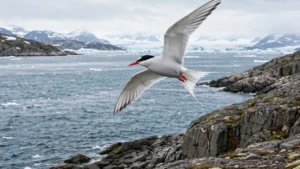
This guide covers the canada goose, a large, heavy, black-necked goose that grazes on grass and lives on lakes and parks, while our arctic tern species guide covers the arctic tern, a small, pale seabird that flies from pole to pole each year on the longest migration of any animal. One stays close to home on the grass; the other crosses the planet.
Conclusion
The canada goose species needs no introduction once you have heard it: one species, Branta canadensis, with seven subspecies, a large black-necked goose with a white cheek patch, a loud honk and a talent for living alongside people.
If you go looking for one, go in winter, go to a lake or an estuary, and look up at dawn or dusk. Find a V formation crossing a cold sky, calling as it goes, and you will see one of the great success stories of the bird world: a goose that was once hunted to the edge of extinction and now numbers in the millions.