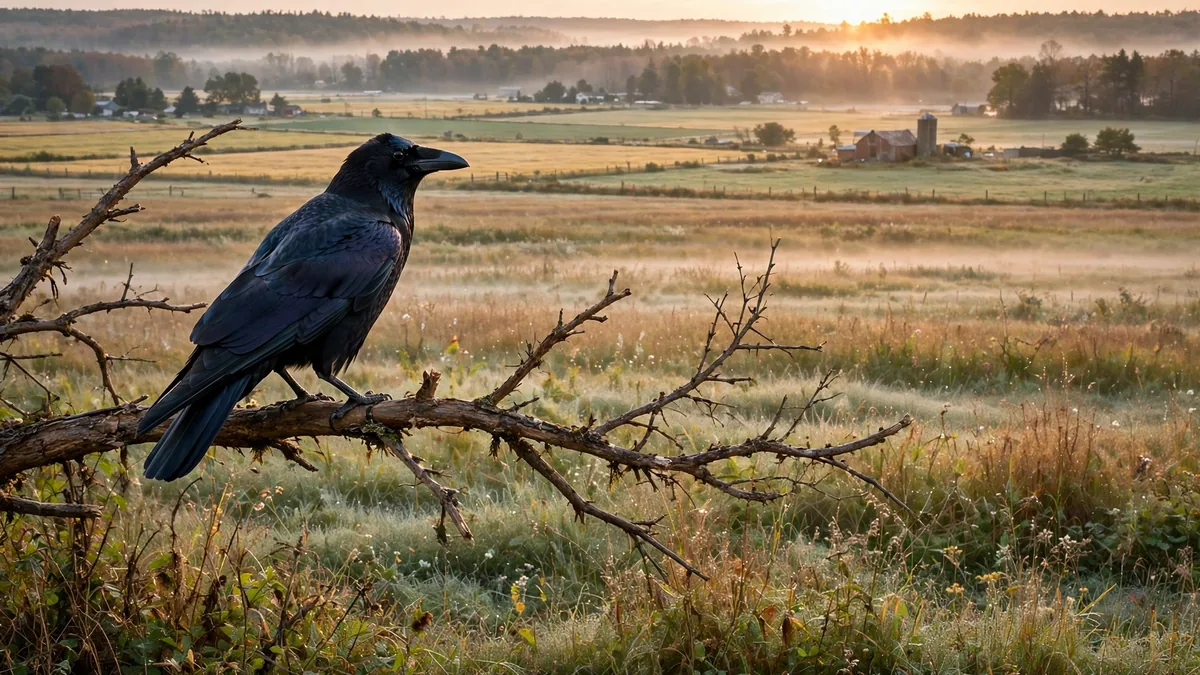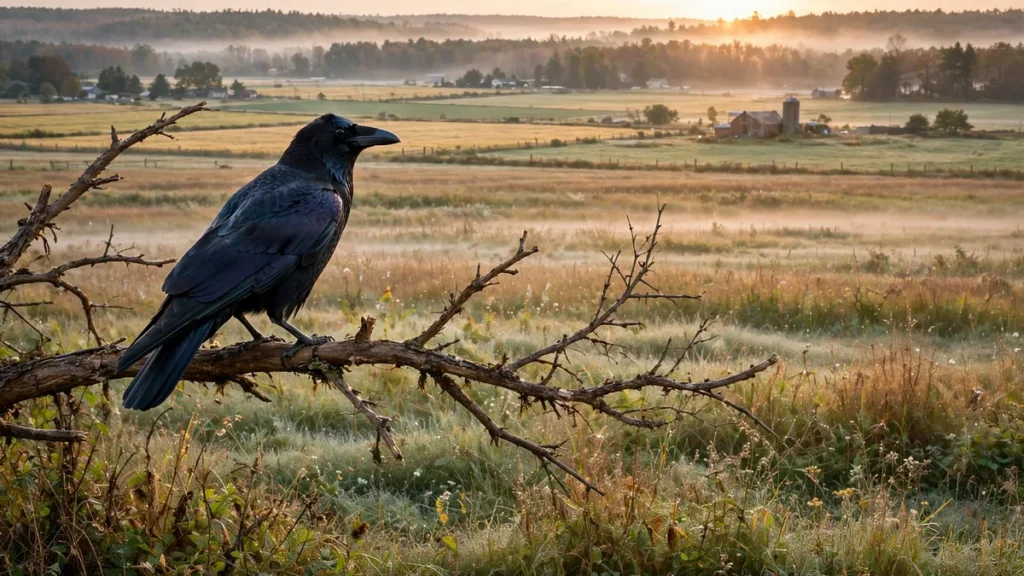
The crow species profiled here is the American crow, Corvus brachyrhynchos, the all-black, sharp-witted bird that watches us from rooftops, fields and woodland edges across North America. If you are asking how many crow species there are, the answer depends on how you count them: this guide follows one species, the American crow, within a genus, Corvus, that holds around 40 crow and raven species worldwide.
A crow is easy to recognise and hard to forget. It is entirely black, from bill to tail, with a fan-shaped tail, a steady wingbeat and a loud, familiar caw, and it remembers the faces of people who have fed it or threatened it, sometimes for years. Few wild birds live so close to us, or study us so carefully.
Key takeaways
- The crow species in this guide is the American crow, Corvus brachyrhynchos, a single species with four generally recognised subspecies, and the genus Corvus holds around 40 crow and raven species worldwide.
- American crows are 40 to 53 centimetres long, with a wingspan of 85 to 100 centimetres and a weight of 316 to 620 grammes, and they are entirely black with a fan-shaped tail.
- Crows are among the most intelligent birds on Earth, using tools, solving puzzles and recognising individual human faces.
- They eat almost anything, from insects and eggs to carrion, seeds, nuts and fruit, and they cache food for later.
- Listed as Least Concern, with a population of about 31 million birds, though West Nile virus has cut numbers sharply in places since 1999.
What makes a crow a crow
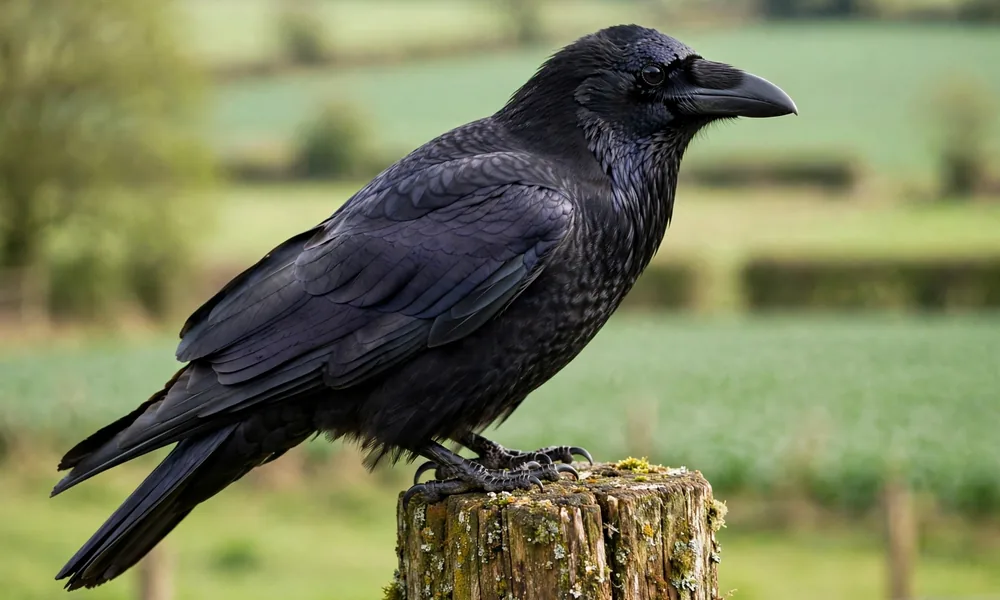
An American crow is a large passerine, 40 to 53 centimetres long, with a wingspan of 85 to 100 centimetres and a weight of 316 to 620 grammes. Its plumage is entirely black, with a faint violet or blue-green sheen in good light, and its bill, legs and feet are black too. The bill is stout and slightly curved, the tail is fan-shaped rather than wedge-shaped, and the wings are broad and rounded, giving a steady, rowing flight with slow, deliberate wingbeats.
The crow is most often confused with the common raven, which is larger, with a heavier bill, a wedge-shaped tail and a deeper, croaking call. A crow in flight looks smaller and neater, flaps more often, and often travels in loose family groups rather than alone or in pairs. Its voice is the familiar caw, though crows also produce rattles, clicks and soft notes.
The crow species and their relatives
The American crow belongs to Corvus, the genus of crows, ravens and rooks in the family Corvidae, and it is a single species with four generally recognised subspecies. The nominate race, C. b. brachyrhynchos, is the eastern crow, the largest form, found from eastern Canada through the eastern and central United States. The western race, C. b. hesperis, is smaller, with a more slender bill and a lower-pitched voice. The Florida race, C. b. pascuus, has a long bill and long legs, while the southern race, C. b. paulus, is smaller still. The count is disputed: some authorities list five subspecies, counting the northwestern crow, C. b. caurinus, separately, but in 2020 the American Ornithological Society merged the northwestern crow into the American crow, treating it as a variation within the western form.
Its closest relatives are the other crows of North America, including the fish crow of the south-eastern coasts and the Chihuahuan raven of the south-west, and the wider genus holds the carrion crow and hooded crow of Europe, the pied crow of Africa and the large-billed crow of Asia. The common raven, the largest member of the genus, is a close cousin, and like the common raven, the crow is a corvid, a member of the family that also holds jays, magpies and nutcrackers.
| Type | Animal | Where it lives | Best-known food | Length or Weight |
|---|---|---|---|---|
| Genus | Crows and ravens of genus Corvus | Almost worldwide | Almost anything | About 40 to 70 cm long |
| Species | American crow (Corvus brachyrhynchos) | Canada to Mexico | Insects, eggs, carrion, seeds | 40 to 53 cm, 316 to 620 g |
| Species | Common raven (Corvus corax) | Northern Hemisphere | Carrion, small animals, eggs | About 60 to 70 cm, 0.7 to 1.6 kg |
| Species | Carrion crow (Corvus corone) | Europe and Asia | Carrion, insects, grain | About 45 to 47 cm, 0.4 to 0.6 kg |
| Species | Hooded crow (Corvus cornix) | Europe and western Asia | Eggs, carrion, grain, shellfish | About 45 to 52 cm, 0.4 to 0.7 kg |
| Species | Pied crow (Corvus albus) | Sub-Saharan Africa | Insects, eggs, carrion, fruit | About 46 to 50 cm, 0.5 to 0.6 kg |
How crows live
Crows are omnivores, and they eat almost anything they can find or catch. Insects and other invertebrates make up much of the summer diet, along with the eggs and nestlings of other birds, small mammals, frogs and fish. In autumn and winter they turn to seeds, grain, nuts, acorns and fruit, and they are frequent visitors to carrion, rubbish bins and bird tables.
What sets crows apart is their intelligence. They use tools, bending wire into hooks and dropping hard nuts onto roads for cars to crack, and they solve multi-step puzzles in the laboratory and in the wild. They recognise individual human faces, remember people who have threatened them, and pass that knowledge on to other crows, so a grudge can last for years and spread through a whole neighbourhood.
Crows live in family groups. A breeding pair is usually helped by one or more of its grown young, which stay for a year or two and help feed the next brood. The pair builds a bulky nest of sticks, lined with bark, moss and soft material, high in a tree, and the female lays three to six eggs, usually four or five, pale blue-green with brown spots. She incubates them for 16 to 18 days, and the chicks leave the nest after 20 to 40 days, staying with their parents for months.
Where crows live
American crows live across almost the whole of North America, from southern Canada to central Mexico, and they use nearly every habitat, from woodland and farmland to desert edges, suburbs and city centres. They favour open country with scattered trees, where they can feed on the ground and still find a perch and a nest site, and they have thrived in towns and cities, learning to use traffic, street lights and rubbish as part of their daily routine. They avoid only dense, unbroken forest and high mountain tops.
Northern birds move south in winter, joining the great roosts, while southern birds stay put all year.
The American crow is listed as Least Concern on the IUCN Red List, with a population estimated at about 31 million birds. West Nile virus, which arrived in North America in 1999, has cut crow numbers by up to 45 per cent in some areas, and local populations are still recovering. The main threats are disease, collisions with vehicles, shooting and the loss of nesting trees, while eggs and chicks are taken by owls, hawks and raccoons. Like the bald eagle and the red-tailed hawk, the crow is protected in the United States under the Migratory Bird Treaty Act.
Best seasons for crow watching
Crows are present all year, so any season works, but winter is the most spectacular, when the great roosts gather and thousands of birds stream across the evening sky to a single wood. Spring is best for family life, when pairs build nests and feed noisy fledglings, and autumn is best for watching crows cache acorns and nuts.
Staying safe around crows
A crow is a bold bird, not a dangerous one, and the main risk is to the bird rather than to you. Never approach a nest closely in spring, since a parent crow may dive at an intruder, and do not feed crows by hand, since a bird that loses its fear of people can become a nuisance. Watch from a distance with binoculars, and keep dogs on a lead near a nest site.
Crow watching checklist
A little preparation turns a walk through farmland or a city park into a real chance of watching crows at their cleverest.
- A visit at dawn or dusk in winter, when the great roosts gather and thousands of birds cross the sky together.
- Binoculars, since a crow high in a tree or on a rooftop is hard to study with the naked eye.
- An eye for the fan-shaped tail and steady, rowing wingbeats, which separate a crow from a raven in flight.
- A listen for the caw, the rattle and the soft cooing notes, which tell you whether the birds are alarmed, feeding or simply chatting.
- A scan of fields, rubbish bins and bird tables, where crows search for insects, grain and scraps.
- Patience and a quiet seat, because a crow that trusts you will come closer and show you its tool use and caching.
- Respect for nests and roosts, keeping your distance in spring and never approaching a fledgling on the ground.
Frequently asked questions
How many crow species are there?
There is one American crow species, Corvus brachyrhynchos, the bird this guide follows, within a genus, Corvus, that holds around 40 crow and raven species worldwide. Modern lists count up to 48 or 49 species in the genus, so the exact total depends on the authority, but the American crow itself is a single species.
How many subspecies of American crow are there?
Four subspecies are generally recognised: the eastern C. b. brachyrhynchos, the western C. b. hesperis, the Florida C. b. pascuus and the southern C. b. paulus. Some authorities list a fifth, the northwestern crow, C. b. caurinus, but in 2020 the American Ornithological Society merged it into the American crow, so the count varies by authority.
What does a crow eat?
A crow eats almost anything: insects, eggs, nestlings, small mammals, carrion, seeds, grain, nuts, acorns and fruit. It caches food for later, hiding nuts and scraps and remembering where it put them.
Are crows intelligent?
Yes, crows are among the most intelligent birds on Earth. They use tools, solve multi-step puzzles, recognise individual human faces and remember people who have threatened them for years, passing that knowledge on to other crows.
Are crows endangered?
Not officially. The American crow is listed as Least Concern on the IUCN Red List, with a population of about 31 million birds. West Nile virus has cut numbers by up to 45 per cent in some areas since 1999, but the species remains widespread and common.
How is this guide different from the Canada goose guide?
This guide covers the crow, a small, all-black, tool-using corvid that lives in family groups, caches food and recognises human faces, while our Canada goose species guide covers the Canada goose, a large, grazing waterbird with a black neck and white cheek patch that migrates in noisy V-shaped flocks. One studies us from the rooftops; the other honks overhead in formation.
Conclusion
The crow species needs no introduction once you have met it: one species, Corvus brachyrhynchos, an all-black, sharp-eyed bird with a fan-shaped tail, a loud caw and a memory for faces that puts most of us to shame.
If you go looking for one, go at dawn or dusk in winter, go quietly, and look up. Find a crow on a fence post, watching you watching it, and you will see why this bird has earned its place in folklore on every continent: it is not just surviving alongside us, it is studying us, and learning.