The great blue heron species is a single species, Ardea herodias, the largest heron in North America and one of the most familiar wading birds on the continent. If you are asking how many great blue heron species there are, the answer is one, a tall grey-blue bird with a dagger bill, a wingspan of up to two metres, and five subspecies.
On a quiet morning you may find one standing motionless at the edge of a marsh, neck folded into an S, watching the water without a twitch. Then the bill strikes like lightning, and a fish is gone, swallowed whole.
Key takeaways
- The great blue heron species is Ardea herodias, a single species with five recognised subspecies, including the all-white great white heron form.
- Adults stand 115 to 138 centimetres tall, with a wingspan of 167 to 201 centimetres and a weight of 1.8 to 3.6 kilogrammes.
- It lives near open water across most of North and Central America, the Caribbean and the Galapagos Islands.
- Great blue herons eat mainly fish, but also frogs, mice, insects, snakes and small birds, hunting by standing still and striking with the bill.
- Listed as Least Concern, with between 500,000 and 5 million mature birds and an increasing trend.
What makes a great blue heron a great blue heron
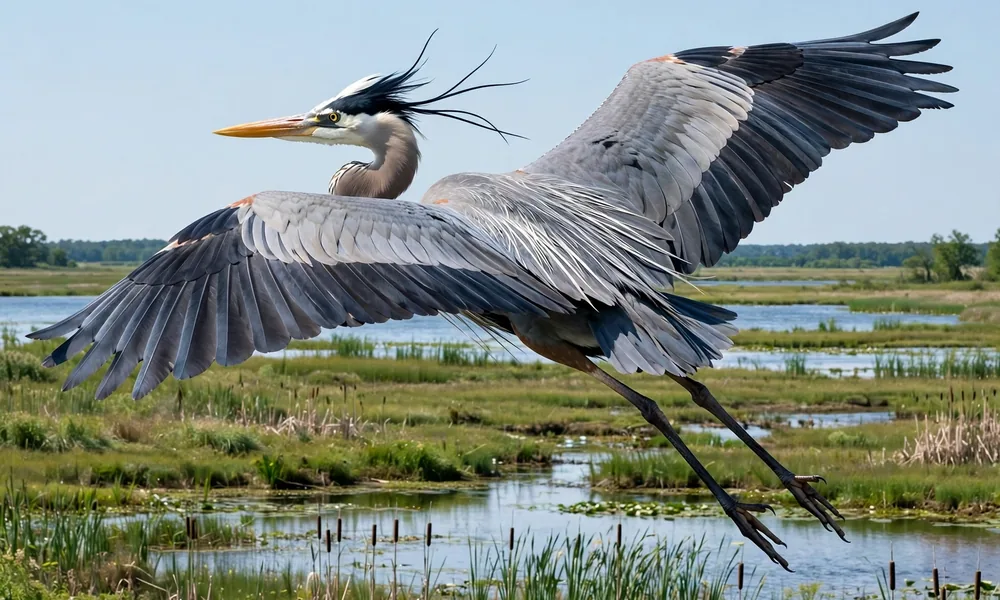
A great blue heron is a very large wading bird, 91 to 137 centimetres long from bill to tail, with a wingspan of 167 to 201 centimetres and a weight of 1.8 to 3.6 kilogrammes. Its plumage is blue-grey above and pale below, with a white face, a black stripe above the eye, and long black plumes trailing from the crown. The neck folds into an S shape, the bill is long and yellow, and the legs are long and dark, built for wading.
In flight it is unmistakable, flying slowly at about 32 to 48 kilometres an hour with its neck folded back and its long legs trailing behind, a posture that separates herons from cranes and storks, which fly with their necks outstretched. Its call is a harsh, deep croak, often given as it lifts off.
The great blue heron species and their relatives
The great blue heron belongs to Ardea, a genus of large herons in the family Ardeidae, described by Carl Linnaeus in 1758. Most classifications recognise five subspecies. The nominate race, A. h. herodias, is the widespread bird of most of North America, from southern Canada to Central America. A. h. fannini lives along the Pacific coast from south-eastern Alaska to Washington, A. h. wardi ranges from Kansas and Oklahoma to northern Florida, and A. h. cognata lives only on the Galapagos Islands.
The fifth form, A. h. occidentalis, is the all-white bird of southern Florida, the Florida Keys and the Caribbean, often called the great white heron. Debate exists about whether these white birds are a colour form, a subspecies, or an entirely separate species, and some authorities count only four subspecies, leaving occidentalis out. White and blue birds sometimes interbreed in the Florida Keys, producing intermediates known as Wurdemann’s herons. The great blue heron’s closest Old World counterpart is the grey heron, Ardea cinerea, of Europe, Asia and Africa, and the two form a superspecies with the Cocoi heron of South America.
| Type | Animal | Where it lives | Best-known food | Length or Weight |
|---|---|---|---|---|
| Family | Herons (Ardeidae) | Worldwide | Fish and frogs | About 28 to 140 cm long |
| Genus | Large herons (Ardea) | Worldwide | Fish and frogs | About 80 to 140 cm long |
| Species | Great blue heron (Ardea herodias) | North and Central America | Fish and frogs | About 91 to 137 cm, 1.8 to 3.6 kg |
| Species | Grey heron (Ardea cinerea) | Europe, Asia and Africa | Fish and frogs | About 90 to 98 cm, 1 to 2 kg |
| Species | Cocoi heron (Ardea cocoi) | South America | Fish and frogs | About 95 to 130 cm, 1.5 to 2.5 kg |
| Species | Great egret (Ardea alba) | Worldwide | Fish and insects | About 80 to 104 cm, 0.7 to 1.5 kg |
How great blue herons live
Great blue herons are expert fishers. They hunt by wading slowly through shallow water or by standing perfectly still, watching for fish to come within reach of the long neck and blade-like bill. The strike is a sudden thrust, and the prey is swallowed whole, head first. Fish are the main food, but they also eat frogs, mice, insects, snakes, small birds and small mammals, and they have been known to choke by trying to swallow a fish too large for the long, S-shaped neck.
They are diurnal, active in daylight, and they usually hunt alone, though they nest in colonies. A heron may stand at one spot for an hour, then move a few slow steps and stand again, and it often returns to the same feeding grounds day after day. Young herons learn to fish by watching adults and by trial and error, growing skilled quickly, since a missed strike costs a meal.
Breeding birds nest in colonies called heronries, usually in tall trees near water, though sometimes in low shrubs. The nest is a large stick platform, sometimes more than a metre wide, built by both parents. The female lays two to seven eggs, and both parents protect and incubate them for roughly four weeks. The chicks hatch naked and helpless, are fed by both parents, and can survive on their own by about two months of age. Great blue herons live for about 15 years in the wild, and some live for more than 20 years.
Where great blue herons live
Great blue herons live near open water across most of North and Central America, the Caribbean, the Galapagos Islands and north-western South America, from Alaska and Canada south to northern Colombia and Venezuela. They favour marshes, lakeshores, riverbanks, estuaries and coastal shallows, anywhere with shallow water and fish. They are common in wetlands, on farms with ponds, and along reservoir edges and tidal flats.
Northern birds are migratory, moving south when the cold arrives, while birds in the southern United States, Mexico and the Caribbean stay put all year. They will feed in flooded fields, drainage ditches and garden ponds when the fishing is good. Like the great egret and the mute swan, the great blue heron is a bird of open water, and it needs clean, fish-filled wetlands to thrive.
The great blue heron is listed as Least Concern on the IUCN Red List, with a population estimated at between 500,000 and 5 million mature birds, and the current trend is increasing. Numbers have risen in eastern North America as returning beavers have created new ponds and wetlands. The species is protected in the United States under the Migratory Bird Treaty Act, and its main threats are wetland loss, disturbance at nesting colonies, and polluted feeding waters.
Best seasons for great blue heron watching
Great blue herons are easiest to watch from spring to autumn, when they are busy around their nesting colonies and feeding in shallow water. In the north, look for them from April to October, when the migrants return and the heronries are active. In the south they are present all year, and winter is a good time to watch them hunting in estuaries and tidal flats.
Staying safe around great blue herons
A great blue heron is a shy bird, and the main risk is to the bird rather than to you. Never approach a nesting colony closely, since the adults may abandon their nests if disturbed too often, and keep your distance from a hunting bird so it is not driven off its feeding ground. Watch from a distance with binoculars, and stay on paths and boardwalks rather than wading through the marsh. Like the Canada goose and the sandhill crane, the great blue heron is protected by law in the United States under the Migratory Bird Treaty Act.
Give a heron room, because a cornered bird can strike with its sharp bill, and keep dogs on a lead near wetlands. If you find a young heron on the ground, leave it alone: its parents are usually nearby, and a wildlife rehabilitator should be called only if it is clearly injured.
Great blue heron watching checklist
A little preparation turns a morning at the marsh into a real chance of watching a great blue heron hunt.
- A visit from spring to autumn in the north, or at any time of year in the south, when the birds are present.
- An early-morning start, when herons are hunting in the shallows.
- Binoculars, since a heron in a marsh is often some way off and hard to see.
- A scan of marsh edges and lakeshores, where herons stand motionless waiting for fish.
- A look up at tall trees near water, where the stick nests of a heronry may be visible.
- Patience and a quiet approach, because a heron will lift off with a harsh croak if you come close.
- Respect for nests and feeding grounds, keeping to paths and never approaching a colony.
Frequently asked questions
How many great blue heron species are there?
There is one great blue heron species, Ardea herodias, with five recognised subspecies: A. h. herodias of most of North America, A. h. fannini of the Pacific coast, A. h. wardi of the south-east, A. h. occidentalis of southern Florida and the Caribbean, and A. h. cognata of the Galapagos Islands. Some authorities count only four, treating the white occidentalis form as a colour variant or separate species.
What is the difference between a great blue heron and a grey heron?
The great blue heron and the grey heron are close relatives filling the same niche on different continents. The great blue heron is larger, at 91 to 137 centimetres long, with a rusty wash on the neck and thighs, while the grey heron is 90 to 98 centimetres long, with a paler grey neck and legs and no brown tones. The great blue heron lives in the Americas; the grey heron lives in Europe, Asia and Africa.
What does a great blue heron eat?
A great blue heron eats mainly fish, but also frogs, mice, insects, snakes, small birds and small mammals. It hunts by standing still or wading slowly in shallow water, then strikes with its long bill and swallows the prey whole.
Where do great blue herons nest?
Great blue herons nest in colonies called heronries, usually in tall trees near water. The nest is a large platform of sticks, sometimes more than a metre wide, and the female lays two to seven eggs, which both parents incubate for roughly four weeks.
Are great blue herons endangered?
Not officially. The great blue heron is listed as Least Concern on the IUCN Red List, with a population of between 500,000 and 5 million mature birds and a trend that is increasing. Wetland loss, disturbance at colonies and water pollution are its main threats.
How is this guide different from the game birds guide?
This guide covers the great blue heron, a tall, grey-blue wading bird that hunts fish in marshes and nests in tree-top colonies, while our game birds guide covers birds hunted for food and sport, such as pheasants, grouse and quail. One stands still in the shallows waiting for a fish; the others run through undergrowth.
Conclusion
The great blue heron species needs no introduction once you have seen it: one species, Ardea herodias, a tall grey-blue wading bird with a dagger bill, a wingspan of up to two metres, and a patience at the water’s edge few other birds can match.
If you go looking for one, go on a quiet morning, go early, and watch the shallows. Find one standing motionless in the reeds, and wait for the strike, one of the finest sights in North American birdwatching.