Penguin species number 18 in total, from the emperor penguin of Antarctica to the Galápagos penguin that lives on the equator. If you are wondering how many penguin species there are and where they live, the short answer is this: there are 18 recognised species, and they all live in the southern hemisphere, on the coasts of Antarctica, South America, southern Africa, Australia and New Zealand — not only on the Antarctic ice.
Here are all 18 species, and where to see them.
Key takeaways
- There are 18 recognised species, from the emperor to the little blue penguin.
- All penguins live in the southern hemisphere, and most species never set foot on Antarctica.
- Penguins fly underwater, using stiff wings as flippers to chase fish, squid and krill.
- Every penguin moults once a year, losing all its feathers at once and staying out of the water until its new coat grows in.
- Most penguins breed in colonies; emperors and kings raise one chick balanced on their feet.
What makes a penguin a penguin
A penguin is a flightless seabird built for the water rather than the air. Its wings have become stiff, flat flippers, its bones are solid rather than hollow, and its body is torpedo-shaped, with a thick layer of fat and dense, waterproof feathers.
Penguins cannot fly, but they fly underwater. A gentoo penguin can swim at around 36 kilometres per hour, and an emperor penguin can dive deeper than 500 metres and stay down for more than 20 minutes.
The great penguins: emperor and king
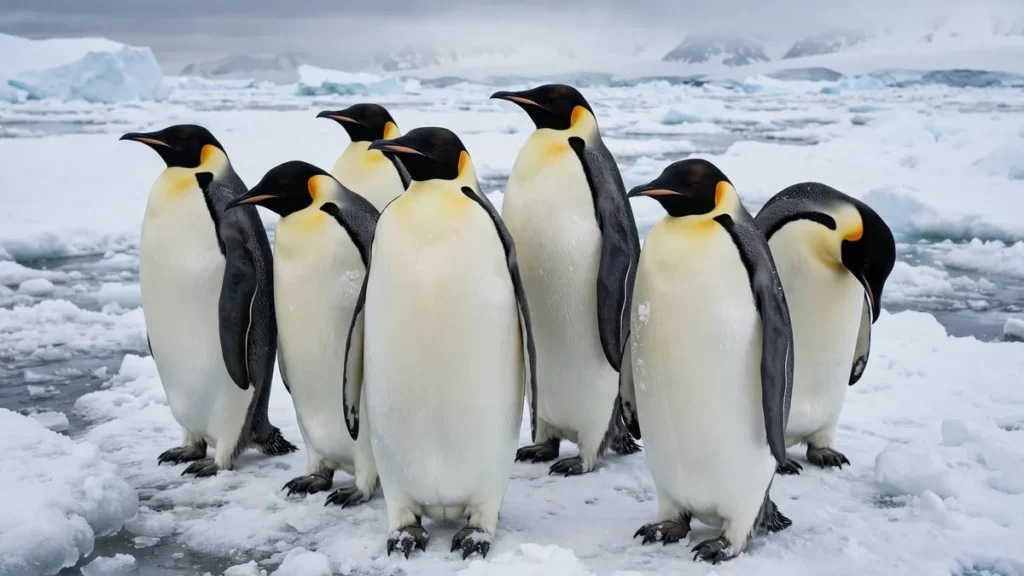
The emperor penguin is the largest of all penguin species, standing about 110 centimetres tall and weighing up to 40 kilograms. It lives on the sea ice around Antarctica and breeds in the middle of the Antarctic winter, when temperatures can fall below minus 50 degrees Celsius. The male holds the single egg on his feet, under a fold of belly skin, for about two months without eating, while the female feeds at sea.
The king penguin is the second largest species, standing about 90 centimetres tall, with bright orange and yellow markings on its head and neck. Kings breed on sub-Antarctic islands such as South Georgia, where the beaches are crowded with birds, and they also balance their single egg on their feet.
The brush-tailed penguins: Adélie, chinstrap and gentoo
The Adélie, chinstrap and gentoo penguins are the brush-tailed penguins, named for their long, stiff tail feathers, which they use as a prop when they stand upright.
The Adélie penguin is the classic Antarctic penguin, with a black head, a white ring around each eye and a short beak. The chinstrap penguin is named for the thin black line under its chin, and it is the most numerous penguin in the world.
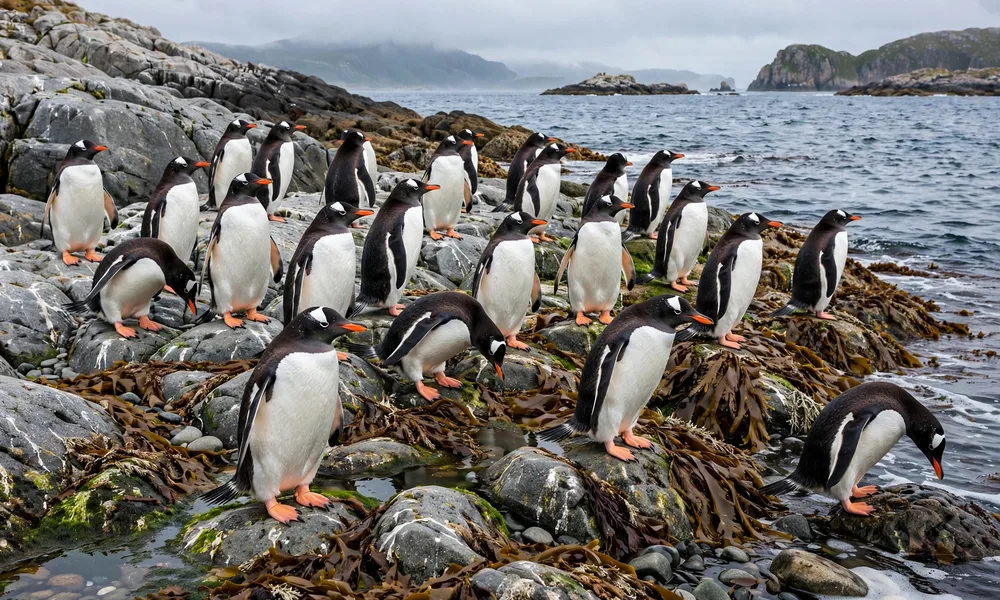
The gentoo penguin is the fastest swimmer of all penguins and the most widespread of the brush-tails, breeding from Antarctica to the Falkland Islands and South Georgia. Gentoos have a white patch above each eye, a bright orange-red beak and long, pale pink feet.
The crested penguins: macaroni, rockhopper, royal and more
The crested penguins are the most flamboyant penguins, with yellow or orange plumes above their eyes and bright red beaks. There are seven crested species: the macaroni, the royal, the erect-crested, the northern rockhopper, the southern rockhopper, the Snares and the Fiordland penguins.
The macaroni penguin is the most numerous crested penguin, with large colonies on South Georgia and the Kerguelen Islands, golden-yellow plumes and a large orange beak. The rockhopper penguins are the smallest crested penguins and the best climbers, hopping from rock to rock on steep shores. Northern rockhoppers live around Tristan da Cunha; southern rockhoppers breed on the Falklands and islands further south.
The royal penguin lives only on Macquarie Island, south of Australia. The erect-crested penguin breeds on the Antipodes and Bounty Islands near New Zealand. The Snares penguin lives only on the Snares Islands, and the Fiordland penguin nests in the forests of Fiordland — the only forest-nesting penguin.
The banded penguins: African, Humboldt, Magellanic and Galápagos
The banded penguins live in warmer waters than their Antarctic cousins, along the coasts of South America and southern Africa. All four have a black chest band and nest in burrows or under bushes.
The African penguin, also called the jackass penguin for its braying call, lives on the coasts of South Africa and Namibia, and it is the only penguin that breeds in Africa. The Humboldt penguin lives on the cold Humboldt Current along the coasts of Peru and Chile, breeding in burrows and rocky crevices.
The Magellanic penguin is the most numerous of the banded penguins, breeding along the coasts of Argentina and Chile and on the Falkland Islands. The Galápagos penguin is the most northerly of all penguins and the rarest of the banded species, living on the Galápagos Islands on the equator. It nests in lava tubes and crevices, cooled by the cold Cromwell Current.
The little blue penguin and the yellow-eyed penguin
The little blue penguin is the smallest penguin species, standing about 30 centimetres tall and weighing around one kilogram. It lives on the coasts of Australia and New Zealand, coming ashore at night to its burrows in the dunes and under coastal scrub. Its evening arrival on the beach is a well-known sight at Phillip Island in Australia.
The yellow-eyed penguin is one of the rarest penguins in the world, with pale yellow eyes, a yellow band across its head and a long, slender beak. It lives only in New Zealand, on the south-east coast of the South Island and on the Auckland and Campbell Islands. Like the flightless birds of other continents, both have traded flight for a life in the water.
How penguins swim, hunt and moult
Penguins spend most of their lives at sea. Their feathers are short, dense and waterproof, layered like tiles, and they trap a layer of air that keeps the bird warm and buoyant. Penguins hunt by sight, chasing fish, squid and krill underwater and swallowing their prey whole.
Once a year, every penguin moults: it loses all its feathers at once and grows a new coat over two to four weeks. During the moult a penguin cannot swim, because its feathers are no longer waterproof, so it stays on land and lives off its fat reserves. The moult is timed to the seasons, so the new feathers are ready before the hardest weather.
Colonies, breeding and raising chicks
Most penguins breed in colonies, from a few dozen pairs of yellow-eyed penguins hidden in the forest to hundreds of thousands of Adélies on a single Antarctic beach. Colonies offer safety in numbers.
Penguin parents share the work of raising their chicks. One parent stays with the egg or chick while the other goes to sea to feed, and they take turns over days or weeks. The returning parent finds its mate and its chick by voice, picking out a single call from the noise of thousands of birds.
Where penguins live around the world
Penguins live only in the southern hemisphere, but in many more places than Antarctica. The Galápagos penguin lives on the equator, the African penguin lives on the warm coasts of South Africa, and the little blue penguin lives on the beaches of Australia and New Zealand. Only four species breed on the Antarctic continent itself: the emperor, the Adélie, the chinstrap and the gentoo. Like the ocean animals that share their seas, penguins depend on healthy fish and krill stocks.
| Species | Where it lives | Best-known fact |
|---|---|---|
| Emperor penguin | Sea ice around Antarctica | Largest penguin |
| King penguin | Sub-Antarctic islands, South Georgia | Breeds over a year |
| Adélie penguin | Antarctic coast | White eye rings |
| Chinstrap penguin | Antarctic Peninsula, Scotia Sea | Most numerous penguin |
| Gentoo penguin | Antarctica to the Falklands | Fastest swimming penguin |
| Macaroni penguin | South Georgia, Kerguelen | Golden plumes |
| Royal penguin | Macquarie Island only | Lives on one island |
| Erect-crested penguin | Antipodes, Bounty Islands | Upright yellow plumes |
| Northern rockhopper | Tristan da Cunha, Amsterdam Island | Hops between rocks |
| Southern rockhopper | Falklands and southern islands | Yellow plumes, red eyes |
| Snares penguin | Snares Islands only | One island group |
| Fiordland penguin | Fiordland, New Zealand | Nests in forest |
| Little blue penguin | Australia and New Zealand | Smallest penguin |
| African penguin | South Africa and Namibia | Only African penguin |
| Humboldt penguin | Peru and Chile | Nests in burrows |
| Magellanic penguin | Argentina, Chile, Falklands | Migrates in winter |
| Galápagos penguin | Galápagos Islands | Lives on the equator |
| Yellow-eyed penguin | New Zealand | Rarest penguin |
Best seasons for seeing penguins
The best season depends on the species. Adélie, chinstrap and gentoo penguins are best in the Antarctic summer, from November to February, when the colonies are full of chicks. King penguins are best on South Georgia in the southern summer. African penguins can be seen all year on the South African coast.
Staying safe around penguins
Penguins are wild animals, and they deserve space. Keep at least five metres away, never walk between a penguin and the sea, and never touch a penguin or a chick. Follow the rules of the colony, stay with your guide, and keep noise to a minimum.
Penguin species checklist
- Learn the 18 species and their key marks: plumes, chin straps, eye rings and chest bands.
- Look for emperors on Antarctic sea ice and kings on South Georgia.
- Watch a gentoo colony on a rocky shore.
- Visit a little blue penguin colony at dusk, when the birds come ashore in groups.
- Keep five metres away, never block the path to the sea, and never feed a penguin.
- Leave no trace: take your rubbish home and keep to marked paths.
Frequently asked questions
How many penguin species are there?
There are 18 recognised species, from the emperor at about 110 centimetres tall to the little blue penguin at about 30 centimetres, all around the southern hemisphere.
How is this guide different from the flightless birds guide?
This guide covers penguins only, in depth, with all 18 species. The flightless birds guide covers flightless birds as a whole, including ostriches, emus, rheas, cassowaries and kiwis.
How is this guide different from the Antarctic animals guide?
This guide covers penguins worldwide, from the Galápagos penguin on the equator to the African penguin of South Africa. The Antarctic animals guide covers only Antarctica, where just four penguin species breed.
Can penguins fly?
No, but they fly underwater: their stiff wings work as flippers, and a gentoo can swim at around 36 kilometres per hour.
Why do penguins moult all at once?
Penguins moult once a year, losing all their feathers at once and growing a new coat over two to four weeks. During the moult they cannot swim, so they stay ashore and live off fat reserves.
Where is the best place to see penguins in the wild?
Antarctic cruises are best for Adélie, chinstrap and gentoo penguins, South Georgia for kings, the South African coast for African penguins, and Phillip Island for little blue penguins at dusk.
Conclusion
Penguin species span the whole southern hemisphere, from the emperor penguin on the Antarctic ice to the Galápagos penguin on the equator, and each of the 18 species has its own home, its own markings and its own way of life.
Pick one species and one place — a gentoo colony, an African penguin beach, or little blue penguins at dusk — and plan around its busiest season.