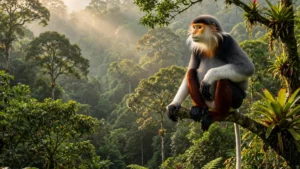
Peru animals range from Andean condors soaring over Colca Canyon to pink river dolphins in the Amazon, and the country holds some of the most varied wildlife in South America. If you are wondering which animals live in Peru and where to see them, the short answer is this: condors, vicunas and spectacled bears live in the high Andes, jaguars, giant river otters and macaws live in the Amazon rainforest of Manu and Tambopata, and Humboldt penguins and sea lions live on the cold Pacific coast.
Peru is one of the best places in the world to watch wildlife, because so much of the country is still mountain, rainforest, desert and coast. This guide covers the species you are most likely to meet, where each one lives and the best seasons to see them.
Key takeaways
- Peru’s most iconic land animals are the Andean condor, the spectacled bear, the jaguar, the vicuna and the giant river otter.
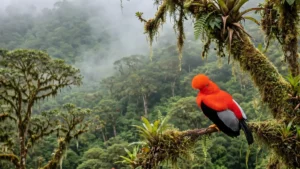
- The Andean cock-of-the-rock is Peru’s national bird, and the cloud forests of Manu are the best place to see it display at dawn.
- Manu National Park and Tambopata are among the best places in the Amazon to see macaws, giant river otters and pink river dolphins.
- Humboldt penguins and South American sea lions live on the cold Pacific coast, and the Ballestas Islands are the best place to see them.
- The dry season, from May to September, is the best time for most wildlife watching, and early morning is the best time of day for forest animals.
What makes Peru’s wildlife special
Peru stretches from the Pacific coast in the west to the Amazon rainforest in the east, with the high Andes running down the middle. That range covers desert coast, high mountain, cloud forest and lowland jungle, so the country holds species from several habitats at once, and it is one of the most biodiverse countries on Earth.
Honesty matters here: Peru has many endemic species, but few large mammals live only here. What it has instead is an extraordinary range of life packed into one country, from the driest desert on Earth to some of the richest rainforest. The Manu Biosphere Reserve alone holds more bird species than the whole of the United States, and the Amazon basin of Peru is among the wildest corners of the continent.
That variety comes from the landscape itself. Peru holds the high peaks of the Cordillera Blanca, the deep canyons of Colca and Cotahuasi, the cloud forests of the eastern Andes and the vast lowland forests of the Amazon. Like the rainforest animals of other Amazonian countries, many Peruvian species depend on large, quiet woodland, and Manu and Tambopata are among the best protected forests in the Amazon.
The great mammals of Peru
The Andean condor is Peru’s most famous bird, but it is the spectacled bear that is the most famous mammal of the high Andes. The bear lives in the cloud forests of the eastern slopes, feeding on bromeliads and fruit, and it is the only bear in South America. It is shy and rarely seen, and the best chance of a sighting is in the cloud forests of Manu, with a local guide.
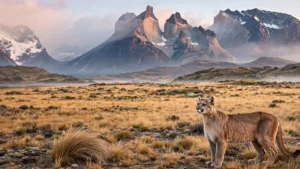
Among the predators, the jaguar is the largest cat in the Americas, and it still lives in the forests of Manu and Tambopata, but it is rare, nocturnal and almost never seen by visitors. The puma is more widespread, hunting deer and vicunas in the high Andes and the lowland forest, and the ocelot hunts at night in the rainforest understorey. Vicunas, the wild relatives of the alpaca, graze the high puna grasslands in elegant herds, and guanacos live on the dry slopes of the south.
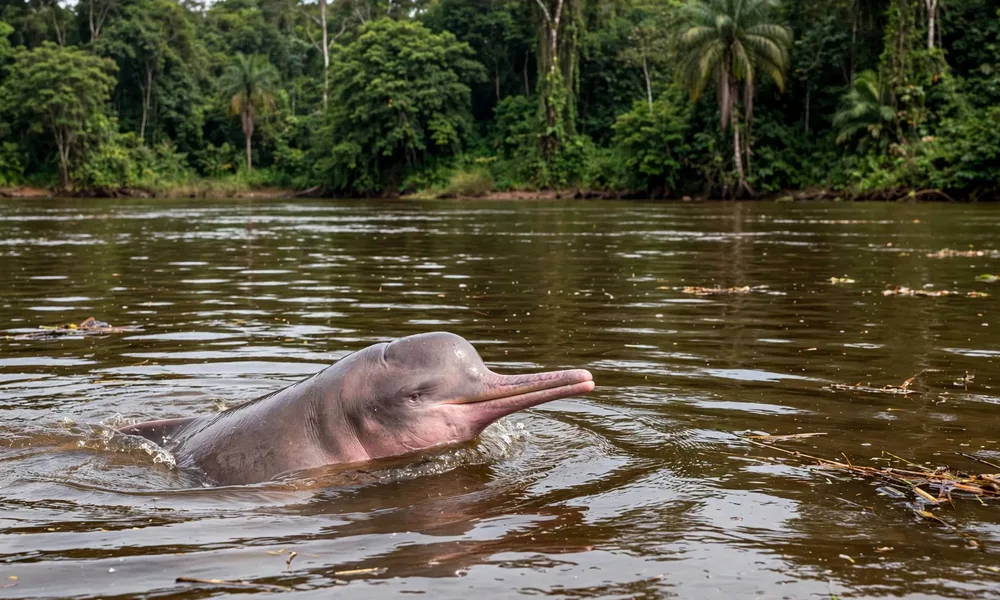
The giant river otter is one of the Amazon’s most striking animals, a large, noisy otter that hunts fish in family groups along the oxbow lakes of Manu and Tambopata. The pink river dolphin lives in the same rivers, surfacing quietly among the flooded forest, and it is one of the few dolphins in the world that lives in fresh water.
One animal should not be on any visitor’s list as a certainty: the jaguar. It survives in Peru, but in small numbers in vast forest, and no honest guide can promise a sighting. The same is true of the giant armadillo, which is now very rare. Both are reminders of how much of Peru’s wildlife depends on large, undisturbed forest.
Birds of Peru
The Andean condor is one of the largest flying birds in the world, with a wingspan of more than three metres, and Colca Canyon is one of the best places in the world to see it. The condors ride the morning thermals up from the canyon floor, passing close to the viewpoints at Cruz del Condor, and the best time to look for them is in the early morning.
The Andean cock-of-the-rock is Peru’s national bird, and one of the most spectacular birds in the Andes. The males gather at dawn in the cloud forest to display, flashing their bright orange plumage and calling loudly, and the best place to see them is in the cloud forests of Manu, where a local guide knows the display sites.
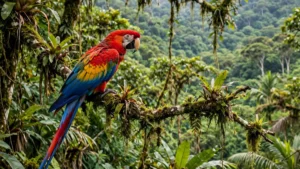
Peru holds more bird species than almost any other country in the world, from scarlet macaws and toucans in the lowland rainforest to hummingbirds in the cloud forest.
Rivers, coasts and smaller wildlife
Peru’s Amazon rivers hold their own wildlife, and the oxbow lakes of Manu and Tambopata are the best places to see it. The lakes hold giant river otters, caimans and paiche, one of the largest freshwater fish in the world.
Along the cold Pacific coast, the Humboldt penguin nests on rocky islands and headlands, and the Ballestas Islands, off Paracas, are the best place to see them. The islands also hold South American sea lions, fur seals and thousands of seabirds, from blue-footed boobies to Inca terns. The cold Humboldt Current brings rich nutrients that feed the whole coastal food chain.
Smaller animals are everywhere in Peru, though they are often overlooked. The Andean fox hunts in the high puna, the mountain vizcacha suns itself on rocky slopes, and the woolly monkey swings through the cloud forest canopy. Like the forest animals of other Andean countries, the monkeys, toucans and hummingbirds of Peru’s cloud forests depend on tall, undisturbed woodland.
| Species | Where to look | Best season | How likely is a sighting |
|---|---|---|---|
| Andean condor | Colca Canyon, Cruz del Condor viewpoint | May to September, early morning | Good in season |
| Giant river otter | Oxbow lakes of Manu and Tambopata | Dry season, May to October | Good with a guide |
| Pink river dolphin | Amazon tributaries of Manu and Tambopata | Dry season | Fair with a guide |
| Andean cock-of-the-rock | Cloud forests of Manu | Year-round, at dawn | Good with a guide |
| Vicuna | High puna grasslands of the Andes | Year-round | Good |
| Humboldt penguin | Ballestas Islands off Paracas | Year-round | Good from a boat |
| Spectacled bear | Cloud forests of the eastern Andes | Year-round | Very low |
Best seasons for wildlife watching
The dry season, from May to September, is the finest season. The trails are easier to walk, the rivers are low and the animals gather at the remaining water, and the condors ride the morning thermals over Colca Canyon. It is also the best season for the Amazon, when the oxbow lakes are at their lowest and the giant river otters are easiest to find.
The wet season, from October to April, brings heavy rain to the Amazon and the cloud forests, when the frogs are at their most active and the forests are at their greenest. The macaw clay licks are busy all year, and the cock-of-the-rock displays at dawn through the breeding season.
Within any season, the time of day matters as much as the month. Early morning is the best time for forest animals: macaws, toucans and cock-of-the-rock are all most active at dawn. Night walks reveal frogs, kinkajous and night monkeys that are invisible by day.
Staying safe around Peru’s wildlife
Peru’s large animals are usually calm, but they deserve respect. Keep your distance from jaguars, pumas, caimans and wild pigs, never approach a vicuna with young, and never try to feed or touch any wild animal. Caimans live in the rivers and oxbow lakes of the Amazon, so never swim unless a local guide says it is safe.
On the coast, keep away from nesting seabirds, never handle a penguin or a sea lion, and keep a safe distance from fur seals, even when they seem calm. In the mountains, carry water and sun protection, and allow time to acclimatise to the altitude before a long walk. The condors and eagles of the high Andes are shy and avoid people, but they should always be watched from a distance.
Peru wildlife watching checklist
- Book a local guide for condors, cock-of-the-rock and giant river otters — they know where the animals are.
- Go out at dawn for birds, and plan Colca Canyon trips for May to September, when the condors ride the thermals.
- Bring binoculars, warm layers and waterproofs, even in the dry season — mountain weather changes fast.
- Keep at least 50 metres from nesting birds and vicunas, and far more from jaguars, pumas and caimans.
- Never feed wild animals, and never use food or calls to lure them closer for a photograph.
- On the coast, keep to marked paths on penguin islands and never approach a sea lion colony.
- Leave no trace: take your rubbish home and keep to marked paths in sensitive habitats.
Frequently asked questions
What is the most famous animal in Peru?
The Andean condor is the most famous bird, and the giant river otter is the most famous mammal of the Amazon. The pink river dolphin and the Andean cock-of-the-rock are the most famous sights after them.
Are there jaguars in Peru?
Yes, but they are rare and shy. Jaguars live in the forests of Manu and Tambopata, and they are almost never seen by visitors. No honest guide can promise a sighting.
Can I see an Andean condor in Peru?
Yes. Colca Canyon is one of the best places in the world to see Andean condors, and the best time is the early morning, from May to September, when the birds ride the thermals up from the canyon floor.
When is the best time to see wildlife in the Peruvian Amazon?
The dry season, from May to October, is the best time, when the rivers are low, the trails are passable and the giant river otters gather at the oxbow lakes. Go early in the morning for birds and macaw clay licks.
Can I see penguins in Peru?
Yes. Humboldt penguins nest on the rocky islands of the Pacific coast, and the Ballestas Islands off Paracas are the best place to see them, from a boat, all year round.
How is this guide different from the Costa Rica animals guide?
This guide covers Peru, a much larger country that runs from the high Andes to the Amazon, with condors, vicunas, giant river otters and pink river dolphins. The Costa Rica animals guide covers a small Central American country, with a different mix of species, including sloths, quetzals and leatherback turtles, in a far smaller area.
Conclusion
Peru’s wildlife rewards patience: Andean condors over Colca Canyon, giant river otters in the oxbow lakes of Manu, pink river dolphins in the Amazon and Humboldt penguins on the Ballestas Islands are all within reach if you plan around the seasons.
The next step is to pick one species and one season — a dry-season trip to Colca Canyon for condors, a visit to Tambopata for macaw clay licks, or a boat trip to the Ballestas Islands for penguins.