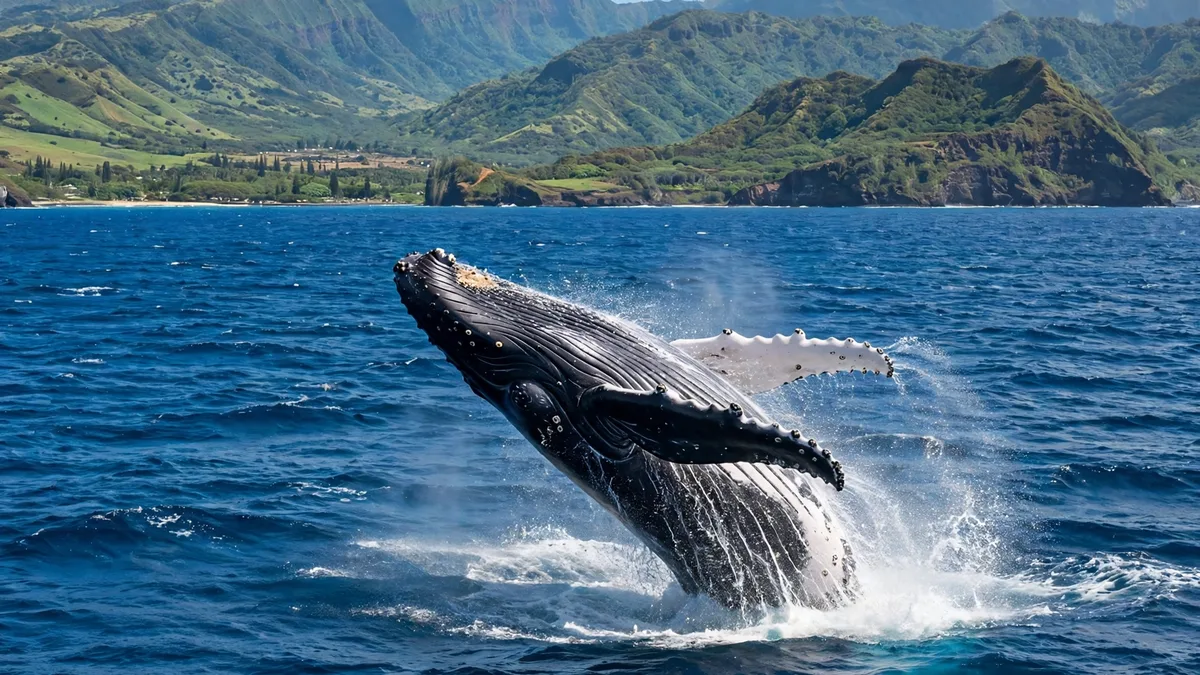
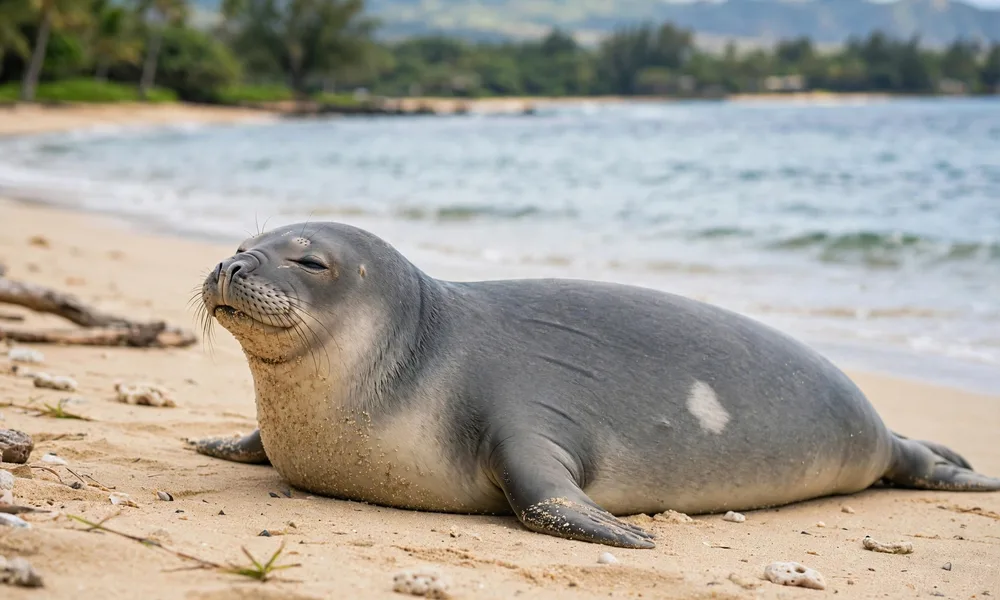
Hawaii animals range from humpback whales breaching off Maui in winter to Hawaiian monk seals resting on remote beaches, and the islands hold some of the most unusual wildlife in the United States. If you are wondering which animals live in Hawaii and where to see them, the short answer is this: humpback whales, spinner dolphins and green sea turtles fill the warm seas, the nene goose and colourful honeycreepers live in the forests and volcanic slopes, and the Hawaiian monk seal, one of the rarest seals in the world, hauls out on quiet beaches.
Hawaii is one of the best places in the Pacific to watch marine wildlife, because the islands sit in the middle of the ocean, far from any continent, and the surrounding seas are warm and rich. This guide covers the species you are most likely to meet, where each one lives and the best seasons to see them.
Key takeaways
- Hawaii’s most iconic land animals are the nene goose, the Hawaiian monk seal, the green sea turtle and the humpback whale.
- The Hawaiian hoary bat is the only native land mammal in Hawaii, and all other land mammals were brought by people.
- Humpback whales gather around Maui and the other islands from December to April, and they are the best whale-watching season in Hawaii.
- Green sea turtles, or honu, can be seen at many beaches all year, and spinner dolphins rest in sheltered bays during the day.
- Many of Hawaii’s native forest birds are endangered or already extinct, so the rarest honeycreepers can only be seen with a guide in protected forest.
What makes Hawaii’s wildlife special
Hawaii is the most isolated island chain on Earth, lying thousands of kilometres from the nearest continent, and its wildlife reflects that long isolation. Only a few kinds of animal ever reached the islands on their own — birds blown in by storms, a single bat, seals and sea turtles that swam, and insects and snails carried on the wind — and those few arrivals evolved into forms found nowhere else.
Honesty matters here: Hawaii has no native deer, bears, wolves or big cats, and its only native land mammal is the Hawaiian hoary bat, a small bat that hunts moths over the forests at dusk. What it has instead is a remarkable collection of endemic birds, a rare seal, and some of the best whale watching in the Pacific. The islands also hold a sad record: more bird species have gone extinct in Hawaii than anywhere else in the United States, and many of the survivors are endangered.
That variety comes from the landscape itself. Hawaii holds active volcanoes, high mountain slopes, wet rainforest, dry grassland and warm coral seas, so animals from many different habitats can live within one small island chain. Like the forest animals of other island groups, many Hawaiian species depend on large, quiet woodland, and the high forests of Hawaii Island and Maui are among the wildest corners of the state.
The great mammals of Hawaii
The Hawaiian monk seal is the state’s most remarkable mammal and one of the rarest seals in the world, with only around 1,600 animals left. Monk seals haul out on quiet sandy beaches to rest, and they are most often seen on the less crowded shores of Kauai, Molokai and the north-western islands. If you see one, keep well back: it is against the law to approach a resting monk seal, and a good viewing distance is at least 15 metres, or 50 metres for a mother with a pup.
The humpback whale is the great winter visitor. Each year thousands of humpbacks travel from Alaska to the warm, shallow waters around Maui, where the mothers give birth and the males sing. The whales are most often seen from December to April, and Maui’s west and south coasts are the best places to look for them, from a boat or from the shore.
Spinner dolphins rest in sheltered bays during the day, spinning out of the water in the early morning as they head out to hunt at night. They are most often seen off the Kona coast of Hawaii Island and off Oahu and Maui, but they should always be watched from a distance, since daytime rest is vital for them.
One animal should not be on any visitor’s list as a certainty: the Hawaiian crow, or alala. It is extinct in the wild, and the surviving birds live in breeding centres, with reintroduction efforts still under way on Hawaii Island. No honest guide can promise a sighting, and the crow’s story is a reminder of how fragile Hawaii’s native birds are.
Birds of Hawaii
The nene, or Hawaiian goose, is the state bird and one of the great conservation recoveries of the islands. It was once down to a few dozen birds, but breeding and release programmes have brought it back to the volcanic slopes of Hawaii Island, Maui and Kauai, where it grazes on grasses and berries. It is now seen regularly in Hawaii Volcanoes National Park and on the slopes of Haleakala.
The honeycreepers are the most remarkable birds of the Hawaiian forests. They arrived long ago as a single finch-like bird and evolved into dozens of species, from the bright red iiwi, with its curved bill, to the yellow-green amakihi.
Hawaii’s position in the middle of the Pacific makes it an important stop for seabirds. The wedge-tailed shearwater, or ua’u kani, nests in burrows on the coasts, and the red-tailed tropicbird, with its long streaming tail feathers, nests on the sea cliffs of Kauai and Oahu. Like the coastal animals of other island groups, Hawaii’s seabirds depend on clean seas and undisturbed nesting cliffs.
Reefs, coasts and smaller wildlife
The green sea turtle, or honu, is Hawaii’s best-loved marine animal, and it is seen at many beaches all year. The turtles graze on algae in the shallows and haul out on the sand to bask, and they are most reliably seen at places like Laniakea Beach on Oahu and the reefs of Maui. Keep at least three metres away, and never touch a turtle or block its path to the sea.
Below the water, Hawaii’s reefs hold their own wildlife. The humuhumunukunukuapua’a, or reef triggerfish, is the state fish, and the reefs hold butterflyfish, parrotfish, moray eels and the occasional reef shark. Hanauma Bay on Oahu is one of the best places to see reef fish, and the clear waters off the Kona coast hold manta rays, which gather at night to feed on plankton.
Smaller land animals are everywhere in Hawaii, though most are introduced. Mongooses, rats, feral pigs and goats live in the forests and farmland, and many are a serious problem for native wildlife.
| Species | Where to look | Best season | How likely is a sighting |
|---|---|---|---|
| Humpback whale | Waters off Maui, Hawaii Island and Oahu | December to April | Good in season |
| Hawaiian monk seal | Quiet beaches of Kauai, Molokai and Oahu | Year-round | Fair, needs luck |
| Green sea turtle | Reefs and beaches of Oahu and Maui | Year-round | Good |
| Nene goose | Hawaii Volcanoes National Park and Haleakala | Year-round | Good with a guide |
| Iiwi | High forests of Hawaii Island and Maui | Year-round, at dawn | Fair with a guide |
| Spinner dolphin | Sheltered bays off Kona and Maui | Year-round, morning | Good from a boat |
| Manta ray | Kona coast of Hawaii Island | Year-round, at night | Good on a night dive |
Best seasons for wildlife watching
Winter is the finest season. The humpback whales arrive from Alaska, the seas are at their clearest for snorkelling, and the nene geese are easy to find on the volcanic slopes. It is also the most popular season, so book boat trips and lodges well ahead.
Spring brings the end of the whale season and the start of the seabird breeding season, when shearwaters and tropicbirds return to their nests on the cliffs. Summer is the easiest season for turtles and reef life, with calm seas and long days, and the forests are at their greenest.
Autumn is the quiet season, but the turtles still bask on the beaches, the monk seals still haul out, and the high forests hold honeycreepers all year.
Staying safe around Hawaii’s wildlife
Hawaii’s large animals are usually calm, but they deserve respect. Keep your distance from monk seals, sea turtles and nesting birds, never approach a seal with a pup, and never try to feed or touch any wild animal. It is against the law to touch a sea turtle or to approach a monk seal, and the fines are heavy.
In the sea, keep away from nesting turtles, never stand on coral, and keep a safe distance from manta rays and sharks, even when they seem calm. In the forests, carry water and sun protection, and tell someone where you are going before a long walk.
Hawaii wildlife watching checklist
- Book a whale-watching boat trip off Maui between December and April for humpback whales.
- Visit Hawaii Volcanoes National Park and Haleakala for nene geese and high-forest birds.
- Go snorkelling at Hanauma Bay or the reefs of Maui for green sea turtles and reef fish.
- Keep at least 15 metres from monk seals, 50 metres from a mother with a pup, and 3 metres from sea turtles.
- Never feed wild animals, and never use food or calls to lure them closer for a photograph.
- On turtle beaches, keep away from marked nests and avoid bright lights at night during the nesting season.
- Leave no trace: take your rubbish home and keep to marked paths in sensitive habitats.
Frequently asked questions
What is the most famous animal in Hawaii?
The humpback whale is the most famous winter visitor, and the Hawaiian monk seal is the most famous native mammal. The nene goose is the state bird, and the green sea turtle is the best-loved animal on the beaches.
Are there whales in Hawaii?
Yes. Humpback whales gather around Maui and the other islands from December to April, and they are one of the great wildlife sights of Hawaii. Spinner dolphins and bottlenose dolphins live in Hawaiian waters all year.
Can I see a Hawaiian monk seal in Hawaii?
It is possible, but not certain. Monk seals haul out on quiet beaches, most often on Kauai, Molokai and Oahu, and they are one of the rarest seals in the world. If you see one, keep at least 15 metres away.
When is the best time to see humpback whales in Hawaii?
December to April is the whale season, when thousands of humpbacks gather in the warm waters around Maui. February and March are usually the peak months, and the best way to see them is on a boat trip.
Can I see sea turtles in Hawaii?
Yes. Green sea turtles live around all the main islands all year, and they are most often seen at Laniakea Beach on Oahu and on the reefs of Maui. Keep at least three metres away and never touch one.
How is this guide different from the Alaska animals guide?
This guide covers Hawaii, a tropical island chain in the middle of the Pacific, with humpback whales, monk seals, sea turtles and endemic forest birds found nowhere else. The Alaska animals guide covers a far-northern state with brown bears, moose, caribou and cold-water whales, in a climate and landscape Hawaii does not share.
Conclusion
Hawaii’s wildlife rewards patience: humpback whales off Maui in winter, monk seals on quiet beaches, green sea turtles on the reefs and nene geese on the volcanic slopes are all within reach if you plan around the seasons.
The next step is to pick one species and one season — a winter whale trip off Maui, a snorkelling trip to Hanauma Bay for turtles, or a dawn walk in Hawaii Volcanoes National Park for nene geese.