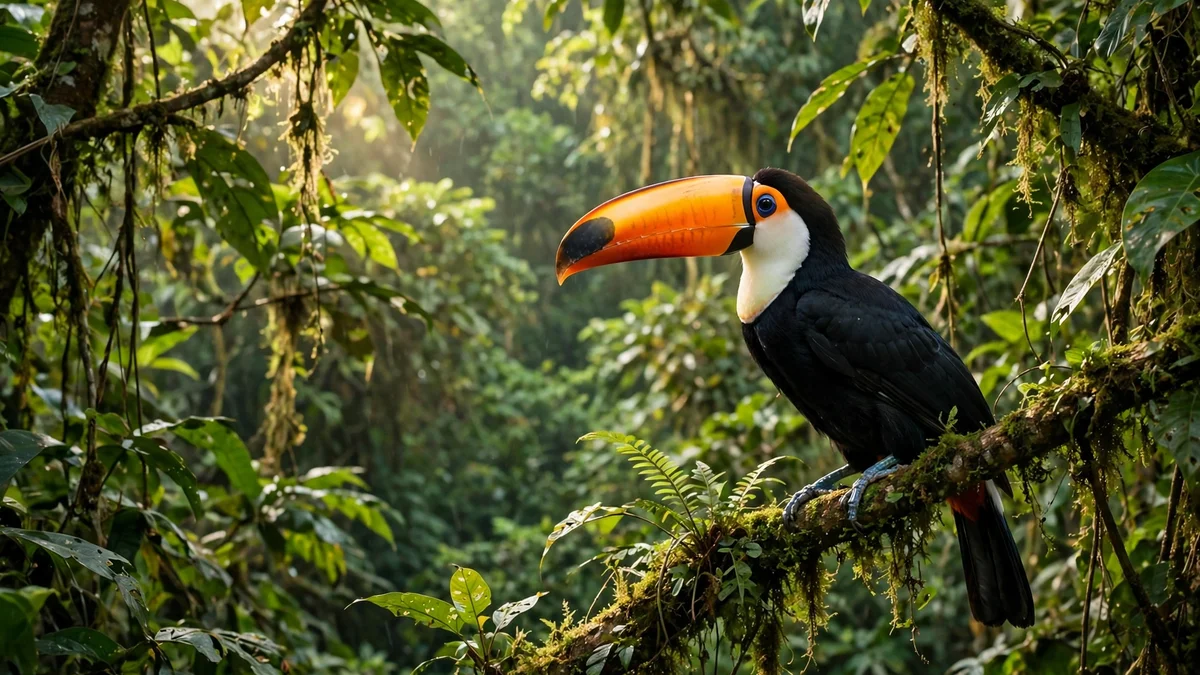
The toucan species number more than forty, big-billed fruit eaters of the American rainforest, and they are the most colourful birds of the canopy, with bills so large they look too heavy to carry, yet so light they are mostly hollow. If you are asking how many toucan species there are, the answer is more than forty: there are more than forty recognised toucan species in the world, in the family Ramphastidae, and every toucan alive today belongs to one of them.
The toucan belongs to the family Ramphastidae, along with its smaller relatives the aracaris and toucanets, and it lives only in the rainforests of Central and South America, from Mexico to Argentina. Its huge colourful bill, its black body and its bright throat make it one of the most recognisable birds on Earth.
Key takeaways
- There are more than forty toucan species, in the family Ramphastidae, including toucans, aracaris and toucanets.
- The toco toucan is the largest toucan, with a bill 19 centimetres long, about a third of its whole body.
- Toucan bills are mostly hollow, built of light honeycomb bone, and they help the bird lose heat in the tropical forest.
- Toucans eat mainly fruit, and they are among the most important seed spreaders in the rainforest.
- Most toucans are listed as Least Concern, though some aracaris are Near Threatened as the forest is cleared.
What makes a toucan a toucan
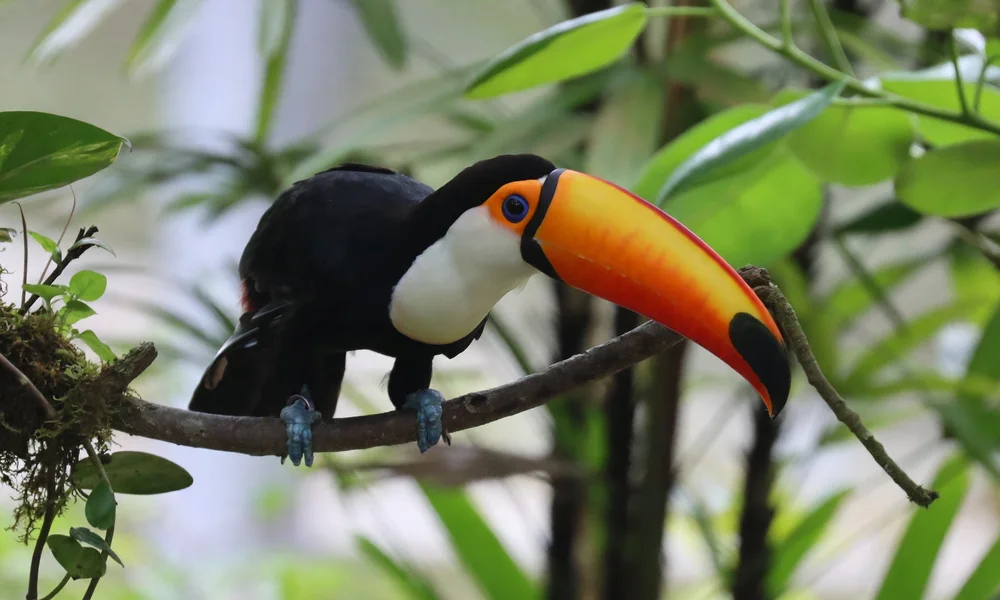
A toucan is a medium-sized rainforest bird with a huge colourful bill, a black body, a bright white or yellow throat and a long tail, and it measures roughly 40 to 65 centimetres long and usually weighs between 130 and 700 grammes, depending on the species. The toco toucan is the largest, at 55 to 65 centimetres and about 700 grammes, with an orange bill 19 centimetres long.
The bill defines the toucan: a huge bill that looks solid but is mostly hollow, built of light honeycomb bone covered in a thin keratin shell, and it weighs only about 20 grammes, less than a tenth of the bird’s weight. The bill lets the toucan reach fruit on thin branches that cannot hold its weight, and it works as a radiator, shedding heat into the air through the many blood vessels inside it. Like other South American animals, it lives in the canopy, and it hops through the trees rather than flying far, with short rounded wings that carry it in brief bursts.
The toucan species and their relatives
There are more than forty toucan species, in five genera. The genus Ramphastos holds the true toucans, with eight species including the toco, keel-billed, channel-billed, white-throated, citron-throated, green-billed, red-breasted and Choco toucans. The aracaris are smaller toucans with serrated bills, and the toucanets are the smallest of all, living in the high cloud forests of the Andes.
The toco toucan is the best-known toucan, with a white throat and an orange bill tipped in black, and it lives across central and eastern South America. The keel-billed toucan is the most colourful, with a green, orange and blue bill, and it lives from Mexico to Colombia. The channel-billed toucan has a black bill with a yellow ridge, the white-throated toucan has a white throat and a black bill, and the citron-throated toucan has a pale yellow throat. The chestnut-eared aracari is a small toucan with a dark bill and a chestnut patch behind its eye, and it lives in the same forests as the toco.
| Type | Animal | Where it lives | Best-known food | Length or Weight |
|---|---|---|---|---|
| Species | Toco toucan (Ramphastos toco) | Central and eastern South America | Fruit, eggs and insects | 55 to 65 cm, about 700 g |
| Close relative | Keel-billed toucan | Mexico to Colombia | Fruit, eggs and lizards | 42 to 55 cm, 300 to 400 g |
| Close relative | Channel-billed toucan | Amazon basin | Fruit and insects | 48 to 55 cm, 300 to 400 g |
| Close relative | White-throated toucan | Amazon basin | Fruit, eggs and small animals | 50 to 60 cm, 500 to 700 g |
| Close relative | Citron-throated toucan | Northern South America | Fruit and insects | 45 to 50 cm, 300 to 400 g |
| Close relative | Green-billed toucan | Atlantic forests of Brazil | Fruit and insects | 42 to 50 cm, 300 to 400 g |
| Close relative | Chestnut-eared aracari | Central and eastern South America | Fruit and insects | 40 to 46 cm, 200 to 300 g |
How toucans live
Toucans are creatures of the rainforest canopy. A toucan lives in small groups, hopping through the treetops by day and roosting together in tree holes by night, with up to six birds squeezing into a single hole, their tails folded flat over their backs to fit. Like other Amazon animals, it follows the fruiting seasons, moving through the forest as different trees come into fruit.
Fruit makes up most of the diet, along with eggs, nestlings, insects, lizards and small frogs, and a toucan eats by tossing fruit into the air and catching it in its throat, swallowing it whole. It spreads seeds across the forest in its droppings, making it one of the most important seed spreaders in the rainforest, and it raids the nests of other birds, using its long bill to reach eggs and chicks in holes too deep for other predators.
Breeding happens in the wet season, when fruit is plentiful, and the pair nests in a tree hole, often one left by a woodpecker, laying 2 to 4 white eggs on a bed of regurgitated seeds. Both parents incubate the eggs for about 16 to 18 days, and the chicks are born naked and blind, growing their feathers over the next six weeks. The parents feed them fruit and insects, and the young leave the nest after about 50 days. Toucans live for around 20 years in the wild.
Where toucans live
The toucan lives in the rainforests of Central and South America, from southern Mexico through Central America to Argentina, and it is most common in the Amazon basin, where the forest is tallest and the fruit is thickest. The toco toucan lives in central and eastern South America, in Brazil, Bolivia, Paraguay and Argentina, while the keel-billed toucan lives from Mexico to Colombia, and the channel-billed toucan lives in the Amazon.
Rainforest is the key requirement. A toucan needs tall trees to feed in, tree holes to nest in and fruiting trees to follow, so it moves through the forest as the fruit ripens, and when the forest is cleared the toucan has nowhere to live. The toco toucan is the most adaptable, living in open woodland and even in gardens, while the forest toucans need deep unbroken rainforest.
Most toucan species are listed as Least Concern, and their numbers are stable in the deep forest. The main pressures are the loss of rainforest to farming, ranching and logging, and the trapping of toucans for the pet trade, which takes the brightest birds from the wild. The Choco toucan, which lives only in the forests of western Colombia and Ecuador, is listed as Near Threatened as its forest shrinks.
Best seasons for toucan watching
There is no closed season, because toucans are active all year, but the best time to look for them depends on where you go. In the Amazon the best months are often the dry season, from about June to October, when the fruit is ripe and the toucans come to the riverside trees to feed. In Costa Rica the best months are often December to April, when the birds are breeding and easy to find near their nests.
Staying safe around toucans
A toucan is a wild bird with a large bill and sharp claws, and it can hurt a person, though toucans are shy and almost never aggressive. Keep your distance, never approach a toucan nest, and never try to catch a toucan, because a frightened bird may bite and the chicks may fall from the nest. If you see toucans feeding, stay on the path and watch with binoculars, because toucans that are disturbed may abandon their fruiting tree.
Toucan watching checklist
A little preparation turns a rainforest visit into a real chance of seeing a toucan, so pack for heat, humidity and long quiet hours.
- Binoculars with good low-light performance, for picking a bright bill out of the green canopy.
- A camera with a long lens, because toucans should always be watched from a distance.
- Sun cream and a hat, because the best watching is in the bright midday sun.
- Water and snacks for long days, because the best sightings come after hours of searching.
- A field guide to rainforest birds, for telling a toco toucan from a keel-billed at a glance.
- A plan to be out in the dry season, when the fruit is ripe and the toucans gather.
- Patience and silence, because toucans are shy birds and a noisy group will send them away.
Frequently asked questions
How many toucan species are there?
There are more than forty toucan species, in the family Ramphastidae, including toucans, aracaris and toucanets. The genus Ramphastos holds eight true toucan species, and the toco toucan is the largest of them all.
Why do toucans have such big bills?
Toucans have big bills because the long bill lets them reach fruit on thin branches that cannot hold their weight, and because the bill works as a radiator, shedding heat into the air through the blood vessels inside it. The bill is mostly hollow, built of light honeycomb bone, and it weighs only about 20 grammes.
Do toucans eat other birds’ eggs?
Yes. Toucans eat mainly fruit, but they also raid the nests of other birds, using their long bills to reach eggs and chicks in tree holes. They eat insects, lizards and small frogs too, and they are among the most important seed spreaders in the rainforest.
Can you keep a toucan as a pet?
No. A toucan is a wild bird that needs rainforest, eats fruit by the kilogramme, and is fully protected by law in every country where it lives. Toucans in zoos need huge aviaries with trees and fruiting branches, and they are not pets.
How is this guide different from the flamingo species guide?
This guide covers more than forty toucan species, big-billed fruit eaters that live in the rainforest canopy of Central and South America, while our flamingo species guide covers six flamingo species, pink wading birds that filter algae from salty lagoons with their heads upside down. The toucan lives in trees and eats fruit, and the flamingo stands in shallow water and eats algae.
Are toucans endangered?
Most toucans are listed as Least Concern, so they are not classed as endangered. The Choco toucan is listed as Near Threatened, and the loss of rainforest and trapping for the pet trade are the main threats.
Conclusion
The toucan species show how much colour one bird can hold: more than forty species of big-billed fruit eater, with bills like lanterns, throats like flags, and lives spent hopping through the canopy of the American rainforest. They are the most recognisable birds of the canopy, and they have lived in the forests of Central and South America for millions of years.
If you go looking for one, go in the dry season to the Amazon or the forests of Costa Rica, go quietly, and go with patience. Watch a toco toucan tossing fruit into the air and you will understand why it has earned its place as the clown of the canopy, and why keeping its rainforest matters most.