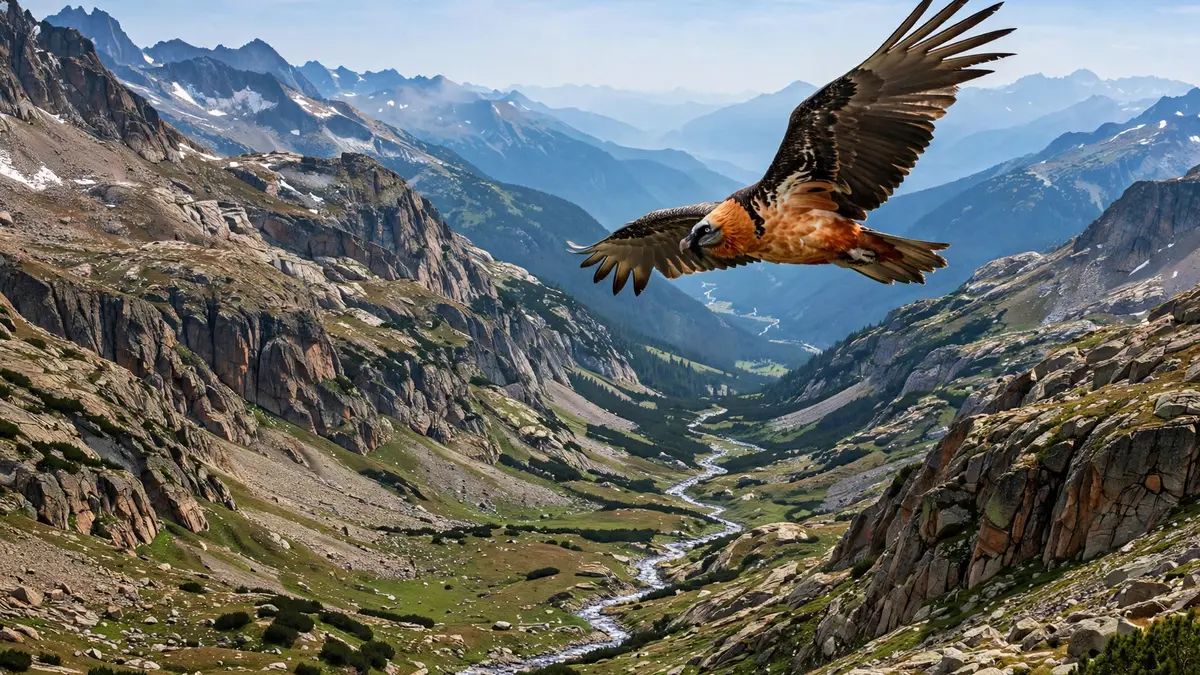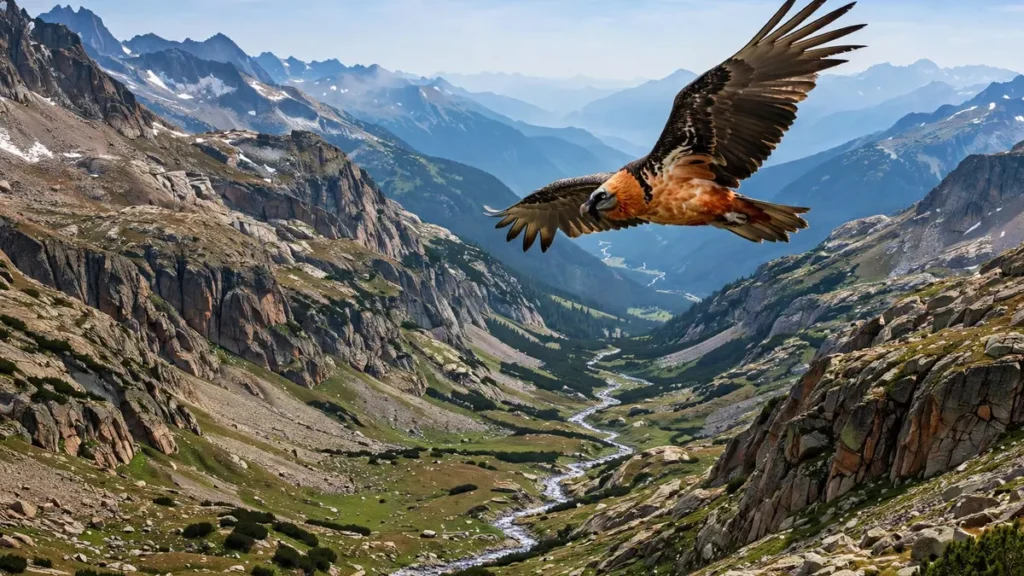
The bearded vulture species number one, a single species called Gypaetus barbatus, and it is the bone-eating vulture of the high mountains, the only bird in the world that lives mostly on bones. If you are asking how many bearded vulture species there are, the answer is one: there is one recognised bearded vulture species in the world, and every bearded vulture alive today belongs to it.
The bearded vulture lives in the high mountains of Europe, Africa and Asia, from the Alps and the Pyrenees to the Himalayas and the Ethiopian highlands, and it is also called the lammergeier and the ossifrage, which means bone breaker. Its rusty plumage, its black beard, its long wedge-shaped tail and its habit of dropping bones onto rocks make it one of the most remarkable birds in the world.
Key takeaways
- There is one bearded vulture species, Gypaetus barbatus, also called the lammergeier.
- Bearded vultures measure 94 to 125 centimetres long, with a wingspan of 2.3 to 2.8 metres, and weigh 4.5 to 7.8 kilogrammes.
- Bearded vultures eat mostly bones, 70 to 90 per cent of their diet, dropping large bones onto rocks to break them.
- Bearded vultures rub iron-rich mud into their feathers, which gives them their rusty colour.
- Bearded vultures are listed as Near Threatened, and they have been brought back to the Alps by reintroduction.
What makes a bearded vulture a bearded vulture
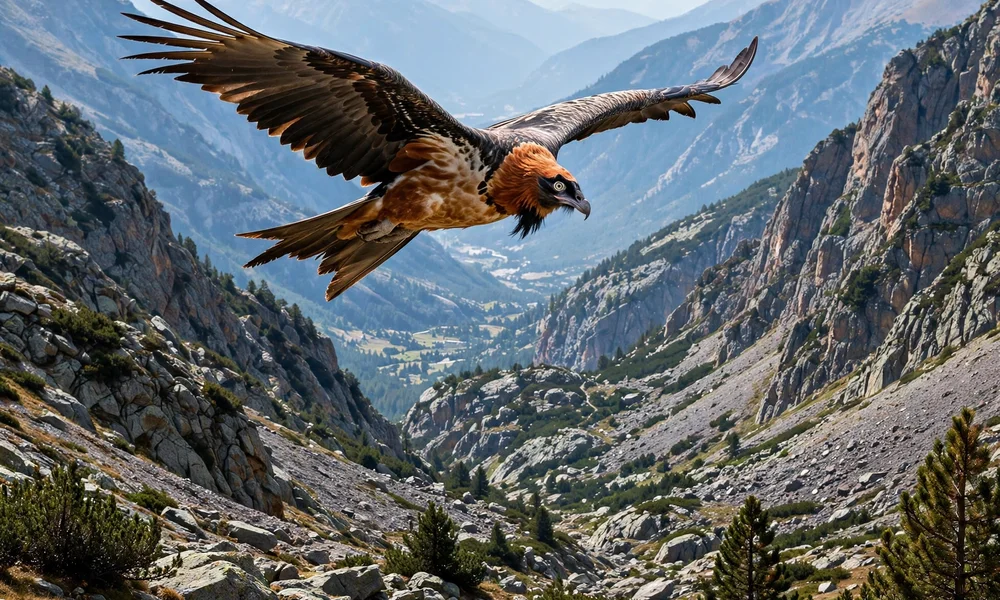
A bearded vulture is a very large bird of prey with a long wedge-shaped tail, long narrow wings, a black beard of bristles under its beak, and a rusty orange head and breast, and it measures 94 to 125 centimetres long, with a wingspan of 2.31 to 2.83 metres, and usually weighs between 4.5 and 7.8 kilogrammes. The rusty colour is not natural: the bird rubs iron-rich mud into its feathers, and the colour shows how healthy it is.
The name lammergeier comes from the German for lamb vulture, from the old belief that it attacked lambs, though it almost never kills live prey. Like other golden eagles, the bearded vulture is a bird of the high mountains, but it is a vulture, not an eagle, and it eats bones, not live prey, and it has a stomach acid of about pH 1 that can dissolve solid bone in a day.
The bearded vulture species and their relatives
There is one bearded vulture species. It belongs to the genus Gypaetus, of which it is the only member, and it is an old and unusual vulture, more closely related to the Egyptian vulture than to the big griffon vultures. The bearded vulture has two subspecies, the northern bird of Europe and Asia and the southern bird of Africa, which differ slightly in size.
The griffon vulture is the bearded vulture’s most famous relative, a large pale vulture of the mountains that eats soft meat from carcasses, while the Egyptian vulture is a small white vulture that uses stones as tools. The Andean condor is a huge vulture of the South American mountains, the cinereous vulture is a dark vulture of Europe and Asia, and the lappet-faced vulture is a large vulture of Africa with a bare pink head.
| Type | Animal | Where it lives | Best-known food | Length or Weight |
|---|---|---|---|---|
| Species | Bearded vulture (Gypaetus barbatus) | High mountains of Europe, Africa and Asia | Bones and bone marrow | 94 to 125 cm long, 4.5 to 7.8 kg |
| Close relative | Griffon vulture | Mountains of Europe, Africa and Asia | Carrion and soft meat | 95 to 110 cm long, 6.5 to 11 kg |
| Close relative | Egyptian vulture | Southern Europe, Africa and Asia | Carrion, eggs and small animals | 60 to 70 cm long, 1.6 to 2.4 kg |
| Close relative | Andean condor | Andes mountains of South America | Carrion and large mammals | 100 to 130 cm long, 11 to 15 kg |
| Close relative | Cinereous vulture | Mountains of Europe and Asia | Carrion and large mammals | 100 to 120 cm long, 7 to 12.5 kg |
| Close relative | Lappet-faced vulture | Africa and the Middle East | Carrion and tough skin | 95 to 115 cm long, 5.5 to 9 kg |
| Close relative | White-backed vulture | African savannas | Carrion and soft meat | 90 to 95 cm long, 5.5 to 7 kg |
How bearded vultures live
Bearded vultures are creatures of the high mountains. A bearded vulture lives alone or in pairs in steep rocky country, and it patrols huge territories, soaring for hours on the mountain winds without a single wingbeat. Like other Andean condors, the bearded vulture is a bird of the high peaks, but it is a bone eater, not a meat eater, and it waits until the other vultures have finished with a carcass, then takes the bones that are left.
Bones make up 70 to 90 per cent of the diet, along with the odd tortoise or small animal, and a bearded vulture eats by carrying a large bone into the air and dropping it onto rocks below, smashing it into pieces small enough to swallow. It feeds mostly in the morning, when the mountain winds are rising, and it can swallow bones up to 20 centimetres long, digesting them in about a day in its fiercely acid stomach.
Breeding is a slow affair, and the pair builds a huge nest of sticks on a cliff ledge, and the female lays one or two eggs in winter. She sits on the eggs for about 55 to 60 days, and usually only one chick survives, because the older chick often kills its younger sibling. The parents feed the chick for about four months, and the young bird then wanders widely for several years before it finds a mate and a territory of its own. Bearded vultures live for about 20 to 25 years in the wild, and for more than 40 years in captivity.
Where bearded vultures live
The bearded vulture lives in the high mountains of Europe, Africa and Asia, from the Alps, the Pyrenees and the Caucasus to the Himalayas, the mountains of Central Asia and the Ethiopian highlands, and it is most common where there are steep cliffs, strong winds and wild goats and sheep to feed on. It is a bird of remote places, and it is rarely seen near towns.
Steep rocky mountains are the key requirement. A bearded vulture needs cliffs for its nest, strong winds for soaring, and rocky slopes where it can drop bones to break them, so it returns to the same territories year after year, generation after generation, and when the wild goats disappear the vultures disappear too, because there are no bones left to eat.
Bearded vultures are listed as Near Threatened, and their numbers have fallen in many places, though they have been brought back to the Alps by reintroduction, with birds released in France, Switzerland, Austria and Italy. The main pressures are poisoning, the loss of wild prey, and collisions with power lines, though bearded vultures are protected by law and the reintroduction has become one of the great success stories of European conservation.
Best seasons for bearded vulture watching
There is no closed season, because bearded vultures are active all year, but the best time to look for them depends on where you go. In the Alps the best months are often May to September, when the birds are feeding their chicks and soaring on the summer thermals, and the mountain passes are open. In the Himalayas the best months are often October to April, when the skies are clear and the birds are at their most visible.
Staying safe around bearded vultures
A bearded vulture is a wild bird with a hooked beak and strong talons, and it can injure a person who comes too close to its nest, though bearded vultures almost never attack people. Keep your distance, never touch a nest, and never feed a vulture, because a bird that is fed by people may lose its fear and become a danger. If you see bearded vultures while walking in the mountains, stay calm, stay still, and let them come to you, because vultures that are chased may abandon their nests for good.
Bearded vulture watching checklist
A little preparation turns a mountain visit into a real chance of seeing a bearded vulture, so pack for cold, wind and long quiet hours.
- Binoculars, because the birds soar high and are best watched from a distance.
- A camera with a zoom lens, for the rusty plumage and the wedge-shaped tail without getting close.
- A telescope, for the cliff nests, because the birds nest on ledges far above the valley.
- A booked mountain guide with a guide who knows the bearded vulture territories and the safe routes.
- A plan to be out in the morning, when the vultures are most active and soaring.
- Patience and silence, because vultures are shy birds and a noisy group will send them away.
- A field guide to vultures, for telling a bearded vulture from a griffon vulture at a glance.
Frequently asked questions
How many bearded vulture species are there?
There is one bearded vulture species, Gypaetus barbatus. It has two subspecies, the northern bird of Europe and Asia and the southern bird of Africa, but scientists now recognise it as a single species, and it is the only member of its genus.
Why do bearded vultures eat bones?
Bearded vultures eat bones because bones are rich in fat and protein, and few other animals can eat them. Their stomach acid is about pH 1, strong enough to dissolve solid bone in about a day, and by eating bones they avoid competing with other vultures for meat.
Why are bearded vultures rusty orange?
Bearded vultures are rusty orange because they rub iron-rich mud into their head, breast and leg feathers. The colour is a signal of health, and the brightest birds are the most successful at breeding, though the feathers underneath are actually white.
Do bearded vultures attack lambs?
Almost never. The name lammergeier means lamb vulture, from the old belief that they attacked lambs, but bearded vultures eat bones and carrion, and they only rarely kill live prey, usually tortoises, which they drop onto rocks to crack open.
How is this guide different from the bird of paradise species guide?
This guide covers the single bearded vulture species, a bone-eating vulture of the high mountains, while our bird of paradise species guide covers more than forty bird of paradise species, rainforest birds of New Guinea whose males dance with bright plumes. The bearded vulture has a wingspan of 2.3 to 2.8 metres and eats bones, and the greater bird of paradise is up to 43 centimetres long and eats fruit.
Are bearded vultures endangered?
Bearded vultures are listed as Near Threatened, not endangered, though they have vanished from many mountains. Poisoning and the loss of wild prey are the main threats, but the reintroduction to the Alps has brought them back to mountains where they had been extinct for a century.
Conclusion
The bearded vulture species shows how much strangeness one bird can hold: a single species of bone-eating vulture, with rusty plumage, a black beard, and a life spent between the high cliffs and the open mountain sky.
If you go looking for one, go in the summer to the Alps or the Pyrenees, go quietly, and go with patience. Watch a bearded vulture drop a bone onto the rocks below and you will understand why it has earned its place as the most remarkable vulture in the mountains, and why keeping its peaks wild matters most.