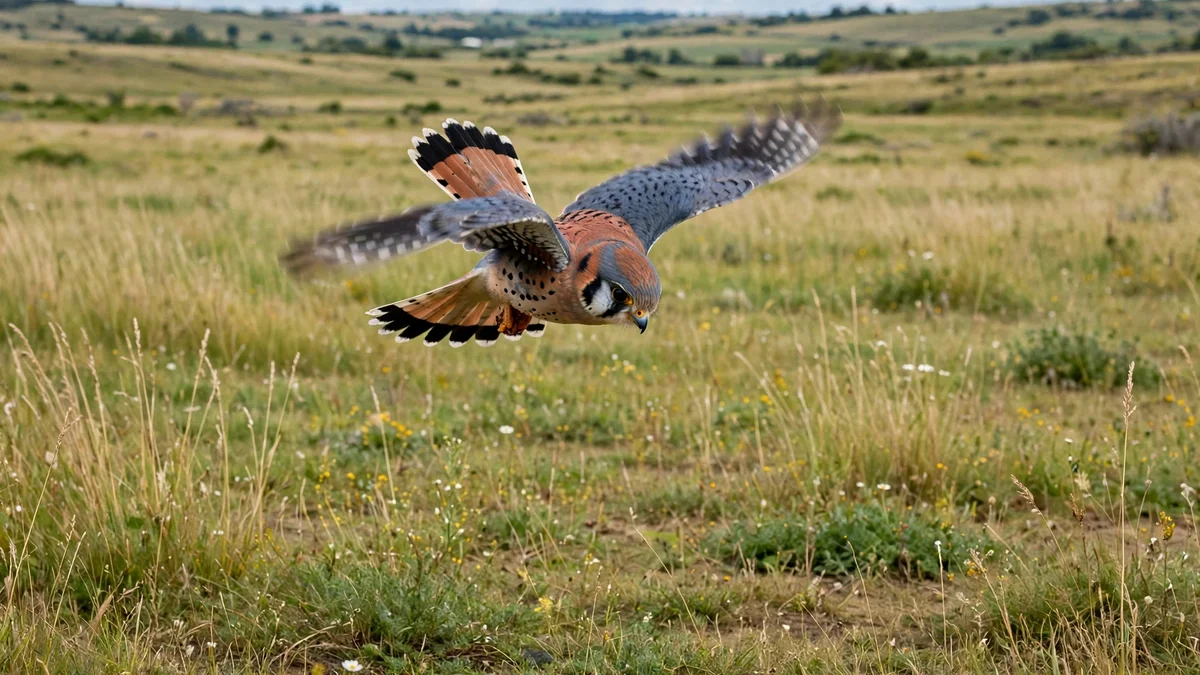
The American kestrel species number one, a single species called Falco sparverius, and it is the smallest falcon in North America, a robin-sized hunter of open fields. If you are asking how many American kestrel species there are, the answer is one: there is one recognised American kestrel species in the world, and every American kestrel alive today belongs to it.
The American kestrel lives across North and South America, from Alaska to Argentina, in open fields, farmland, deserts and towns, and it is often seen perched on wires and fence posts, or hovering in the air above a field. Its rusty back, its blue-grey wings, its black face pattern and its habit of hovering make it one of the most recognisable small birds of prey in the world.
Key takeaways
- There is one American kestrel species, Falco sparverius, the smallest falcon in North America.
- American kestrels measure 22 to 31 centimetres long, with a wingspan of 51 to 61 centimetres, and weigh 80 to 165 grammes.
- American kestrels hunt by hovering in the air, then diving onto insects, mice and small birds.
- American kestrels nest in tree holes and nest boxes, laying four or five eggs.
- American kestrel numbers have fallen by about half since 1966, and the species is listed as Least Concern.
What makes an American kestrel an American kestrel
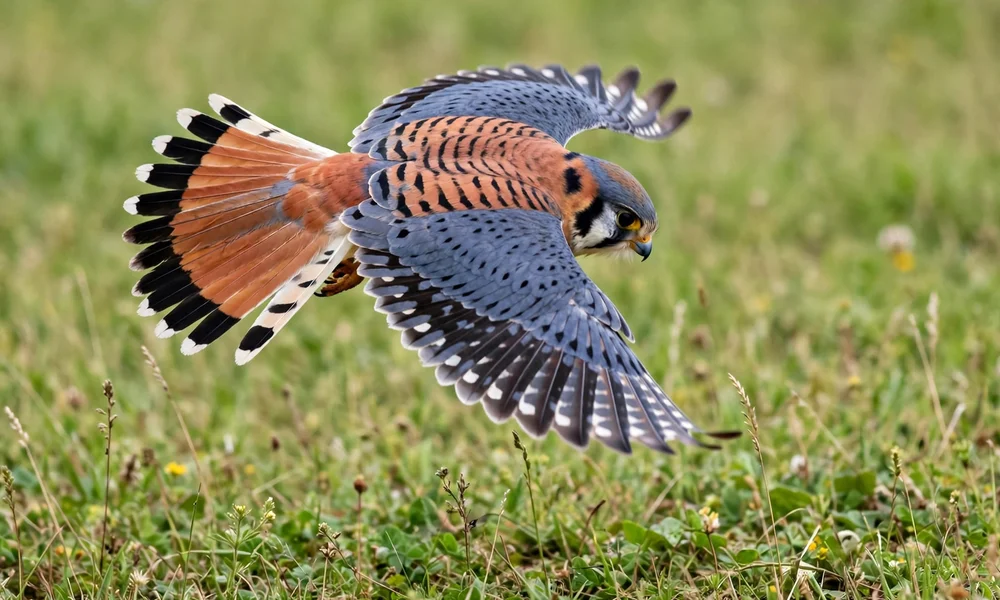
An American kestrel is a small falcon with a rusty-orange back and tail, blue-grey wings in the male and rusty wings in the female, and a bold black and white face pattern with two black stripes down each cheek, and it measures 22 to 31 centimetres long, with a wingspan of 51 to 61 centimetres, and usually weighs between 80 and 165 grammes. The male is smaller and more colourful than the female, and the young birds look like the female.
The scientific name Falco sparverius means falcon of the sparrows, though the kestrel eats far more insects and mice than sparrows. Like other peregrine falcons, the American kestrel is a falcon with long pointed wings, but it is far smaller than the peregrine, and it hunts by hovering over fields, not by diving at great speed.
The American kestrel species and their relatives
There is one American kestrel species. It belongs to the genus Falco, the true falcons, and it has many subspecies spread across the Americas, from the pale birds of the north to the dark birds of the Caribbean, though all of them are the same species. The American kestrel is the most widespread falcon in North America, and it is also one of the most common birds of prey on the continent.
The peregrine falcon is the American kestrel’s most famous relative, a large falcon that dives at more than 300 kilometres an hour, while the merlin is a small dark falcon of the northern forests that chases small birds in fast low flight. The Eurasian kestrel is the American kestrel’s Old World cousin, a bird of European fields, and the aplomado falcon is a long-tailed falcon of the deserts and grasslands of the Americas.
| Type | Animal | Where it lives | Best-known food | Length or Weight |
|---|---|---|---|---|
| Species | American kestrel (Falco sparverius) | Open country across the Americas | Insects, mice and small birds | 22 to 31 cm long, 80 to 165 g |
| Close relative | Peregrine falcon | Worldwide on cliffs and in cities | Birds caught in flight | 34 to 58 cm long, 330 to 1,500 g |
| Close relative | Merlin | Northern forests and coasts | Small birds and insects | 24 to 32 cm long, 125 to 300 g |
| Close relative | Eurasian kestrel | Europe, Asia and Africa | Voles, mice and insects | 32 to 39 cm long, 136 to 300 g |
| Close relative | Aplomado falcon | Deserts and grasslands of the Americas | Birds, insects and bats | 36 to 46 cm long, 200 to 400 g |
| Close relative | Prairie falcon | Western North American deserts | Ground squirrels and birds | 37 to 47 cm long, 400 to 800 g |
| Close relative | Red-footed falcon | Eastern Europe and Asia | Insects and small birds | 28 to 34 cm long, 130 to 200 g |
How American kestrels live
American kestrels are creatures of the open field. An American kestrel lives alone or in pairs in spring and summer, and in loose groups in winter, and it is often seen perched on a wire, a fence post or a bare branch, watching the ground below. Like other golden eagles, the American kestrel is a bird of prey with sharp talons and a hooked beak, but it is a falcon, not an eagle, and it is barely bigger than a robin, and it hunts insects and mice, not rabbits and deer.
Insects make up much of the diet in summer, along with grasshoppers, dragonflies and beetles, and voles, mice and small birds in winter, and an American kestrel hunts by hovering in the air, beating its wings fast while holding its head still, then dropping onto its prey in a short dive. It feeds mostly in the morning and evening, when the insects are active and the mice are moving, and it stores spare food in grass clumps and tree holes for later.
Breeding is a spring affair, and the pair nests in a tree hole, an old woodpecker hole, a cliff crevice or a nest box, and the female lays four or five white eggs with brown spots. She sits on the eggs for about 28 to 31 days, and both parents feed the chicks, which leave the nest after about a month. A pair raises one brood a year, and the young birds wander widely in their first autumn. American kestrels live for about 1 to 2 years on average in the wild, though some have lived for more than 11 years.
Where American kestrels live
The American kestrel lives across North and South America, from Alaska and Canada to Argentina, and in open fields, farmland, deserts, grasslands and towns, and it is most common where there are open fields to hunt in and tree holes to nest in. It is the most widespread falcon in North America, and it is one of the most familiar birds of prey on the continent.
Open country with perches is the key requirement. An American kestrel needs a wire, a fence post or a bare branch where it can sit and watch, with open ground below for hunting, so it follows the seasons as they change, and when the northern fields freeze in winter the birds move south to where the insects and mice are still active.
American kestrels are listed as Least Concern, but their numbers have fallen by about half since 1966, at a rate of about 1.4 per cent a year, and scientists still do not know the exact cause. The main pressures are the loss of nesting holes, the use of pesticides, the loss of grassland, and more Cooper’s hawks hunting the young birds, though American kestrels are protected by law and nest box programmes have helped them in many places.
Best seasons for American kestrel watching
There is no closed season, because American kestrels are active all year, but the best time to look for them depends on where you go. In the north the best months are often March to August, when the birds are nesting in boxes and hunting over the fields, and the young birds are learning to fly. In the south the best months are often October to March, when the winter birds arrive from the north and gather on wires and fence posts.
Staying safe around American kestrels
An American kestrel is a wild bird with sharp talons and a hooked beak, and it can scratch a person who comes too close to its nest, though American kestrels almost never attack people. Keep your distance, never touch a nest, and never take a chick from the ground, because a young kestrel that has left the nest is still being fed by its parents nearby. If you see American kestrels while walking in a field, stay calm, stay still, and let them come to you, because kestrels that are chased may abandon their nests for good.
American kestrel watching checklist
A little preparation turns a country drive into a real chance of seeing an American kestrel, so pack for sun, wind and long quiet hours.
- Binoculars, because the birds are small and best watched from a distance without disturbing them.
- A camera with a zoom lens, for the rusty back and the black face stripes without getting close.
- A notebook, for the perch sites, because kestrels return to the same wires day after day.
- A road through open farmland, where the kestrels hunt from wires and fence posts.
- A plan to be out in the morning or evening, when the kestrels are most active and hunting.
- Patience and silence, because kestrels are shy birds and a noisy group will send them away.
- A field guide to falcons, for telling an American kestrel from a merlin at a glance.
Frequently asked questions
How many American kestrel species are there?
There is one American kestrel species, Falco sparverius. It has many subspecies spread across the Americas, but scientists now recognise it as a single species, and it is the smallest and most widespread falcon in North America.
Why do American kestrels hover?
American kestrels hover to hunt, holding still in the air while they scan the ground below for insects and mice. They beat their wings fast and hold their heads steady, and when they spot prey they drop onto it in a short dive, a style called kiting.
What do American kestrels eat?
American kestrels eat insects, voles, mice, lizards and small birds, and they change their diet with the seasons. In summer they eat mostly grasshoppers, dragonflies and beetles, and in winter they eat mostly voles and mice.
Why are American kestrels declining?
Scientists do not know for certain, but the loss of nesting holes, the use of pesticides, the loss of grassland and more Cooper’s hawks are all likely causes. American kestrel numbers have fallen by about half since 1966, and nest box programmes are one of the best ways to help them.
How is this guide different from the bearded vulture species guide?
This guide covers the single American kestrel species, a small falcon that hovers over open fields and eats insects and mice, while our bearded vulture species guide covers the single bearded vulture species, a huge vulture of the high mountains that eats bones. The American kestrel measures 22 to 31 centimetres and weighs 80 to 165 grammes, and the bearded vulture has a wingspan of 2.3 to 2.8 metres and eats bones.
Are American kestrels endangered?
No. American kestrels are listed as Least Concern, though their numbers have fallen by about half since 1966, and they are listed as endangered or threatened in four north-eastern states. The loss of nesting holes and grassland are the main threats to watch.
Conclusion
The American kestrel species shows how much spirit one small falcon can hold: a single species of hovering hunter, with a rusty back, a black face pattern, and a life spent between the fence post and the open field.
If you go looking for one, go in the spring to open farmland, go quietly, and go with patience. Watch an American kestrel hover over a field and you will understand why it has earned its place as the most loved small falcon in the Americas, and why keeping its fields open matters most.