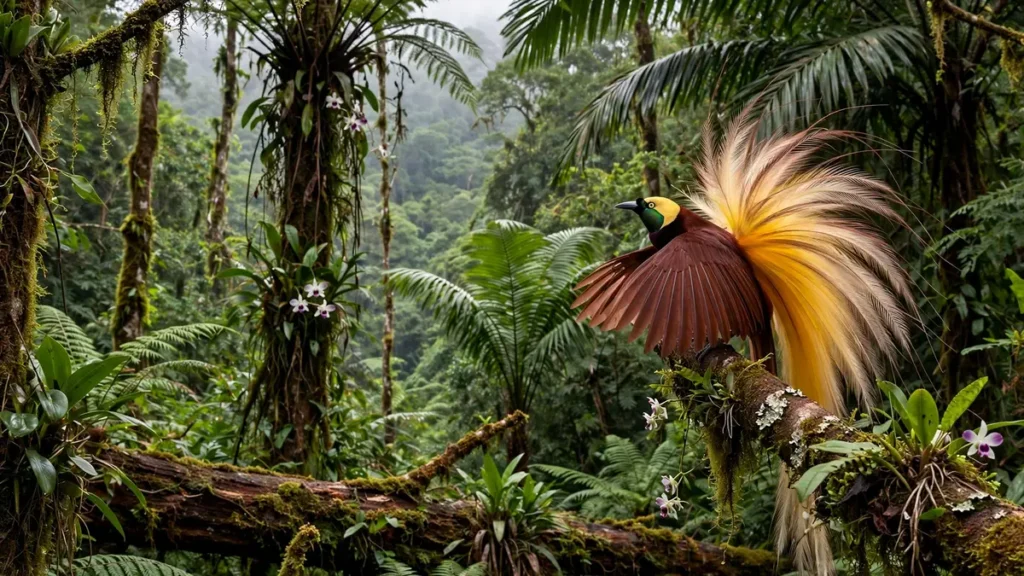
The bird of paradise species number more than forty, all in the family Paradisaeidae, and they are the dancing birds of New Guinea, some of the most beautiful birds in the world. If you are asking how many bird of paradise species there are, the answer is more than forty: there are more than forty recognised bird of paradise species in the world, in fifteen genera, and every bird of paradise alive today belongs to one of them.
The bird of paradise lives in the rainforests of New Guinea and eastern Australia, in the canopy of tall trees, and the males are famous for their bright plumes, their iridescent colours and their elaborate courtship dances. Their feathers, their dances and their forest homes make them one of the most loved bird families in the world.
Key takeaways
- There are more than forty bird of paradise species, in the family Paradisaeidae, in fifteen genera.
- Bird of paradise males are brightly plumed and dance to win a mate, while the females are plain brown.
- Bird of paradise species eat mostly fruit, along with insects, frogs and small lizards.
- Bird of paradise species live in the rainforests of New Guinea and eastern Australia, mostly in the canopy.
- Several bird of paradise species are listed as Vulnerable or Near Threatened, and their forests are shrinking.
What makes a bird of paradise a bird of paradise
A bird of paradise is a crow-sized bird with a strong beak, strong feet, and, in the male, bright plumes of extraordinary shape and colour, and it measures about 15 to 110 centimetres long, depending on the species, and usually weighs between 50 and 450 grammes. The male greater bird of paradise is the largest, at up to 43 centimetres long with plumes that trail far behind, while the king bird of paradise is the smallest, at about 16 centimetres long.
The plumes define the bird of paradise: long flowing feathers, iridescent breast shields, wire-like tail feathers and fan-like head plumes that the male shows off in a dance. Like other scarlet macaws, the bird of paradise is a bird of bright colours and loud calls, but it is a passerine, not a parrot, and it is most closely related to crows and jays, not to parrots.
The bird of paradise species and their relatives
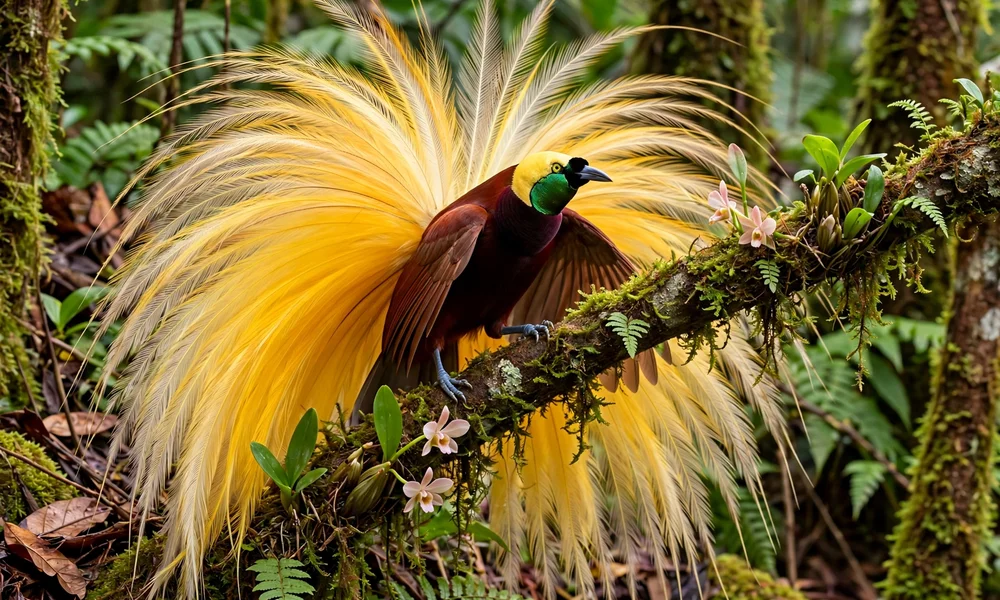
There are more than forty bird of paradise species. The greater bird of paradise lives in the lowland forests of New Guinea, with yellow and maroon plumes, and it is the species that first reached Europe in the sixteenth century, when traders sold its skins without feet or wings. The Wilson’s bird of paradise lives on the islands of Waigeo and Batanta, with a bare blue crown and a green breast shield, and the king bird of paradise lives across New Guinea, a small red bird with two long wire-like tail feathers tipped with green discs.
The superb bird of paradise is the bird of paradise’s most famous relative, a black bird with a blue-green breast shield that opens like a fan in its dance, while the twelve-wired bird of paradise is a black and yellow bird with twelve long wire-like plumes. The magnificent riflebird is a bird of the Australian rainforest with a velvet black body and a green throat, and the sicklebill is a bird with a long curved beak for probing flowers.
| Type | Animal | Where it lives | Best-known food | Length or Weight |
|---|---|---|---|---|
| Species | Greater bird of paradise (Paradisaea apoda) | Lowland forests of New Guinea | Fruit and insects | Up to 43 cm long, 170 to 250 g |
| Close relative | King bird of paradise | New Guinea lowland forests | Fruit and insects | About 16 cm long, 45 to 64 g |
| Close relative | Wilson’s bird of paradise | Waigeo and Batanta islands | Fruit and insects | About 16 cm long, 40 to 60 g |
| Close relative | Superb bird of paradise | New Guinea mountain forests | Fruit and insects | About 26 cm long, 60 to 105 g |
| Close relative | Twelve-wired bird of paradise | New Guinea lowland forests | Fruit, insects and frogs | About 33 cm long, 100 to 200 g |
| Close relative | Magnificent riflebird | Rainforests of New Guinea and Australia | Fruit and insects | About 30 cm long, 100 to 200 g |
| Close relative | Black sicklebill | New Guinea mountain forests | Fruit and nectar | Up to 110 cm long, 160 to 250 g |
How birds of paradise live
Birds of paradise are creatures of the rainforest canopy. A bird of paradise lives alone or in small groups in the high branches, and the males gather at display sites called leks, where each male dances on his own perch to win a female. Like other toucans, the bird of paradise is a fruit eater of the forest canopy, but it is a passerine, not a toucan, and it dances to win a mate, not to defend a nest.
Fruit makes up most of the diet, along with insects, frogs and small lizards, and a bird of paradise eats by plucking figs and berries from the branches, and by snatching insects from leaves and bark. It feeds mostly in the morning, when the fruit is fresh and the insects are active, and it can eat dozens of figs in a single day, spreading the seeds through the forest in its droppings.
Breeding is a one-sided affair, and the male dances at his lek, fanning his plumes, puffing his breast shield and shaking his wires, while the female watches from above and chooses the best dancer. She then builds a cup nest alone, lays one or two eggs, and raises the chicks without any help from the male. The chicks leave the nest after about three weeks, and the young males take several years to grow their adult plumes. Birds of paradise live for about 5 to 8 years in the wild, though some have lived for more than 20 years in captivity.
Where birds of paradise live
The bird of paradise lives in the rainforests of New Guinea, from the lowlands to the mountains, and in the rainforests of eastern Australia, and it is most common where the forest is tall and unbroken, with fruiting trees and clear display perches. New Guinea holds almost all of the species, and the island is the centre of the family.
Tall unbroken rainforest is the key requirement. A bird of paradise needs a canopy of fruiting trees, with clear branches for its display and quiet forest for its nest, so it returns to the same leks year after year, generation after generation, and when the forest is cut down the birds disappear, because they cannot live in open fields or gardens.
Several bird of paradise species are listed as Vulnerable or Near Threatened, and their numbers have fallen where the forests have been cut for logging and farming. The main pressures are the loss of rainforest, the hunting of males for their plumes, and the pet trade, though birds of paradise are protected by law and most of their forests lie in remote mountains.
Best seasons for bird of paradise watching
There is no closed season, because birds of paradise are active all year, but the best time to look for them depends on where you go. In New Guinea the best months are often June to October, when the dry season makes the forest trails passable and the males are dancing at their leks. In Australia the best months are often September to December, when the riflebirds are displaying in the rainforest.
Staying safe around birds of paradise
A bird of paradise is a wild bird with a strong beak and sharp claws, and it can peck a person who comes too close to its nest, though birds of paradise almost never attack people. Keep your distance, never touch a nest, and never play recordings to lure a male, because a bird that is disturbed may leave its lek and its display may fail. If you see birds of paradise while walking in a rainforest, stay calm, stay still, and let them come to you, because birds that are chased may abandon their leks for good.
Bird of paradise watching checklist
A little preparation turns a rainforest visit into a real chance of seeing a bird of paradise, so pack for heat, rain and long quiet hours.
- Binoculars, because the birds live high in the canopy and are best watched from a distance.
- A camera with a zoom lens, for the plumes and the dance without getting close.
- A local guide, because the leks are hidden and the birds are hard to find without one.
- A booked forest lodge with a guide who knows the bird of paradise leks and the safe routes.
- A plan to be out at dawn, when the males are most active and dancing.
- Patience and silence, because birds of paradise are shy birds and a noisy group will send them away.
- A field guide to birds of paradise, for telling a greater from a king at a glance.
Frequently asked questions
How many bird of paradise species are there?
There are more than forty bird of paradise species, in fifteen genera of the family Paradisaeidae. The exact count changes as scientists split and join species, but most lists recognise between 42 and 45 species, and New Guinea holds almost all of them.
Why do male birds of paradise dance?
Male birds of paradise dance to win a mate, showing off their plumes, their colours and their skill. The female watches the dance and chooses the best male, and the dance is so important that the males spend hours each day practising it, even when no female is watching.
What do birds of paradise eat?
Birds of paradise eat mostly fruit, especially figs, along with insects, frogs and small lizards. They pluck fruit from the branches and snatch insects from leaves, and they spread the seeds of the forest in their droppings.
Are birds of paradise related to crows?
Yes. Birds of paradise are passerines in the same broad group as crows, jays and magpies, and their closest relatives are the manucodes, plain black birds of New Guinea. The plumes are a recent invention, and the family is still close to the crows.
How is this guide different from the barn swallow species guide?
This guide covers more than forty bird of paradise species, rainforest birds of New Guinea whose males dance with bright plumes, while our barn swallow species guide covers the single barn swallow species, a fork-tailed swallow that lives in barns and catches insects on the wing. The greater bird of paradise is up to 43 centimetres long and dances in the canopy, and the barn swallow measures 17 to 19 centimetres and flies all day.
Are birds of paradise endangered?
Some are. Several bird of paradise species are listed as Vulnerable or Near Threatened, though most are still common in remote forests. The loss of rainforest and the hunting of males for their plumes are the main threats to watch.
Conclusion
The bird of paradise species show how much beauty one bird family can hold: more than forty species of dancing bird, with plumes like silk, colours like jewels, and lives spent in the high rainforest of New Guinea.
If you go looking for one, go in the dry season to New Guinea, go quietly, and go with patience. Watch a greater bird of paradise dance on its perch and you will understand why it has earned its place as the most loved bird of the rainforest, and why keeping its forests standing matters most.