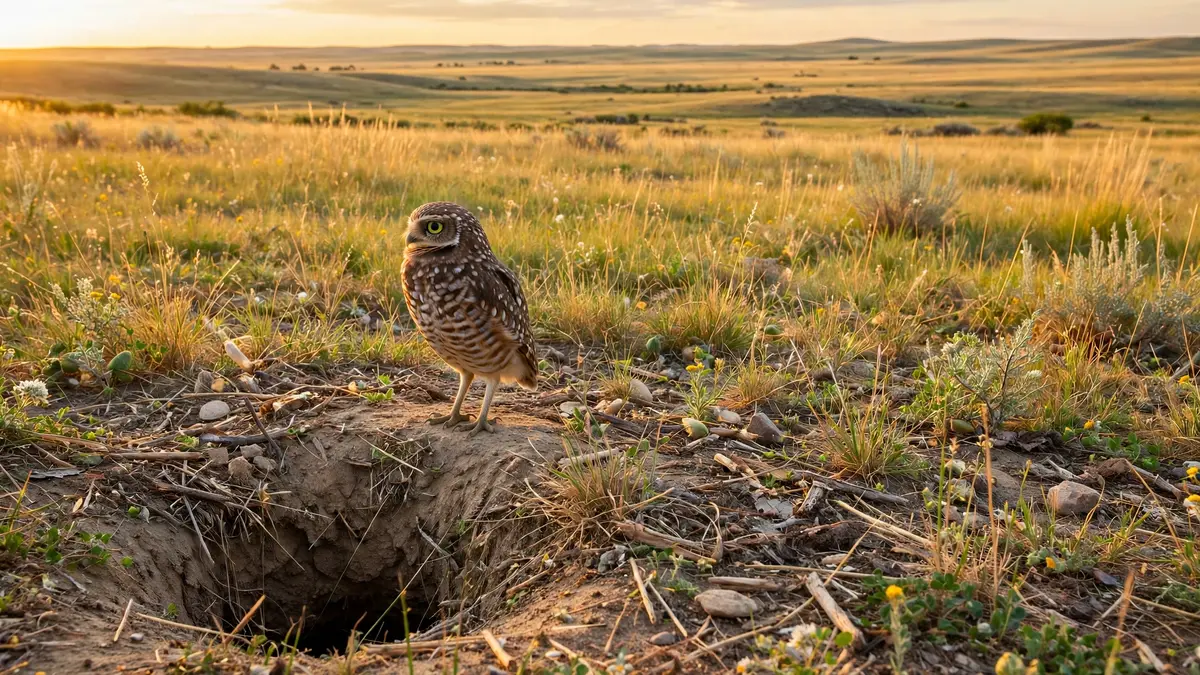
The burrowing owl species number one, a single species called Athene cunicularia, and it is the small long-legged owl that lives underground in the open grasslands, deserts and prairies of North and South America. If you are asking how many burrowing owl species there are, the answer is one: there is one recognised burrowing owl species in the world, and every burrowing owl alive today belongs to it.
The burrowing owl is the owl that moved downstairs. While most owls nest in trees, this one lives in a burrow in the ground, often one dug by a prairie dog or a badger, and it spends much of its day standing at the burrow mouth. It is more active by day than almost any other owl, and it is famous for collecting mammal dung to attract dung beetles, and for bobbing its head when alarmed.
Key takeaways
- There is one burrowing owl species, Athene cunicularia, found across North and South America.
- Burrowing owls stand about 19 to 28 centimetres tall and weigh 140 to 240 grammes, with long legs and a wingspan of about 51 to 61 centimetres.
- Burrowing owls live in burrows in the ground, often old prairie dog burrows, and are more active by day than most owls.
- Burrowing owls eat mostly insects and small mammals, and they place mammal dung near the burrow to attract dung beetles.
- Burrowing owls are listed as Least Concern, though their numbers are falling as grassland is lost.
What makes a burrowing owl a burrowing owl
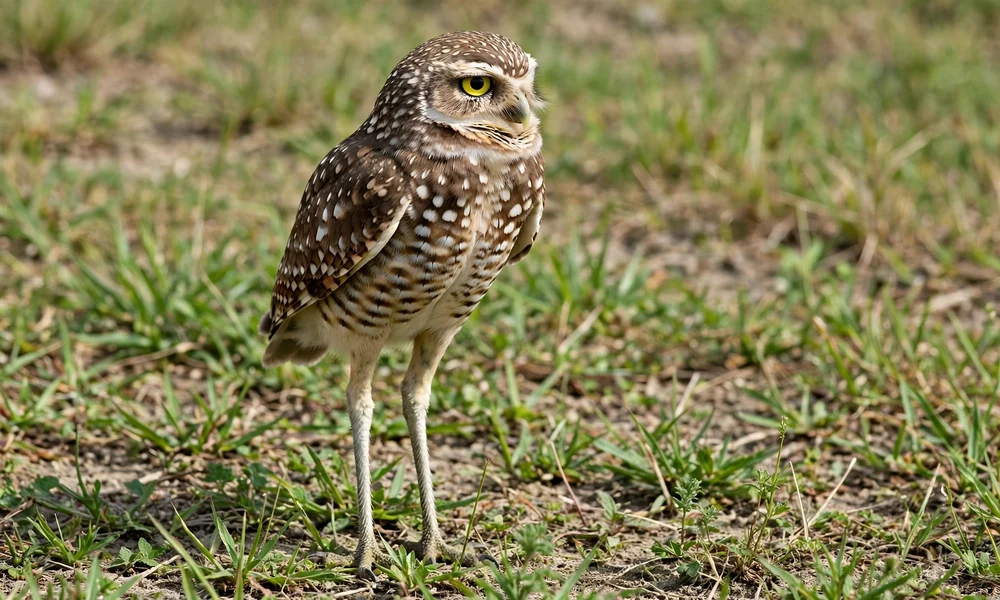
A burrowing owl is a small owl with a round head, no ear tufts, bright yellow eyes and a sandy brown back speckled with white spots, and it measures about 19 to 28 centimetres tall and usually weighs 140 to 240 grammes. Its legs are the giveaway: long, pale and mostly bare, built for walking and running on the ground, and when the owl stands upright at its burrow entrance it looks more like a small wading bird than an owl. Males are slightly larger than females, which is unusual among owls.
The name tells the story. Athene cunicularia joins Athene, the Greek goddess of wisdom, with cunicularia, Latin for burrower or miner. Like other snowy owls, the burrowing owl is a true owl of the family Strigidae, but it has given up the trees, and it hunts, rests and raises its young at ground level, in a burrow that may run three metres into the earth.
The burrowing owl species and their relatives
There is one burrowing owl species. It belongs to the genus Athene, the small owls, and its closest relative is the little owl of Europe and Asia, a bird of similar size that also hunts from the ground. It is the only member of its genus in the Americas, found from southern Canada to the tip of South America, a range wider than that of almost any other owl.
The elf owl is another small American owl, barely bigger than a sparrow, that nests in holes in cactus and trees, while the snowy owl is a much larger white owl of the Arctic tundra that also hunts by day. The great horned owl is a big owl with ear tufts that hunts at night, the barn owl is a pale heart-faced owl of open fields, and the tawny owl is a woodland owl of Europe with dark eyes.
| Type | Animal | Where it lives | Best-known food | Length or Weight |
|---|---|---|---|---|
| Species | Burrowing owl (Athene cunicularia) | Grasslands of the Americas | Insects, small mammals | 19 to 28 cm, 140 to 240 g |
| Close relative | Little owl | Open country in Europe and Asia | Insects, small mammals | 22 cm, 140 to 220 g |
| Close relative | Elf owl | South-western United States deserts | Insects, scorpions | 13 to 15 cm, about 40 g |
| Close relative | Snowy owl | Arctic tundra | Lemmings | 52 to 71 cm, 1.6 to 3 kg |
| Close relative | Great horned owl | Americas, forest and fields | Rabbits and rodents | 46 to 64 cm, 0.9 to 2.5 kg |
| Close relative | Barn owl | Open fields worldwide | Mice and voles | 33 to 39 cm, 220 to 460 g |
| Close relative | Tawny owl | Woodland across Europe | Mice and small birds | 37 to 43 cm, 330 to 590 g |
How burrowing owls live
Burrowing owls are creatures of open ground. A burrowing owl lives in a burrow dug by another animal, usually a prairie dog, a badger or a ground squirrel, and it will move into a ready-made hole rather than dig its own. The burrow may run three metres underground, sloping down to a nesting chamber that stays dark, cool and protected, and the owl often lines the entrance with grass, feathers and dung. It hunts on foot, running after insects and pouncing from a low perch, and like other great horned owls it has sharp talons, though it is a far smaller hunter.
The dung is the owl’s strangest tool. A burrowing owl scatters mammal dung around the burrow entrance, and the dung attracts dung beetles, which the owl then catches and eats, so the burrow becomes a trap that brings food to the door. Insects make up more than three quarters of the things it eats, though small mammals give it most of its food by weight, and it also takes scorpions, lizards and small birds. It hunts at dawn and dusk, and through the day too, which makes it easier to watch than most owls.
Breeding is a busy season. The male performs courtship flights, rising straight up, hovering, and then dropping down again, while bowing, preening and bringing food to the female. The female lays between four and twelve eggs, usually around nine, and incubates them for about 28 to 30 days while the male guards the entrance and brings her food. The chicks hatch blind and helpless, covered in white down, leave the burrow at about four weeks old and fly well by six weeks. Burrowing owls are usually monogamous for the season, and they often nest in loose colonies. When danger comes near, an alarmed owl bobs its head, and a young owl in the burrow can mimic the buzz of a rattlesnake. Burrowing owls live for about six to eight years in the wild, though one banded bird lived for almost ten.
Where burrowing owls live
The burrowing owl lives across a huge range, from the prairies of southern Canada, through the western and central United States and Mexico, and down to the grasslands and deserts of South America as far as Patagonia. It is a bird of open dry country with low vegetation, and it needs grassland, prairie, desert or open farmland where burrowing animals have already dug its home. Northern birds migrate south for the winter, to Mexico and the southern United States.
Burrowing owls are listed as Least Concern by the International Union for Conservation of Nature, because their South American range is so large, but their numbers are falling overall, and they are listed as endangered in Canada and as threatened in several American states, including Colorado, Florida and California. The main pressures are the loss of grassland, the control of prairie dogs, and collisions with vehicles.
Best seasons for burrowing owl watching
There is no closed season, because burrowing owls are active all year, but the best time to look for them depends on where you go. In North America the best months are often April to August, when the owls are at their burrows with eggs and chicks, and the adults stand at the burrow mouth morning and evening. Further south the owls are resident all year, and the dry season is often the easiest time to find them, because the grass is short.
Staying safe around burrowing owls
A burrowing owl is a wild animal with sharp talons and a strong beak, and it can give a painful bite or scratch to a person who comes too close, though burrowing owls almost never attack people. Keep your distance, never touch an owl, and never reach into a burrow, because a burrow may hold eggs or chicks, and a disturbed owl may abandon its nest. Stay on paths and roadsides, watch from your car, and never flush an owl from its burrow just for a photograph.
Burrowing owl watching checklist
A little preparation turns a grassland visit into a real chance of seeing a burrowing owl, so pack for sun, wind and long quiet hours.
- Binoculars, because burrowing owls are small.
- A camera with a zoom lens, for the head-bobbing display.
- Sun protection and water, for grassland with no shade.
- A field guide to owls, for telling a burrowing owl from a little owl.
- A plan to be out early or late, when the owls are most active.
- Patience and silence, because a noisy group will send them underground.
- A note of local burrow sites, from a birding group.
Frequently asked questions
How many burrowing owl species are there?
There is one burrowing owl species, Athene cunicularia. It was once placed in its own genus, but scientists now put it in the genus Athene with the little owl, and there is a single recognised species across North and South America, with about eighteen subspecies.
Why do burrowing owls live underground?
Burrowing owls live underground because a burrow gives them a safe nest in open country with no trees. The burrow stays cool and hidden from predators, and it protects the eggs and chicks, so the owl can raise its young where a tree-nesting owl could not breed.
Why do burrowing owls put dung around their burrows?
Burrowing owls place mammal dung around the burrow entrance because the dung attracts dung beetles, which the owls then catch and eat. It brings food to the door of the burrow, so the owl can feed its chicks without flying far to hunt.
What do burrowing owls eat?
Burrowing owls eat mostly insects, which make up more than three quarters of the things they catch, along with small mammals such as mice and voles. They also take scorpions, lizards and small birds, though insects are the most frequent food and small mammals give the owl most of its food by weight.
How is this guide different from the blue-footed booby species guide?
This guide covers the single burrowing owl species, a small long-legged owl that lives in a burrow in the grasslands of the Americas and eats insects and small mammals, while our blue-footed booby species guide covers the single blue-footed booby species, a seabird of the eastern Pacific that dives for fish. The burrowing owl stands about 19 to 28 centimetres tall and hunts on foot, and the booby is a much larger bird with bright blue feet that plunges into the sea.
Are burrowing owls endangered?
No, not globally. Burrowing owls are listed as Least Concern by the International Union for Conservation of Nature, though their numbers are falling, and they are listed as endangered in Canada and as threatened in several American states. The loss of grassland and the control of prairie dogs are the main threats.
Conclusion
The burrowing owl species shows how much character one small bird can hold: a single species of long-legged owl, with a burrow for a home, dung for a trap, and a head-bob that gives away its alarm.
If you go looking for one, go to open grassland in the breeding season, go quietly, and go with patience. Watch a burrowing owl standing at its burrow mouth in the morning light, bobbing its head as it sizes you up, and you will understand why this ground-dwelling owl is one of the most loved birds of the Americas, and why keeping its grasslands matters most.