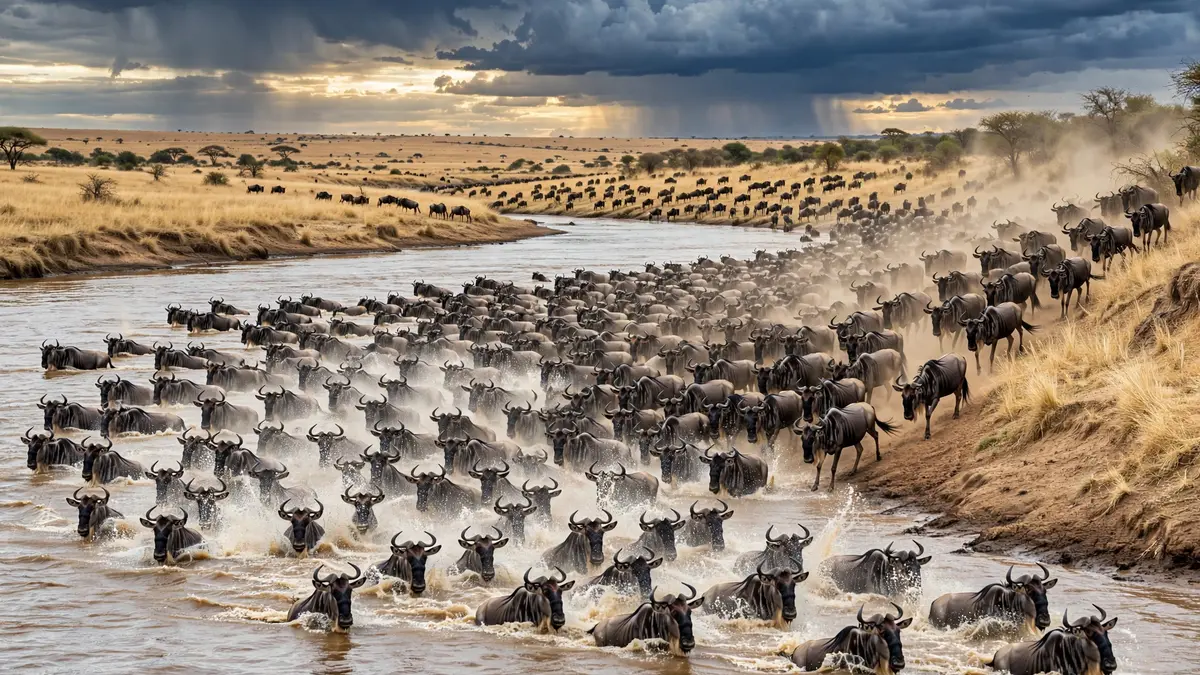
The wildebeest species number two, blue and black wildebeests, migrating herds of the African plains, and they drive the largest land migration on Earth. If you are asking how many wildebeest species there are, the answer is two: there are two recognised wildebeest species in the world, the blue wildebeest and the black wildebeest, and every wildebeest alive today belongs to one of them.
The wildebeest belongs to the family Bovidae, the antelope family, and it lives on the grasslands of eastern and southern Africa, from Kenya to South Africa. Its heavy shoulders, its shaggy mane, its curved horns and its endless migration make it one of the most famous animals of the African savanna.
Key takeaways
- There are two wildebeest species, the blue wildebeest and the black wildebeest, both in the genus Connochaetes.
- About 1.5 million blue wildebeest take part in the Great Migration between the Serengeti and the Maasai Mara each year.
- Wildebeests are grazers that eat short grass, and they must drink water every day.
- About 500,000 wildebeest calves are born in a few weeks each February and March on the Serengeti plains.
- Both wildebeest species are listed as Least Concern, and the black wildebeest has recovered from near extinction.
What makes a wildebeest a wildebeest
A wildebeest is a large antelope with a heavy front body, sloping shoulders, a shaggy mane, a beard and curved horns, and it measures roughly 1.7 to 2.4 metres long and usually weighs between 110 and 250 kilogrammes, depending on the species. The blue wildebeest is the larger of the two, at up to 250 kilogrammes, while the black wildebeest is smaller, at up to 160 kilogrammes, with a white tail and a darker coat.
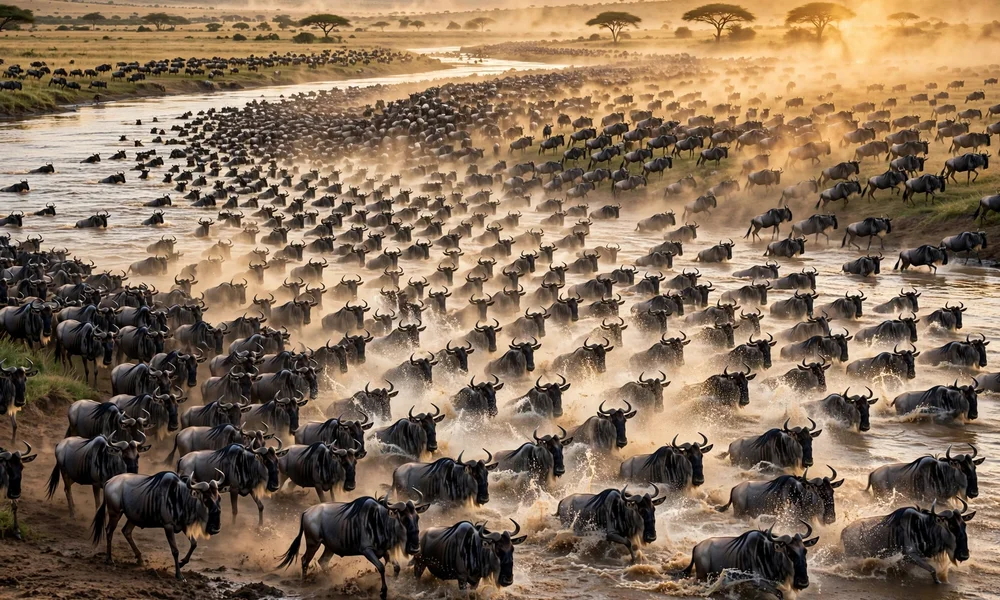
The migration defines the wildebeest: a circular journey of hundreds of kilometres each year, following the rains across the Serengeti and the Mara, and the herds move in columns that stretch for kilometres, crossing rivers full of crocodiles. The wildebeest can run at up to 80 kilometres per hour, and it grunts and bellows constantly as it moves, the sound carrying across the plain. Like other African buffalo, the wildebeest is a herd grazer of the savanna, but it migrates in millions, while the buffalo stays in one place.
The wildebeest species and their relatives
There are two wildebeest species. The blue wildebeest lives across eastern and southern Africa, from Kenya to South Africa, and it is the wildebeest of the Great Migration, with five subspecies of its own. The black wildebeest lives only in South Africa, Lesotho and Eswatini, and it was once hunted to near extinction, though it has now recovered to more than 10,000 animals.
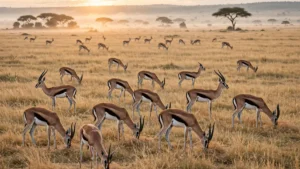
The common eland is the wildebeest’s most famous relative, the largest antelope in Africa, while the hartebeest is a long-faced antelope of the savanna with twisted horns. The springbok is a small antelope of southern Africa that leaps high into the air, the impala is a graceful antelope of the bush, and the Thomson’s gazelle is a small gazelle of the Serengeti that migrates with the wildebeest.
| Type | Animal | Where it lives | Best-known food | Length or Weight |
|---|---|---|---|---|
| Species | Blue wildebeest (Connochaetes taurinus) | Grasslands of eastern and southern Africa | Short grass | 1.7 to 2.4 m, 170 to 250 kg |
| Close relative | Black wildebeest | South Africa, Lesotho and Eswatini | Short grass | 1.7 to 2.2 m, 110 to 160 kg |
| Close relative | Common eland | Savanna of eastern and southern Africa | Leaves, grass and fruit | 2 to 3.4 m, 400 to 940 kg |
| Close relative | Hartebeest | Savanna of sub-Saharan Africa | Grass | 1.5 to 2.4 m, 100 to 200 kg |
| Close relative | Springbok | Dry plains of southern Africa | Grass and shrubs | 1.2 to 1.5 m, 27 to 48 kg |
| Close relative | Impala | Savanna of eastern and southern Africa | Grass, leaves and shoots | 1.2 to 1.6 m, 40 to 76 kg |
| Close relative | Thomson’s gazelle | Serengeti and East Africa | Short grass | 0.8 to 1.1 m, 20 to 35 kg |
How wildebeests live
Wildebeests are creatures of the open grassland. A wildebeest lives in a herd, a group of hundreds or thousands of animals that graze, rest and travel together, and the herds join into gatherings of more than a million animals during the migration, when the grass is plentiful. Like other zebras, the wildebeest migrates with the rains, but it follows the grass, while the zebra follows the wildebeest, eating the tall grass first and leaving the short grass for the wildebeest.
Short grass makes up most of the diet, along with leaves and the occasional shrub, and a wildebeest eats by grazing for hours each day, tearing grass with its broad muzzle and teeth. It drinks water every day, and it must drink twice a day in the dry season, which is why droughts are so deadly for wildebeests, and why the herds follow the rains so closely.
Breeding happens in the wet season, and the females give birth in February and March, when about 500,000 calves are born in a few weeks on the southern Serengeti plains. The calf can stand within minutes of birth and run within a day, and it must be able to run, because lions, hyenas and crocodiles hunt the herds at every river crossing. Wildebeests live for around 20 years in the wild, and up to 40 years in captivity.
Where wildebeests live
The wildebeest lives on the grasslands of eastern and southern Africa, from Kenya and Tanzania to South Africa, and it is most common in the Serengeti and the Maasai Mara, where the Great Migration takes place. It is seen regularly in the Serengeti National Park, the Maasai Mara and the Kruger National Park, where huge herds graze the plains.
Grass and water are the key requirements. A wildebeest needs open grassland to graze in, and water to drink every day, so it follows the rains as they move across the savanna, and when the dry season comes the herds gather around the remaining waterholes. It depends on the grass staying plentiful, and it grazes the same plains year after year, returning to the same rivers.
Both wildebeest species are listed as Least Concern, and their numbers are stable across most of their range. Roughly 1.55 million blue wildebeest live in Africa, and the black wildebeest has recovered to more than 10,000 animals. The main pressures are the loss of grassland to farming, fences that block the migration, and drought, though the wildebeest’s huge numbers keep the species safe for now.
Best seasons for wildebeest watching
There is no closed season, because wildebeests are active all year, but the best time to look for them depends on where you go. In the Serengeti the best months are often February to March, when the calves are born on the southern plains. In the Maasai Mara the best months are often July to September, when the herds cross the Mara River.
Staying safe around wildebeests
A wildebeest is a wild animal with great strength and sharp horns, and it can injure a person with a charge, though wildebeests almost never attack people. Keep your distance, never approach a wildebeest herd, and never try to touch or feed a wildebeest, because a wildebeest that feels cornered will charge without warning. If you see wildebeests, stay in your vehicle or behind a guide, and watch with binoculars, because wildebeests that are disturbed may stampede and the calves may be lost.
Wildebeest watching checklist
A little preparation turns a safari visit into a real chance of seeing a wildebeest, so pack for sun, dust and long quiet hours.
- Binoculars with good low-light performance, for picking a dark herd out of the grass.
- A camera with a zoom lens, because wildebeests should always be watched from a distance.
- Sun cream and a hat, because the best watching is in the bright midday sun.
- A booked safari with a guide who knows the wildebeest herds and the safe routes.
- A plan to be out in the morning, when the wildebeests are most active and grazing.
- Patience and silence, because wildebeests are wary animals and a noisy group will send them away.
- A field guide to African mammals, for telling a blue wildebeest from a black wildebeest at a glance.
Frequently asked questions
How many wildebeest species are there?
There are two wildebeest species, the blue wildebeest and the black wildebeest. The blue wildebeest is the wildebeest of the Great Migration, and the black wildebeest lives only in the south, though they are both in the same genus.
What is the Great Migration?
The Great Migration is the annual circular journey of about 1.5 million blue wildebeest, plus zebra and gazelle, between the Serengeti in Tanzania and the Maasai Mara in Kenya. The herds follow the rains in search of fresh grass, crossing the Mara River twice a year, and it is the largest land migration on Earth.
Why are so many calves born at once?
About 500,000 wildebeest calves are born in a few weeks each February and March, and this is called predator swamping. With so many calves born at once, the lions and hyenas cannot eat them all, and most of the calves survive, though thousands still die at the river crossings.
Can you keep a wildebeest as a pet?
No. A wildebeest is a wild animal that needs the savanna, eats grass by the kilogramme, and is fully protected by law in most of the countries where it lives. Wildebeests in zoos need huge enclosures with grassland and herds, and they are not pets.
How is this guide different from the ring-tailed lemur species guide?
This guide covers two wildebeest species, migrating grazers that travel in herds of more than a million across the African savanna, while our ring-tailed lemur species guide covers the single ring-tailed lemur species, a sunbathing lemur that weighs 2 to 3.5 kilogrammes and lives only in southern Madagascar. The blue wildebeest weighs up to 250 kilogrammes and runs at 80 kilometres per hour, and the lemur weighs up to 3.5 kilogrammes and sits in trees.
Are wildebeests endangered?
Both wildebeest species are listed as Least Concern, so they are not classed as endangered. Roughly 1.55 million blue wildebeest live across Africa, and the black wildebeest has recovered to more than 10,000 animals, though fences and drought are the main threats.
Conclusion
The wildebeest species show how much movement one animal can hold: two species of migrating grazer, with herds of more than a million, river crossings full of crocodiles, and a life spent following the rains across the African savanna.
If you go looking for one, go in February to the Serengeti or in July to the Mara, go quietly, and go with patience. Watch a wildebeest herd cross the river and you will understand why it has earned its place as the greatest migrant of Africa, and why keeping its grassland open matters most.