The burmese python species is a single snake, Python bivittatus, and it is one of the largest snakes in the world, a heavy-bodied constrictor that can grow longer than a family car and weigh as much as a grown man. If you are asking how many burmese python species there are, the answer is one: there is a single burmese python species, Python bivittatus, one of about 40 python species in the family Pythonidae, and it is native to the rivers, swamps and forests of southern and Southeast Asia.
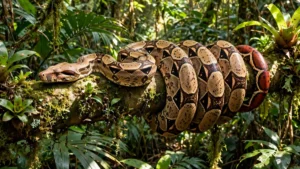
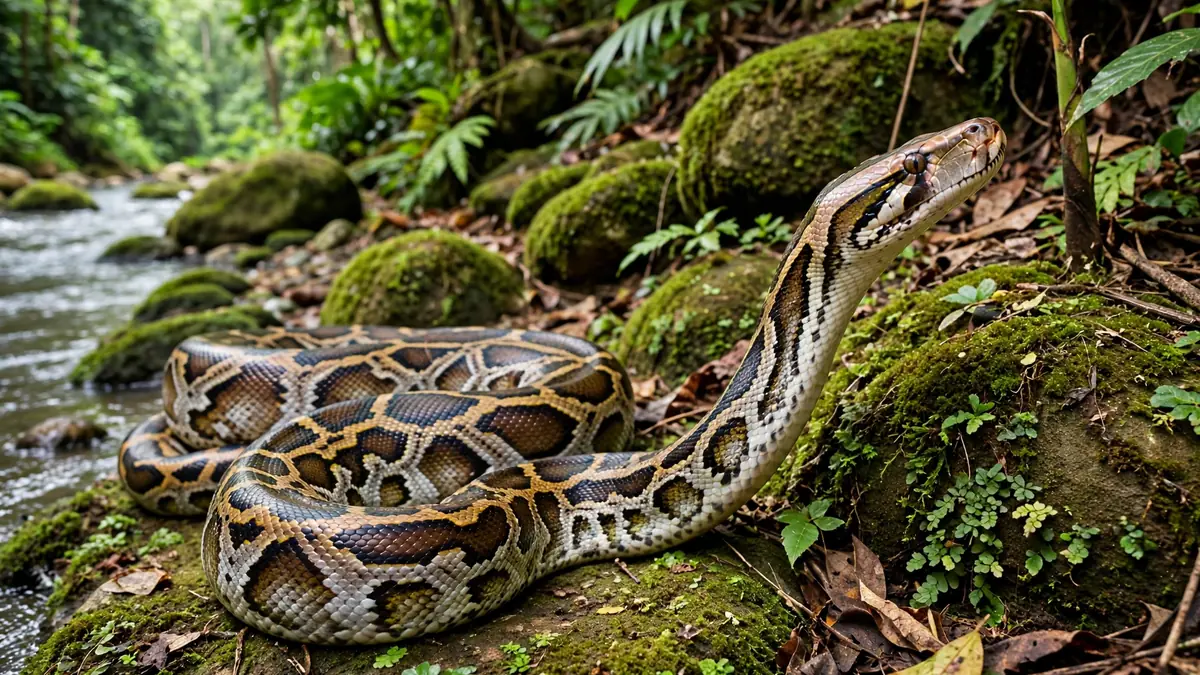
At first glance a Burmese python looks like a creature from another age: tan skin marked with dark brown blotches edged in black, and a body as thick as a telephone pole in the largest adults. It is not venomous. It kills by constriction, wrapping its coils around its prey and squeezing so tightly that its blood stops flowing, and then swallowing it whole.
Key takeaways
- There is one burmese python species, Python bivittatus, one of about 40 python species in the family Pythonidae.
- Adults usually grow to 3 to 5 metres long and weigh up to about 90 kilograms, with the largest confirmed wild snake measuring 5.79 metres and weighing 97.5 kilograms.
- Burmese pythons are non-venomous constrictors that hunt mostly at night, using heat-sensing pits along their jaws and a forked tongue to find warm-blooded prey in the dark.
- They eat birds, reptiles and mammals, from rats and rabbits to pigs, goats, deer and even alligators.
- Burmese pythons are listed as Vulnerable in their native Asian range, yet they are a serious invasive species in the Florida Everglades, where escaped and released pets have formed a breeding population estimated at tens of thousands to hundreds of thousands of snakes.
What makes a Burmese python a Burmese python
A Burmese python is easy to recognise once you know the pattern: a tan or yellowish-brown background covered in dark brown blotches bordered with black, running in a neat row down the back, with smaller dark spots along the sides. The head carries a dark arrow-shaped blotch on top and a dark stripe from each eye towards the jaw, and the eyes are golden brown. Young snakes are brightly patterned, and the colours fade a little as the snake grows older.
The body is built for power rather than speed. A Burmese python is thick and muscular, with a broad head set apart from the neck and rows of sharp, backward-curving teeth that grip prey and stop it escaping. Heat-sensing pits run along the upper and lower jaws, letting the snake detect the body heat of a warm animal in complete darkness, and the forked tongue collects scent particles from the air. Like ball pythons, its smaller African cousins, it has poor eyesight and relies on smell and heat to hunt.
The Burmese python species and their relatives
There is one burmese python species, Python bivittatus, and it belongs to the family Pythonidae, a family of about 40 constricting snakes found in Africa, Asia and Australia. Until 2009 it was treated as a subspecies of the Indian python, but it is now recognised as a separate species in its own right. Dwarf forms live on the Indonesian islands of Java, Bali and Sulawesi, where adults average only about 2 metres long, far smaller than their mainland cousins.
The wider python family holds some of the longest snakes on Earth. The reticulated python of Southeast Asia is the longest snake in the world, reaching more than 6 metres, the African rock python is the largest snake in Africa, and the Indian python is the Burmese python’s closest relative. The family also includes small pythons such as the ball python of West Africa, which rarely grows longer than 1.5 metres.
| Type | Animal | Where it lives | Best-known food | Length or Weight |
|---|---|---|---|---|
| Family | Pythons (family Pythonidae) | Africa, Asia and Australia | Small mammals and birds | Up to about 6 m long |
| Species | Burmese python (Python bivittatus) | Southern and Southeast Asia | Rats, rabbits and deer | About 3 to 5 m long |
| Species | Ball python (Python regius) | West and central Africa | Rats and mice | About 1.2 to 1.5 m long |
| Species | Reticulated python (Malayopython reticulatus) | Southeast Asia | Mammals and birds | Up to about 6 m long |
| Species | Indian python (Python molurus) | India and Pakistan | Mammals and birds | About 3 to 4.5 m long |
| Species | African rock python (Python sebae) | Sub-Saharan Africa | Antelope and warthogs | Up to about 5 m long |
| Species | Boa constrictor (Boa constrictor) | South America east of the Andes | Rats, birds and bats | About 2 to 3 m long |
How Burmese pythons live
Burmese pythons are carnivores, and they eat a wide range of birds, reptiles and mammals. Young snakes feed on rats, mice and small birds, while adults take rabbits, pigs, goats, deer and even alligators. They are ambush hunters: a python waits motionless, hidden in water or vegetation, until prey comes close enough to strike. It seizes the animal with its teeth, throws two or three coils around it and squeezes so tightly that the prey’s blood stops flowing, then swallows it whole, head first.
They are mainly nocturnal, and they are excellent swimmers and climbers. A Burmese python can stay underwater for up to half an hour, and young snakes spend much of their time in trees, although heavy adults stay mostly on the ground. After a large meal a python may not eat again for weeks or even months. They live for 20 to 25 years in the wild.
Breeding takes place in the cooler months, and the female lays a clutch of 20 to 50 eggs, although clutches of more than 100 have been recorded. She coils around the eggs and stays with them for two to three months, shivering her muscles to generate warmth, a rare show of parental care in a snake. Hatchlings are 45 to 60 centimetres long and leave the nest soon after hatching.
Where Burmese pythons live
Burmese pythons are native to southern and Southeast Asia, from Nepal, Bangladesh and north-eastern India through Myanmar, Thailand, Laos, Cambodia and Vietnam to southern China, and on the Indonesian islands of Java, Bali, Sumbawa and Sulawesi. They live in tropical and subtropical forests, mangrove forests, grasslands, swamps and rivers, always near a permanent source of water, and they are often found half-submerged in slow-moving water or resting on a riverbank.
In their native range they are in trouble. Burmese pythons are listed as Vulnerable by the International Union for Conservation of Nature, with a population that is decreasing. Habitat loss, hunting for their skins and flesh, and collection for the pet trade have all taken a toll.
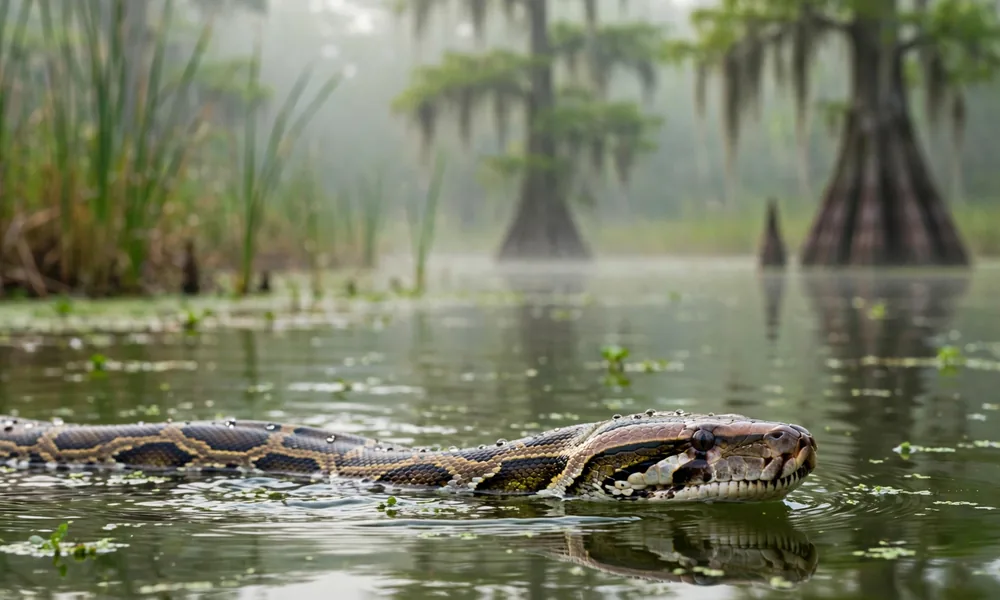
Yet the same snake is thriving where it does not belong. Escaped and released pets founded a breeding population in the Florida Everglades, first recognised as reproducing in 2000, and the population is now estimated at anywhere from 30,000 to more than 300,000 snakes. In the Everglades they eat native birds, mammals and crocodilians, and the populations of marsh rabbits, raccoons, foxes and bobcats have fallen by more than 90 percent in areas where pythons are common. Florida has banned their import and runs removal programmes, but the snakes are secretive and hard to find.
Best seasons for Burmese python watching
The best time to look for Burmese pythons in their native range is the dry season, from November to March, when the snakes bask in the open on riverbanks and forest edges during the cooler mornings. In the early morning and late afternoon they are most likely to be seen stretched out in the sun or lying half-submerged at the edge of slow water, and after rain they often appear on warm roads and tracks.
Staying safe around Burmese pythons
A Burmese python is a powerful wild animal and should always be watched from a distance. Never approach one, never try to handle it, and never corner it on a path or a riverbank, because a frightened python can strike and bite, and a large snake can coil around a person. Keep dogs on a lead near water where pythons live, and do not reach into hollow logs, burrows or dense riverside vegetation. If you see one in Florida, report it to the local wildlife authorities.
Burmese python watching checklist
A little preparation turns a morning beside a slow Asian river into a real chance of seeing one of the world’s largest snakes, so pack for heat, water and long quiet waits.
- Binoculars, because a basking python is best watched from well back.
- Light clothing, a hat and plenty of water, for hot mornings beside a river.
- A visit to a slow river, swamp or mangrove edge in the dry season, from November to March.
- A plan to arrive at dawn, when pythons bask in the open before the heat builds.
- Sturdy boots and a torch, for muddy banks and shaded forest paths.
- Patience and silence, because a python will slip into the water at the first loud footstep.
- A field guide to Asian snakes, for telling a Burmese python from a reticulated python.
Frequently asked questions
How many burmese python species are there?
There is one burmese python species, Python bivittatus. Until 2009 it was treated as a subspecies of the Indian python, but it is now recognised as a separate species, one of about 40 python species in the family Pythonidae.
How big does a Burmese python get?
Adults usually grow to 3 to 5 metres long and weigh up to about 90 kilograms. The largest confirmed wild snake measured 5.79 metres and weighed 97.5 kilograms, and there are unconfirmed reports of snakes reaching 7 metres.
What does a Burmese python eat?
Burmese pythons eat birds, reptiles and mammals, from rats, mice and rabbits to pigs, goats, deer and even alligators. They are ambush hunters that kill by constriction and swallow their prey whole, and after a large meal they may not eat again for weeks or months.
Are Burmese pythons dangerous to people?
Burmese pythons are non-venomous, but a large one is a powerful animal that can bite and constrict, and it should never be handled. Attacks on people are rare, and the real danger is to pets and livestock near water where pythons live. Always watch from a distance and never corner one.
How is this guide different from the boa constrictor species guide?
This guide covers the Burmese python, a single Asian snake that lays eggs, grows to 5 metres or more and lives in the rivers and forests of Southeast Asia, while our boa constrictor species guide covers the boa constrictor, a snake of Central and South America that gives birth to live young and is usually smaller, at about 3 to 4 metres. Pythons lay eggs and boas do not, and the two snakes live on opposite sides of the world.
Are Burmese pythons endangered?
In their native Asian range, yes: they are listed as Vulnerable by the International Union for Conservation of Nature, with a decreasing population threatened by habitat loss, hunting for skins and flesh, and collection for the pet trade. In Florida, by contrast, they are an invasive species with a large and growing population.
Conclusion
The burmese python species shows how one snake can be both a threatened native and a feared invader: a single species, Python bivittatus, a giant constrictor of Asian rivers and forests that is disappearing at home and spreading fast in the Florida Everglades.
If you go looking for one, go to a slow river at dawn in the dry season, go quietly, and go with respect for an animal that can weigh more than you do. Watch it from a distance as it basks or slips into the water, and you will understand why keeping its Asian home intact matters most.