The chameleon species number about 228, all of them lizards in the family Chamaeleonidae, and they are among the most specialised reptiles on Earth, famous for changing colour, moving each eye on its own and firing a tongue longer than their own body to catch insects. If you are asking how many chameleon species there are, the answer is about 228 recognised species, and new ones are still being described from the forests of Madagascar and Africa, so the count keeps rising.
Most chameleons live in trees, where flattened bodies, gripping feet and curling tails let them move safely along thin branches. A few tiny leaf chameleons live on the forest floor among dead leaves. Together the family ranges from a lizard small enough to sit on a fingertip to one nearly 70 centimetres long, and almost two thirds of all species live only on Madagascar.
Key takeaways
- There are about 228 chameleon species in the family Chamaeleonidae, and new species are still being described.
- Chameleons range from the nano-chameleon, about 2 centimetres long, to the Parson’s chameleon, up to about 69 centimetres long.
- Chameleons change colour to communicate, to warm up or cool down and to show mood, not to match their background exactly.
- Each eye can swivel and focus on its own, and its sticky tongue can reach more than twice its body length.
- Almost two thirds of chameleon species live only on Madagascar, and many are threatened by habitat loss and the pet trade.
What makes a Chameleon a Chameleon
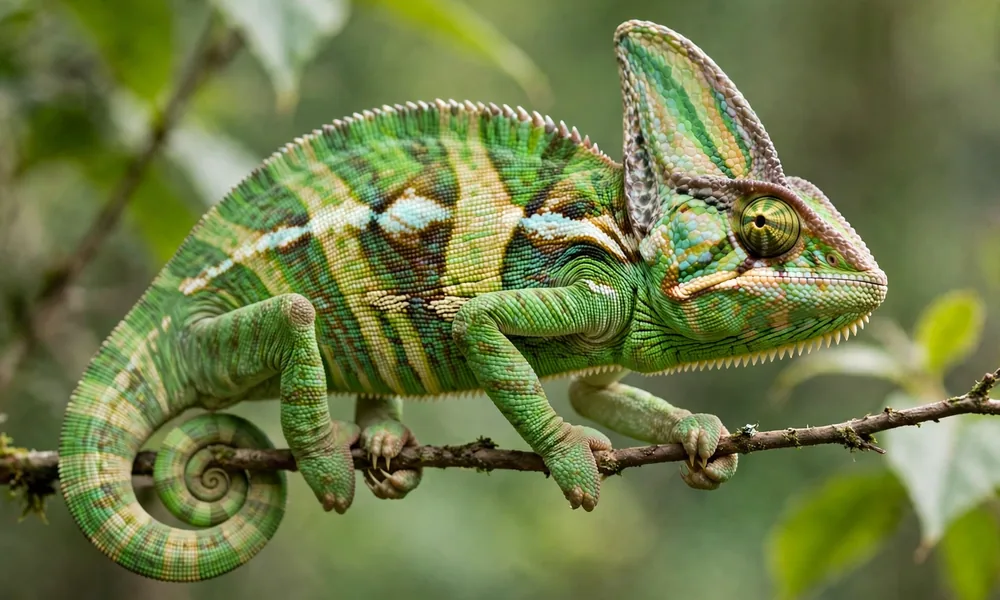
A chameleon is built like no other lizard. Its body is flattened from side to side, like a leaf, so it can hide behind a stem. Its tail curls around a branch like a fifth limb, and its feet are zygodactyl, with the toes fused into two opposed bundles that grip a branch like tongs. A casque, a helmet-like crest, rises from the back of the head in many species, and males of some kinds carry horns as well.
The eyes are the most remarkable feature of all. Each eye sits in a cone-shaped turret and can swivel on its own, so a chameleon can look in two directions at once. When it spots prey, both eyes lock forward to judge the distance, and then the tongue fires. The tongue is a sticky projectile that can stretch to more than twice the body length and snap back in a fraction of a second, its tip acting like a suction cup and catching prey up to a third of the chameleon’s own weight. Like Argentine tegus, which also hunt with a quick tongue, a chameleon is a patient visual hunter, but no other lizard hunts quite like this.
The Chameleon species and their relatives
The chameleon species belong to the family Chamaeleonidae, divided into two subfamilies: the Brookesiinae, small and often ground-dwelling leaf chameleons, and the Chamaeleoninae, the larger tree-dwelling kinds most people recognise. The family holds about 12 genera, including Chamaeleo, Furcifer, Calumma and Trioceros, and it sits inside the iguana group of lizards, the Iguania. Its closest relatives are the agamas, the dragon lizards of Africa and Asia.
The best-known chameleons show the family’s variety. The panther chameleon of Madagascar is one of the most colourful, with males flashing red, blue, green and orange. The veiled chameleon of Yemen and Saudi Arabia carries a tall casque and is the species most often kept as a pet. The Parson’s chameleon is the largest of all, and the nano-chameleon of northern Madagascar is one of the smallest reptiles ever found. The Jackson’s chameleon of East Africa has three horns, and the Meller’s chameleon is the largest species on the African mainland.
| Type | Animal | Where it lives | Best-known food | Length or Weight |
|---|---|---|---|---|
| Family | Chameleons (family Chamaeleonidae) | Madagascar, Africa, southern Europe and Asia | Insects and small animals | About 2 cm to 69 cm long |
| Species | Parson’s chameleon (Calumma parsonii) | Rainforests of eastern Madagascar | Insects and small lizards | Up to about 69 cm long |
| Species | Panther chameleon (Furcifer pardalis) | Madagascar, introduced to Reunion and Mauritius | Crickets and locusts | About 30 to 52 cm long |
| Species | Veiled chameleon (Chamaeleo calyptratus) | Yemen and Saudi Arabia | Insects and some leaves | About 43 to 61 cm long |
| Species | Jackson’s chameleon (Trioceros jacksonii) | Mountains of East Africa, introduced to Hawaii | Insects and spiders | About 23 to 33 cm long |
| Species | Meller’s chameleon (Trioceros melleri) | East and southern Africa | Insects and small birds | Up to about 61 cm long |
| Species | Nano-chameleon (Brookesia nana) | Rainforest of northern Madagascar | Tiny insects and mites | About 2 cm long |
How Chameleons live
Chameleons are daytime hunters that eat mostly insects, and they catch them with patience rather than speed. A chameleon sways gently as it walks, like a leaf in the breeze, and moves so slowly that prey does not notice it. When an insect comes within range, it freezes, aims both eyes at it, and fires its tongue. Large species sometimes take small lizards or birds, and a few, including the veiled chameleon, also nibble leaves.
Colour change is the chameleon’s most famous trick, and it is widely misunderstood. A chameleon cannot turn any colour to match any background. Instead, special skin cells containing pigment and tiny crystals shift the way light is reflected, driven by temperature, light and mood. A cold chameleon turns dark to absorb heat, a hot one turns pale to reflect it, and a male showing off flashes his brightest colours. A stressed chameleon often turns dark, and a calm one at night can show colours it never wears by day.
Most chameleons live alone and meet only to mate. Males defend a branch, flashing bright colours to warn off rivals, and fights are usually settled by display rather than biting. Females lay 20 to 40 eggs in a burrow in soft soil, and the eggs can take many months to hatch. A few highland species, including the Jackson’s chameleon, give birth to live young instead. There is no parental care: the young are born fully independent and must feed and hide from predators from their first day. Lifespans vary from a few months for tiny species to more than ten years for a large Parson’s chameleon.
Where Chameleons live
Chameleons are Old World lizards, found only in Africa, Madagascar, southern Europe and southern Asia. Madagascar is their heartland: almost two thirds of all species live nowhere else. Mainland Africa holds most of the rest, from the rainforests of the Congo to the mountains of East Africa. A few species reach further: the common chameleon lives around the Mediterranean, and others live in Arabia, India and Sri Lanka.
Within that range, each species has its own home. Tree-dwelling chameleons live in rainforest, mountain forest and savanna woodland, wherever there are branches to grip and insects to catch. Leaf chameleons live on the forest floor, where their small brown bodies are almost invisible among fallen leaves. Veiled chameleons live wild in Florida, Jackson’s chameleons in Hawaii, and panther chameleons on Reunion and Mauritius, where people introduced them.
Chameleons are in trouble in much of their range, because they depend on forest and cannot survive when it is cut down. Many species live in a single valley or on a single mountain, so losing a small patch of forest can wipe out an entire species. The pet trade adds pressure, since wild chameleons are collected for sale abroad. All chameleon species are listed under CITES, and many are listed as threatened on the IUCN Red List. Protecting Madagascar’s forests matters more for chameleons than anything else.
Best seasons for Chameleon watching
The best time to watch chameleons is the warm wet season, roughly November to April in Madagascar, when insects are plentiful and chameleons are active. In the dry season many are harder to find, resting quietly and conserving moisture. Go out in the morning, when chameleons bask to warm up, or in the late afternoon, when they feed again. At night, a torch can reveal a sleeping chameleon on a branch tip.
Staying safe around Chameleons
A chameleon is harmless to people: it has no venom and no bite worth fearing, though a large one may nip if grabbed. The danger runs the other way, since chameleons are delicate and easily stressed by handling. Never pick one up or pull it from a branch, because its grip is strong and its bones are fragile. Watch from a short distance and move slowly. Never take one home: wild chameleons belong in the forest, and most need specialist care to survive in captivity.
Chameleon watching checklist
A little preparation turns a forest walk into a real chance of finding a chameleon, so pack for slow searching and patient looking.
- Binoculars, because chameleons often sit motionless high in a tree.
- A local guide, because an experienced eye finds chameleons a visitor would miss.
- A torch with a red filter, for spotting pale sleeping chameleons at night.
- A visit in the warm wet season, when chameleons are feeding.
- A morning walk, when chameleons bask and are easiest to see.
- Patience and a slow pace, because chameleons are found by looking carefully.
- A field guide to the chameleons of Madagascar or Africa.
Frequently asked questions
How many chameleon species are there?
There are about 228 recognised chameleon species, and the count keeps rising as new species are described from Madagascar and Africa. Almost two thirds live only on Madagascar.
Can chameleons really change colour to match anything?
No. A chameleon cannot match any background exactly. It changes colour to communicate, to warm up or cool down, and to show mood: dark when cold or stressed, pale when hot, and brightest when a male is displaying.
How long is a chameleon’s tongue?
A chameleon’s tongue can stretch to more than twice its body length and fires in a fraction of a second. The sticky tip acts like a suction cup and can catch prey up to about a third of the chameleon’s own weight.
What does a chameleon eat?
Most chameleons eat insects such as crickets, locusts and flies, caught with the tongue. Large species sometimes take small lizards or birds, and a few, including the veiled chameleon, also eat leaves.
How is this guide different from the caiman species guide?
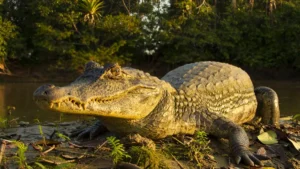
This guide covers the chameleon, a family of about 228 colour-changing lizards that live in trees in Madagascar and Africa and hunt insects with a tongue longer than their body, while our caiman species guide covers the caiman, a group of small crocodilians that live in the rivers and wetlands of Central and South America and hunt fish in the water. Chameleons sway along branches in the forest canopy, and caimans float in warm rivers with only their eyes above the water.
Are chameleons endangered?
There is no single answer for the whole family, because chameleons are assessed species by species. Many are threatened by forest loss and the pet trade, and all are listed under CITES, which controls international trade. The species with the smallest ranges are the most at risk.
Conclusion
The chameleon species show how far one family of lizards can go in the trees: about 228 species, from a lizard the size of a thumbnail to one nearly 70 centimetres long, with eyes that look in two directions at once and a tongue that fires faster than the eye can follow.
If you go looking for one, go to Madagascar in the wet season, go with a local guide, and go slowly. Watch a branch tip at dusk, and when a chameleon finally sways into view, remember that its forest is shrinking, and keeping it standing matters more than any photograph.