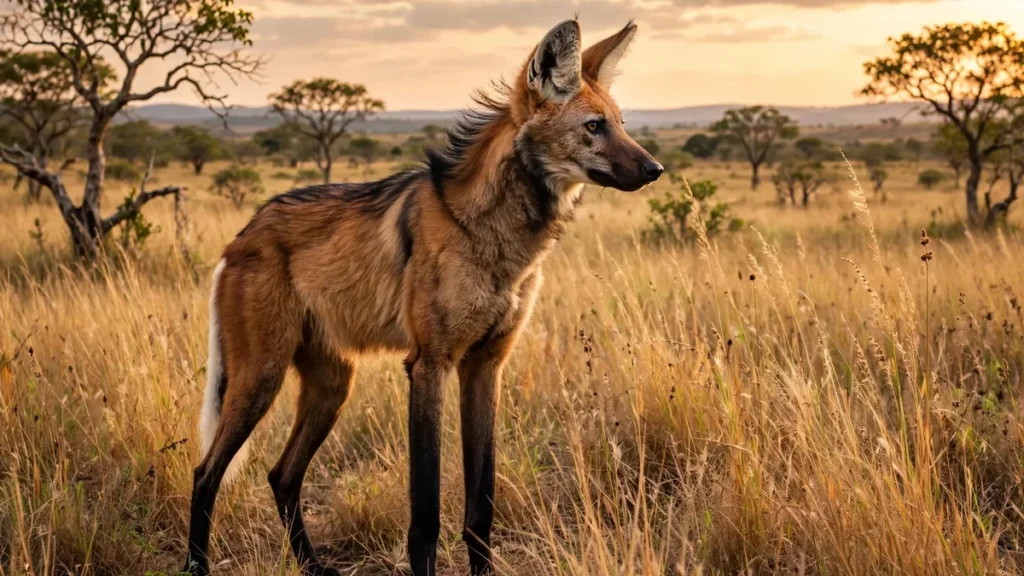
The maned wolf species is a single species, Chrysocyon brachyurus, a stilt-legged canid of the South American savanna, and the largest canid in South America. If you are asking how many maned wolf species there are, the answer is one: there is only one maned wolf species in the world, and it is the only species in its genus, and every maned wolf alive today belongs to it.
The maned wolf belongs to the family Canidae, the dogs, and it lives in the grasslands and scrub of central and eastern South America, from Brazil to Argentina. Its long black legs, its reddish coat, its erectile mane and its solitary life make it one of the most unusual animals on Earth.
Key takeaways
- There is only one maned wolf species, Chrysocyon brachyurus, and it is the only species in its genus.
- Maned wolves are neither true wolves nor foxes, and they are the largest canids in South America.
- Maned wolves have very long black legs, like a fox on stilts, and a mane they can raise when threatened.
- Maned wolves eat about half plants and half animals, and the wolf apple fruit is their most important food.
- Maned wolves are listed as Near Threatened, and the loss of the Cerrado grassland is the main threat.
What makes a maned wolf a maned wolf
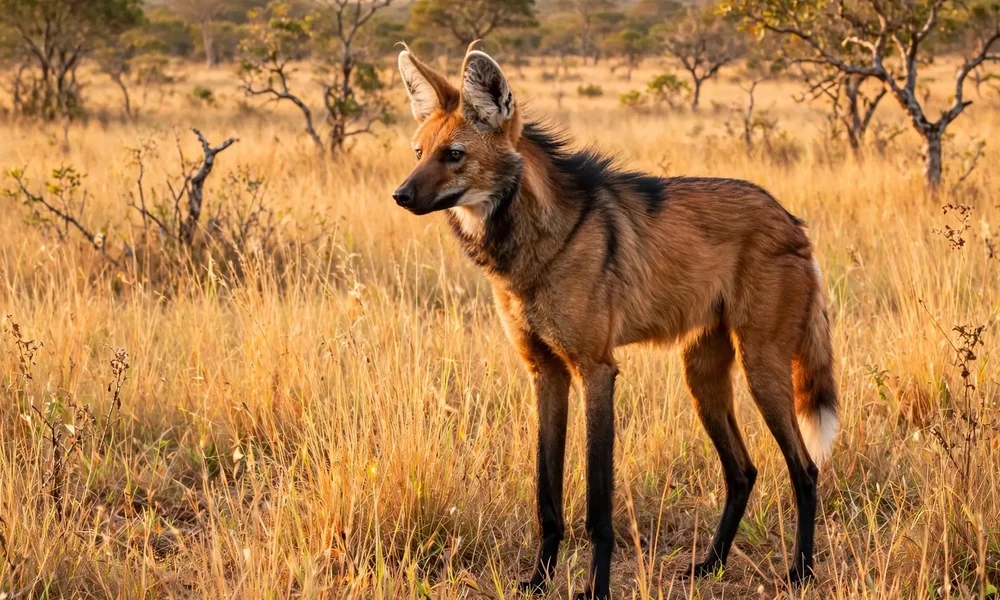
A maned wolf is a tall slender canid with a reddish-brown coat, very long black legs, large ears, a white-tipped tail and a black mane running from the back of its head to its shoulders, and it measures roughly 100 to 130 centimetres long with a shoulder height of 74 to 90 centimetres, and usually weighs between 20 and 30 kilogrammes. The mane can be raised when the animal is threatened, making it look larger, and the long legs let it see over the tall grass of the savanna.
The legs define the maned wolf: legs so long that the animal looks like a fox on stilts, and they are an adaptation to the tall grass of the Cerrado, letting the wolf see over the grass and leap high to catch prey. The diet defines it too, and the wolf apple fruit makes up a large part of what it eats, protecting it from the giant kidney worm. Like other red foxes, the maned wolf is a solitary hunter, but it is far taller and longer-legged, and it is neither a fox nor a wolf, but a canid all of its own.
The maned wolf species and their relatives
There is one maned wolf species, Chrysocyon brachyurus, and it lives in the open grasslands of South America. It is most common in the Cerrado of Brazil, a vast savanna of tall grasses and scattered trees, and it is the flagship animal of that grassland, though it is rarely seen because it is shy and solitary.
The gray wolf is the maned wolf’s most famous relative, the largest wolf in the world, living in the forests of the north, while the red fox is a small fox of the northern hemisphere with a bushy tail. The coyote is a dog-like canid of North America, the golden jackal is a jackal of Africa and Asia, and the Ethiopian wolf is a rare wolf of the highlands of Ethiopia. The African wild dog is a pack-hunting dog of the African savanna.
| Type | Animal | Where it lives | Best-known food | Length or Weight |
|---|---|---|---|---|
| Species | Maned wolf (Chrysocyon brachyurus) | Grasslands of central South America | Wolf apple fruit and rodents | 100 to 130 cm, 20 to 30 kg |
| Close relative | Gray wolf | Forests of the Northern Hemisphere | Deer, elk and moose | 105 to 160 cm, 30 to 50 kg |
| Close relative | Red fox | Northern Hemisphere worldwide | Rabbits, rodents and birds | 60 to 90 cm, 5 to 10 kg |
| Close relative | Coyote | North and Central America | Rabbits, rodents and deer | 80 to 135 cm, 9 to 16 kg |
| Close relative | Golden jackal | Africa and southern Asia | Rodents, birds and fruit | 60 to 106 cm, 6 to 15 kg |
| Close relative | Ethiopian wolf | Highlands of Ethiopia | Giant mole rats | 84 to 100 cm, 14 to 19 kg |
| Close relative | African wild dog | Savanna of sub-Saharan Africa | Antelopes and other mammals | 75 to 110 cm, 18 to 36 kg |
How maned wolves live
Maned wolves are creatures of the open grassland. A maned wolf lives alone, holding a territory of tens of square kilometres that it marks with scent and defends with loud barking calls, and it hunts by night, listening with its large ears for the rustle of rodents in the grass. Like other coyotes, the maned wolf is a solitary hunter, but it is far taller and more plant-eating, and it never hunts in packs.
Wolf apple fruit and rodents make up most of the diet, along with armadillos, birds, insects and other fruit, and a maned wolf eats about half plants and half animals, one of the most plant-eating canids in the world. It feeds mostly at dusk and dawn, when rodents are out in the grass, and it leaps high to pounce on prey, pinning it down with its long front legs.
Breeding happens in the dry season, and the female gives birth in a den after a pregnancy of about two months, and she has between two and six pups, usually three or four. The pups are dark-furred at first, and they stay in the den for the first weeks, then follow their mother out to hunt, and they grow fast, leaving their mother after about a year. Maned wolves live for around 12 to 15 years in the wild, and up to 17 years in captivity.
Where maned wolves live
The maned wolf lives in the open grasslands of central and eastern South America, from Brazil and Paraguay to northern Argentina and Bolivia, and it is most common in the Cerrado of Brazil, where the tall grass and scattered trees suit it best. It is seen regularly in the Serra da Canastra National Park in Brazil, where the grasslands stretch to the horizon.
Open grassland is the key requirement. A maned wolf needs tall grass to hunt in, and wolf apple trees to feed from, so it follows the fruit as it ripens through the year, and when the dry season comes the wolves gather around the remaining water. It depends on the grassland staying open, and it hunts the same territory year after year, generation after generation.
The species is listed as Near Threatened, and its numbers are falling as the Cerrado is cleared for soy farming and cattle ranching. Roughly 17,000 adult maned wolves live in the wild, and the species is one of the most threatened canids in South America. The main pressures are the loss of grassland, road deaths, and disease from domestic dogs, though the wolf’s shyness keeps it away from people.
Best seasons for maned wolf watching
There is no closed season, because maned wolves are active all year, but the best time to look for them depends on where you go. In the Cerrado the best months are often May to September, the dry season, when the grass is short and the wolves are easy to see. In Serra da Canastra the best months are often June to August, when the wolves come out to hunt at dusk.
Staying safe around maned wolves
A maned wolf is a wild animal with sharp teeth and strong legs, and it can bite hard enough to injure a person, though maned wolves almost never attack people. Keep your distance, never approach a den, and never try to touch or feed a maned wolf, because a wolf that is disturbed may abandon its den and its pups may die. If you see maned wolves while walking, stay on the path, and watch with binoculars, because wolves that are disturbed may leave their territory for good.
Maned wolf watching checklist
A little preparation turns a grassland visit into a real chance of seeing a maned wolf, so pack for sun, tall grass and long quiet hours.
- Binoculars with good low-light performance, for picking a tall wolf out of the grass at dusk.
- A camera with a zoom lens, because wolves should always be watched from a distance.
- Sun cream and a hat, because the best watching is in the bright midday sun.
- A booked visit to a reserve with a guide who knows the maned wolf territories.
- A plan to be out at dusk, when the wolves are most active and hunting.
- Patience and silence, because wolves are shy animals and a noisy group will send them away.
- A field guide to South American mammals, for telling a maned wolf from a crab-eating fox at a glance.
Frequently asked questions
How many maned wolf species are there?
There is one maned wolf species, Chrysocyon brachyurus. It is the only species in its genus, and it is neither a true wolf nor a fox, though it is a member of the dog family, and its closest relatives are the bush dogs and short-eared dogs of South America.
Is the maned wolf a real wolf?
No. The maned wolf is not a true wolf, and it does not belong to the genus Canis, which holds the gray wolf and the coyote. It is the only species in its own genus, Chrysocyon, which means golden dog, and it is more closely related to the small foxes of South America than to the wolves of the north.
What is the wolf apple?
The wolf apple is a tomato-like fruit, Solanum lycocarpum, that grows in the Cerrado, and it is the maned wolf’s most important food. The fruit makes up a large part of the wolf’s diet, and it is thought to protect the wolf from the giant kidney worm, a parasite that infects the kidneys.
Can you keep a maned wolf as a pet?
No. A maned wolf is a wild animal that needs the grasslands of South America, eats wolf apples and rodents, and is fully protected by law in most of the countries where it lives. Maned wolves in zoos need huge enclosures with grassland and dens, and they are not pets.
How is this guide different from the warthog species guide?
This guide covers the single maned wolf species, a stilt-legged canid that eats wolf apples and rodents in the grasslands of South America, while our warthog species guide covers two warthog species, kneeling grazers that live in burrows and run with their tails held high on the African savanna. The maned wolf weighs 20 to 30 kilogrammes and stands 74 to 90 centimetres at the shoulder, and the common warthog weighs up to 150 kilogrammes and grazes on its knees.
Are maned wolves endangered?
Maned wolves are listed as Near Threatened, so they are not classed as endangered, but their numbers are falling. Roughly 17,000 adults live in the wild, and the loss of the Cerrado grassland to soy farming is the main threat.
Conclusion
The maned wolf species shows how much strangeness one animal can hold: a single species of stilt-legged canid, with a mane it can raise, a taste for wolf apples, and a life spent alone in the grasslands of South America.
If you go looking for one, go in the dry season to Serra da Canastra, go quietly, and go with patience. Watch a maned wolf stand tall in the golden grass and you will understand why it has earned its place as the most unusual canid in the world, and why keeping its grassland matters most.