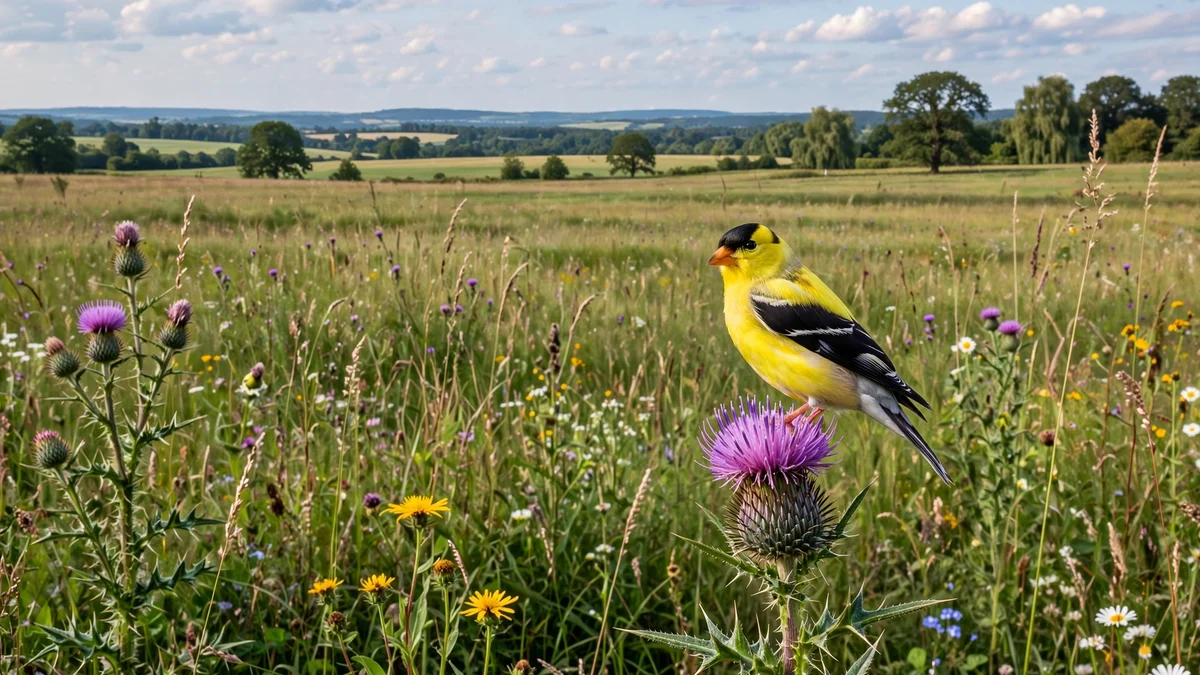
The American goldfinch species number one, a single species called Spinus tristis, and it is the bright yellow finch of the thistle fields, one of the most cheerful birds in North America. If you are asking how many American goldfinch species there are, the answer is one: there is one recognised American goldfinch species in the world, and every American goldfinch alive today belongs to it.
The American goldfinch lives across North America, from Canada to Mexico, in open fields, gardens, parks and weedy meadows, and the breeding male is bright lemon yellow with a black cap and black wings. Its song, its bouncing flight and its habit of hanging from thistles make it one of the best-loved small birds in the world.
Key takeaways
- There is one American goldfinch species, Spinus tristis, a finch of North America.
- American goldfinches measure 11 to 14 centimetres long and weigh between 11 and 20 grammes, with a wingspan of 19 to 22 centimetres.
- American goldfinches moult twice a year, turning bright yellow in spring and dull olive in winter.
- American goldfinches eat mostly seeds, especially thistle and sunflower seeds, and they are strict vegetarians.
- American goldfinches are listed as Least Concern, and they are the state bird of New Jersey, Iowa and Washington.
What makes an American goldfinch an American goldfinch
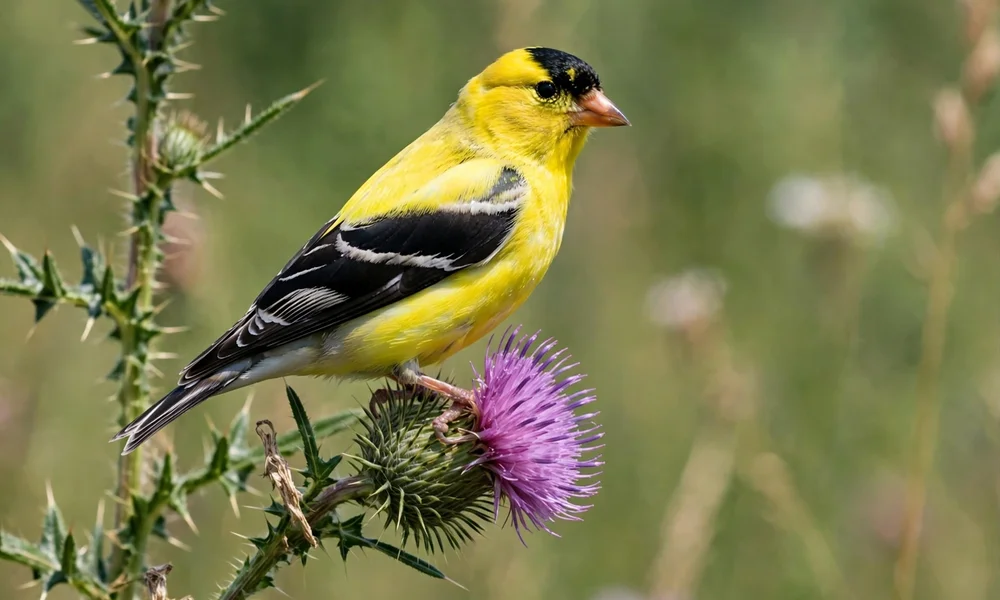
An American goldfinch is a small finch with a short pointed beak, a notched tail, and, in the breeding male, bright lemon-yellow feathers with a black cap and black wings marked with white, and it measures 11 to 14 centimetres long, with a wingspan of 19 to 22 centimetres, and usually weighs between 11 and 20 grammes. The female is duller, in olive yellow, and the winter birds of both sexes are dull olive brown.
The moult defines the American goldfinch: it is one of the few birds that moults twice a year, turning bright yellow in spring and dull olive in autumn, so the same bird can look like two different species in different seasons. Like other hummingbirds, the American goldfinch is a small bird that people see in their gardens, but it is a finch, not a hummingbird, and it eats seeds, not nectar, and it sings a sweet warbling song.
The American goldfinch species and their relatives
There is one American goldfinch species. It belongs to the genus Spinus, the goldfinches and siskins, and it shares that genus with the lesser goldfinch and Lawrence’s goldfinch, both of which live in the western United States and Mexico. The American goldfinch is the most widespread goldfinch in North America, and it is also one of the most abundant finches on the continent.
The lesser goldfinch is the American goldfinch’s closest relative, a small black-backed finch of the west and south-west, while Lawrence’s goldfinch is a grey and yellow finch of the dry chaparral. The European goldfinch is the Old World cousin, a bird with a red face and a yellow wing bar, and the pine siskin is a streaky brown finch of the northern forests.
| Type | Animal | Where it lives | Best-known food | Length or Weight |
|---|---|---|---|---|
| Species | American goldfinch (Spinus tristis) | Open fields and gardens of North America | Thistle and sunflower seeds | 11 to 14 cm long, 11 to 20 g |
| Close relative | Lesser goldfinch | Western and south-western North America | Seeds and buds | 9 to 12 cm long, 8 to 12 g |
| Close relative | Lawrence’s goldfinch | Dry chaparral of California and Mexico | Seeds and buds | 10 to 12 cm long, 9 to 12 g |
| Close relative | European goldfinch | Europe, Asia and North Africa | Thistle and teasel seeds | 12 to 13 cm long, 14 to 19 g |
| Close relative | Pine siskin | Northern forests of North America | Seeds and buds | 11 to 14 cm long, 12 to 18 g |
| Close relative | Common redpoll | Arctic tundra and northern forests | Birch and alder seeds | 12 to 14 cm long, 11 to 20 g |
| Close relative | House finch | North American towns and fields | Seeds, buds and fruit | 13 to 15 cm long, 16 to 27 g |
How American goldfinches live
American goldfinches are creatures of the weedy field and the garden feeder. An American goldfinch lives in small flocks for most of the year, and in pairs in the breeding season, and it is often seen hanging upside down from a thistle head, or bouncing through the air in a roller-coaster flight, rising and falling with each wingbeat. Like other scarlet macaws, the American goldfinch is a bird of bright colours, but it is a finch, not a parrot, and it eats seeds, not fruit, and it sings a sweet warble that people often remember as potato chip, potato chip.
Seeds make up almost the whole diet, along with the odd bud or leaf, and an American goldfinch eats by hanging from thistle heads and sunflower heads, picking out the seeds with its short pointed beak. It feeds mostly in the morning and evening, when the seeds are dry and easy to husk, and it is one of the strictest vegetarians among birds, feeding its chicks seeds too, not insects.
Breeding is a late affair, and the pair nests in July or August, later than almost any other North American bird, because the female lines her nest with thistle down. She builds a neat cup nest in a shrub or a tree, and lays four to six pale blue eggs. She sits on the eggs for about 12 to 14 days, and both parents feed the chicks, which leave the nest after about two weeks. A pair may raise two broods in a single year, and the young birds are streaky brown for their first few months. American goldfinches live for about 3 to 6 years in the wild, though some have lived for more than 10 years.
Where American goldfinches live
The American goldfinch lives across North America, from Canada to Mexico, and in open fields, gardens, parks, weedy meadows and roadsides, and it is most common where there are thistles, sunflowers and feeders to eat from. It is the state bird of New Jersey, Iowa and Washington, and it is one of the most familiar small birds on the continent.
Weedy open ground is the key requirement. An American goldfinch needs thistles, sunflowers and other seeding plants, with shrubs nearby for nesting and water for drinking, so it follows the seasons as they change, and when the northern fields freeze in winter the birds move south to where the seeds are still standing.
American goldfinches are listed as Least Concern, and their numbers have stayed broadly stable, though some populations have fallen where weedy fields have been built over and thistles have been sprayed. The main pressures are the loss of weedy habitat, the use of herbicides, and window strikes, though American goldfinches are protected by law and they visit garden feeders in huge numbers.
Best seasons for American goldfinch watching
There is no closed season, because American goldfinches are active all year, but the best time to look for them depends on where you go. In the north the best months are often May to September, when the males are bright yellow and singing, and the thistles are in seed. In the south the best months are often October to March, when the winter flocks arrive from the north and gather at feeders.
Staying safe around American goldfinches
An American goldfinch is a wild bird with a short pointed beak and strong wings, and it can peck a person who comes too close to its nest, though American goldfinches almost never attack people. Keep your distance, never touch a nest, and never take a chick from the ground, because a young goldfinch that has left the nest is still being fed by its parents nearby. If you see American goldfinches while walking in a garden, stay calm, stay still, and let them come to you, because goldfinches that are chased may abandon their nests for good.
American goldfinch watching checklist
A little preparation turns a garden visit into a real chance of seeing an American goldfinch, so pack for sun, rain and long quiet hours.
- Binoculars, because the birds are small and best watched from a distance without disturbing them.
- A camera with a zoom lens, for the bright yellow feathers and the black cap without getting close.
- A thistle feeder with nyjer seed, because goldfinches love it and visit feeders all day.
- A garden with thistles and sunflowers, where the goldfinches feed through the summer.
- A plan to be out in the morning, when the goldfinches are most active and singing.
- Patience and silence, because goldfinches are shy birds and a noisy group will send them away.
- A field guide to finches, for telling an American goldfinch from a lesser goldfinch at a glance.
Frequently asked questions
How many American goldfinch species are there?
There is one American goldfinch species, Spinus tristis. It has several subspecies spread across North America, but scientists now recognise it as a single species, and it is one of the most abundant finches on the continent.
Why do American goldfinches change colour?
American goldfinches change colour because they moult twice a year, turning bright yellow in spring and dull olive in autumn. The bright yellow is the breeding plumage, worn to attract a mate, and the dull olive is the winter plumage, worn to hide from predators.
What do American goldfinches eat?
American goldfinches eat mostly seeds, especially thistle, sunflower, dandelion and alder seeds, and they are one of the strictest vegetarians among birds. They even feed their chicks seeds, not insects, which is rare among songbirds.
Why do American goldfinches nest so late?
American goldfinches nest late, in July or August, because they line their nests with thistle down, which is only available in late summer. They are among the latest nesting birds in North America, and they time their breeding to the thistle harvest.
How is this guide different from the American kestrel species guide?
This guide covers the single American goldfinch species, a bright yellow finch that eats seeds in thistle fields, while our American kestrel species guide covers the single American kestrel species, a small falcon that hovers over open fields and eats insects and mice. The American goldfinch measures 11 to 14 centimetres and weighs 11 to 20 grammes, and the American kestrel measures 22 to 31 centimetres and hunts from the air.
Are American goldfinches endangered?
No. American goldfinches are listed as Least Concern, with tens of millions of birds, though some local populations have fallen where weedy fields have been built over and thistles have been sprayed. The loss of weedy habitat is the main threat to watch.
Conclusion
The American goldfinch species shows how much cheer one small bird can hold: a single species of bright yellow finch, with a black cap, a sweet song, and a life spent between the thistle head and the garden feeder.
If you go looking for one, go in the summer to a weedy field or a garden, go quietly, and go with patience. Watch an American goldfinch hang from a thistle and you will understand why it has earned its place as the most loved finch in North America, and why keeping its fields weedy matters most.