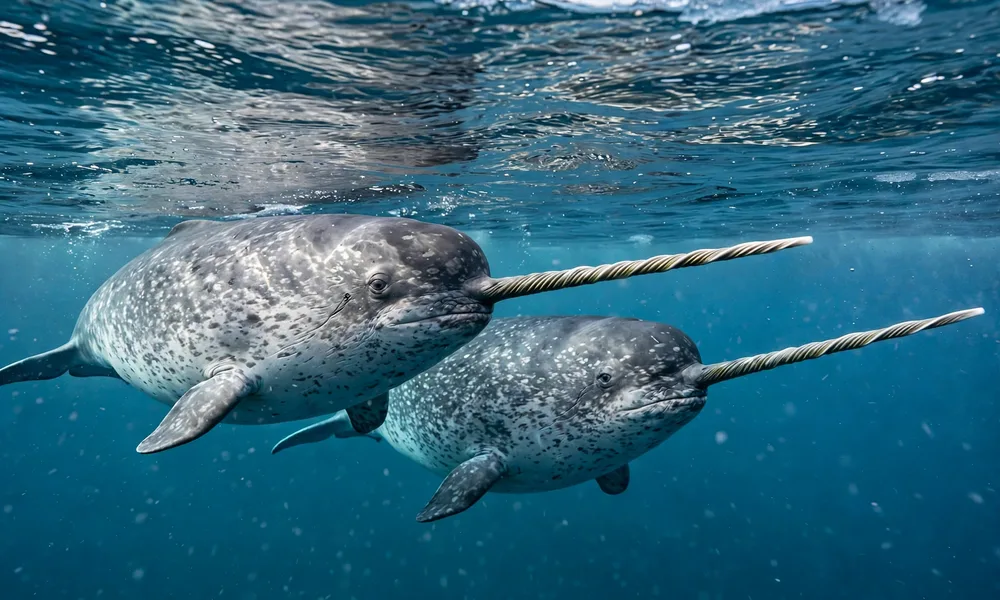
The narwhal species is a single species, Monodon monoceros, a toothed whale of the high Arctic that is famous for the long spiral tusk carried by the males. If you are asking how many narwhal species there are, the answer is one: there is only one narwhal species in the world, and every narwhal alive today belongs to it.
The narwhal belongs to the family Monodontidae, along with its closest relative, the beluga, and it lives only in the cold waters of the Arctic, where sea ice covers the sea for much of the year. Its mottled grey skin, its lack of a dorsal fin and its remarkable tusk make it one of the most recognisable whales on Earth.
Key takeaways
- There is only one narwhal species, Monodon monoceros, and it lives only in the Arctic.
- The narwhal’s tusk is not a horn but an elongated left canine tooth, carried mainly by males and growing up to about 3 metres long.
- Narwhals dive deeper than 1,500 metres to hunt fish, squid and shrimp in the dark.
- About 80,000 narwhals are estimated to live in the wild, most of them in Canadian and Greenland waters.
- Narwhals are listed as Near Threatened, because they depend on sea ice and are sensitive to noise, hunting and a warming Arctic.
What makes a narwhal a narwhal
A narwhal is a medium-sized toothed whale with a rounded head, a short blunt snout, mottled grey and white skin, and no dorsal fin, just a low ridge along its back. Its body measures roughly 3.8 to 4.5 metres long, not counting the tusk, and it usually weighs between 800 and 1,600 kilogrammes, with males larger than females.
The tusk defines the narwhal: an elongated left canine tooth that spirals anticlockwise as it grows, reaching up to about 3 metres long in large males. Most females do not grow a tusk, although a small number do, and the tusk is packed with nerve endings, which suggests that it senses changes in the water. Like other whales, the narwhal breathes air through a blowhole on top of its head, and it can stay underwater for a long time on a single breath.
The narwhal species and its relatives
Monodon monoceros is the only narwhal species, and it is not split into formally recognised subspecies. Narwhals in different parts of the Arctic form distinct populations that return to the same summering grounds each year, but these are regional populations of the same species.
The beluga is the narwhal’s closest living relative, being the only other member of its family, but it is pure white as an adult, has no tusk and lives in shallower coastal waters. The bowhead whale is another Arctic whale, much larger and slow-moving, feeding on tiny krill.
| Type | Animal | Where it lives | Best-known food | Length or Weight |
|---|---|---|---|---|
| Species | Narwhal (Monodon monoceros) | Arctic waters of Canada and Greenland | Greenland halibut and Arctic cod | 3.8 to 4.5 m, 800 to 1,600 kg |
| Close relative | Beluga whale | Arctic and sub-Arctic coasts | Fish, squid and crustaceans | 3 to 5 m |
| Close relative | Bowhead whale | Arctic seas | Krill and small crustaceans | 14 to 18 m |
| Close relative | Sperm whale | Deep oceans worldwide | Giant squid | 11 to 19 m |
| Close relative | Killer whale | Oceans worldwide | Fish, seals and other whales | 6 to 9 m |
| Close relative | Humpback whale | Oceans worldwide | Krill and small fish | 12 to 16 m |
| Close relative | Grey whale | North Pacific | Amphipods from the sea floor | 11 to 15 m |
How narwhals live
Narwhals are creatures of the pack ice. A narwhal lives in pods of around ten to twenty animals, and these pods join into much larger groups of hundreds in summer, when the ice breaks up and the whales gather in the same bays and fjords. Like other tundra and Arctic animals, it follows the seasons of the ice, moving with the freezing and melting of the sea.
Greenland halibut, Arctic cod and other fish make up most of the diet, along with squid and shrimp, and the narwhal hunts in deep water, diving to more than 1,500 metres where the light never reaches. It finds its prey by echolocation, sending out clicks and listening for the echoes, and it can stay underwater for over 20 minutes on a single breath. In winter it feeds under the ice, surfacing to breathe through cracks and leads.
Breeding happens in spring, and after a gestation of about 14 months the female gives birth to a single calf, usually in summer, in the sheltered bays where the pods gather. The calf is born grey-brown, about 1.5 metres long, and it stays with its mother for about two years. Narwhals live for around 50 years or more in the wild, and their skin grows paler and more mottled as they age.
Where narwhals live
The narwhal lives only in the Arctic, in the waters of Arctic Canada, Greenland, Svalbard and the Russian Arctic, and it is most common in Baffin Bay and the Canadian Arctic Archipelago. It spends the summer in shallow coastal bays and fjords, and the winter in deep offshore waters under the pack ice.
Sea ice is the key requirement. A narwhal needs cracks and leads in the ice to breathe through in winter, and open water in summer to feed and raise its calves, and it migrates hundreds of kilometres between its summer and winter grounds each year. It depends on the ice staying thick enough to shelter it from predators such as killer whales, yet open enough to let it breathe, like many other animals of the high Arctic.
The species is listed as Near Threatened, with about 80,000 animals estimated to live in the wild, most of them in Canadian and Greenland waters. The main pressures are the loss of sea ice as the Arctic warms, noise from shipping and seismic surveys, and hunting by Inuit communities, which is managed by quotas.
Best seasons for narwhal watching
There is no simple watching season, because narwhals live in remote Arctic waters and are shy animals that are hard to find even for experienced guides. The best chance comes in summer, from about June to September, when the sea ice breaks up and the whales gather in the bays and fjords of the Canadian Arctic and Greenland, and small expedition cruises sail through their waters.
The summer has its own trade-offs: the Arctic weather is changeable, fog is common, and the whales may be far from shore, so no trip can promise a sighting. Whichever trip you choose, book a small expedition cruise with guides who know the narwhal’s summering grounds.
Good places to try include the fjords of Baffin Island in Canada, the waters around Pond Inlet and Arctic Bay, and Disko Bay in Greenland, all of which are known summering grounds.
Staying safe around narwhals
A narwhal is a wild animal with a long, sharp tusk, and it can hurt a person, though narwhals almost never approach people and there are no recorded attacks on swimmers. Keep your distance, never enter the water with narwhals, and never try to touch or feed one. If you see narwhals from a boat, keep the engine slow and quiet, and let the animals come to you if they choose, because a noisy boat can startle a pod and drive it away.
Like other wild whales, narwhals can carry diseases, and any injury from a tusk should be treated as a medical emergency at once. Admire from a distance, from the deck of a boat, and never chase a pod. In the Arctic, the greater risks to visitors are cold water, bad weather and ice.
Narwhal watching checklist
A little preparation turns an Arctic cruise into a real chance of seeing a narwhal, so pack for cold wind, sea spray and long days on deck.
- Binoculars with good low-light performance, for picking a narwhal’s back out of the waves.
- A camera with a long lens, because narwhals should always be watched from a boat, never from the water.
- Warm layers and a waterproof jacket, because the Arctic wind is cold even in summer.
- Sea-sickness tablets, taken before boarding, because the best trips spend days at sea.
- A booked licensed expedition operator with guides who know the narwhal’s summering grounds.
- A plan to be out in summer, when the ice breaks up and the whales gather in the bays.
- Patience and silence, because narwhals are shy animals and a noisy boat will send them away.
Frequently asked questions
How many narwhal species are there?
There is one narwhal species, Monodon monoceros. Populations in different parts of the Arctic return to the same summering grounds each year, but they are regional populations of the same species. No second narwhal species is recognised.
Is a narwhal’s tusk a horn?
No. A narwhal’s tusk is an elongated left canine tooth that spirals as it grows, and it can reach about 3 metres long in large males. It is packed with nerve endings, which suggests that it senses changes in the water.
How deep can narwhals dive?
Narwhals dive deeper than 1,500 metres to hunt fish, squid and shrimp in the dark, and they can stay underwater for over 20 minutes on a single breath. They find their prey by echolocation, sending out clicks and listening for the echoes in water where no light reaches.
Why do narwhals depend on sea ice?
Narwhals depend on sea ice because it shelters them from predators such as killer whales, and because their feeding grounds and migration routes follow the freezing and melting of the sea. As the Arctic warms and the ice thins, narwhals lose both shelter and the predictable seasons they rely on.
How is this guide different from the Komodo dragon species guide?
This guide covers the single narwhal species, a whale of the icy Arctic seas, while our Komodo dragon species guide covers the single Komodo dragon species, a lizard of five hot Indonesian islands. The narwhal swims in freezing water under the ice, and the Komodo dragon hunts on foot in tropical heat.
Are narwhals endangered?
Narwhals are listed as Near Threatened, so they are not classed as endangered, but they are close to it, with about 80,000 left in the wild. They are among the most sensitive of all whales to a warming Arctic, because they live in such a narrow range and depend so closely on sea ice.
Conclusion
The narwhal species shows how much specialisation one animal can hold: Monodon monoceros, with a spiral tusk that is really a tooth, dives deeper than 1,500 metres, and a life spent following the sea ice of the high Arctic. It is one of the most northerly whales on Earth, and it has lived in the frozen north for thousands of years.
If you go looking for one, go in summer, go with a small expedition cruise, and go with patience. Watch a narwhal surface among the ice floes, its long tusk breaking the water, and you will understand why it has earned its place as the unicorn of the sea, and why keeping its Arctic ice matters most.