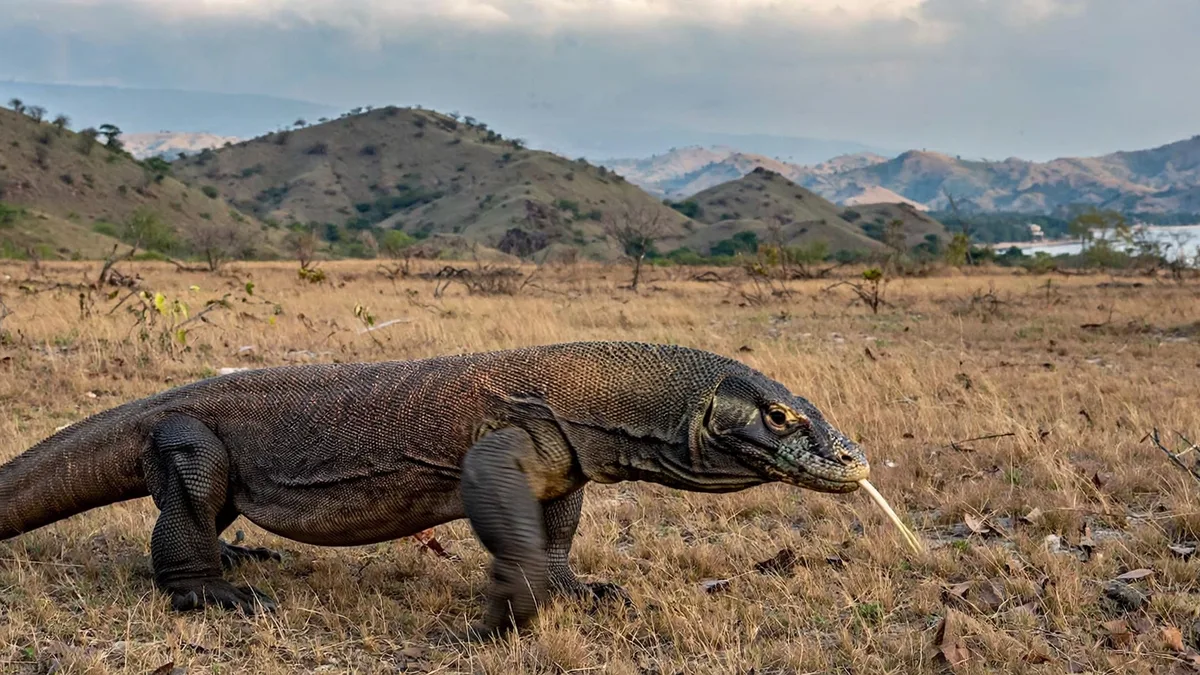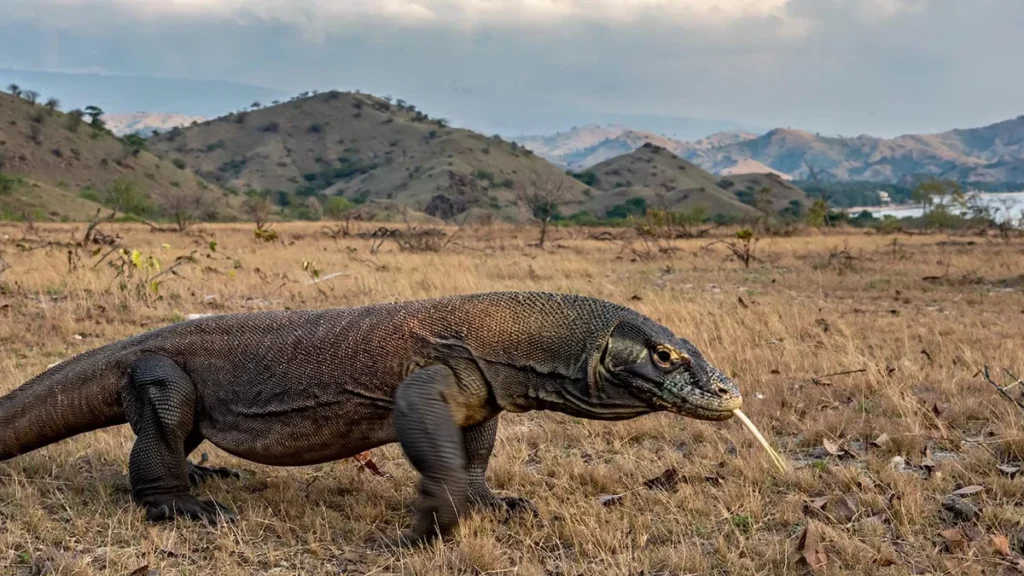
The Komodo dragon species is a single species, Varanus komodoensis, the largest living lizard on Earth, a heavy-bodied hunter that lives only on a handful of Indonesian islands. If you are asking how many Komodo dragon species there are, the answer is one: there is only one Komodo dragon species in the world, and every Komodo dragon alive today belongs to it.
The Komodo dragon belongs to the monitor lizard family, Varanidae, and it is the largest member of that family by a wide margin, growing to lengths that no other lizard reaches. It has rough, armoured skin, a long forked tongue, powerful legs with sharp claws, and a bite that is both venomous and full of bacteria.
Key takeaways
- There is only one Komodo dragon species, Varanus komodoensis, and it is the largest living lizard on Earth.
- Komodo dragons grow up to about 3 metres long and usually weigh around 70 to 90 kilogrammes.
- Komodo dragons live only on five Indonesian islands: Komodo, Rinca, Flores, Gili Motang and Padar.
- Komodo dragons have a venomous bite, and bacteria in their mouths can also infect a wound.
- Komodo dragons are listed as Endangered, with only a few thousand left in the wild.
What makes a Komodo dragon a Komodo dragon
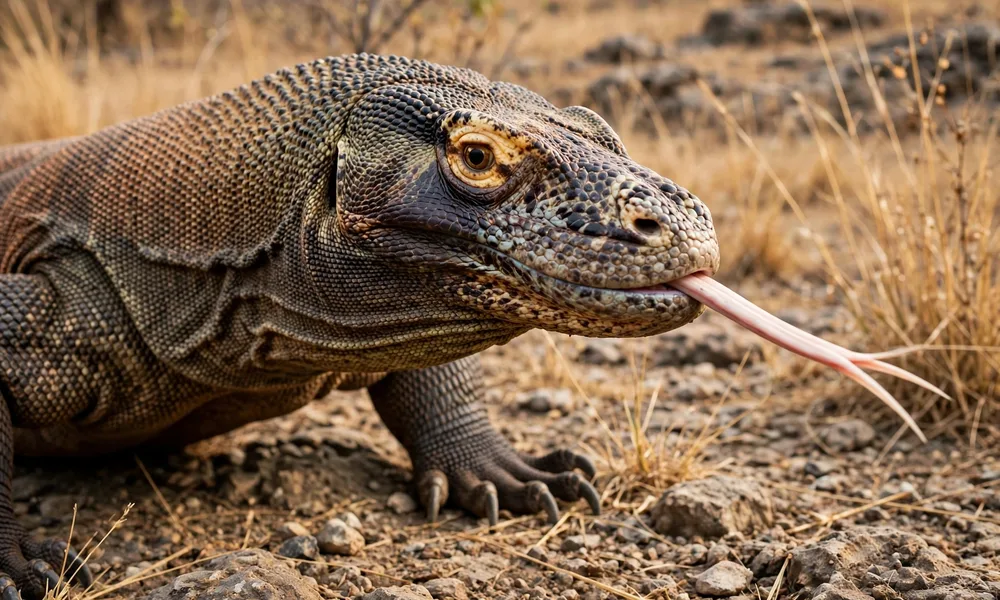
A Komodo dragon is a massive lizard with rough, grey-brown skin covered in small bony plates, a long muscular tail, strong legs with curved claws, and a long yellow forked tongue that flicks in and out to taste the air. Its body measures roughly 2 to 3 metres long, including the tail, and it usually weighs around 70 to 90 kilogrammes, with males larger than females.
The bite defines the Komodo dragon: it has around 60 sharp, serrated teeth, set in jaws that can open wide, and glands that produce venom, which lowers blood pressure and stops blood from clotting. Bacteria in its mouth can also infect a bite wound, so even a bite that is not deep can be dangerous. Like other predator animals, it is an ambush hunter, waiting in cover before rushing its prey.
The Komodo dragon species and its relatives
Varanus komodoensis is the only Komodo dragon species, and it is not split into formally recognised subspecies. Dragons on different islands vary slightly in size, but these are island populations of the same species, not separate species.
The perentie of Australia is the Komodo dragon’s closest relative in size, being the largest lizard in Australia, but it is smaller, faster and more slender. The Asian water monitor is a large swimmer of rivers and coasts, and the Nile monitor fills the same role in Africa.
| Type | Animal | Where it lives | Best-known food | Length or Weight |
|---|---|---|---|---|
| Species | Komodo dragon (Varanus komodoensis) | Five islands in Indonesia | Deer, pigs and carrion | Up to about 3 m, 70 to 90 kg |
| Close relative | Perentie | Deserts of Australia | Kangaroos and other lizards | Up to about 2.5 m |
| Close relative | Asian water monitor | Rivers and coasts of Asia | Fish, crabs and snakes | Up to about 2 m |
| Close relative | Nile monitor | Rivers and wetlands of Africa | Fish, frogs and crocodile eggs | Up to about 2.2 m |
| Close relative | Lace monitor | Forests of eastern Australia | Birds, eggs and small mammals | Up to about 2 m |
| Close relative | Crocodile monitor | Rainforests of New Guinea | Birds, eggs and small mammals | Up to about 2.5 m |
| Close relative | Bengal monitor | South Asia | Insects, rodents and birds | Up to about 1.8 m |
How Komodo dragons live
Komodo dragons are creatures of the dry savanna and open woodland. A Komodo dragon lives alone for most of its life, holding a home range that it patrols daily, and it comes together with other dragons only around a large carcass or in the breeding season, when males fight for the right to mate. Young dragons climb trees to escape the adults, which will eat them.
Deer and wild pigs make up most of the diet of adult dragons, along with water buffalo, goats and carrion, and a dragon can eat a huge meal in one sitting, swallowing large chunks of meat and bone. It hunts by ambush, waiting in cover near a game trail and then rushing out to bite the prey’s leg or throat. A dragon can also follow the scent of a dead animal for several kilometres, using its forked tongue to taste the air.
Breeding happens in the dry season, and after mating the female lays her eggs in a nest, often in a burrow dug by another animal, laying about 20 to 30 eggs. The eggs hatch after seven to eight months, and the young dragons, about 40 centimetres long, climb into the trees at once and stay there for their first years. Komodo dragons live for around 30 years in the wild, and longer in captivity.
Where Komodo dragons live
The Komodo dragon lives only on five islands in Indonesia: Komodo, Rinca, Flores, Gili Motang and Padar, in the Lesser Sunda Islands between Java and Timor. It lives in dry savanna grassland, open woodland and coastal scrub, and it needs warm temperatures, open ground for hunting and burrows for shelter. It is one of the most famous savanna animals of Asia.
Dry, hot islands are the key requirement. A Komodo dragon needs temperatures that stay warm all year, because it is cold-blooded, and it basks in the morning sun before hunting. It depends on healthy populations of deer and pigs and on large areas of unbroken savanna.
The species is listed as Endangered, with only a few thousand left in the wild. The main pressures are the loss of savanna to farming and settlement, the decline of deer and pigs through hunting, and the risk of a single disaster, such as a fire or a disease outbreak, striking one of its five small islands. Most dragons live inside Komodo National Park, which was set up to protect them, and the park’s rangers guard the islands and their prey.
Best seasons for Komodo dragon watching
There is no closed season, because Komodo dragons are active all year on their warm islands, but the dry season, from about April to December, is usually the best time to look for them. The grass is short, the dragons bask in the open, and the walking trails are dry and easy to follow. The wet season, from January to March, brings lush grass that hides the dragons and muddy trails.
The dry season has its own trade-off: the heat is intense by midday, and the dragons rest in the shade or in their burrows through the hottest hours. Whichever season you choose, the best hours are the early morning, when the dragons bask in the sun, and the late afternoon, when they hunt. All visits to Komodo National Park must be made with a licensed ranger, and no one may walk the trails alone.
Good places to try include the islands of Komodo and Rinca, where the rangers know the dragons’ home ranges and the best trails.
Staying safe around Komodo dragons
A Komodo dragon is a wild animal with sharp teeth, strong claws and a venomous bite, and it can kill a person, although attacks are rare. Keep your distance, never walk the trails without a ranger, and never approach a dragon, even one that looks asleep. If a dragon approaches, stay calm, keep the ranger between you and the animal, and back away slowly, and never run, because a dragon can run faster than a person over a short distance.
Like other wild reptiles, Komodo dragons can carry bacteria, and any bite or scratch should be washed at once and checked by a doctor without delay, because the venom and bacteria together make a bite a medical emergency. Admire from a distance, with a ranger at your side.
Komodo dragon watching checklist
A little preparation turns a park visit into a real chance of seeing a Komodo dragon, so pack for tropical heat, dry dust and early mornings.
- Binoculars with good low-light performance, for picking a dragon out of the dry grass.
- A camera with a long lens, because dragons should always be watched from a distance.
- Light layers and sun protection, because the islands are hot by day and bright all year.
- Water and snacks for long walks, because the best sightings come after hours of searching.
- A booked licensed ranger, who is required on every walk in Komodo National Park.
- A plan to be out at dawn, when dragons are basking and the light is at its best.
- Patience and silence, because dragons are wary animals and a noisy group will send them away.
Frequently asked questions
How many Komodo dragon species are there?
There is one Komodo dragon species, Varanus komodoensis. Dragons on different islands vary slightly in size, but they are island populations of the same species. No second Komodo dragon species is recognised.
Are Komodo dragons venomous?
Yes. Komodo dragons have glands that produce venom, which lowers blood pressure and stops blood from clotting, and bacteria in their mouths can also infect a bite wound. A bite is a medical emergency and should be treated by a doctor at once.
Where do Komodo dragons live?
Komodo dragons live only on five Indonesian islands: Komodo, Rinca, Flores, Gili Motang and Padar. They live nowhere else in the wild, and most of them are inside Komodo National Park.
What do Komodo dragons eat?
Komodo dragons eat deer, wild pigs, water buffalo, goats and carrion. Young dragons eat insects, small lizards and birds in the trees, and adults hunt by ambush.
How is this guide different from the bald eagle species guide?
This guide covers the single Komodo dragon species, a flightless lizard of five Indonesian islands, while our bald eagle species guide covers the single bald eagle species, a bird of prey of the lakes and coasts of North America. The Komodo dragon hunts on foot in hot savanna, and the bald eagle hunts from the air over cold water.
Are Komodo dragons endangered?
Komodo dragons are listed as Endangered, so they are classed as endangered, with only a few thousand left in the wild. Their whole range covers just five small islands, so protecting the savanna, the deer and pigs they eat, and the national park that shelters them are the most important steps for keeping them healthy.
Conclusion
The Komodo dragon species shows how much specialisation one animal can hold: Varanus komodoensis, with a venomous bite, a forked tongue that tastes the air for kilometres, and a life spent hunting on five small islands where no other large predator lives. It is the largest living lizard on Earth, and it has ruled its islands for thousands of years.
If you go looking for one, go in the dry season, go with a ranger, and go quietly. Watch a Komodo dragon stride across the savanna in the morning sun and you will understand why it has earned its place as one of the most famous reptiles in the world, and why keeping its five islands whole matters most.