The kodkod species is a single species, Leopardus guigna, a tiny spotted wild cat that lives in the temperate rainforests of Chile and Argentina. If you are asking how many kodkod species there are, the answer is one.
The kodkod is the smallest cat of the Americas, a cat so small that an adult can weigh about as much as a bag of sugar. It hunts at night, climbs trees with ease, and slips through dense bamboo thickets that larger cats cannot enter.
Key takeaways
- There is only one kodkod species, Leopardus guigna, a small spotted cat of southern South America.
- Kodkods are the smallest cats of the Americas, usually weighing about two to three kilogrammes.
- They live in the temperate rainforests of Chile and Argentina, including dense bamboo forest.
- Kodkods are partly tree-dwelling and mostly nocturnal, hunting rodents, birds and lizards after dark.
- The kodkod is listed as Vulnerable, threatened mainly by the loss and splitting up of its forest home.
What makes a kodkod a kodkod
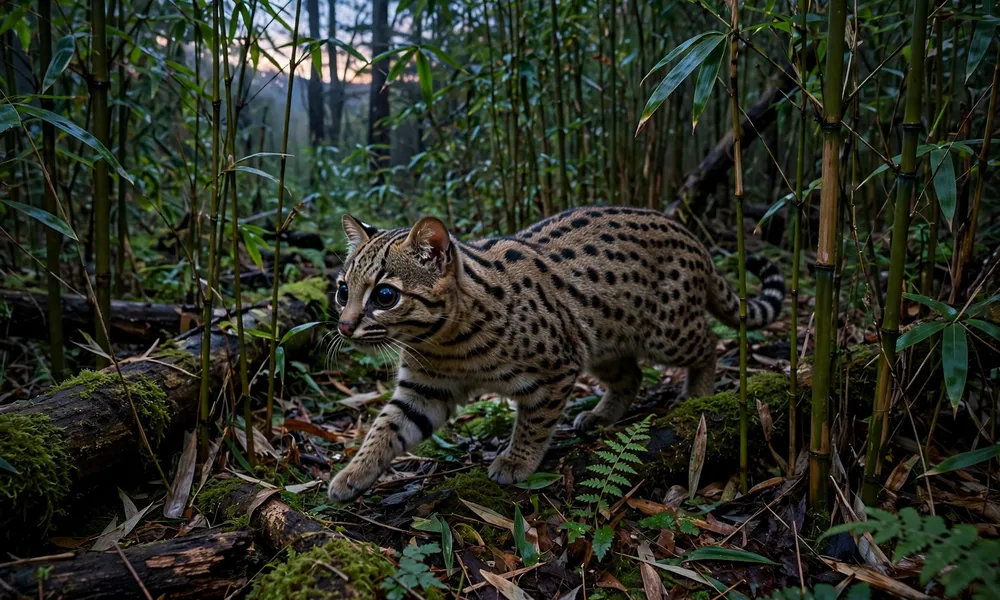
A kodkod is a compact little cat with a grey-brown coat covered in small black spots, a pale belly, and a short tail banded with dark rings. Its head is small and rounded, with large eyes and neat ears, and its body measures about 37 to 51 centimetres, with a tail of about 20 to 25 centimetres. An adult usually weighs between two and three kilogrammes.
The spots are the kodkod’s first clue, but its size is the second. No other wild cat in the Americas is so small, and the kodkod’s short legs and long body give it a low, creeping shape as it moves through undergrowth. Some kodkods are much darker than others, and a few are almost black, a form known as melanistic.
What sets the kodkod apart is how at home it is in trees. It climbs with strong, curved claws, rests on mossy branches by day, and can leap between branches or drop quietly to the forest floor. Its large eyes gather what little light reaches the forest at night.
The kodkod species and its relatives
Leopardus guigna is the only kodkod species. A few local forms have been described, but they are all the same species. It sits in the cat family, Felidae, alongside the ocelot, the margay and the other small spotted cats of the Americas.
The oncilla is the kodkod’s nearest lookalike, but it lives further north and is slightly larger and longer-legged. The margay is a longer-tailed tree climber of tropical forests, the ocelot is a much larger spotted hunter, and Geoffroy’s cat hunts in drier scrub and grassland. The pampas cat and the Andean mountain cat live in open high country, while the jaguarundi is a plain-coated cat of lowland forest and scrub.
| Type | Animal | Where it lives | Best-known food | Length |
|---|---|---|---|---|
| Species | Kodkod (Leopardus guigna) | Chile and Argentina | Rodents, birds and lizards | 37 to 51 cm body |
| Close relative | Oncilla | Central and South America | Rodents, birds and lizards | 38 to 59 cm body |
| Close relative | Margay | Central and South America | Rodents, birds and small monkeys | 48 to 79 cm body |
| Close relative | Ocelot | Central and South America | Small mammals and birds | 55 to 100 cm body |
| Close relative | Geoffroy’s cat | Southern South America | Rodents, birds and hares | 42 to 66 cm body |
| Close relative | Pampas cat | South American grassland and scrub | Rodents, birds and lizards | 46 to 70 cm body |
| Close relative | Andean mountain cat | High Andes of South America | Viscachas and small rodents | 57 to 85 cm body |
| Close relative | Jaguarundi | Central and South America | Rodents, birds and reptiles | 53 to 77 cm body |
How kodkods live
Kodkods are solitary cats. Each adult holds a small home range in the forest, marked with scent and defended against other kodkods of the same sex. They are most active at night, resting through the day in a tree hollow, a dense thicket or a mossy fork. Like other nocturnal animals, they use the dark for cover.
Rodents are the kodkod’s main prey. It hunts on the ground and in the trees, listening for movement in leaf litter or bamboo, then pouncing with a short rush. Birds, lizards and large insects make up the rest of the diet, and a kodkod may also take small marsupials that share its forest.
Breeding can happen at any time of year, and after a gestation of about 72 to 78 days the female gives birth to one to three kittens in a sheltered den, often in a tree hollow or a dense bamboo clump. The kittens are born spotted, open their eyes at about ten days, and start hunting with their mother at a few months old.
Where kodkods live
The kodkod lives only in Chile and Argentina, in the cool temperate rainforests of the southern Andes and the coastal ranges. It is at home in the Valdivian forest, with its evergreen trees, ferns and hanging moss, and it is one of the hardiest rainforest animals of the far south, living where winter rain is heavy and snow falls on the higher slopes.
Within that range the kodkod favours thick cover. Bamboo thickets are a favourite haunt, because they hide the cat and hold many rodents, and old forest with hollow trees gives it safe dens and daytime resting places. It is also found in forest patches near farms, where it hunts along hedges and streams.
The species is listed as Vulnerable, and its forest is shrinking. Logging, farming and roads cut the forest into small patches, and kodkods are also killed by dogs, by cars on forest roads, and by farmers protecting poultry. A kodkod that must cross open ground between forest patches is in real danger.
Best seasons for kodkod watching
Kodkods are active all year, so there is no closed season, but the southern summer, from December to February, is usually the best time to look for them. The nights are shorter and warmer, the forest tracks are drier, and a patient watcher can sit out at dusk without the cold and rain of winter.
The wet winter, from May to August, has its own rewards. The forest is at its greenest, and kodkods are often bolder near the edges of the bamboo, but rain can cut a walk short, and the tracks turn to mud. The best hours are the last two before sunset and the first two after it.
Good places to try include the national parks of southern Chile, such as Chiloé and Pumalín, and the forested parks of the Argentine Andes. A local guide makes a real difference, because kodkods are quiet, small and quick to vanish into bamboo, and a guide knows the tracks and the resting trees.
Staying safe around kodkods
A kodkod is a wild cat with sharp teeth and strong claws, and although it is far too small to be a danger to people, it should always be treated with respect. Keep your distance, never approach one on foot, and never try to touch or feed it, because a cornered cat can bite hard. If one comes close, stay still and let it move away.
Kodkods are sometimes seen near farms, where they may take chickens, and farmers in some regions shoot or trap them for it. If you are staying on a farm or near a forest edge, keep poultry shut in at night and ask the local staff how kodkods are managed in the area. Any bite or scratch should be washed at once and checked by a doctor without delay.
The other safety issue is dogs. A free-roaming dog can kill a kodkod, and dogs also disturb the forest at night. Keep dogs on a lead in kodkod country, walk on marked tracks, and never leave food out, because food draws in dogs and other animals that put pressure on the forest.
Kodkod watching checklist
A little preparation turns a dusk walk in wet forest into a real chance of seeing a kodkod, so pack for rain, mud and long, quiet waits.
- Binoculars with good low-light performance, for picking a small spotted kodkod out of dark bamboo.
- A camera with a fast shutter speed, ready for a sudden pounce or a short climb.
- Waterproof clothing and sturdy boots, because kodkod forest is wet and the tracks are muddy.
- A red-filtered torch, which lets you watch at night without blinding the animals.
- A booked local guide who knows the tracks, the bamboo thickets and the kodkod territories.
- A plan to be out at dusk, when kodkods leave cover to hunt.
- Patience and silence, because kodkods are quiet, shy animals and a noisy group will send them away.
Frequently asked questions
How many kodkod species are there?
There is one kodkod species, Leopardus guigna. It is the only kodkod species in southern South America, and although a few local forms have been described, they are all the same species. No second kodkod species is recognised.
Is the kodkod the smallest cat in the world?
No, the kodkod is the smallest cat of the Americas, not the smallest cat in the world. The rusty-spotted cat of Asia and the black-footed cat of Africa are smaller still. The kodkod is small for an American cat, usually weighing about two to three kilogrammes.
What do kodkods eat?
Kodkods eat rodents, birds, lizards and large insects. Rodents make up most of the diet, hunted on the forest floor and in the trees, while birds and lizards are taken when the chance comes. A kodkod may also take small marsupials that share its forest home.
Where do kodkods live, and can they climb trees?
Kodkods live in the temperate rainforests of Chile and Argentina, including Valdivian forest and dense bamboo thickets, and yes, they are strong climbers. They rest in tree hollows and on mossy branches by day, hunt in the branches at night, and use the trees to escape dogs and other danger.
How is this guide different from the margay species guide?
This guide covers the single kodkod species, a tiny, short-tailed cat of the cool temperate rainforests of Chile and Argentina, while our margay species guide covers the margay, a longer-tailed tree climber of the warm tropical forests of Central and South America. The two are close relatives, but they live in different climates and hunt in different forests.
Are kodkods endangered?
Kodkods are listed as Vulnerable, which means they are at high risk of becoming endangered if their forest keeps shrinking. The main pressures are the loss and splitting up of temperate rainforest, along with killing by dogs, road deaths, and shooting by farmers who lose poultry to them.
Conclusion
The kodkod species shows how much life one tiny cat can hold: Leopardus guigna, the smallest cat of the Americas, with its spotted grey-brown coat, its large night eyes and its skill in the trees, a hunter built for the wet, green forests of Chile and Argentina. It slips through bamboo, climbs mossy branches and hunts where few other cats can.
If you go looking for one, go at dusk, go with a guide, and go quietly. Watch a kodkod standing alert on a branch, eyes wide in the half-light, and you will understand why this little forest cat has earned its place in the southern rainforest, and why keeping its forest standing matters most.