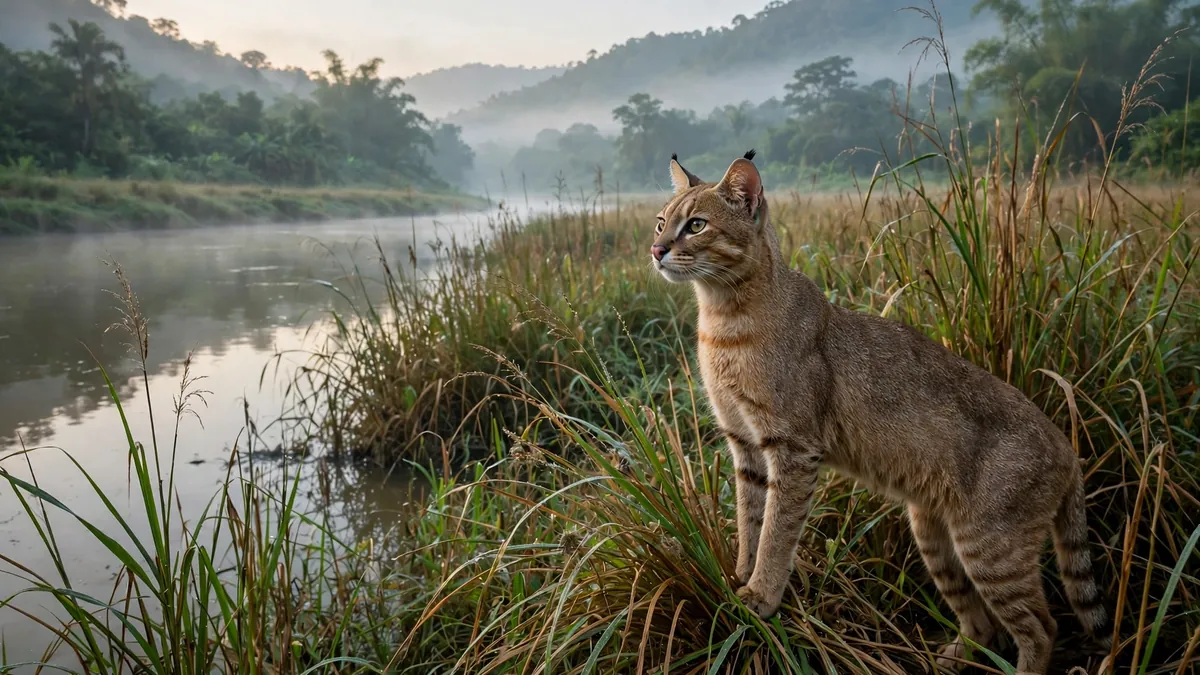
The jungle cat species is a single species, Felis chaus, a medium-sized wild cat with long legs and small ear tufts that hunts in the reed beds and marshes of Asia. If you are asking, how many jungle cat species are there? The answer is one.
Despite its name, the jungle cat does not live mainly in jungle. It prefers wetlands, reed beds, riverbanks and scrub, from Egypt in the west to India and South-east Asia in the east. It is a strong swimmer, a skilled hunter of birds, rodents and fish, and one of the most water-loving of all the small cats.
Key takeaways
- There is only one jungle cat species, Felis chaus.
- Despite the name, jungle cats live mainly in wetlands, reed beds, marshes and riverbanks, not in deep jungle.
- Jungle cats are strong swimmers and will wade into shallow water to catch fish and frogs.
- A jungle cat usually weighs between 5 and 9 kilogrammes, with a plain sandy-brown coat and small ear tufts.
- The jungle cat is listed as Least Concern, but wetland loss is shrinking its hunting grounds.
What makes a jungle cat a jungle cat
A jungle cat is a tall, long-legged cat with a plain coat of sandy brown or greyish brown, a pale belly, and faint markings that fade as the animal grows up. It measures roughly 59 to 76 centimetres in head and body length, with a tail of 21 to 36 centimetres, and usually weighs between 5 and 9 kilogrammes, although large males can reach about 16 kilogrammes.
The ears are the first thing to look for. They are large and pointed, set close together on a fairly narrow head, and each is tipped with a small dark tuft of hair. The tufts are much shorter than those of a caracal, and the jungle cat is slimmer and longer-legged, built for moving through tall reeds rather than leaping across open ground.
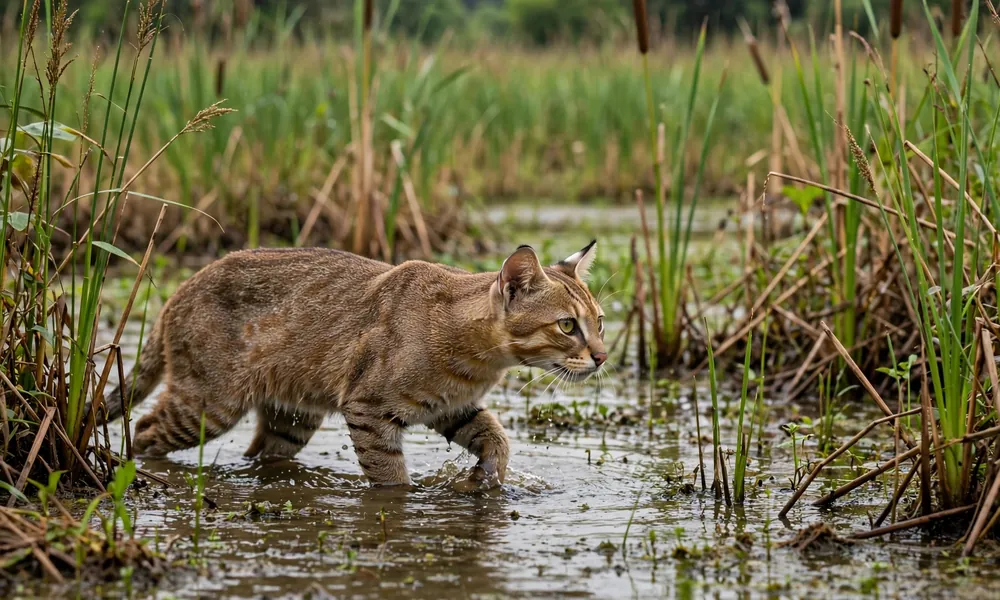
What sets the jungle cat apart from most other small cats is its love of water. It wades through shallow marshes, swims across channels without hesitating, and dives for fish with its head under the surface. Few cats will enter water so willingly, and the jungle cat uses that habit to reach prey that other cats cannot.
The jungle cat species and its relatives
Felis chaus is the only jungle cat species. It sits in the cat family, Felidae, in the genus Felis alongside the African wildcat, the sand cat and the black-footed cat, and its closest wetland-loving relative is the fishing cat.
The fishing cat is the jungle cat’s nearest lookalike in the marshes, but it is stockier, shorter-legged and spotted, and it fishes more than it hunts on land. The leopard cat is smaller and heavily spotted, and it hunts in forest rather than reeds. The caracal is larger and lives in drier country, the serval is spotted and longer-legged, and the African wildcat and sand cat are smaller cats of dry country.
| Type | Animal | Where it lives | Best-known food | Length |
|---|---|---|---|---|
| Species | Jungle cat (Felis chaus) | Asia, from Egypt to South-east Asia | Rodents, birds and fish | 59 to 76 cm body |
| Close relative | Caracal | Africa, Middle East, Central Asia and India | Birds, rodents and small antelope | 60 to 92 cm body |
| Close relative | Serval | African grassland and wetlands | Rodents, birds and frogs | 59 to 92 cm body |
| Close relative | Fishing cat | Wetlands of South and South-east Asia | Fish, crabs and rodents | 57 to 78 cm body |
| Close relative | Leopard cat | Forests and scrub across Asia | Rodents, birds and small reptiles | 45 to 60 cm body |
| Close relative | African wildcat | Africa, Middle East and Central Asia | Rodents, birds and small reptiles | 45 to 75 cm body |
| Close relative | Sand cat | Deserts of North Africa and Central Asia | Rodents, birds and reptiles | 39 to 52 cm body |
| Close relative | Eurasian lynx | Forests of Europe and Asia | Roe deer and hares | 76 to 106 cm body |
How jungle cats live
Jungle cats are solitary cats. Each adult holds a home range along a stretch of river, marsh or reed bed, marked with scent and defended against other jungle cats of the same sex. They are most active at dawn and dusk, resting through the heat of the day in dense reeds or a hollow among the roots. Like other nocturnal animals, they also hunt well after dark, using their hearing to find prey hidden in the reeds.
Rodents are the jungle cat’s main food. It moves slowly through the reeds, ears swivelling, listening for the rustle of a rat or mouse, then pounces with a high, stiff-legged leap. Birds are taken the same way, snatched from the ground or from low perches, and fish are caught by wading into shallow water and striking with a fast paw.
Breeding can happen at any time of year, and after a gestation of about 63 to 68 days the female gives birth to one to five kittens in a sheltered den, often in a dense reed bed, a hollow log or an abandoned burrow. The kittens are born spotted, open their eyes at about ten days, and start hunting with their mother at five or six months old.
Where jungle cats live
The jungle cat has one of the widest ranges of any small cat. It is found from Egypt and the Nile Delta, through the Middle East and Central Asia, across India and Sri Lanka, and eastwards into South-east Asia as far as Vietnam. It is a cat of low, wet country, at home in reed beds, marshes, swamps and riverbanks, and one of the most water-loving wetland animals among the cats.
Within that range the jungle cat follows the water. It is commonest where tall reeds, sugarcane and thick riverside scrub give it cover to hunt in, and it is often seen near villages and farmland, where rats and mice gather in the crops. It avoids true rainforest and high mountains.
The species is listed as Least Concern, but its numbers are falling in many places. The main pressure is the loss of wetlands to farming, drainage and building, which drains its reed beds and cuts off the routes between populations.
Best seasons for jungle cat watching
Jungle cats are active all year, so there is no closed season, but the dry season is usually the best time to look for them. Water levels fall, so fish and frogs gather in the remaining pools, and jungle cats come to the same places to hunt. The reeds are shorter and thinner too, which makes a sandy-brown cat easier to spot against the water.
The wet season has its own rewards. There is more prey about, and jungle cats are often bolder along the edges of flooded fields, but tall reeds hide them well, and rain can cut a walk short.
Good places to try include the wetlands and river reserves of India, such as Bharatpur and the Sundarbans fringes, and the reed beds of the Nile Delta in Egypt, where jungle cats are often seen at dawn. A local guide makes a real difference, because jungle cats are quiet and quick to vanish into the reeds.
Staying safe around jungle cats
A jungle cat is a wild cat with sharp teeth and strong claws, and although it is not a danger to people under normal conditions, it should always be treated with respect. Keep your distance, never approach one on foot or try to touch or feed it, because a cornered cat can bite hard. If one comes close, stay still and let it move away.
Jungle cats are sometimes seen near villages and farms, where they may take poultry, and farmers in some regions shoot or trap them for it. If you are staying near farmland or a reserve boundary, keep poultry and small pets indoors at night and ask the local staff how jungle cats are managed in the area. Any bite or scratch should be washed at once and checked by a doctor without delay.
The other safety issue is the pet trade. Jungle cats are sometimes sold as exotic pets, but they make poor ones: they are active, strong and restless, need a large space to roam and swim, and can injure a person badly when frightened.
Jungle cat watching checklist
A little preparation turns a dawn or dusk walk along the reeds into a real chance of seeing a jungle cat, so pack for wet ground and long, quiet waits.
- Binoculars with good low-light performance, for picking a sandy-brown jungle cat out of tall reeds.
- A camera with a fast shutter speed, ready for a sudden pounce.
- Waterproof boots or waders, because jungle cat country is wet, muddy and often flooded.
- Neutral-coloured clothing in tan, khaki or olive, which blends into reeds and riverbanks.
- Water, sun protection and a hat, because reed beds are hot by day.
- A booked local guide who knows the reed beds, the tracks and the jungle cat territories.
- Patience and silence, because jungle cats are quiet, shy animals and a noisy group will send them away.
Frequently asked questions
How many jungle cat species are there?
There is one jungle cat species, Felis chaus. It sits in the genus Felis alongside the African wildcat, the sand cat and the black-footed cat. No second jungle cat species is recognised.
Do jungle cats live in jungles?
Not mainly, despite the name. Jungle cats prefer wetlands, reed beds, marshes, riverbanks and scrub, and they avoid true rainforest. The name is an old one, from a time when jungle was used loosely for any wild, overgrown ground.
Can jungle cats swim?
Yes, jungle cats are strong swimmers and will wade and swim through marshes and channels without hesitating. They catch fish by striking with a fast paw in shallow water. Few small cats are as comfortable in water as the jungle cat.
What do jungle cats eat?
Jungle cats eat rodents, birds, fish, frogs and reptiles. Rodents are the main food day to day, but fish and frogs matter most in the wettest reed beds. A large jungle cat can take prey as big as a hare.
How is this guide different from the caracal species guide?
This guide covers the single jungle cat species, a long-legged hunter of Asian reed beds and marshes that swims and fishes, while our caracal species guide covers the caracal, a tufted-eared hunter of dry savanna, scrub and semi-desert that leaps up to three metres to catch birds. The two are close relatives, but they live in different places and hunt in different ways.
Are jungle cats endangered?
Jungle cats are listed as Least Concern, so they are not classed as endangered, but their numbers are declining in many parts of their range. The loss of wetlands to farming, drainage and building is the main pressure, along with killing by farmers who lose poultry to them.
Conclusion
The jungle cat species shows how much character one medium-sized cat can hold: Felis chaus, with its long legs, its small ear tufts and its plain sandy-brown coat, a hunter built for the reed beds and marshes of Asia. It swims where other cats will not, fishes in shallow water, and lives where the river meets the reeds.
If you go looking for one, go at dawn or dusk, go with a guide, and go quietly. Watch a jungle cat standing alert in the reeds, ears swivelling, and you will understand why the reed-bed hunter has earned its place in the wetlands, and why keeping its marshes and rivers standing matters most.