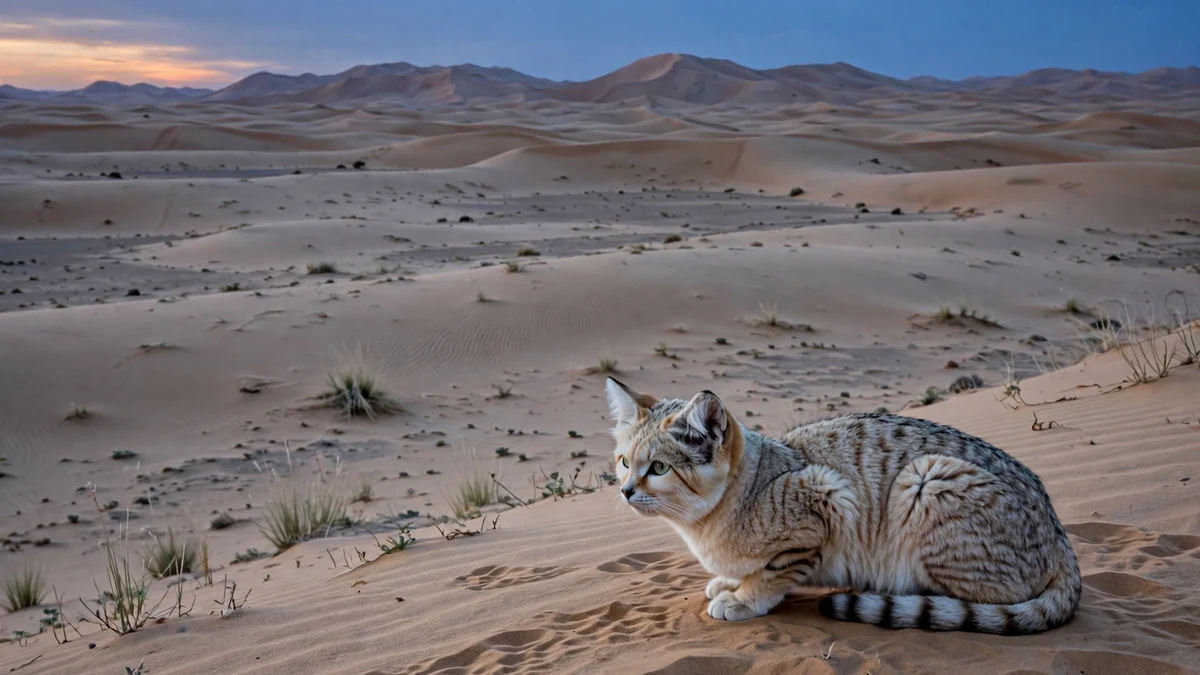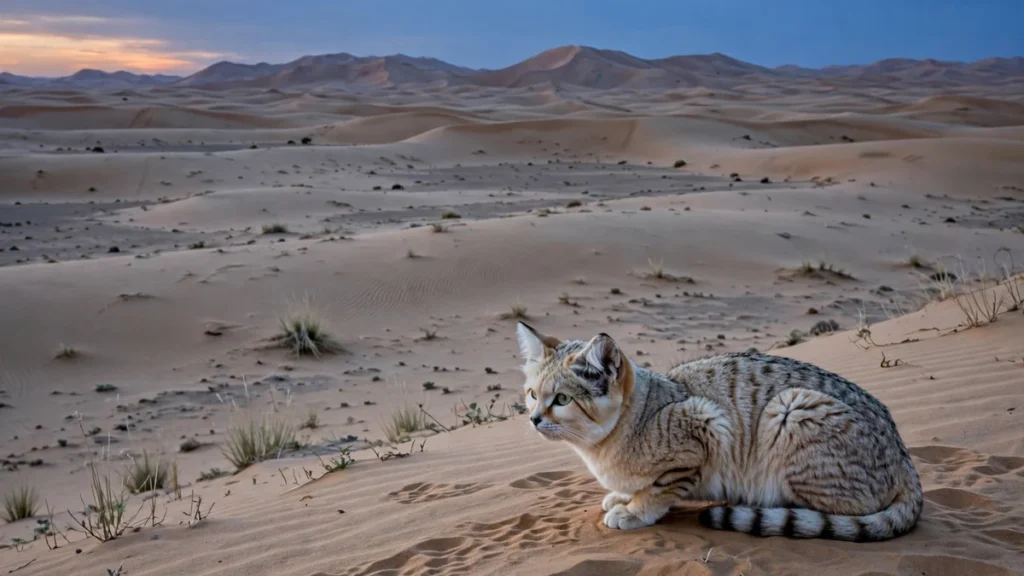
The sand cat species is a single species, Felis margarita, a small wild cat of the deserts of Africa and Asia that is the only cat to live mainly in true desert. If you are asking how many sand cat species there are, the answer is one: there is only one sand cat species in the world, and every sand cat alive today belongs to it.
The sand cat is a small, pale cat with large ears, a flat head and fur-covered paws that protect it from hot sand. It lives in the Sahara, the Arabian deserts and the deserts of Central Asia, hunting at night in a landscape of sand, rock and sparse scrub, and it is one of the least seen of all the small cats.
Key takeaways
- There is only one sand cat species, Felis margarita.
- Sand cats live in the true deserts of Africa and Asia, from the Sahara to Central Asia.
- The fur-covered paws protect the sand cat from hot sand and give it grip on loose dunes.
- A sand cat usually weighs about 1.5 to 3.5 kilogrammes and hunts rodents, birds and reptiles.
- Sand cats are listed as Least Concern, but they lose habitat to farming and settlement.
What makes a sand cat a sand cat
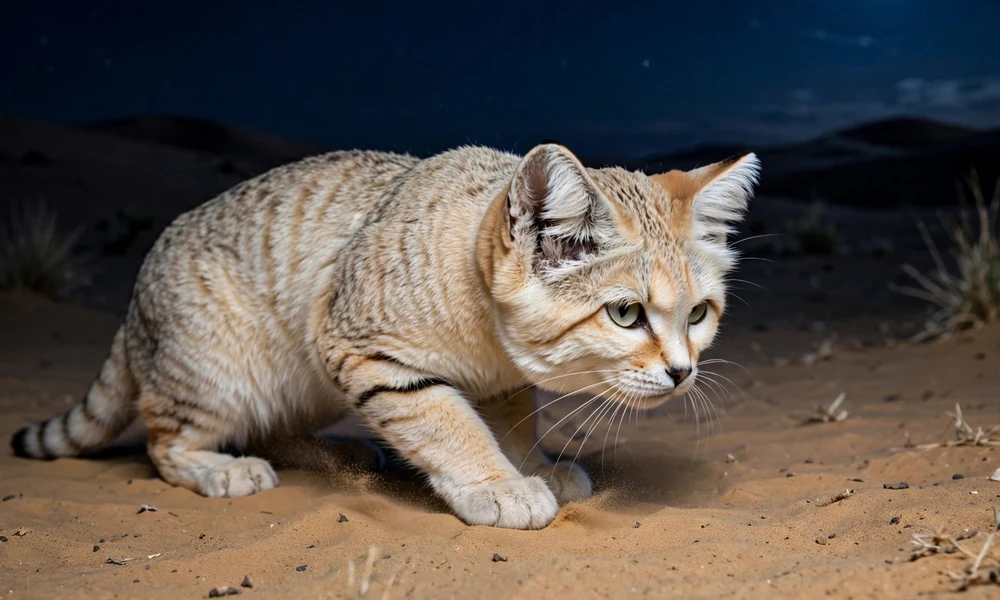
A sand cat is a small, stocky cat with a head and body measuring roughly 39 to 57 centimetres, a tail of about 23 to 31 centimetres, and a weight of about 1.5 to 3.5 kilogrammes. Its coat is pale sandy-yellow or grey, marked with faint spots and stripes, with a pale belly and dark bands on the legs and tail. Its ears are very large and set low on the sides of the head, and its head is broad and flat.
The sand cat is built for the desert. Its paws are covered in dense fur, which protects the pads from hot sand by day and gives it grip on loose dunes, and its ears are large enough to pick up the faintest sounds of prey moving under the sand. Its fur is thick and soft, insulating it against cold desert nights, and its eyes are large for hunting after dark.
What sets the sand cat apart is its desert life. It is the only cat that lives mainly in true desert, in places where rain may not fall for months, and it can live for long periods without drinking, getting most of its water from its prey. It digs burrows in the sand, shelters from the heat of the day, and emerges at dusk to hunt through the cool night.
The sand cat species and its relatives
Felis margarita is the only sand cat species, and the only living member of its species. A number of subspecies have been described, but they are subspecies only, not separate species. It sits in the genus Felis alongside the wildcat, the jungle cat, the black-footed cat and the domestic cat, all small cats of the Old World.
The African wildcat is its nearest relative, a larger cat of the savanna and scrub that is the ancestor of the domestic cat, while the jungle cat hunts in similar wetlands and the black-footed cat is a smaller desert specialist of southern Africa. The caracal is a larger desert hunter that shares much of the same range, the fennec fox is a fellow desert animal with very large ears, and the Pallas’s cat is a high-altitude specialist of Central Asia.
| Type | Animal | Where it lives | Best-known food | Length |
|---|---|---|---|---|
| Species | Sand cat (Felis margarita) | Deserts of Africa and Asia | Rodents, birds and reptiles | 39 to 57 cm body |
| Close relative | African wildcat | Africa and Asia | Small mammals and birds | 45 to 75 cm body |
| Close relative | Jungle cat | Asia, from Egypt to South-east Asia | Rodents, birds and fish | 59 to 76 cm body |
| Close relative | Black-footed cat | Southern African deserts | Small mammals and birds | 36 to 52 cm body |
| Close relative | Caracal | Africa, the Middle East and Asia | Birds, rodents and small antelope | 60 to 92 cm body |
| Close relative | Fennec fox (fellow desert animal, not a cat) | Sahara desert | Rodents, birds and reptiles | 24 to 41 cm body |
| Close relative | Pallas’s cat | Central Asian steppes and mountains | Pikas and other small mammals | 46 to 65 cm body |
| Close relative | Domestic cat | Worldwide, with people | Small mammals and birds | 46 to 51 cm body |
How sand cats live
Sand cats are creatures of the night. They rest by day in a burrow dug in the sand or in a rocky shelter, and emerge at dusk to hunt through the cool night, returning to cover before dawn. Mostly solitary, each sand cat holds a home range that it marks with scent and patrols regularly. Like other nocturnal animals, they rely on darkness for cover and are rarely seen by day.
Rodents make up most of the diet, above all gerbils, jerboas and jirds, with birds, lizards and snakes taken when the chance arises. A sand cat hunts by stealth, moving slowly and silently across the sand, freezing at the slightest sound, and then pouncing in a short rush. It can also dig prey out of the sand with its paws, and it kills venomous snakes with a quick bite to the head.
Breeding happens in the cooler months, and after a gestation of about 59 to 63 days the female gives birth to one to eight kittens in a burrow dug in the sand or in a rocky shelter. The kittens open their eyes at about two weeks old, stay with their mother for around a year, and learn to hunt by watching her. Sand cats live for around 10 to 13 years in the wild, and longer in captivity.
Where sand cats live
The sand cat range runs from the Sahara across North Africa, through the Arabian Peninsula and the Middle East, and eastwards across Central Asia to Pakistan. It lives in true desert, in sand dunes, rocky deserts and dry plains, wherever there is loose sand to dig in and sparse scrub to hunt in. It is one of the defining desert animals of the world, and it is found nowhere else.
Loose sand is the key requirement. A sand cat digs burrows in the sand, hunts rodents that live in burrows, and needs dry, open ground where it can move silently and hear prey under the surface. It is rarely found in rocky mountains or in wet country, and it avoids the wettest lowland swamps, preferring dry, open desert. Like many other desert animals, it depends on that dry country staying wild and connected.
The species is listed as Least Concern, because it remains widespread and fairly common in much of its range. Even so, its numbers are falling in many places. The main pressure is the loss of desert habitat to farming, settlement and oil development, which removes burrows and hunting ground, while hunting and the illegal pet trade add to the decline in some countries.
Best seasons for sand cat watching
There is no closed season, because sand cats are active all year in the desert, but the cooler months are usually the best time to look for them. The heat is less extreme, the cats are active for longer at night, and the tracks in the sand are easier to follow. The hottest months are the hardest, because the sand is too hot by day and the cats stay deep in their burrows.
The wet season has its own rewards in the desert, when rain brings a brief flush of green and prey is plentiful, although rain in the desert is rare and unpredictable. Whichever season you choose, the best hours are just after dusk and the hour before dawn, when sand cats leave their burrows to hunt.
Good places to try include the deserts of Morocco, Algeria and Egypt, the Arabian deserts of Saudi Arabia and Oman, and the deserts of Central Asia, where guided night drives are part of the stay. A local guide makes a real difference, because sand cats are quiet, shy and superbly camouflaged.
Staying safe around sand cats
A sand cat is a wild cat with sharp teeth and strong claws, and it can bite hard if cornered or handled. Keep your distance, never touch one or offer it food, because feeding teaches wild animals to approach people. If one comes close, stay still and quiet and let it pass.
Like other wild mammals, sand cats can carry diseases, and any bite or scratch should be washed at once and checked by a doctor without delay. Avoid flash photography too, because a bright flash can dazzle a nocturnal animal and disturb its hunting.
The pet trade is the other safety issue, and it is the animal that pays for it. Sand cats are sometimes sold as exotic pets, but they make poor ones: active all night, needing a large space with sand to dig in, and liable to bite when stressed. Keeping one is illegal in many places.
Sand cat watching checklist
A little preparation turns a night drive into a real chance of seeing a sand cat, so pack for the desert night and the sand.
- A torch with a red filter, for spotting eye shine without dazzling a nocturnal animal.
- Binoculars with good low-light performance, for picking a pale sand cat out of the dunes.
- Long sleeves, long trousers and insect repellent, because desert nights bring insects.
- Water, sun protection and a hat, because sand cat country is hot and dry by day.
- A booked local guide who knows the dunes, the tracks and the night routes.
- A plan to be out just after dusk, when sand cats leave their burrows to hunt.
- Patience and silence, because sand cats are shy animals and a noisy group will send them away.
Frequently asked questions
How many sand cat species are there?
There is one sand cat species, Felis margarita. A number of subspecies have been described, but they are all the same species. No second sand cat species is recognised.
Is the sand cat the ancestor of the domestic cat?
No. The sand cat is a close relative of the domestic cat, but the domestic cat descends from the African wildcat, not from the sand cat. The two share the genus Felis, but they are separate animals.
How do sand cats survive in the desert?
Sand cats survive in the desert by hunting at night, sheltering in burrows by day, and getting most of their water from prey. Their fur-covered paws protect them from hot sand, their large ears pick up the faintest sounds of prey under the sand, and their thick fur insulates them against cold desert nights.
What do sand cats eat?
Sand cats eat mostly rodents, above all gerbils, jerboas and jirds, along with birds, lizards and snakes. They hunt at night in the desert, moving slowly and silently across the sand before pouncing.
How is this guide different from the caracal species guide?
This guide covers the single sand cat species, a small, pale cat of the true deserts of Africa and Asia, while our caracal species guide covers the caracal, a larger desert hunter with long black ear tufts that leaps up to three metres to catch birds. The two share the desert, but they hunt in different ways.
Are sand cats endangered?
Sand cats are listed as Least Concern, so they are not classed as endangered, but their numbers are declining in many places. Desert habitat loss removes burrows and hunting ground, and hunting and the pet trade take animals in some countries.
Conclusion
The sand cat species shows how much skill one small cat can hold in the driest country on earth: Felis margarita, with its large ears, its fur-covered paws and its pale sandy coat, a hunter built for the true deserts of Africa and Asia, from the Sahara to Central Asia. It hunts at night, digs burrows in the sand and lives where few other cats can.
If you go looking for one, go at dusk, go with a guide, and go quietly. Watch a sand cat crouching low on a dune and you will understand why this desert cat has earned its place in the Sahara, and why keeping its wild, dry country standing matters most.