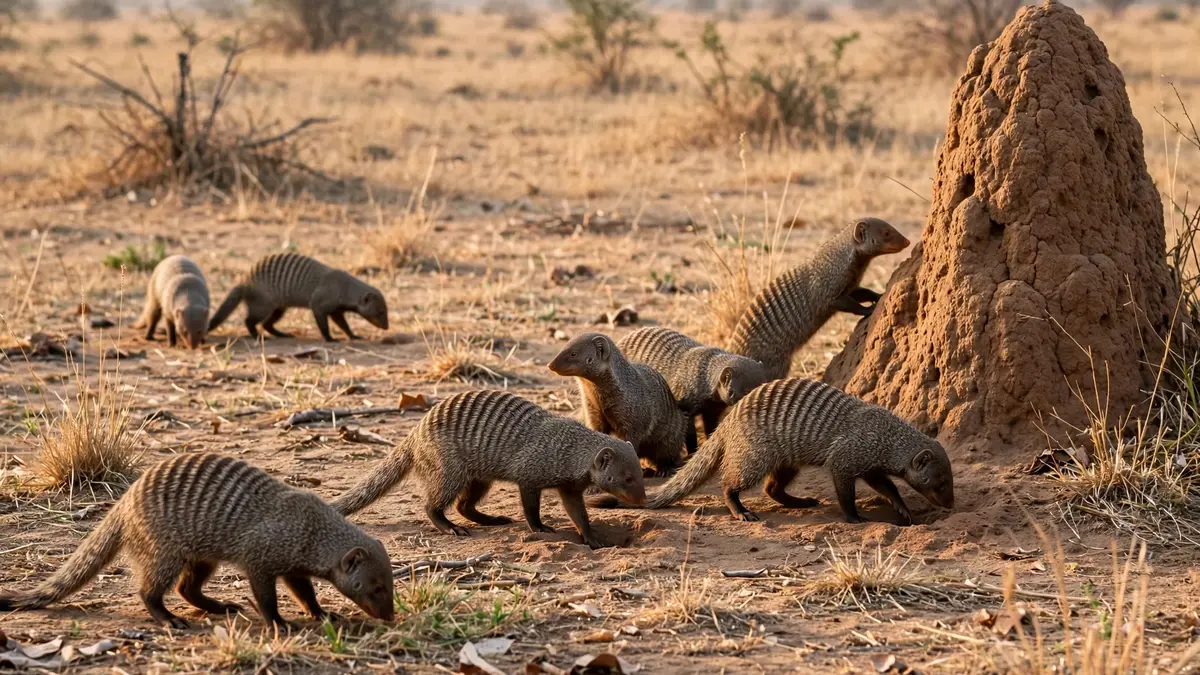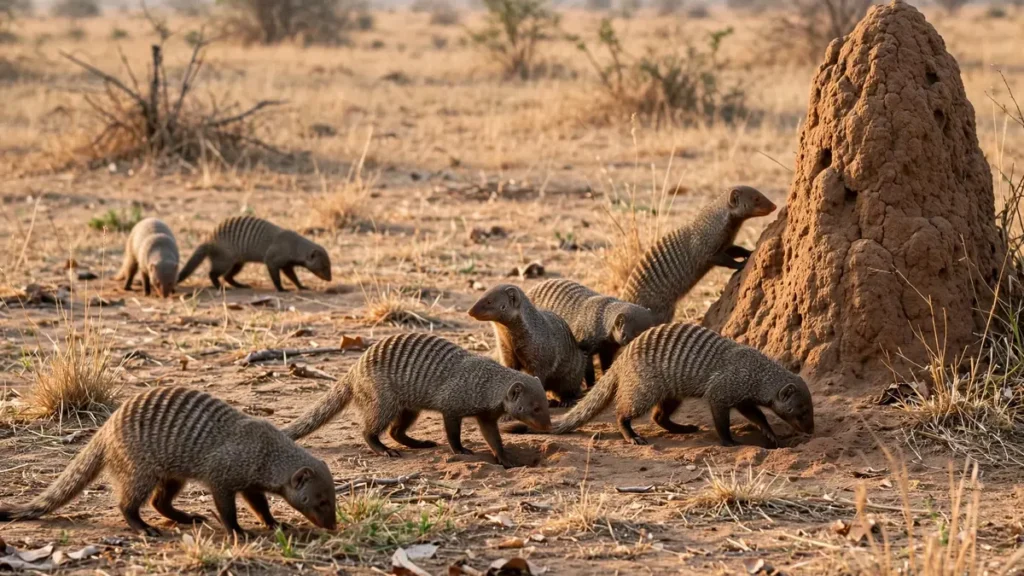
The banded mongoose species number one, a single species called Mungos mungo, and it is the most social of all the mongooses, a striped pack-hunter that lives, forages and raises its young together on the African savanna. If you are asking how many banded mongoose species there are, the answer is one.
The banded mongoose lives across sub-Saharan Africa, from the Sahel in the west to the savannas of East Africa and south to South Africa, in grassland, open woodland and savanna, usually near water and often close to termite mounds. It is a small, sturdy carnivore with a coarse grey-brown coat marked by dark bands, and it spends its days in a noisy pack, digging for beetles and millipedes with its strong front claws.
Key takeaways
- There is one banded mongoose species, Mungos mungo, the only member of its genus.
- Banded mongooses measure about 30 to 45 centimetres long, with a tail of 15 to 30 centimetres, and weigh about 1.5 to 2.25 kilogrammes.
- Banded mongooses live in packs of about 5 to 75 animals, usually around 20, and sleep together in dens.
- Banded mongooses eat mainly beetles and millipedes, along with termites, lizards, small snakes and eggs.
- Banded mongooses are listed as Least Concern, and they can live for more than 10 years in the wild.
What makes a banded mongoose a banded mongoose
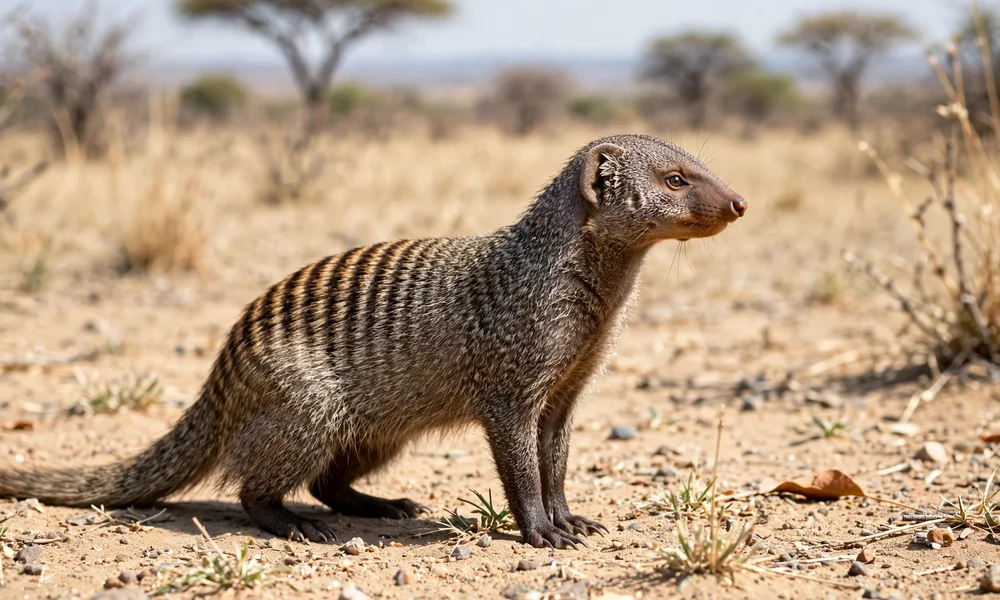
A banded mongoose is a sturdy little carnivore with a large head, small rounded ears, short muscular legs and a long tail that is almost as long as the rest of its body, and it measures about 30 to 45 centimetres from head to body, with a tail of 15 to 30 centimetres, and usually weighs between 1.5 and 2.25 kilogrammes. Its coat is coarse and grey-brown, with dark feet, a black-tipped tail, and ten to fifteen dark bands across its back, and those bands give the animal its name.
The banded mongoose is a mongoose of the family Herpestidae, and like other mongooses it is a small carnivore built for digging, with long strong claws on its front feet. Unlike most mongooses, which live alone, the banded mongoose almost never lives alone, and it moves through the savanna in a pack, calling to its companions with soft chirps and grunts as it goes.
The banded mongoose species and their relatives
There is one banded mongoose species. It belongs to the genus Mungos, and it is the only living member of that genus, a single species that has spread across much of sub-Saharan Africa. Its closest relatives are the other mongooses of Africa and Asia, and the banded mongoose shares its savanna home with several of them, including the meerkat of the dry south and the slender mongoose that hunts alone through the same grassland.
The meerkat is the banded mongoose’s most famous relative, a small social mongoose of the Kalahari that also lives in a group and posts sentries to watch for eagles while the rest of the group digs for food. The dwarf mongoose is the smallest African mongoose, living in small family groups in termite mounds, while the white-tailed mongoose is a much larger, mostly solitary night hunter. The Egyptian mongoose is a larger mongoose of North Africa and southern Europe, the slender mongoose is a slim, quick hunter of open country, and the honey badger is a tough, fearless relative from the weasel family that shares the banded mongoose’s taste for snakes.
| Type | Animal | Where it lives | Best-known food | Length or Weight |
|---|---|---|---|---|
| Species | Banded mongoose (Mungos mungo) | Savannas of sub-Saharan Africa | Beetles, millipedes and termites | About 30 to 45 cm long, 1.5 to 2.25 kg |
| Close relative | Meerkat | Kalahari and southern African deserts | Scorpions, insects and small vertebrates | About 25 to 35 cm long, 0.6 to 1 kg |
| Close relative | Dwarf mongoose | East and southern African bush | Insects, grubs and small lizards | About 18 to 28 cm long, 0.2 to 0.35 kg |
| Close relative | Slender mongoose | Open country across sub-Saharan Africa | Rodents, birds, insects and eggs | About 27 to 40 cm long, 0.5 to 1 kg |
| Close relative | White-tailed mongoose | Savannas of sub-Saharan Africa | Insects, rodents, frogs and fruit | About 53 to 71 cm long, 1.8 to 5 kg |
| Close relative | Egyptian mongoose | North Africa and southern Europe | Rabbits, rodents, reptiles and eggs | About 48 to 60 cm long, 1.7 to 4 kg |
| Close relative | Honey badger | Africa and Asia | Snakes, honey, rodents and scorpions | About 60 to 77 cm long, 5 to 16 kg |
How banded mongooses live
Banded mongooses are creatures of the daylight and the pack. A banded mongoose lives in a mixed group of about 5 to 75 animals, usually around 20, and the group sleeps together at night in an underground den, often an old termite mound with many entrances, and moves to a new den every two or three days. The pack leaves the den soon after sunrise, rests in the shade at midday, and returns before sunset, marking its home range with scent.
Beetles and millipedes make up most of the diet, along with ants, termites, crickets, grasshoppers and snails, and a banded mongoose also eats mice, frogs, lizards, small snakes, birds and eggs. The pack forages as a group, but each animal searches on its own, digging in soil and leaf litter with its strong claws, and the animals mob a venomous snake such as a cobra together until it retreats. A banded mongoose that finds a bird’s egg throws it backwards between its hind legs against a rock to crack the shell.
Breeding is a shared affair. All the females in a pack can breed, and they often give birth on the same day, after a gestation of about 60 to 70 days, with litters of two to six pups and an average of four. For the first four weeks the pups stay in the den, guarded by one to three babysitters while the rest of the pack forages, and when the pups emerge each one is looked after by a single adult escort, usually a young male, who guards it and helps it find food. Banded mongooses can live for more than 10 years in the wild, and animals in human care have lived to about 17 years.
Where banded mongooses live
The banded mongoose lives across a large part of East, Southeast and South-Central Africa, with other populations in the northern savannas of West Africa, from Senegal and Gambia east to Ethiopia and Somalia and south to South Africa. It lives in savannas, open forests and grassland, especially near water, and also in dry, thorny bushland, but not in deserts.
Termite mounds are the key to the banded mongoose’s home. A banded mongoose uses many kinds of dens for shelter, including rock shelters, thickets, gullies and burrows under bushes, but the most common den is an old termite mound, and the animals prefer mounds with many entrances in semi-closed woodland, close to open thicket where they can feed. The pack changes dens every few days, which keeps the den free of parasites and keeps predators guessing.
Banded mongooses are listed as Least Concern, and their numbers are stable across much of their range, partly because they cope well with farmland and even with the edges of villages, where they forage around rubbish dumps for scraps. The main threats to a banded mongoose are predators rather than people, and leopards, martial eagles and rock pythons take adults, while marabou storks and Nile monitors take pups.
Best seasons for banded mongoose watching
There is no closed season, because banded mongooses are active all year, but the best time to look for them depends on what you want to see. The dry season is often the best time for watching, because the grass is short and the packs are easy to follow as they move across open ground. The rainy season is the best time for pups, because breeding peaks when food is plentiful and the young animals emerge from the den with their escorts.
Staying safe around banded mongooses
A banded mongoose is a wild animal with sharp teeth and strong claws, and it can give a painful bite to a person who tries to pick it up, though banded mongooses almost never attack people and would far rather run for the nearest den. Keep your distance, never try to touch a banded mongoose or feed one by hand, and never stand between a pack and its den. If you see banded mongooses on a safari, stay in the vehicle or keep well back, stay calm, and let them carry on with their foraging.
Banded mongoose watching checklist
A little preparation turns a morning on the savanna into a real chance of seeing a banded mongoose.
- Sun protection and a hat, for standing on bright open savanna.
- Binoculars, because the packs move fast and are best watched from a distance.
- A camera with a zoom lens, for the dark bands and the digging claws.
- A visit to a savanna park such as the Serengeti, where packs are common.
- A plan to be out in the early morning, when the packs leave their dens and forage together.
- Patience and silence, because a noisy group will send them away.
- A field guide to African mammals, for telling a banded mongoose from its meerkat cousins.
Frequently asked questions
How many banded mongoose species are there?
There is one banded mongoose species, Mungos mungo. It lives across sub-Saharan Africa in savannas, open forests and grassland, usually in packs of about 20 animals.
What do banded mongooses eat?
Banded mongooses eat mainly beetles and millipedes, along with termites, ants, crickets, grasshoppers and snails. They also eat mice, rats, frogs, lizards, small snakes, ground birds and eggs, and they crack eggs open by throwing them against a hard surface.
Why do banded mongooses live in packs?
Banded mongooses live in packs because the group gives them safety and help with the young. Sentries watch for eagles and leopards while the rest of the pack digs for food, the pack mobs snakes together, and babysitters and escorts look after the pups while the other adults forage.
Where do banded mongooses sleep?
Banded mongooses sleep together in underground dens, most often in old termite mounds. The pack changes dens every two or three days.
How is this guide different from the cockatoo species guide?
This guide covers the single banded mongoose species, a striped pack-hunting mammal that lives on the African savanna and eats beetles and millipedes, while our cockatoo species guide covers the cockatoo, a crested parrot that lives in Australia and Asia and eats seeds, nuts and fruit. The banded mongoose weighs about 1.5 to 2.25 kilogrammes and digs for its food in the soil, and the cockatoo flies through the trees and cracks its food open with a strong curved beak.
Are banded mongooses endangered?
No. Banded mongooses are listed as Least Concern, with stable numbers across much of their range. They cope well with farmland and the edges of villages, and they are common in many of Africa’s protected areas.
Conclusion
The banded mongoose species shows how much character one small carnivore can hold: a single species of striped mongoose, with a pack that forages together, babysitters that guard the den, and escorts that teach each pup how to find its own food.
If you go looking for one, go to the savanna in the early morning, go quietly, and go with patience. Watch a banded mongoose pack sweep across the grass, and you will understand why it has earned its place as the most social mongoose in Africa.