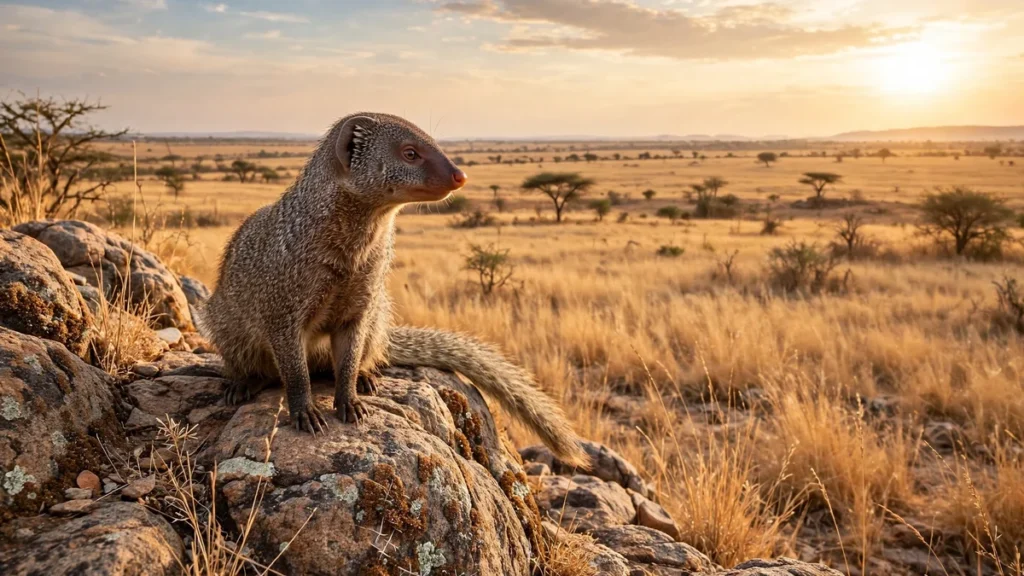
Mongoose species are the quick, clever hunters of the family Herpestidae, and there are about 34 mongoose species, from the Indian grey mongoose of Asia to the banded mongoose of Africa. If you are wondering which mongoose species exist and how such small animals dare to hunt snakes, the short answer is this: mongooses are famously bold, with grizzled fur, long tails and quick reflexes, and they hunt snakes, rats, eggs and insects, working alone or in troops across Africa and Asia.
Key takeaways
- There are about 34 mongoose species in the family Herpestidae, living across Africa and Asia.
- The Indian grey mongoose is the best-known species, famous for its battles with cobras.
- Mongooses are not immune to snake venom: they are fast, and they have some resistance, but a bite can still kill them.
- Some mongooses live alone, while banded and dwarf mongooses live in troops of up to thirty.
- The meerkat is a mongoose cousin, and it has its own guide.
What makes a mongoose a mongoose
A mongoose is a small mammal built for speed and quick reflexes. Its body is long and low, its legs are short, and its tail is long and thick at the base. Its fur is grizzled, a mix of light and dark hairs, and its head is small and pointed, with a sharp snout, small ears and bright eyes. Its claws are strong and curved for digging, and its teeth are sharp for cracking eggs and gripping snakes.
Mongooses are hunters and foragers, active mainly by day, unlike many small hunters. They move with quick, darting runs, stopping often to stand upright and look around. A mongoose has excellent eyesight and a sharp sense of smell, and it can turn, leap and dodge faster than almost any animal its size. It is this speed, more than any other gift, that lets a mongoose face a snake and live to tell the tale.
The mongooses of the world
The Indian grey mongoose is the best-known of all, made famous by stories of its fights with cobras. It lives across India, Pakistan, Sri Lanka and parts of the Middle East, in grassland, scrub and farmland, and it is about 60 centimetres long, with grizzled grey-brown fur and a long, bushy tail. It hunts rats, mice, birds, eggs, lizards and snakes, and it is often seen near villages, where it keeps rats down.
The banded mongoose lives across central and eastern Africa, from Senegal to Ethiopia and south to South Africa, in savanna, woodland and rocky ground. It is about 60 centimetres long, with grey-brown fur marked by dark bands across its back, and it lives in troops of up to thirty animals that forage together, chattering as they search for food. A troop shares a den, often in a termite mound or an old burrow, and all help to guard and raise the young.
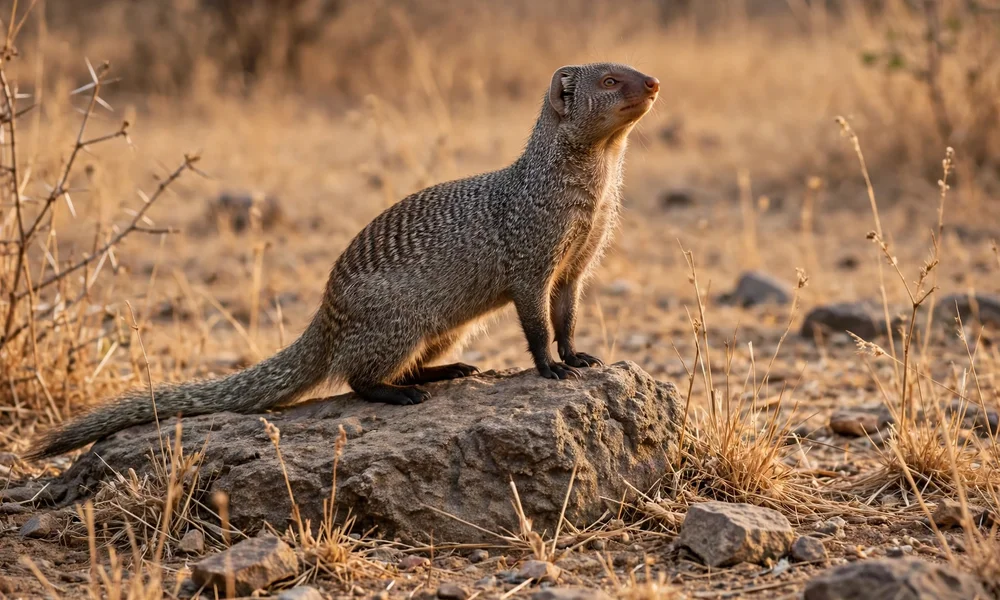
The common dwarf mongoose is the smallest mongoose in Africa, about 40 centimetres long, with soft brown fur and a short tail. It lives in eastern and southern Africa, in savanna and woodland, and it is one of the most social mongooses. Dwarf mongooses take turns standing guard on a rock or a termite mound, watching for eagles while the rest of the troop digs for insects and grubs.
The yellow mongoose lives in southern Africa, in the dry grasslands and semi-deserts of Namibia, Botswana and South Africa, named for its yellow-red coat. It is about 50 centimetres long, living in small family groups, digging burrows in sandy soil and hunting insects, rodents, birds and eggs. The Egyptian mongoose lives around the Mediterranean, in North Africa, Spain and Portugal, and it is about 90 centimetres long, with dark brown fur. It hunts rats, rabbits, birds, eggs and snakes in scrub, farmland and riverbanks.
The white-tailed mongoose lives across sub-Saharan Africa, in forests, savanna and farmland, and it is about 90 centimetres long, with dark fur, long legs and a long white tail. It hunts at night, taking rats, mice, birds, eggs, insects and snakes, and it is one of the largest and most solitary mongooses. The marsh mongoose lives in the wetlands of central and western Africa, in swamps and riverbanks, and it is about 90 centimetres long, with dark brown fur and webbed feet that help it swim. It hunts crabs, frogs, fish, birds and eggs in shallow water, the most water-loving of all mongooses.
The slender mongoose lives across much of Africa south of the Sahara, in savanna, woodland and rocky ground, and it is about 60 centimetres long, with slim, reddish-brown fur and a long tail tipped in black or white. It hunts alone, chasing rats, mice, birds, lizards and insects through the grass, and it climbs trees to search for nests and eggs. Together, these eight species show how far the mongoose family has spread, from the dry grasslands of India to the wetlands of the Congo.
How mongooses hunt
A mongoose hunts by sight, smell and sheer speed. It moves through grass or scrub in quick runs, stopping to stand upright and scan for movement, then pouncing on a rat, a lizard or a grasshopper. It digs with strong claws for grubs and eggs, cracks eggs by throwing them against a rock, and chases small animals through burrows and under stones. Banded and dwarf mongooses hunt together, spreading out and calling to each other, while solitary mongooses hunt alone, covering wide ground each day.
The most famous mongoose hunt is the fight with a snake. A mongoose facing a cobra circles it, feinting and dodging, waiting for the snake to strike and miss, then darting in to bite the back of its neck. Mongooses are not immune to snake venom: they are very fast, and their bodies have some resistance to venom, but a bite from a large cobra can still kill a mongoose. Among the predators of the animal world, the mongoose is unusual in hunting by day, in taking on snakes, and in living in troops that work together to find food.
Where mongooses live
Mongooses live across Africa and Asia, from the dry grasslands of India to the rainforests of the Congo and the deserts of Namibia. They favour grassland, savanna, scrub, woodland edges, riverbanks and farmland, denning in burrows, termite mounds, hollow logs, rock piles and old aardvark holes. The desert animals of southern Africa include the yellow mongoose, which digs its burrows in sandy soil, and the forest animals of the Congo include the marsh mongoose, which swims through the wetlands after crabs and frogs. The nocturnal animals of the African night include the white-tailed mongoose, which hunts after dark while most of its cousins sleep.
| Species | Where it lives | Best-known food | Length |
|---|---|---|---|
| Indian grey mongoose | India, Pakistan, Sri Lanka and the Middle East | Rats, snakes, eggs, lizards | 0.60 metres |
| Banded mongoose | Central and eastern Africa | Insects, eggs, small mammals | 0.60 metres |
| Common dwarf mongoose | Eastern and southern Africa | Insects, grubs, eggs | 0.40 metres |
| Yellow mongoose | Southern Africa, Namibia, Botswana and South Africa | Insects, rodents, birds, eggs | 0.50 metres |
| Egyptian mongoose | North Africa, Spain and Portugal | Rats, rabbits, birds, snakes | 0.90 metres |
| White-tailed mongoose | Sub-Saharan Africa | Rats, birds, eggs, snakes | 0.90 metres |
| Marsh mongoose | Wetlands of central and western Africa | Crabs, frogs, fish, eggs | 0.90 metres |
| Slender mongoose | Africa south of the Sahara | Rats, birds, lizards, insects | 0.60 metres |
Best seasons for mongoose watching
The dry season is the finest time for mongoose watching in Africa and India, when the grass is short and mongooses are easy to spot as they forage in the open. Banded and dwarf mongoose troops are out all day, moving across the savanna in a noisy group, and a sentry on a termite mound is a clear sign that a troop is feeding nearby.
Early morning and late afternoon are the best times of day, when mongooses are most active and the light is soft. Watch at the edge of a grassland, near a termite mound or a pile of rocks, and look for a quick, darting movement in the grass. In the wet season they are harder to see among tall grass, but their tracks and droppings around a burrow show where they live.
Staying safe around mongooses
Mongooses are wild animals, and they deserve respect. Never try to catch a mongoose, never corner one in a burrow or a den, and never handle one with bare hands. A mongoose is small, but it is a fierce fighter when trapped, and it has sharp teeth. Keep dogs on a lead near mongoose habitat, and leave the animal a clear path to escape. If you find a young mongoose alone, leave it where it is, because its mother is almost certainly nearby. Mongooses can also carry disease, so never touch a dead mongoose.
Mongoose watching checklist
- Look for a sentry standing upright on a termite mound or a rock, watching over a feeding troop.
- Watch grassland edges, termite mounds and rock piles in the early morning and late afternoon.
- Listen for the chattering calls of a banded or dwarf mongoose troop in the grass.
- Check burrows, termite mounds and old aardvark holes for signs of a mongoose den.
- Never corner a mongoose or handle one with bare hands, and keep dogs on a lead.
- Leave no trace: take your rubbish home and keep to marked paths.
Frequently asked questions
How many mongoose species are there?
There are about 34 mongoose species in the family Herpestidae, living across Africa and Asia. The table above shows eight of the best-known: the Indian grey, banded, common dwarf, yellow, Egyptian, white-tailed, marsh and slender mongooses. The meerkat is a mongoose cousin, and it has its own guide.
How is this guide different from the predator animals guide?
This guide covers only the mongoose species of the family Herpestidae, from the Indian grey mongoose to the slender mongoose. The predator animals guide covers the whole world of hunting animals, from wolves and eagles to sharks and big cats.
Are mongooses immune to snake venom?
No, mongooses are not immune to snake venom. They are very fast, and their bodies have some resistance to venom, but a bite from a large cobra can still kill a mongoose. A mongoose survives mainly by dodging the strike and biting the snake before it can bite back.
What is the smallest mongoose species?
The common dwarf mongoose is the smallest mongoose in Africa, at about 40 centimetres long, and it is one of the smallest mongooses in the world. It lives in troops of up to thirty animals, taking turns standing guard while the rest of the troop digs for insects and grubs.
Do mongooses live alone or in groups?
It depends on the species. Banded and dwarf mongooses live in troops of up to thirty animals, sharing a den and raising the young together. Most others, including the Indian grey, Egyptian, white-tailed and slender mongooses, live alone or in pairs, coming together only to mate and raise young.
Where is the best place to see a mongoose?
The best place is a grassland edge, a termite mound or a rock pile in the early morning or late afternoon, when mongooses are out foraging. In Africa, look for a banded mongoose troop moving noisily through the savanna, and in India, look for an Indian grey mongoose hunting near a village or a field edge.
Conclusion
Mongoose species, all about 34 of them, are the quick, bold hunters of the animal world: Indian grey mongooses facing cobras, banded mongooses foraging in noisy troops, and marsh mongooses swimming through wetlands after crabs and frogs.
The next step is to walk a grassland edge at dawn, watch a termite mound for a small sentry standing upright, and remember that one of the fastest hunters in the animal world is nearby.














