
Meerkat species are a question with a surprisingly short answer, because there is only one meerkat species in the world: the suricate, Suricata suricatta, of the Kalahari desert. If you are wondering how many meerkat species exist, the answer is that a single species does it all, living in large family groups called mobs, taking turns as sentries, and raising pups together in burrows in the red sand of southern Africa.
Key takeaways
- There is only one meerkat species, the suricate (Suricata suricatta) of southern Africa.
- Meerkats are mongooses in the family Herpestidae, not cats and not rodents.
- Meerkats live in family mobs of up to 40 animals, sharing burrows, food and care of the young.
- A sentry stands guard while the mob forages, warning of eagles, hawks and jackals.
- Pups are raised by the whole mob, with helpers bringing food and babysitting while the mother forages.
What makes a meerkat a meerkat
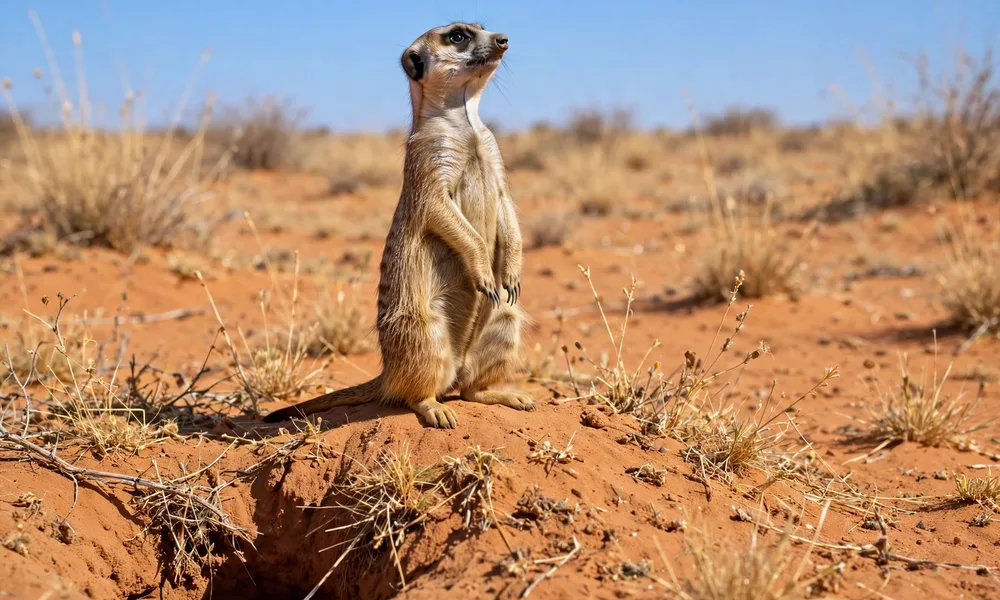
A meerkat is a small, sandy-grey mammal with dark bands across its back, dark patches around its eyes, a pointed face and a long, thin tail that it uses as a third leg when it stands upright. It is about 30 centimetres long, with a 20-centimetre tail, and weighs roughly 700 grams. Its front claws are long and curved for digging, and the dark patches around its eyes cut the glare of the desert sun.
What truly makes a meerkat a meerkat, though, is the way it lives. Meerkats are among the most social of all small mammals, and almost everything they do is done together. The mob forages together, sentries watch in turns, and pups are fed and guarded by the whole family. A meerkat in a mob is bold, noisy and busy, chattering to its family in soft peeps and trills.
The meerkats of the world
The single meerkat species, the suricate, lives in the dry, open country of southern Africa: the Kalahari of Botswana, Namibia and South Africa, and the Namib of Namibia. It needs open ground, where it can see danger coming, and soft, sandy soil for its burrows. Within this one species, three subspecies are usually recognised, but they are all the same species.
Because there is only one meerkat species, this guide also introduces its closest cousins, the other mongooses of Africa. The yellow mongoose is the meerkat’s nearest neighbour and frequent burrow-mate, a sandy-coloured mongoose that lives in the same Kalahari country, often sharing burrow systems with meerkats. The banded mongoose is a larger, greyer cousin of the woodlands of central and eastern Africa, living in troops of up to 40.
The dwarf mongoose, the smallest mongoose in Africa at barely 25 centimetres, lives in family groups in the dry bush of eastern and southern Africa, hunting insects among rocks and termite mounds. The slender mongoose lives alone or in pairs across Africa south of the Sahara, hunting in grassland and scrub. The Egyptian mongoose is the largest of this group, about 60 centimetres long, and it lives across North Africa and into southern Europe and the Middle East, hunting rats, snakes and birds.
The white-tailed mongoose, named for the pale fur on its bushy tail, hunts alone after dark in the forests and savannas of sub-Saharan Africa. The marsh mongoose is a strong swimmer that lives near rivers, lakes and swamps across central and western Africa, hunting crabs, frogs and fish. Together, the meerkat and its seven cousins show how one family has spread across Africa into deserts, forests, rivers and mountains.
How meerkats live
A meerkat mob begins its day at sunrise, when the animals come out of the burrow to warm themselves in the first light, standing upright to warm their pale bellies in the sun. Then the mob spreads out to forage, digging for beetles, grubs and millipedes, and sometimes taking scorpions, spiders, lizards, small birds and eggs. Meerkats eat scorpions, biting off the sting first, and have some resistance to their venom. They also dig for roots and bulbs when insects are scarce, and get most of their water from their food.
While the mob forages, one meerkat climbs a mound, bush or rock and stands guard as the sentry. Among the predators of the Kalahari, the martial eagle and the jackal are the greatest threats, and the sentry gives different alarm calls for danger from the air and danger on the ground, so the mob knows whether to dive into a burrow or freeze. At midday the mob rests in the shade or in the cool of the burrow, then forages again before returning to the burrow for the night, where the animals sleep piled together.
Meerkat pups are born in the burrow after a pregnancy of about eleven weeks, usually two to four pups at a time, and they stay underground for the first three weeks of their lives. When they come out, the whole mob helps to raise them: older siblings babysit while the mother forages, and helpers bring the pups food, teaching them how to handle scorpions. A helper first gives a pup a dead scorpion with the sting removed, then a live one with the sting removed, and only later a whole, live scorpion.
Where meerkats live
Meerkats live in the dry deserts and grasslands of southern Africa: the Kalahari of Botswana, Namibia and South Africa, and the Namib of Namibia. They need open ground, where they can see eagles coming, and soft soil for their burrows. A burrow is a maze of tunnels up to two metres deep, and a mob may use several, moving every few days. The desert animals of the Kalahari include many that share the meerkat’s burrows, from yellow mongooses to ground squirrels.
Unlike the nocturnal animals of the desert, meerkats are active by day, which makes them one of the easiest desert animals to watch. A mob defends a home range of a few square kilometres against neighbouring mobs. Meerkats cannot live in forest or in wet country, and they are not found outside southern Africa in the wild, though they are common in zoos around the world, where they are one of the most popular animals on show.
| Animal | Type | Where it lives | Best-known food | Length |
|---|---|---|---|---|
| Meerkat (suricate) | Species | Kalahari and Namib deserts | Insects, scorpions, eggs | 0.30 metres |
| Yellow mongoose | Close relative | Kalahari and dry grasslands | Insects, small rodents | 0.30 metres |
| Banded mongoose | Close relative | Central and eastern Africa | Insects, millipedes | 0.35 metres |
| Dwarf mongoose | Close relative | Eastern and southern Africa | Insects, grubs | 0.25 metres |
| Slender mongoose | Close relative | Africa south of the Sahara | Insects, rodents, birds | 0.35 metres |
| Egyptian mongoose | Close relative | North Africa, southern Europe | Rats, snakes, birds | 0.60 metres |
| White-tailed mongoose | Close relative | Forests, sub-Saharan Africa | Rats, birds, insects | 0.60 metres |
| Marsh mongoose | Close relative | Central and western Africa | Crabs, frogs, fish | 0.60 metres |
Best seasons for meerkat watching
The dry winter months from May to September are the finest season for meerkat watching in southern Africa, when the mornings are cool and clear and the mobs come out of their burrows to sunbathe on the sand before foraging. The animals are easy to see against the bare winter ground. In the wet summer months from October to March the grass grows tall and the mobs are harder to spot, but this is when pups are born.
The best time of day is the first two hours after sunrise, when the mob is out foraging, and the last hour before sunset. At midday the mob rests in the shade or underground, and there is little to see. In the Kalahari, guided meerkat walks start before dawn, and a patient watcher who sits still and quiet downwind of a burrow may see a whole mob foraging within a few metres.
Staying safe around meerkats
Meerkats are small and not dangerous to people, but they are still wild animals, and they deserve respect. Never pick up a meerkat, never corner one near its burrow, and never put a hand into a burrow, which may also shelter snakes and scorpions. Meerkats in popular watching areas may come close, but even these can bite if they feel trapped, so keep your hands to yourself. Never feed meerkats, because human food can make them ill.
The desert itself needs more care than the meerkats do. Take water, a hat and sunscreen, because the Kalahari sun is fierce even in winter, and tell someone where you are going before you walk out to a burrow. Keep dogs on a lead, and stay on marked paths so you do not collapse a burrow roof. If you find a young meerkat alone, leave it: its family is almost certainly nearby.
Meerkat watching checklist
- Arrive before sunrise, and sit still and quiet downwind of a burrow.
- Look for the sentry first: one meerkat standing tall on a mound or rock means a mob is nearby.
- Listen for the soft peeps and trills that keep the family together.
- Look for pups in summer, wobbling after their older siblings near the burrow.
- Never feed meerkats, never touch one, and never put a hand into a burrow.
- Leave no trace: take your rubbish home, keep dogs on a lead, and stay on marked paths.
Frequently asked questions
How many meerkat species are there?
There is only one meerkat species, the suricate (Suricata suricatta) of southern Africa. Three subspecies are recognised, but they are all the same species. The table above shows the meerkat alongside its seven closest mongoose relatives, which are separate species, not meerkats.
How is this guide different from the predator animals guide?
This guide covers only one species, the meerkat, and its closest mongoose relatives, from the yellow mongoose to the marsh mongoose. The predator animals guide covers the whole world of hunting animals, from wolves and eagles to sharks and big cats.
Are meerkats cats or rodents?
Meerkats are neither cats nor rodents. They are mongooses, members of the family Herpestidae, a separate family in the same wider group as cats. Their cat-like face is misleading, and standing on their hind legs is a habit shared with many small mammals.
Why do meerkats stand on their hind legs?
Meerkats stand on their hind legs to see further, and the sentry stands guard this way, watching the sky for eagles and the horizon for jackals. The meerkat’s long tail acts as a third leg while it stands, and the dark patches around its eyes cut the sun’s glare.
What do meerkats eat?
Meerkats eat mainly insects, along with scorpions, spiders, lizards, small birds and eggs. They bite the sting off a scorpion before eating it, and they get most of their water from their food, so they can go for days without drinking.
Where is the best place to see a meerkat?
The best place to see a meerkat is the Kalahari desert, early in the morning, when the mob comes out to sunbathe and forage. Guided walks near Kuruman in South Africa and in the Kgalagadi Transfrontier Park visit mobs used to people.
Conclusion
Meerkat species number just one, the suricate of the Kalahari, yet that single species packs in more family life than almost any other small mammal: mobs of up to 40, sentries on guard in turns, and pups raised by the whole family.
The next step is to set an early alarm, walk out to a Kalahari burrow before sunrise, and watch for the first meerkat of the day standing tall on its mound.














