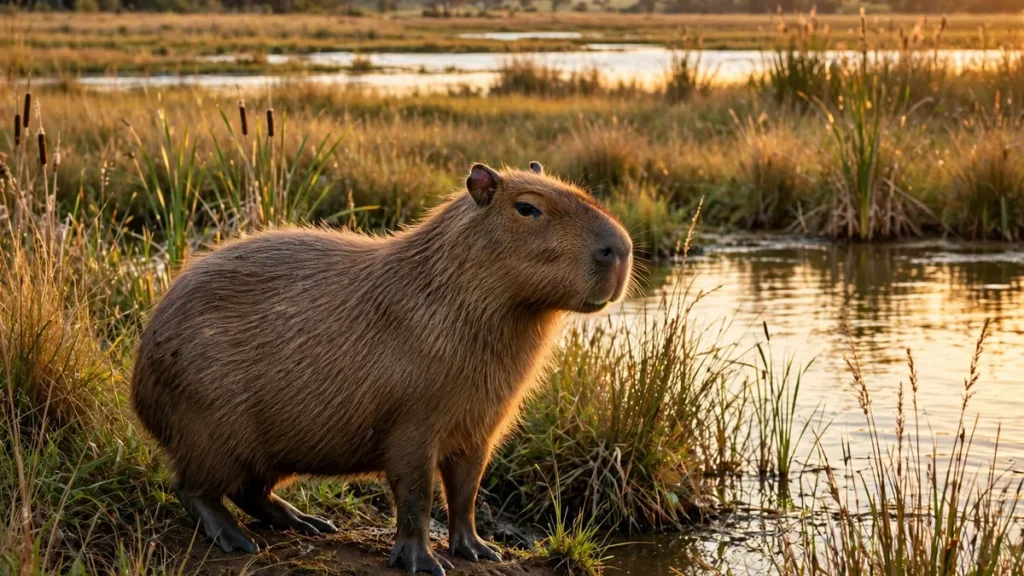
Capybara species are the largest rodents in the world, and there are only two capybara species, the greater capybara and the lesser capybara, both belonging to the genus Hydrochoerus. If you are wondering how many capybara species exist and what makes these gentle giants different from every other rodent, the short answer is this: capybaras are huge, barrel-bodied grazers that live in herds beside South American rivers and wetlands, spending their days eating grasses, swimming with only their eyes and nostrils above the water, and resting in the shade with their young.
Key takeaways
- There are only two capybara species in the genus Hydrochoerus: the greater capybara and the lesser capybara.
- Capybaras are the largest rodents in the world, with the greater capybara weighing up to about 65 kilograms.
- Capybaras are semi-aquatic grazers that live in herds beside rivers, lakes and wetlands in South America.
- A capybara can stay underwater for up to five minutes, and it swims with only its eyes, ears and nostrils above the surface.
- Capybaras are close relatives of guinea pigs, and the guinea pig has its own guide.
What makes a capybara a capybara
A capybara is a giant rodent built for a life in and beside the water. Its body is large and barrel-shaped, its legs are short and sturdy, and its head is blunt and heavy, with small ears, dark eyes set high on the head, and nostrils on top of the snout. Its fur is coarse and sparse, reddish-brown to grey-brown, and its feet are partly webbed, which helps it swim. It has no visible tail at all.
Capybaras are grazers, and their bodies are tuned for eating tough grasses and water plants. They have large, chisel-like front teeth that grow throughout their lives, and they grind their food with strong back teeth. A capybara spends much of its time feeding, resting in the shade, and slipping into the water to cool off or to escape danger.
Capybaras are social animals, and they live in herds of ten to twenty animals, sometimes many more in the dry season. A herd is usually led by one dominant male, with several females, their young, and younger males around them. Capybaras talk to each other with barks, whistles, purrs and grunts, and they rest side by side in the sun or in the shallows.
The capybaras of the world
The greater capybara is the larger of the two capybara species, and the largest rodent in the world. It can grow to about 1.3 metres long and weigh up to about 65 kilograms, as heavy as a large dog. It lives across much of South America, from Colombia and Venezuela to Argentina and Uruguay, wherever there are slow-moving rivers, lakes, marshes and flooded grasslands. It is the capybara most visitors see, grazing in large herds on riverbanks in the Pantanal wetlands of Brazil and the Llanos grasslands of Venezuela.
The lesser capybara is the smaller of the two species, growing to about one metre long and weighing up to about 30 kilograms. It lives in a much smaller range, in the lowlands of Panama, Colombia and north-western Venezuela, west of the Andes mountains. It looks very much like its larger cousin, but it is slighter in build and usually lives in smaller groups.

The two species rarely meet, because the Andes mountains and the distance between their ranges keep them apart. Scientists recognise them as separate species because of their size, their range, and differences in the shape of their skulls and teeth. Both live the same water-loving, herd-based life.
Capybaras have many close relatives among the rodents of South America. The guinea pig is the best-known, a small domesticated cousin that shares the capybara’s blunt head and habit of grazing in groups. The rock cavy lives among the rocks of eastern Brazil, the agouti is a quick forest rodent, and the paca is a spotted, nocturnal forest dweller. The mara looks like a small deer with long legs, while the chinchilla lives high in the Andes mountains.
How capybaras live
A capybara lives by grazing, swimming and staying close to its herd. It feeds mainly in the early morning and late afternoon, eating grasses, reeds, water plants and the occasional fruit, and it may eat several kilograms of plants every day. It rests in the heat of the day, lying in the shade or floating in the water with only its eyes and nostrils showing.
Water is the capybara’s refuge. When danger threatens, a capybara dives into the river and swims away, or sinks beneath the surface with only its nose above the water, where it can stay for up to five minutes. It is a strong swimmer, using its webbed feet to paddle smoothly, and it can cross wide rivers with ease. Young capybaras learn to swim within days of birth.
A female usually gives birth to four or five young after a pregnancy of about five months. The young are born fully furred, with their eyes open, and they can walk, swim and nibble grass within hours of birth. In the wild, capybaras live for about eight to ten years, and they are hunted by jaguars, caimans, anacondas and harpy eagles.
Where capybaras live
Capybaras live in the wetlands, rivers and flooded grasslands of South America, and they are never far from water. They favour slow-moving rivers, lakes, marshes, swamps and seasonally flooded plains, where grasses grow thick and the water is shallow enough to wade in. The wetland animals of South America include the capybara, which is one of the most common large animals of the Pantanal, and the river animals of the Amazon and the Orinoco include capybaras grazing on their banks. The rainforest animals of the Amazon include capybaras along forest rivers and oxbow lakes, where they feed at the water’s edge.
The greater capybara has the wider range, living from Colombia and Venezuela, through the Amazon basin and the Pantanal, to northern Argentina and Uruguay. It is most numerous in the Pantanal of Brazil, Paraguay and Bolivia, the largest tropical wetland in the world, and in the Llanos of Venezuela and Colombia, where herds gather around shrinking pools in the dry season. The lesser capybara lives only in Panama, Colombia and north-western Venezuela, west of the Andes.
| Animal | Type | Where it lives | Best-known food | Size |
|---|---|---|---|---|
| Greater capybara | Species | South America, east of the Andes | Grasses, water plants | Up to about 65 kilograms |
| Lesser capybara | Species | Panama, Colombia and north-west Venezuela | Grasses, water plants | Up to about 30 kilograms |
| Guinea pig | Close relative | South America, domesticated worldwide | Grasses, hay, vegetables | About 1 kilogram |
| Rock cavy | Close relative | Rocky areas of eastern Brazil | Leaves, fruits, seeds | About 1 kilogram |
| Agouti | Close relative | Forests of Central and South America | Fruits, nuts, seeds | About 4 kilograms |
| Paca | Close relative | Forests of Central and South America | Fruits, leaves, roots | About 10 kilograms |
| Mara | Close relative | Open grasslands of Argentina | Grasses, leaves, flowers | About 12 kilograms |
| Chinchilla | Close relative | High Andes of Chile, Peru and Bolivia | Grasses, seeds, shrubs | About 0.5 kilograms |
Best seasons for capybara watching
The dry season is the finest time for capybara watching, when water levels fall and capybaras gather in large herds around the remaining pools and rivers. In the Pantanal, the dry season runs roughly from May to September, and herds of twenty or more animals graze together on the open banks. In the Llanos, the dry season also concentrates capybaras around shrinking waterholes, where they rest in the shallows.
The wet season, roughly from October to April in the Pantanal, spreads capybaras across a much wider area, and they are harder to find as the floodwaters rise. Watch in the early morning and late afternoon, when capybaras are feeding and most active, and look for them at the water’s edge.
Staying safe around capybaras
Capybaras are wild animals, and they deserve respect. They are usually calm and gentle, but they are large and strong, with sharp teeth that can give a serious bite if they feel threatened. Never try to touch, feed or handle a wild capybara, never corner one on a riverbank, and never come between a mother and her young. Keep dogs on a lead near capybara habitat, and leave the animal a clear path to the water.
Capybara watching checklist
- Look for herds grazing on riverbanks and wetland edges in the early morning and late afternoon.
- Watch the water for a pair of eyes and nostrils above the surface, the sign of a capybara resting in the shallows.
- Listen for barks, whistles and purrs, the sounds capybaras use to stay in touch with the herd.
- Check muddy banks for large, webbed footprints and grazed patches of grass.
- Never feed, touch or corner a wild capybara, and keep dogs on a lead.
- Leave no trace: take your rubbish home and keep to marked paths.
Frequently asked questions
How many capybara species are there?
There are only two capybara species, both in the genus Hydrochoerus: the greater capybara and the lesser capybara. The greater capybara lives across much of South America east of the Andes, while the lesser capybara lives only in Panama, Colombia and north-western Venezuela. The table above shows both species alongside six close relatives.
How is this guide different from the guinea pig species guide?
This guide covers only the two capybara species of the genus Hydrochoerus, the greater capybara and the lesser capybara, and how they live as large, semi-aquatic herd animals in South American wetlands. The guinea pig species guide covers the guinea pig and its close relatives, which are far smaller, mostly domesticated animals that live in homes and gardens rather than in rivers and marshes.
What is the largest rodent in the world?
The greater capybara is the largest rodent in the world, growing to about 1.3 metres long and weighing up to about 65 kilograms. The lesser capybara is much smaller, at up to about 30 kilograms.
Can capybaras swim?
Yes, capybaras are excellent swimmers, with partly webbed feet and eyes, ears and nostrils set high on the head so they can swim with almost the whole body underwater. They can stay submerged for up to five minutes, and they dive into the water to escape predators such as jaguars and caimans.
Are capybaras dangerous to people?
Capybaras are not dangerous to people, and they will usually run to the water rather than attack. A cornered capybara can bite, so never try to touch, feed or handle one. Capybaras are far more useful than harmful, because their grazing shapes wetland vegetation and they are an important food source for jaguars, caimans and other predators.
Where is the best place to see a capybara?
The best place to see a capybara is the Pantanal wetlands of Brazil in the dry season, when large herds graze on riverbanks in the morning light. The Llanos grasslands of Venezuela and Colombia are another fine place, especially around shrinking waterholes in the dry season. Watch at dawn and dusk, at the water’s edge.
Conclusion
Capybara species, just two of them, are the gentle giants of the rodent world: greater capybaras grazing in herds on the banks of the Pantanal, and lesser capybaras living quietly in the swamps of Panama and Colombia, both bound to the water they swim in and the grasses they eat.
The next step is to visit a South American wetland at dawn, watch the riverbank for a large brown shape grazing in the mist, and remember that the largest rodent in the world is also one of the calmest animals you will ever see.














