
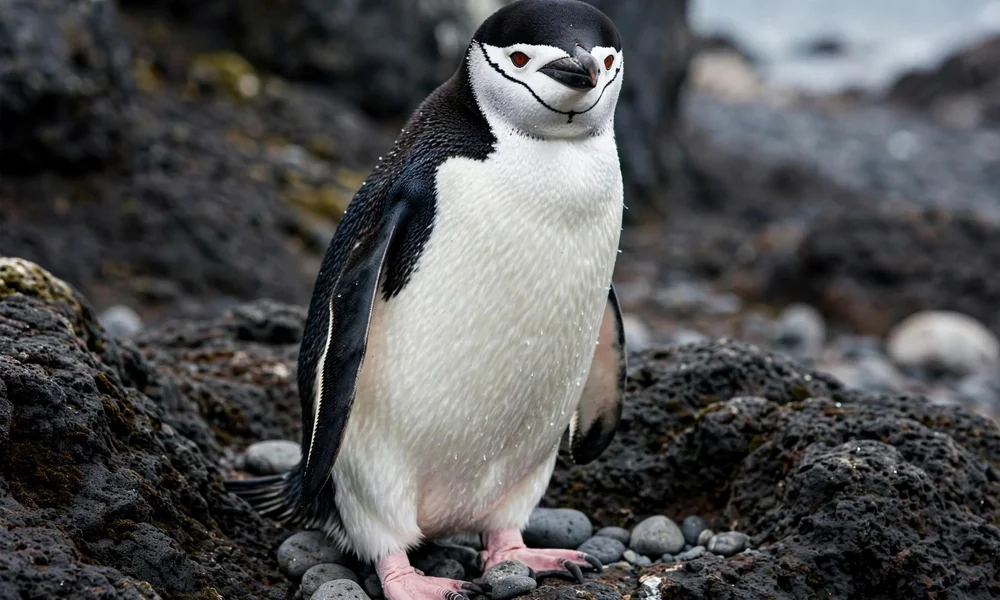
The chinstrap penguin species number one, a single species called Pygoscelis antarcticus, and it is the penguin with the thin black band under its chin that looks like the strap of a helmet. If you are asking how many chinstrap penguin species there are, the answer is one: there is one recognised chinstrap penguin species in the world, and every chinstrap penguin alive today belongs to it.
The chinstrap penguin lives around the Antarctic Peninsula and on the rocky islands of the Southern Ocean, where it gathers in colonies so large that a single hillside can hold more than a million breeding pairs. It is one of the most abundant penguins in Antarctica, a noisy and bold bird that nests on bare rock, eats almost nothing but krill, and returns to the same colony each year.
Key takeaways
- There is one chinstrap penguin species, Pygoscelis antarcticus, named for the black band under its chin.
- Chinstrap penguins stand about 68 to 76 centimetres tall and weigh between 3 and 5 kilogrammes.
- Chinstrap penguins eat almost entirely Antarctic krill, with a little fish and squid.
- Chinstrap penguins nest in circular nests of stones, and both parents share the incubation of two eggs.
- There are about 8 million chinstrap penguins, listed as Least Concern, though their numbers are falling.
What makes a chinstrap penguin a chinstrap penguin
A chinstrap penguin is a medium-sized penguin with a black head and back, a white face and belly, and a thin black band that runs from one side of the head to the other, passing under the chin, and it measures about 68 to 76 centimetres tall and usually weighs between 3 and 5 kilogrammes. The black band is the mark that sets it apart from every other penguin, and it gives the bird its name, because the band looks like the chin strap of a helmet.
The chinstrap penguin is also known as the stonecracker penguin, after the loud harsh call it makes at its colonies, a sound that early visitors compared to stones being cracked together. Like other emperor penguins, the chinstrap penguin is a flightless seabird, but it is a much smaller and far noisier bird than the emperor, and it is known as the boldest and most ill-tempered of all the penguins.
The chinstrap penguin species and their relatives
There is one chinstrap penguin species. It belongs to the genus Pygoscelis, the brush-tailed penguins, and it shares that genus with the Adélie penguin and the gentoo penguin, its two closest relatives. All three breed on the rocky shores of the Antarctic Peninsula and the islands around it.
The emperor penguin is the chinstrap penguin’s most famous relative, a much larger bird that breeds through the Antarctic winter on the sea ice, while the African penguin is a warm-water cousin of South Africa and Namibia. The macaroni penguin is a crested penguin with golden head plumes, the king penguin is a tall elegant penguin of the sub-Antarctic islands with orange markings on its head and neck, and the little blue penguin is the smallest penguin in the world, standing barely 40 centimetres tall.
| Type | Animal | Where it lives | Best-known food | Length or Weight |
|---|---|---|---|---|
| Species | Chinstrap penguin (Pygoscelis antarcticus) | Antarctic Peninsula and Southern Ocean islands | Krill, small fish and squid | About 68 to 76 cm tall, 3 to 5 kg |
| Close relative | Emperor penguin | Antarctic sea ice and coast | Fish, krill and squid | About 110 cm tall, 23 to 40 kg |
| Close relative | Adélie penguin | Antarctic coast and sea ice | Krill, fish and squid | About 70 cm tall, 4 to 6 kg |
| Close relative | Gentoo penguin | Sub-Antarctic islands and Antarctic Peninsula | Krill, fish and squid | About 76 cm tall, 5 to 8 kg |
| Close relative | Macaroni penguin | Sub-Antarctic islands | Krill and small crustaceans | About 71 cm tall, 4 to 6 kg |
| Close relative | King penguin | Sub-Antarctic islands | Fish and squid | About 95 cm tall, 11 to 16 kg |
| Close relative | Little blue penguin | New Zealand and southern Australia | Small fish and squid | About 40 cm tall, about 1 kg |
How chinstrap penguins live
Chinstrap penguins are creatures of the colony and the cold sea. A chinstrap penguin lives in noisy colonies on rocky slopes and beaches, and some colonies hold hundreds of thousands of birds, with the largest colony, on Zavodovski Island, holding about 1.2 million breeding pairs. Like other penguins, the chinstrap penguin is clumsy on land, waddling on its short legs, but in the water it is fast and graceful, diving to about 50 metres in search of food.
Krill makes up almost the whole diet, about 95 per cent of what a chinstrap penguin eats, along with a little small fish and squid, and a chinstrap penguin feeds by chasing swarms of Antarctic krill in the cold water near its colony, sometimes swimming up to 80 kilometres offshore in a single day. It feeds mostly in the daylight of the Antarctic summer, when krill gather in dense swarms, and it eats a large share of its body weight in krill in a single day.
Breeding is a busy season, and the pair builds a circular nest of small stones on the bare rock, and the female lays two eggs in the nest. Both parents take turns sitting on the eggs, and the chicks hatch after about 37 days, covered in grey down. The parents feed the chicks for about three to four weeks, and the young birds then gather in crèches, or nurseries, guarded by a few adults, before heading to sea on their own. Chinstrap penguins live for about 15 to 20 years in the wild.
Where chinstrap penguins live
The chinstrap penguin lives around the Antarctic Peninsula and on the islands of the Scotia Sea, breeding on the South Sandwich Islands, the South Orkney Islands, the South Shetland Islands, and South Georgia, as well as on the northern Antarctic Peninsula itself. It spends the winter north of the sea ice, returning to its nest sites in late October or early November, usually with the same breeding partner as the year before.
Rocky ground and open water are the key requirements. A chinstrap penguin needs an ice-free rocky slope close to the sea, with small stones for building its nest and a clear path down to the water, so it returns to the same colonies year after year, and when the krill move away the birds struggle to raise their chicks.
Chinstrap penguins are listed as Least Concern, with about 8 million birds in the world, but their numbers are falling, and several colonies on the Antarctic Peninsula have declined sharply in recent decades. The main pressures are the warming of the Southern Ocean, which pushes the krill further from the colonies, and the loss of sea ice, while the leopard seal is the main predator at sea. Their close dependence on krill makes them one of the clearest signals of change in the Antarctic seas.
Best seasons for chinstrap penguin watching
There is no closed season, because chinstrap penguins are active all year, but the best time to look for them depends on what you want to see. The best months are November to March, the Antarctic summer, when the birds return to their colonies to breed and the hillsides are full of birds on stone nests feeding chicks. In December and January the chicks are in their crèches, and in February the young birds head to sea, so mid-season shows the colony at its busiest and noisiest.
Staying safe around chinstrap penguins
A chinstrap penguin is a wild animal with a sharp beak and a bold temper, and it can give a painful peck to a person who comes too close, though chinstrap penguins almost never attack people. They will stand their ground and peck at boots and tripods that enter their nesting ground. Keep your distance, never touch a penguin, and never walk through a colony, because a penguin that is disturbed may leave its nest and its eggs may chill and die. If you see chinstrap penguins on an Antarctic landing, stay on the marked paths, stay calm, and let them come to you.
Chinstrap penguin watching checklist
A little preparation turns a visit to the Antarctic Peninsula into a real chance of seeing a chinstrap penguin.
- Warm waterproof clothing and sturdy boots, for standing on wet rocky shores in the Antarctic wind.
- Binoculars, because the colonies are large and the birds are best watched from a distance.
- A camera with a zoom lens, for the black chin band and the stone nests without getting close.
- A visit to the South Shetland Islands, where large chinstrap colonies are easy to see from the shore.
- A plan to be out in the middle of the day, when the penguins are most active and heading out to sea.
- Patience and silence, because penguins are shy animals and a noisy group will send them away.
- A field guide to penguins, for telling a chinstrap penguin from its Adélie and gentoo neighbours at a glance.
Frequently asked questions
How many chinstrap penguin species are there?
There is one chinstrap penguin species, Pygoscelis antarcticus. It is the only penguin with a thin black band under its chin, and it lives around the Antarctic Peninsula and the islands of the Southern Ocean, with about 8 million birds in the world.
Why are chinstrap penguins called stonecracker penguins?
Chinstrap penguins are called stonecracker penguins because of their loud harsh call, which sounds like stones being cracked together. The birds call at their colonies to find their mates and defend their nests, and the nickname comes from the sound of a whole colony calling at once.
What do chinstrap penguins eat?
Chinstrap penguins eat almost entirely Antarctic krill, about 95 per cent of their diet, along with a little small fish and squid. They dive to about 50 metres to catch krill where it gathers in dense swarms near their colonies.
Can chinstrap penguins fly?
No. Chinstrap penguins are flightless birds, and their wings have become flippers for swimming, not flying. They are clumsy on land but fast and graceful in the water, where they porpoise in and out of the waves and can swim up to 80 kilometres offshore in a single day.
How is this guide different from the cedar waxwing species guide?
This guide covers the single chinstrap penguin species, a flightless seabird that lives on the Antarctic Peninsula and eats almost nothing but krill, while our cedar waxwing species guide covers the cedar waxwing, a small songbird that lives in North American woodland and eats berries and insects. The chinstrap penguin stands about 68 to 76 centimetres tall and swims in the Southern Ocean, and the cedar waxwing is about 15 to 18 centimetres long and flies through forests.
Are chinstrap penguins endangered?
No. Chinstrap penguins are listed as Least Concern, with about 8 million birds in the world, but their numbers are falling, and several colonies on the Antarctic Peninsula have declined sharply as the warming Southern Ocean takes the krill the penguins need.
Conclusion
The chinstrap penguin species shows how much character one small bird can hold: a single species of bold Antarctic penguin, with a black chin strap, a stonecracker call, and a life spent between rocky Southern Ocean slopes and the krill-rich sea.
If you go looking for one, go to the Antarctic Peninsula in the summer season, go quietly, and go with patience. Watch one waddle through its colony with a stone in its beak and you will understand why keeping its seas full of krill matters most.














