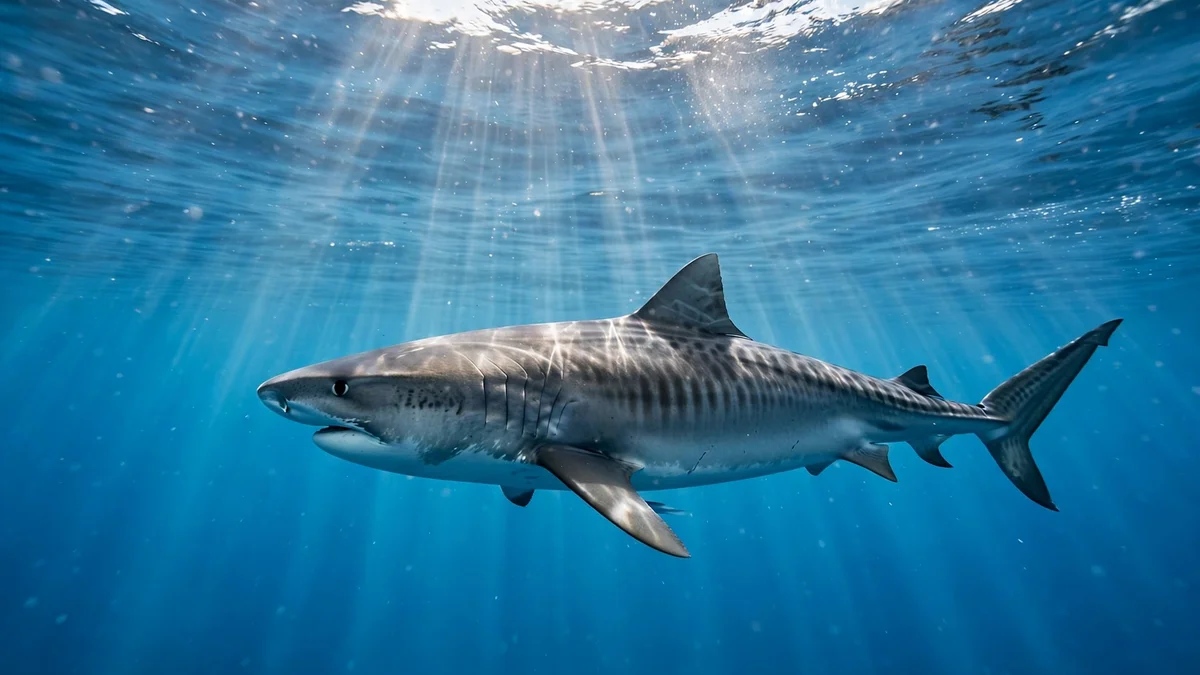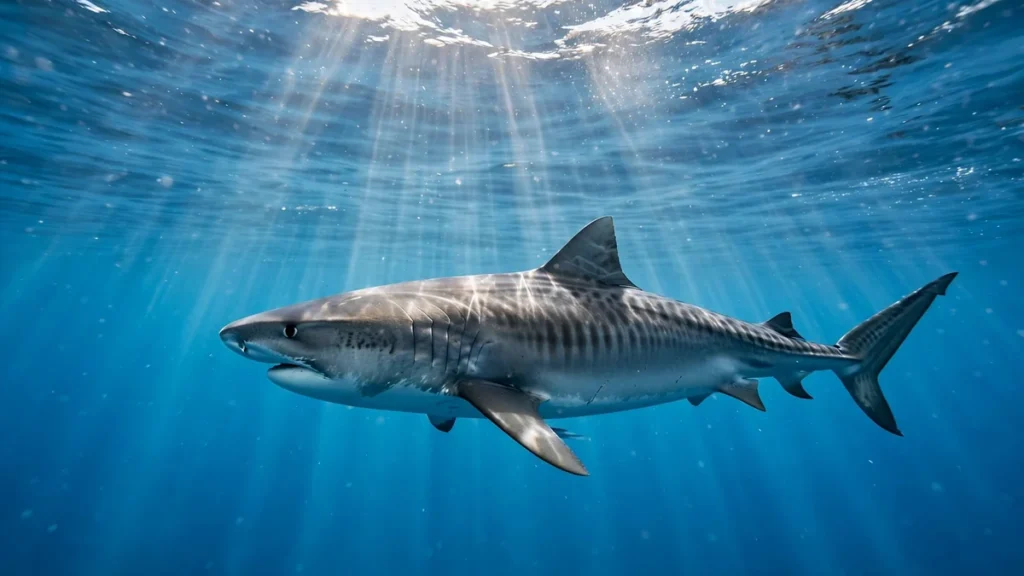
The tiger shark species is a single species, Galeocerdo cuvier, a great striped hunter of the warm seas, and one of the largest sharks on Earth, famous for eating almost anything it finds. If you are asking how many tiger shark species there are, the answer is one: there is only one tiger shark species in the world, and every tiger shark alive today belongs to it.
The tiger shark belongs to the family Galeocerdonidae, and it lives in the warm tropical and subtropical seas of every ocean, from shallow reefs to the open sea. Its grey back, its pale belly, its dark stripes and its blunt snout make it one of the most recognisable sharks in the world.
Key takeaways
- There is only one tiger shark species, Galeocerdo cuvier, and it is one of the largest sharks on Earth.
- Tiger sharks are named for the dark stripes on their sides, which fade as the shark grows older.
- Tiger sharks eat almost anything, from turtles and seals to birds, and even rubbish thrown from ships.
- Tiger sharks give birth to litters of 10 to 80 pups, among the largest litters of any shark.
- Tiger sharks are listed as Near Threatened, and fishing for their fins and meat is the main threat.
What makes a tiger shark a tiger shark
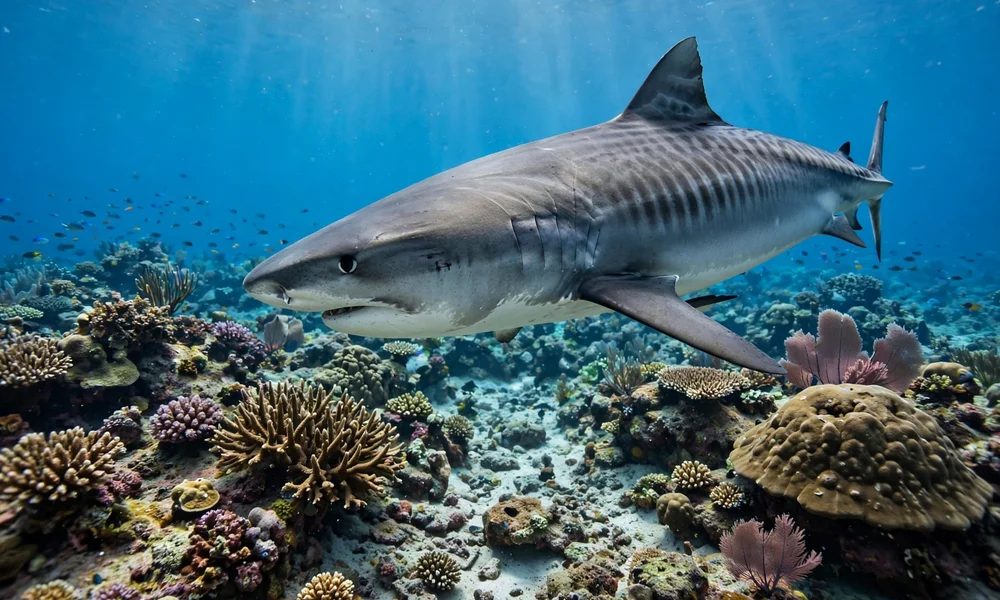
A tiger shark is a large shark with a blunt rounded snout, a grey back, a pale belly and dark vertical stripes along its sides, and it measures roughly 3.25 to 4.25 metres long and usually weighs between 385 and 635 kilogrammes, though large females can reach 5 metres and more than 900 kilogrammes. The tiger shark is the second largest predatory shark in the world, after the great white.
The stripes define the tiger shark: dark bars that run down its sides like a tiger’s, bright in young sharks and fading as the animal grows older, until a very old tiger shark may have almost no stripes at all. Its teeth are short and broad, shaped like a corkscrew, built for cutting through turtle shells and bone, and its snout is packed with sensors that detect the electric fields of animals hidden in the sand. Like other sharks, the tiger shark must keep swimming to breathe, driving water over its gills, and it can swim at up to 32 kilometres per hour in a burst.
The tiger shark species and their relatives
Galeocerdo cuvier is the only tiger shark species, and it is not split into formally recognised subspecies. Tiger sharks in different oceans form separate populations, from the Atlantic to the Pacific, but they are all the same species, and the animals travel thousands of kilometres across the open sea.
The great white shark is the tiger shark’s most famous relative, a larger predator that hunts seals in cold water, while the hammerhead shark has a wide head that senses the electric fields of fish buried in the sand. The bull shark is a stocky shark that swims up rivers into fresh water, the whale shark is the largest fish in the world and eats only plankton, and the mako shark is the fastest shark in the sea. The blue shark is a slim blue shark of the open ocean, and the lemon shark is a yellow shark of the shallow reefs.
| Type | Animal | Where it lives | Best-known food | Length or Weight |
|---|---|---|---|---|
| Species | Tiger shark (Galeocerdo cuvier) | Tropical and subtropical seas worldwide | Turtles, seals and fish | 3.25 to 4.25 m, 385 to 635 kg |
| Close relative | Great white shark | Cool coastal waters worldwide | Seals and sea lions | 4 to 6 m, 680 to 1,100 kg |
| Close relative | Hammerhead shark | Tropical and subtropical seas | Rays and fish | 3 to 6 m, 200 to 580 kg |
| Close relative | Bull shark | Warm coastal waters and rivers | Fish, turtles and rays | 2.1 to 3.5 m, 90 to 230 kg |
| Close relative | Whale shark | Tropical and subtropical seas | Plankton and small fish | Up to 12 m, up to 20 tonnes |
| Close relative | Mako shark | Temperate and tropical open ocean | Tuna and swordfish | 2.5 to 4 m, 60 to 570 kg |
| Close relative | Blue shark | Open ocean worldwide | Squid and fish | 2 to 3.3 m, 60 to 200 kg |
How tiger sharks live
Tiger sharks are creatures of the warm seas. A tiger shark lives alone, patrolling reefs, lagoons and the open sea by day and night, and it travels thousands of kilometres across the ocean, following turtles and fish as they move with the seasons. Like other great white sharks, it is a top predator, and it has no natural enemies except larger sharks and humans.
Turtles make up a large part of the diet, along with seals, sea snakes, fish, rays, squid, crabs and seabirds, and a tiger shark will eat almost anything it finds, including rubbish thrown from ships. It hunts by smell and by the electric fields of animals hidden in the sand, and it bites with serrated teeth that cut through turtle shells and bone, swallowing large chunks whole. It eats for hours at a time, and it can go for weeks without food when prey is scarce.
Breeding happens all year round in warm water, and after a gestation of 14 to 16 months the female gives birth to a litter of 10 to 80 pups, among the largest litters of any shark. The pups are born about 50 to 75 centimetres long, and they are left to fend for themselves at once, swimming away from their mother, who might eat them. The young grow slowly, taking 4 to 6 years to mature, and tiger sharks live for around 27 to 37 years in the wild, and up to 50 years in the best cases.
Where tiger sharks live
The tiger shark lives in the warm tropical and subtropical seas of every ocean, from the coasts of Florida and Hawaii to the waters of Australia and South Africa, and it is most common in shallow coastal waters, reefs and lagoons. It is seen regularly in Hawaii, where it is called the mano, in the Bahamas and in the waters of northern Australia, where it follows the turtles to their nesting beaches.
Warm water is the key requirement. A tiger shark needs water above about 18 degrees Celsius, with plenty of turtles and fish to eat, so it follows the warm currents as they move with the seasons, and when the water cools the sharks move towards the equator. It hunts in water from the surface to more than 1,000 metres deep, and it migrates thousands of kilometres across the open ocean.
The species is listed as Near Threatened, and its numbers are falling in most regions. The main pressures are fishing for its fins, meat and liver oil, and entanglement in fishing nets and shark nets, and in some places tiger sharks are killed in culls after attacks on swimmers. Tiger sharks are responsible for more attacks on people than any shark except the great white, though attacks are still rare, with only a few dozen each year worldwide.
Best seasons for tiger shark watching
There is no closed season, because tiger sharks are active all year, but the best time to look for them depends on where you go. In Hawaii the best months are often October to December, when the sharks come into the shallow bays to pup. In the Bahamas the best months are often the dry season, when the water is clear and the sharks gather at the reefs, and in South Africa the best months are often the summer, when the turtles nest.
Staying safe around tiger sharks
A tiger shark is a wild animal with great strength and sharp teeth, and it can kill a person, though attacks are rare and usually happen when a swimmer is mistaken for a turtle or a seal. Keep your distance, never swim alone at dawn or dusk, and never swim near fishing boats or where fish are being cleaned, because a tiger shark that smells blood may come to investigate. If you see a tiger shark, stay calm, keep eye contact and swim slowly back to the boat or shore, because a frightened swimmer that splashes looks like prey.
Tiger shark watching checklist
A little preparation turns a reef visit into a real chance of seeing a tiger shark, so pack for sun, warm water and long quiet hours.
- A mask and snorkel with good visibility, for picking a striped shark out of the blue water.
- A camera in an underwater housing, because tiger sharks should always be watched from a distance.
- Sun cream and a hat, because the best watching is in the bright midday sun.
- A booked boat tour with a guide who knows the shark rules and the safe routes.
- A plan to be out in the morning, when the sharks are most active and feeding.
- Patience and silence, because tiger sharks are shy animals and a noisy group will send them away.
- A wetsuit, for staying warm during long hours in the water.
Frequently asked questions
How many tiger shark species are there?
There is one tiger shark species, Galeocerdo cuvier. Tiger sharks in different oceans form separate populations, from the Atlantic to the Pacific, but they are all the same species. No second tiger shark species is recognised.
Why are tiger sharks called tiger sharks?
Tiger sharks are called tiger sharks because of the dark vertical stripes on their sides, which look like a tiger’s stripes. The stripes are brightest in young sharks and fade as the shark grows older, until a very old tiger shark may have almost no stripes at all.
Do tiger sharks really eat rubbish?
Yes. Tiger sharks eat almost anything, and their stomachs have been found to contain licence plates, tyres, bottles, cans and even a suit of armour. They are sometimes called the garbage cans of the sea, though most of what they eat is turtles, seals and fish.
Can you keep a tiger shark as a pet?
No. A tiger shark is a wild animal that needs the open ocean, eats up to 30 kilogrammes of food a day, and is fully protected by law in many countries. Tiger sharks in aquariums need huge tanks with filtered seawater, and they are not pets.
How is this guide different from the capuchin monkey species guide?
This guide covers the single tiger shark species, a striped hunter that eats turtles and seals in the warm seas, while our capuchin monkey species guide covers more than twenty capuchin monkey species, clever tool-using monkeys that live in the rainforest canopy of Central and South America. The tiger shark lives in the sea and eats almost anything, and the capuchin lives in trees and cracks nuts with stones.
Are tiger sharks endangered?
Tiger sharks are listed as Near Threatened, so they are not classed as endangered, but their numbers are falling in most regions. Fishing for their fins and meat is the main threat, and entanglement in fishing nets kills many more.
Conclusion
The tiger shark species shows how much appetite one animal can hold: a single species of striped hunter, with teeth like corkscrews, stripes like a tiger’s, and a life spent patrolling the warm seas of the world. It is one of the largest sharks on Earth, and it has lived in the tropical oceans for millions of years.
If you go looking for one, go in the dry season to the reefs of Hawaii or the Bahamas, go with a guide, and go quietly. Watch a tiger shark glide over the reef and you will understand why it has earned its place as the striped hunter of the warm seas, and why keeping its ocean clean matters most.