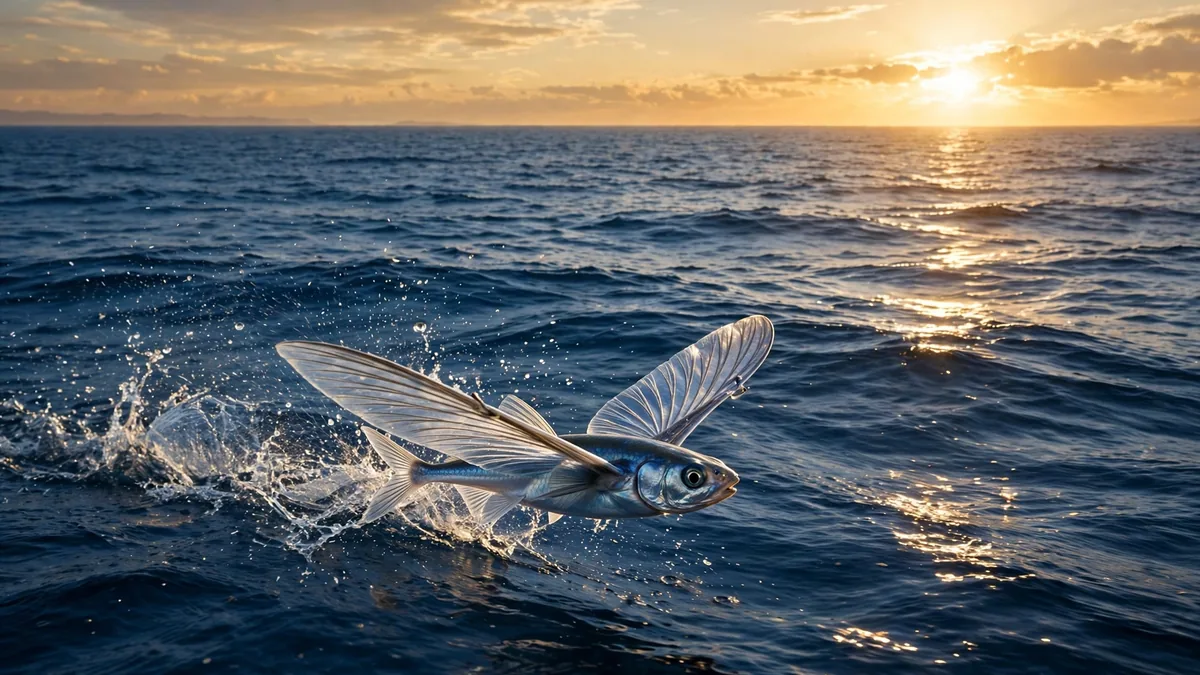
The flying fish species are the ocean’s great escape artists, small silver fish of the open sea that can leap out of the water and glide through the air on fins as broad as wings. If you are asking what a flying fish is, the short answer is a member of the family Exocoetidae, a group of about 40 to 64 species that live in the warm surface waters of the world’s tropical and subtropical oceans. They do not truly fly, the way a bird does, but they can stay airborne for up to 45 seconds and cover as much as 200 metres in a single glide, and sometimes twice that, which is enough to leave most of their hunters behind.
Seeing one is a moment you do not forget. A silver shape bursts from a wave beside a boat, spreads its fins, and skims along just above the surface, sunlight flashing off its flanks, before it drops back into the sea with barely a splash. On a good day in the tropics you may see dozens of them at once, rising and falling ahead of the bow like a flock of startled birds. They are not rare or mysterious animals, but they live their whole lives far from shore, in the blue water where the ocean is at its deepest and emptiest, so most people only ever meet them by chance, from the deck of a ship or a fishing boat.
Key takeaways
- The flying fish species belong to the family Exocoetidae, a group of about 40 to 64 species that live in the warm open oceans of the world.
- They are small fish, usually 18 to 30 centimetres long, with greatly enlarged pectoral fins that work like wings when they glide through the air.
- A flying fish can glide for up to 200 metres, and occasionally as far as 400 metres, staying airborne for as long as about 45 seconds.
- They take to the air to escape predators such as tuna, marlin, dolphins and seabirds, launching themselves out of the water at high speed.
- They lay their eggs on floating seaweed and debris at the surface, and the young drift with the currents until they are big enough to glide themselves.
The flying fish species and their relatives
Flying fishes belong to the family Exocoetidae, a family of ray-finned fishes in the order Beloniformes, and they are close cousins of the halfbeaks and the needlefishes, which share the same long, surface-living build. The family takes its name from the Greek word exocoetus, meaning a fish that sleeps outside the water, which is an old sailors’ idea that these fish came ashore at night to rest on the beach. They do nothing of the sort, but the name stuck, and it suits them well enough, because no other fish spends quite so much of its life in the air. National Geographic, whose profile of the flying fish is one of the best-known introductions to the group, describes them as fish that can glide for remarkable distances, and that description is the gap this guide sets out to fill, with the full story of how they live, feed and breed.
The family holds about 40 to 64 species, depending on how the newest studies split them, spread across seven genera. The best-known of them are the California flying fish, Cheilopogon pinnatibarbatus, the big, dark-winged fish of the eastern Pacific, and the Atlantic flyingfish, Cheilopogon melanurus, the common gliding fish of the tropical Atlantic and the Caribbean. Other familiar members include the tropical two-wing flying fish, Exocoetus volitans, which has only two enlarged fins instead of four, and the small, short-winged species of the genus Cypselurus that fill the warm waters of the Indo-Pacific. All of them share the same basic plan, and the differences between them are mostly a matter of size, fin shape and the pattern of dark markings on the wings.

| Type | Animal | Where it lives | Best-known food | Length or Weight |
|---|---|---|---|---|
| Family | Flying fishes (Exocoetidae) | Tropical and subtropical open oceans | Plankton and small crustaceans | About 18 cm to 45 cm long |
| Genus | Four-wing flying fishes (Cheilopogon) | Tropical Atlantic, Pacific and Indian Oceans | Plankton, small crustaceans and small fish | About 20 cm to 45 cm long |
| Species | California flying fish (Cheilopogon pinnatibarbatus) | Eastern Pacific, California to Peru | Plankton and small crustaceans | About 25 cm to 45 cm long |
| Species | Atlantic flyingfish (Cheilopogon melanurus) | Tropical western Atlantic and Caribbean | Plankton and small crustaceans | About 20 cm to 30 cm long |
| Species | Tropical two-wing flying fish (Exocoetus volitans) | Tropical oceans worldwide | Plankton and small crustaceans | About 18 cm to 25 cm long |
| Species | Japanese flying fish (Cypselurus agoo) | North-western Pacific, Japan and Korea | Plankton and small crustaceans | About 25 cm to 35 cm long |
The two-wing and four-wing flying fishes are the two great designs in the family, and the difference is easy to see once you know to look. Two-wing species, like Exocoetus volitans, have only their pectoral fins enlarged, and they glide in a straight, level line. Four-wing species, like the California flying fish and the Atlantic flyingfish, have both their pectoral fins and their pelvic fins enlarged, so they have a second pair of wings set further back, and they can steer and stay up a little longer. The four-wing fish are the better gliders of the two, and they include most of the larger species, while the two-wing fish are smaller, quicker off the water, and more common in the open ocean far from land.
Their nearest relatives are the halfbeaks, slender surface fish with a long lower jaw, and the needlefishes, long, toothy hunters that skim the surface at speed. Both groups share the flying fishes’ love of the top few centimetres of the sea, and all three are built for life at the boundary between water and air. The resemblance to the marlin is a different kind of kinship: marlins are not close relatives at all, but they are one of the flying fish’s great enemies, great blue hunters that drive schools of flying fish to the surface until the little fish have no choice but to take to the air.
What sets the flying fishes apart from every other fish in the sea is that they solved the problem of predators by leaving the water altogether, at least for a few seconds at a time. Most fish escape by swimming faster, diving deeper, or hiding in a reef, and the flying fish does none of those things. It lives in the open ocean, where there is nowhere to hide and no bottom to dive to, so it took the one route left: up. That single choice shaped its whole body, from its wing-like fins to its forked tail, and it is the reason this small, silvery fish has become one of the best-known animals in the sea.
What flying fishes look like
A flying fish is a small, torpedo-shaped fish, built for speed at the surface, with a body that is usually 18 to 30 centimetres long, though the largest species, like the California flying fish, can reach about 45 centimetres. The back is a deep, steely blue or blue-green, the flanks are bright silver, and the belly is white, a pattern called countershading that makes the fish hard to see from above against the dark water and hard to see from below against the bright sky. The scales are large and smooth, and the whole animal shines like polished metal when it catches the sun, which is why a school of flying fish can look like a scatter of mirrors on the waves.
The feature that defines them is the fins. In most species the pectoral fins are enormous, stretching back along the body to the tail, and when they are spread they look like the wings of a small aeroplane, dark on top and pale underneath, sometimes marked with spots or a dark edge. In the four-wing species the pelvic fins are enlarged too, giving the fish a second, smaller pair of wings set low on the body, and the effect in the air is unmistakable. The tail is deeply forked, and the lower lobe is longer than the upper one, which is a shape built for a very particular job, beating against the water to build up speed before take-off.
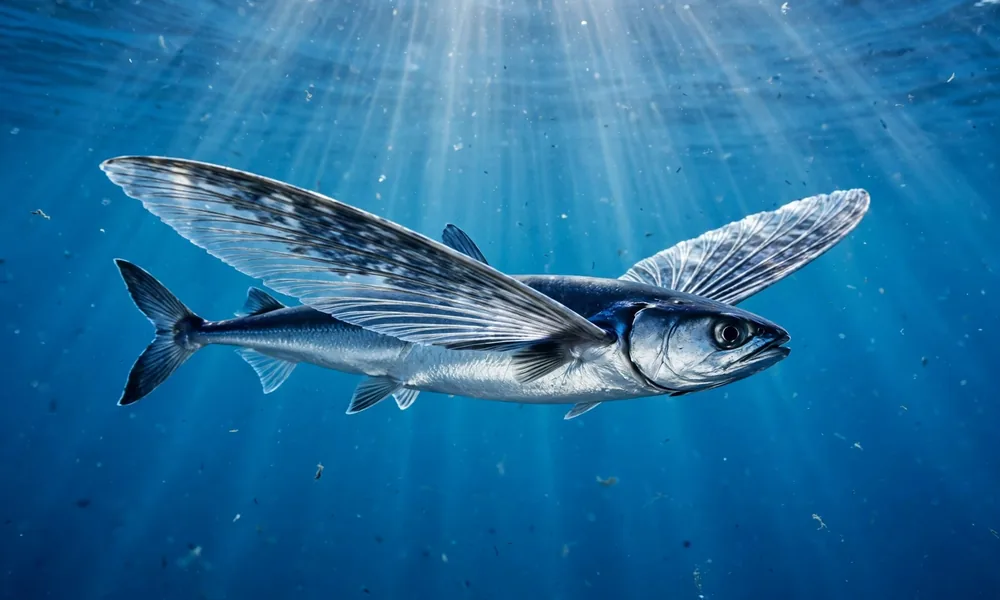
The head is short and blunt, with a small mouth set at the tip and large eyes placed high on the sides, so the fish can watch the surface from just below it. The eyes are dark and prominent, and they give the flying fish good vision both under water and, for a few seconds, in the air. Young flying fishes look quite different from the adults, and for a long time people thought they were a different kind of animal altogether. The young have long, thread-like barbels hanging from the chin, sometimes two or four of them, and fringed, leaf-like fins, and they drift at the surface looking more like bits of floating seaweed than like fish, which is exactly the point.
Males and females look much alike, and there is no reliable way to tell them apart by eye at sea. Females tend to grow a little larger than males, and during the breeding season a female’s belly swells with eggs, but the difference is small, and even fishermen who handle thousands of them rely on size and season rather than on any mark on the body. The colour of the wings varies between species and between individuals, from plain dark blue to wings patterned with pale spots, and in a few species the fins are marked with bright yellow or white, which makes them easy to recognise when they glide past a boat.
Where flying fishes live
Flying fishes live in the open ocean, in the warm surface waters of the tropical and subtropical Atlantic, Pacific and Indian Oceans, roughly between 40 degrees north and 40 degrees south of the equator. They are creatures of the blue water, far from the coast, and they are most common where the surface is warm, clear and rich in the small drifting life they feed on. The California flying fish ranges along the eastern Pacific from California down to Peru, the Atlantic flyingfish fills the tropical western Atlantic and the Caribbean, and the tropical two-wing flying fish is found in warm waters all round the world, one of the most widely spread fish in the sea.
The habitat they choose is the top layer of the sea, the sunlit few metres where plankton gathers and where the water is warmest. They are almost never found deeper than a few metres down, and they are rarely seen close to shore except where a current carries them in, or where an island rises steeply from deep water. Around islands like Barbados, where the flying fish is famous enough to appear on the national coat of arms and on the dollar coin, they come close inshore in large numbers, and the local fishery depends on them. Elsewhere they are animals of the high seas, met by ships far from land.

Floating seaweed and debris matter far more to a flying fish than any reef or rock. Rafts of sargassum, driftwood and floating pumice are the places where the eggs are laid, where the young shelter, and where the adults find the small animals they eat. A flying fish that finds a good raft may stay near it for days, feeding in the rich water around it and using it as a landmark in an otherwise featureless sea. When the raft drifts on, the fish drift with it, and in that way the whole population moves with the currents, spread across thousands of miles of open water.
What flying fishes eat
Flying fishes feed on the small drifting life of the surface waters, and their diet is a mix of plankton, small crustaceans and the larvae of other sea animals. The everyday food is copepods, tiny shrimp-like animals barely a few millimetres long, along with krill, small jelly animals and the eggs and larvae of fish, all taken at or just below the surface. A flying fish feeds by swimming slowly through a patch of plankton with its mouth open, picking out the larger pieces one by one, and it can spend hours working the same rich patch, rising and falling in the top metre of water.
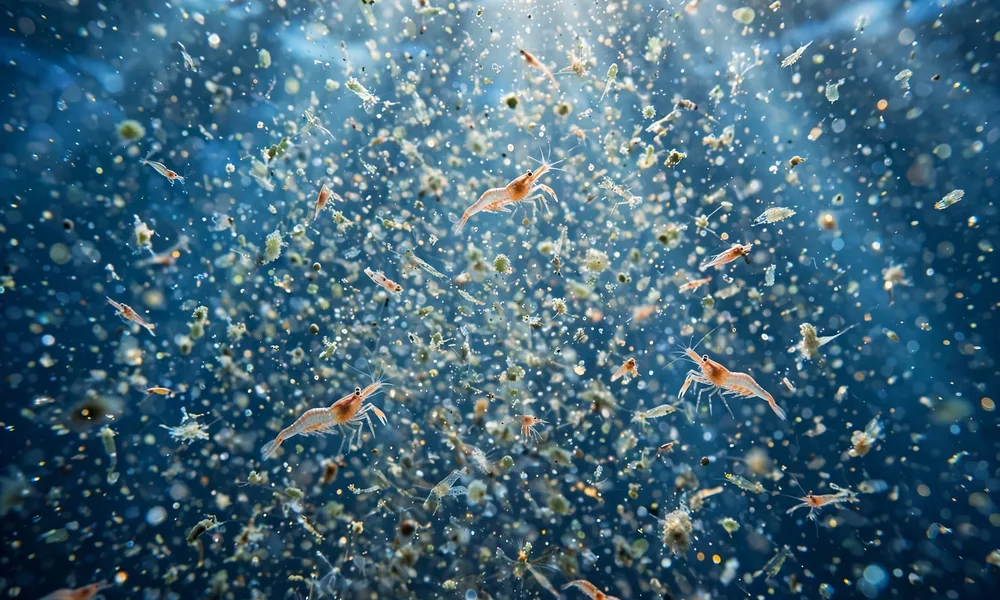
The larger species take larger prey. A California flying fish will eat small fish, including anchovy larvae and the young of other surface fishes, and it will take small squid when it finds them. The Atlantic flyingfish is more of a plankton specialist, and its stomachs are usually full of copepods and small crustaceans, with the occasional small fish mixed in. None of them are hunters in the way a tuna is a hunter. They do not chase, they do not ambush, and they have no teeth worth speaking of. They are grazers of the surface, picking food out of the water the way a cow picks grass out of a field.
Feeding happens mostly by day, when the plankton rises towards the light and the flying fish can see what it is eating. At night much of the plankton sinks or scatters, and the flying fishes rest near the surface, drifting with the current and saving their energy. They feed in loose schools, sometimes hundreds strong, and a school working a plankton patch is a busy, restless sight, with fish turning and rising and breaking the surface as they feed. The school is also a defence: a hundred silver fish are harder for a hunter to pick apart than one fish on its own, and when the school is attacked, the whole group takes to the air at once.
How flying fishes behave
The behaviour that matters most is the glide, and it is worth understanding properly, because it is not flying at all. A flying fish takes off by swimming fast just below the surface, building up speed until it is moving at roughly 60 kilometres an hour, and then it breaks the surface with its fins folded and its tail still beating hard against the water. The long lower lobe of the tail keeps pushing against the surface, adding speed, and then the fish spreads its pectoral fins and lifts clear of the water, gliding on the wind like a paper plane. It cannot flap, and it cannot gain height on its own, but it can ride the air just above the waves.

The glide is an escape, first and last. Flying fishes take to the air when a predator comes at them from below, and the usual hunters are tuna, marlin, dolphinfish and dolphins, all fast animals that can out-swim a flying fish in the water. In the air, the flying fish is safe from them, and a glide of 200 metres is often enough to put it well clear of the hunter. The cost is that the air has its own hunters, and frigatebirds and other seabirds have learned to watch for flying fish and snatch them in mid-glide. A flying fish that escapes a tuna can still end up in the beak of a bird, which is a hard bargain, but a better one than staying in the water.
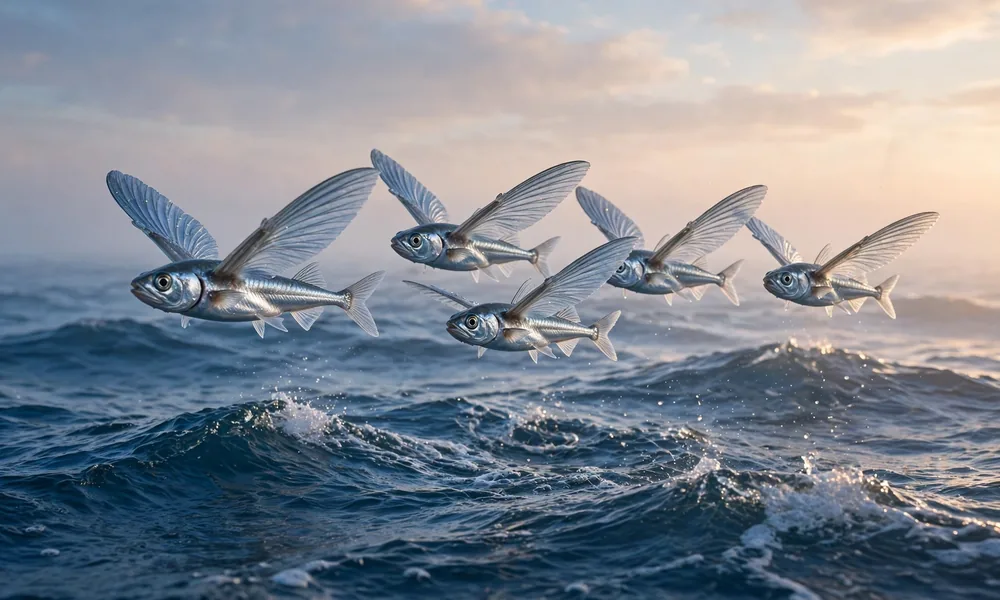
Gliding is also how flying fishes travel. A fish that has to cover ground will take off, glide for a hundred metres or more, drop back into the water, and take off again, covering distance in long, easy bounds that cost far less energy than swimming. Schools move this way for hours, rising and falling across the surface like a flock of birds, and a ship can follow a school for miles, watching the same silver shapes rise ahead of the bow again and again. The longest glides on record are around 400 metres, and the longest times in the air are about 45 seconds, though most glides are shorter, a few seconds and a few dozen metres.
The comparison with the swordfish shows how different two surface fish can be. A swordfish is a lone hunter that uses its speed and its sword to kill, and it has no need of wings. A flying fish is a small, schooling animal that survives by being hard to catch, and its whole body is built around that one trick.
Breeding and life cycle
Flying fishes breed in the warm months, when the surface water is at its warmest and the plankton is thickest, and the season runs through the spring and summer in most of their range. They gather in schools over deep water, and the females release their eggs at the surface while the males shed their milt over them, in the open water where there is nothing to hide the eggs and nothing to protect them. A single female can lay thousands of eggs in a season, sometimes tens of thousands, and she does it in batches over several weeks, so that the eggs are spread across time as well as across the sea.

The eggs are the reason floating seaweed matters so much. Each egg is about two millimetres across, round and clear, and it carries a tuft of fine, sticky threads that tangle onto seaweed, driftwood or anything else floating at the surface. The threads hold the eggs in the warm surface water, where they develop fast, hatching in a few days in warm seas and a little longer where the water is cooler. Without something to stick to, the eggs would sink into the cold, dark water below, where they would not survive, so a flying fish that cannot find a raft cannot breed at all, which is why the fish follow the weed.

The hatchlings are tiny, only a few millimetres long, and they are nothing like the adults. They have long barbels on the chin, fringed fins, and a body that is often banded or mottled, and they cling to floating weed, feeding on the tiny animals that live on it. They grow fast in the warm surface water, and within a few weeks they are a few centimetres long and starting to look like proper flying fishes. The barbels shrink as they grow, the fins grow into their adult shape, and by the time the young fish is about half-grown it can take off and glide, though its first flights are short and clumsy.
Conservation status
Flying fishes as a group are not considered threatened, and most species are listed as Least Concern, because they are widespread, numerous and fast-breeding, and their open-ocean home is still largely intact. That broad picture is reassuring, but it hides real pressures, and the International Union for Conservation of Nature has assessed only some of the species, so for many of them there is simply not enough data to say how they are doing, which is a gap in itself.
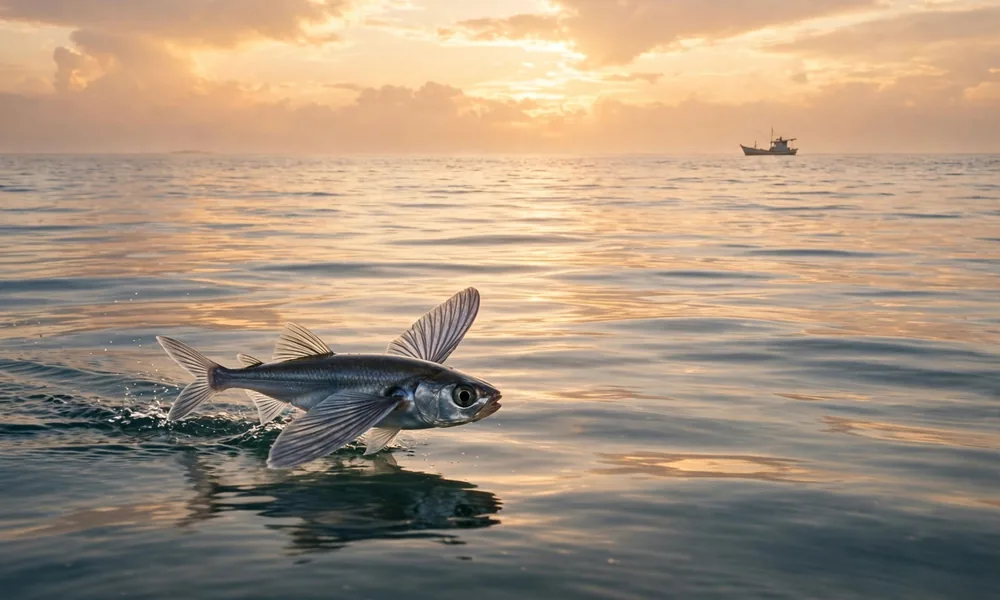
The main pressure is fishing. Flying fishes are caught in large numbers across the tropics, especially around Barbados, where the flying fish is the national fish and the fishery is a pillar of the local economy, and across South-East Asia, where they are eaten fresh, dried and salted. They are caught with gillnets, dip nets and scoop nets, often at night, when they are drawn to lights, and the catch is used for food and for bait. The fishery is mostly small-scale and local, and it has gone on for centuries, but in some places the catch has fallen, and nobody is quite sure whether the fish are fewer or whether the fishing has simply moved.
The second pressure is the loss of floating seaweed. Sargassum rafts are the flying fish’s nursery, and anything that breaks up the rafts takes away the places where the eggs are laid. Pollution is part of it, and so is the changing climate, which is shifting the currents that carry the weed and warming the surface water beyond what some species prefer. The most useful conservation work is simple and practical: manage the fisheries so the catch stays within what the population can replace, keep plastic and oil out of the surface waters, and protect the sargassum rafts that the fish depend on.
Best seasons for flying fish watching
The best time to see flying fishes is the warm season, from late spring through early autumn, when the surface water is warmest, the plankton is thickest, and the fish are feeding and breeding in large schools. In the Caribbean the peak runs from about December to June, when the flying fish come close inshore around Barbados and the other islands, and in the eastern Pacific the best months are the summer, when the California flying fish move north along the coast. In the open ocean the season is less sharp, and you can find them for most of the year, but the numbers are always highest in the warm months.
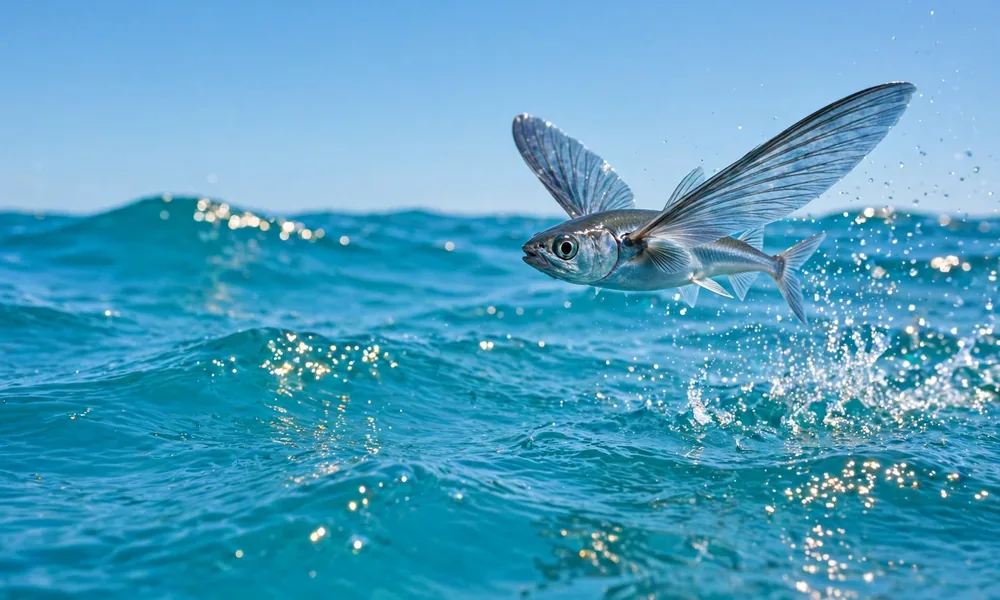
The best hours are the morning and the late afternoon, when the sun is low and the fish are feeding near the surface, and when the light catches their silver flanks as they rise. A boat moving at a steady speed through warm water is the best way to see them, because the fish are startled by the bow wave and take off ahead of it. From a beach or a cliff you will see far fewer, but a ferry crossing between islands in the tropics can be as good as any dedicated trip, with fish rising on both sides of the boat for miles.
Staying safe around flying fishes
Flying fishes are not dangerous to people, and there is no reason to fear them, but they are worth a little respect, because a fish that can launch itself out of the water at 60 kilometres an hour can surprise you. The main risk is to people in small boats, where a flying fish can land on deck or strike a passenger, and there are stories of fishermen being knocked over by a flying fish that came aboard at speed. The fish itself is harmless, it has no teeth and no sting, but a 30-centimetre fish hitting you at that speed is a shock, and it can leave a bruise.
There are a few practical points for watching them. Keep your eyes on the water ahead of the boat, because the fish take off without warning and the best views last only a few seconds. If you are in a small boat, wear a hat and keep loose gear stowed, so a fish that lands on board does not knock anything overboard. If a flying fish lands on your deck, pick it up gently with wet hands and return it to the water at once. And remember that the sea itself is the real danger, not the fish: wear a life jacket in a small boat and watch the weather.
Flying fish watching checklist
A little preparation turns a boat trip through warm water into a real chance of seeing flying fishes glide.
- A visit in the warm season, from late spring through early autumn, when the fish are feeding and breeding in large schools.
- A boat moving at a steady speed through warm, clear water, so the bow wave startles the fish into taking off ahead of you.
- Morning or late afternoon light, when the low sun catches the silver flanks and makes the gliding fish easy to follow.
- Deep water close to shore, or a ferry crossing between tropical islands, where the fish come near land in numbers.
- Binoculars for spotting the first fish, and a camera ready, because a glide lasts only a few seconds.
- A hat and stowed loose gear in a small boat, so a fish that lands on deck does not knock anything overboard.
- Respect for the fish and the sea, returning any fish that lands on board to the water at once and never leaning over the side at speed.
Frequently asked questions
How far can a flying fish glide?
A flying fish can glide for up to 200 metres in a single flight, and the longest glides on record are around 400 metres, with the fish staying airborne for as long as about 45 seconds. Most glides are shorter, a few seconds and a few dozen metres, and a fish can extend its flight by dipping its tail back into the water to pick up speed again before lifting off a second time.
Do flying fishes really fly?
No, not in the way a bird flies. A flying fish cannot flap its fins or gain height under its own power. It launches itself out of the water at high speed, spreads its enlarged pectoral fins, and glides on the air like a paper plane, slowly losing height until it drops back into the sea. The fins are wings in shape and in function, but the fish is gliding, not flying.
Why do flying fishes leave the water?
They leave the water to escape predators. In the open ocean there is nowhere to hide, so when a tuna, marlin, dolphinfish or dolphin attacks from below, the flying fish’s best chance is to take to the air, where those hunters cannot follow. A glide of 200 metres is often enough to put it clear of the hunter, though seabirds can catch them in mid-air.
What do flying fishes eat?
Flying fishes eat plankton, small crustaceans such as copepods and krill, and the eggs and larvae of other sea animals, all taken at or just below the surface. The larger species also eat small fish and small squid. They are grazers of the surface, picking food out of the water rather than hunting, and they feed mostly by day, when the plankton rises towards the light.
Where do flying fishes lay their eggs?
They lay their eggs on floating seaweed, driftwood and other debris at the surface. Each egg carries a tuft of fine, sticky threads that tangle onto the weed and hold it in the warm surface water, where it hatches in a few days. Without something floating to stick to, the eggs would sink into cold, deep water and would not survive.
How is this guide different from the coelacanth guide?
This guide covers the flying fish, a small, fast, surface-living fish of the warm open ocean that escapes its hunters by gliding through the air, while our coelacanth guide covers a huge, slow, deep-water fish of the Indian Ocean that was thought extinct for 66 million years before it was found alive. One is a glittering sprinter of the sunlit surface; the other is a living fossil of the deep.
Conclusion
The flying fish species are a reminder that the best answer to danger is not always to fight or to hide, but to find a way out that nobody else has thought of. A small silver fish of the open ocean, with no teeth, no armour and no speed to match a tuna, learned to leave the water altogether, and in doing so it became one of the most famous fish in the sea, a creature that sailors have written about for centuries and that still stops people in their tracks when it rises beside a boat.
If you go looking for them, go in the warm season, go by boat, and keep your eyes on the water ahead of the bow. Watch for the silver flash, the spread wings and the long, low glide across the waves, and you will have seen one of the sea’s cleverest tricks, performed by a fish that was never meant to fly.