The coelacanth species is a fish that was supposed to be extinct, and then it was not. If you are asking what a coelacanth is, the short answer is a large, lobe-finned fish of the deep reef, Latimeria chalumnae, a so-called living fossil whose relatives were thought to have died out with the dinosaurs 66 million years ago, until one was pulled from the sea off South Africa in 1938. It is a slow, heavy fish of dark, cold water, blue-grey with white spots, with fins on fleshy stalks like the limbs of a land animal, and it lives hundreds of metres down, in caves and on volcanic slopes where sunlight barely reaches.
Most people first hear about the coelacanth as a story, and it is a good story. A trawler captain, a young museum curator, a fish no scientist had ever seen alive, and a letter that changed what we thought we knew about the history of life on earth. The fish at the centre of it is less dramatic than the tale: it does not leap, it does not hunt in packs, and it does not do much of anything quickly. It drifts, it hovers, it waits, and it has done so, in much the same form, for hundreds of millions of years. That stillness is the heart of this guide: how a fish from the deep past lives in the deep present, and why it is so rare, so slow and so hard to protect.
Key takeaways
- The coelacanth species is Latimeria chalumnae, a large lobe-finned fish of the deep reef, with a second species, Latimeria menadoensis, living off Indonesia.
- Coelacanths were thought extinct for 66 million years until one was caught off South Africa in 1938 and identified by Marjorie Courtenay-Latimer.
- They grow to about 1 to 2 metres long and weigh 80 to 100 kilograms, with fins on fleshy stalks, a three-lobed tail and no swim bladder.
- They live 150 to 700 metres down, in caves and on volcanic slopes, and they give birth to live young, usually 5 to 25 pups at a time.
- The West Indian Ocean coelacanth is listed as Critically Endangered and the Indonesian coelacanth as Vulnerable, and both are threatened by deep-set fishing nets.
The coelacanth species and their relatives
Coelacanths belong to the family Latimeriidae, a family with only one living genus, Latimeria, and two living species. The order they sit in, the Coelacanthiformes, was once a large and varied group, with dozens of species swimming in the seas of the Devonian, some 400 million years ago, and the family name comes from the Greek words for hollow spine, a nod to the hollow, fluid-filled tube that runs through the backbone instead of a solid column of bone. The living species are the last survivors of that old order, and they are the only coelacanths left on earth. National Geographic keeps a live profile of the coelacanths on its animals pages, and it tells the 1938 discovery story well, but it leaves plenty of room for a deeper look, which is the gap this guide fills: the depth, the breeding, the slow life and the conservation trouble that a short profile cannot carry.
The West Indian Ocean coelacanth, Latimeria chalumnae, is the species of this guide, and its name carries the whole discovery story in it. The genus, Latimeria, honours Marjorie Courtenay-Latimer, the young curator at the East London Museum who recognised the strange fish for what it was, and the species name, chalumnae, honours the Chalumna River, near the mouth of which the fish was caught. The second species, the Indonesian coelacanth, Latimeria menadoensis, was found much later, in 1997, when a dead specimen turned up in a fish market in Manado, on the island of Sulawesi, and it was formally described in 1999. The two species look much alike, though the Indonesian fish is a little smaller, growing to about 1.4 metres, and it lives thousands of kilometres from its African cousin.
The coelacanth’s closest living relatives are the lungfish, and the family resemblance is real, though it takes a careful eye to see it. Like the salmon, a coelacanth is a bony fish, but the salmon is a ray-finned fish, with fins supported by thin, bony rays, while the coelacanth is a lobe-finned fish, with fins set on fleshy, muscular stalks. That difference matters enormously, because the lobe-finned fish are the group from which the first land animals evolved, and the coelacanth’s fins move in a slow, alternating rhythm that looks uncannily like the walking of a four-legged animal. The Australian lungfish, which grows to about 1.5 metres, and the West African lungfish, which grows to about 1 metre, are the coelacanth’s nearest living cousins, and all three are survivors of a group that was once far larger.
| Type | Animal | Where it lives | Best-known food | Length or Weight |
|---|---|---|---|---|
| Family | Coelacanths (Latimeriidae) | Deep slopes of the Indian Ocean | Small fish, squid and cuttlefish | About 1 m to 2 m long |
| Genus | Coelacanths (Latimeria) | Western Indian Ocean and Indonesia | Small fish and cephalopods | About 1 m to 2 m long |
| Species | West Indian Ocean coelacanth (Latimeria chalumnae) | Comoros, South Africa and Mozambique | Small fish, squid and octopus | About 1 m to 2 m long, 80 kg to 100 kg |
| Species | Indonesian coelacanth (Latimeria menadoensis) | Sulawesi, Indonesia | Small fish and cephalopods | Up to about 1.4 m long |
| Species | Australian lungfish (Neoceratodus forsteri) | Rivers of Queensland, Australia | Small fish, frogs and plants | Up to about 1.5 m long |
| Species | West African lungfish (Protopterus annectens) | Rivers and swamps of West Africa | Small fish, frogs and molluscs | Up to about 1 m long |
The discovery story is worth telling properly, because it is one of the great moments in the history of biology. On 22 December 1938, a trawler working off the mouth of the Chalumna River, near East London in South Africa, brought up a strange, steel-blue fish, about 1.5 metres long, with fins on stalks and scales like armour plate. The captain, Hendrik Goosen, kept it and called Marjorie Courtenay-Latimer, the curator of the small local museum, and she recognised at once that she had never seen anything like it. She wrote to J. L. B. Smith, a fish expert at Rhodes University, who replied by telegram that the fish was a coelacanth, a group known only from fossils and thought to have died out 66 million years ago, and he warned her to look after it at all costs. The fish was preserved, the world was astonished, and a second specimen was not found until 1952, off the Comoros Islands, where a local population turned out to live in the deep water around the volcanic islands.
That second discovery changed the story again. The Comoros, a small island nation between Madagascar and Mozambique, turned out to hold the largest known population of West Indian Ocean coelacanths, living in caves on the steep volcanic slopes at depths of 150 to 300 metres, and for decades almost every coelacanth studied by scientists came from those waters.
What a coelacanth looks like
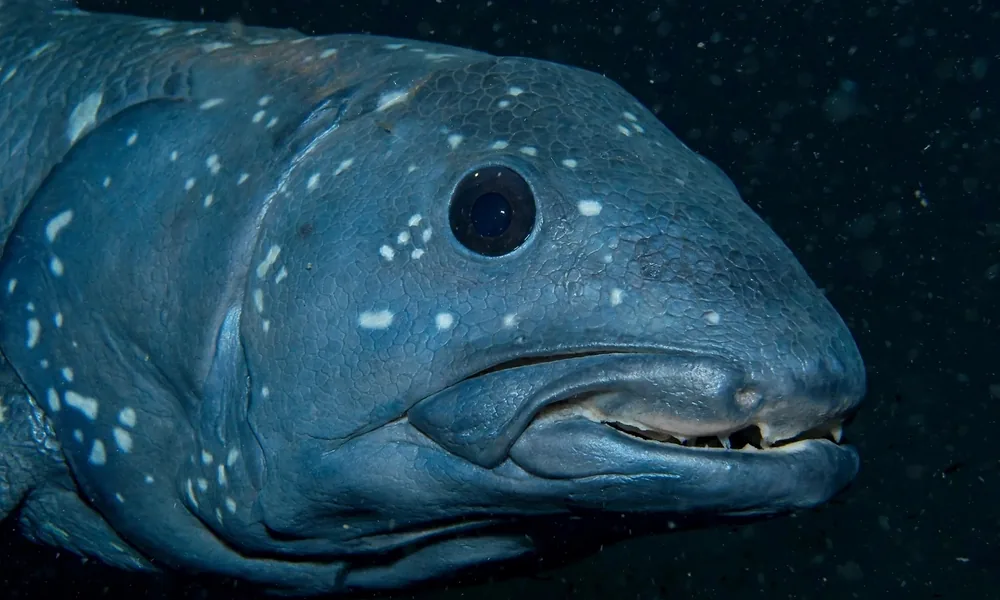
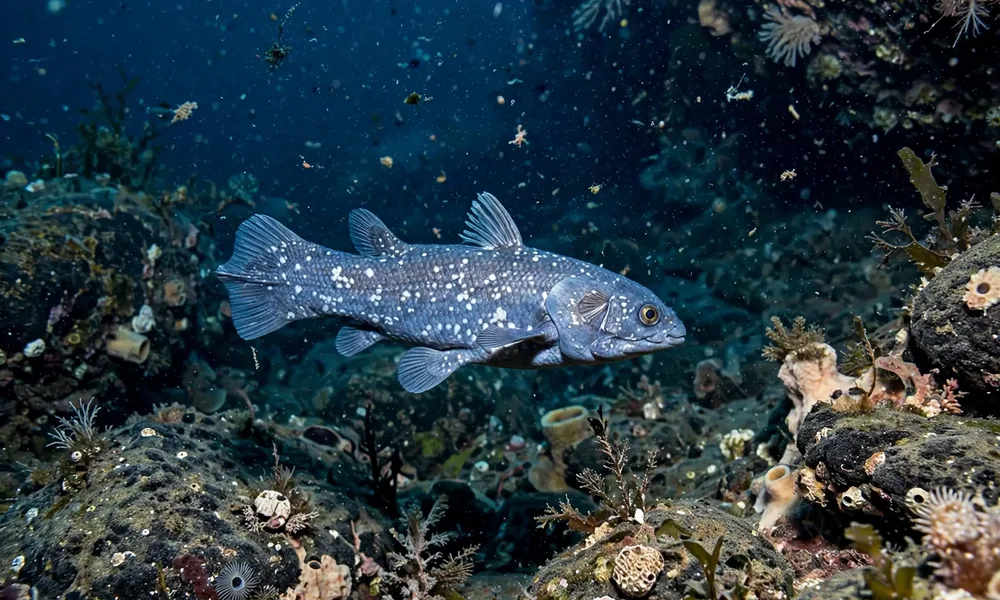
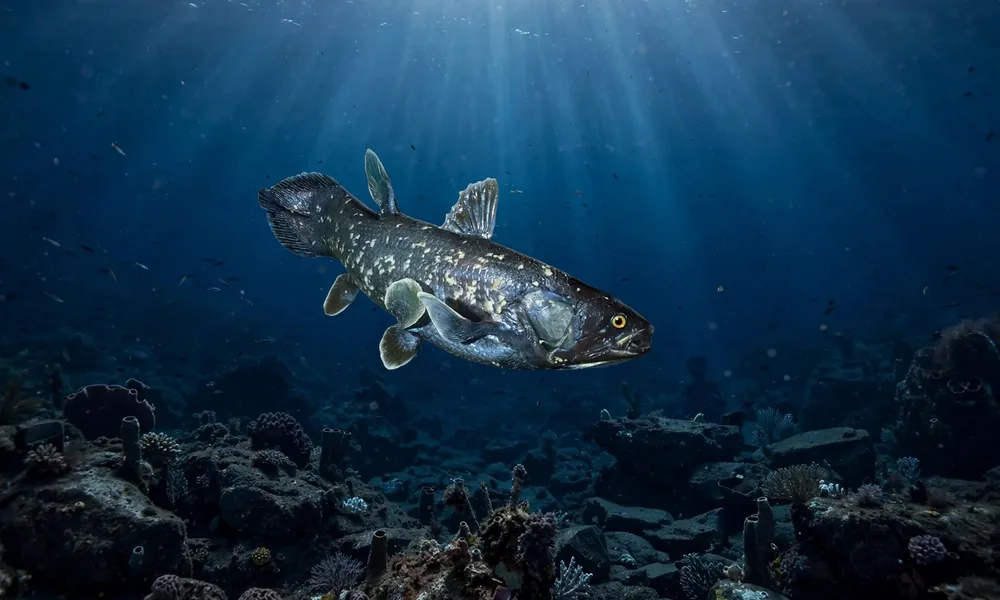
A coelacanth is a large, heavy fish, and it looks old in a way that no other living fish does. Most adults measure about 1 to 2 metres from snout to tail, and a large fish can weigh 80 to 100 kilograms, which makes it one of the biggest fish on the deep reef. The body is thick and muscular, covered in large, rough scales that feel like sandpaper, and the colour is a deep blue-grey, almost steel blue in life, with scattered white spots that are different on every fish, like a fingerprint. The head is broad and blunt, with a large mouth, big dark eyes and a curious fleshy snout that hides a special sense organ, the rostral organ, which can detect the faint electric fields of hidden prey.
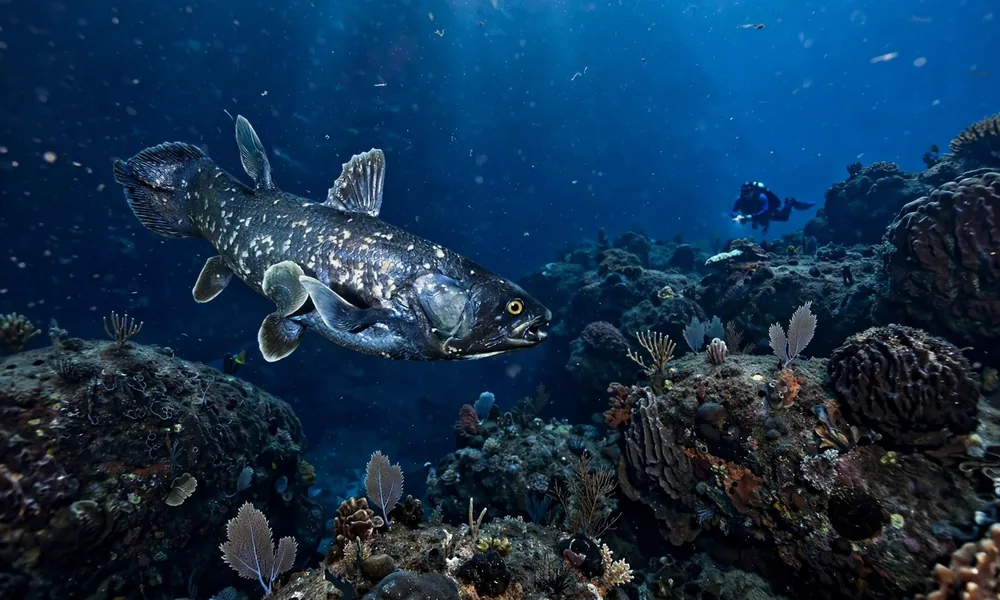
The fins are the feature that makes a coelacanth unmistakable. The paired fins, the pectoral and pelvic fins, sit on short, fleshy stalks, like the limbs of a land animal, and they move in a slow, alternating rhythm, the front left fin with the back right fin, the way a four-legged animal walks. The tail is three-lobed, with a small middle lobe between the two main lobes, a shape that no other living fish has, and the second dorsal fin and the anal fin sit opposite one another near the tail, giving the back end of the fish a symmetrical, almost deliberate look. When a coelacanth swims, it does not beat its tail hard the way a tuna does; it drifts, it hovers, and it uses its lobe fins to steer and to hold its place in the water.
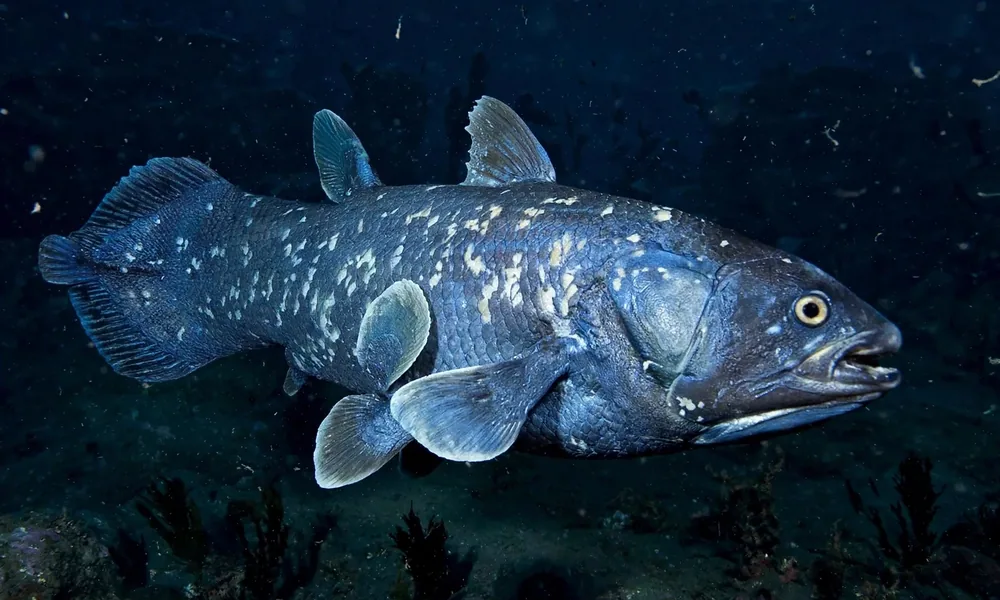
Inside, the coelacanth is as strange as it looks outside. It has no swim bladder, the gas-filled sac that most bony fish use to control their buoyancy, and instead it carries a large, fat-filled organ that does a similar job, letting the fish hover without effort at great depth. Its backbone is not a solid column of bone but a hollow, fluid-filled tube, a relic of the earliest vertebrates, and its brain is tiny, taking up only a small part of a large, fluid-filled skull. The heart is simple, the gut is short, and the whole animal is built for a slow, low-energy life in cold, dark water, where food is scarce and there is no point in hurrying.
Males and females look much alike, though a female is usually a little larger and heavier, and she carries the young inside her body until they are born. Juveniles are smaller copies of the adults, with the same blue-grey colour and white spots, and a newborn pup is already about 35 centimetres long, a substantial fish in its own right. The spots are worth a second look, because they are unique to each fish, and scientists who study coelacanths use photographs of the spot pattern to recognise individuals, the way whale researchers use the pattern on a whale’s tail.
Where coelacanths live
Coelacanths live in deep water on the steep, volcanic slopes of the western Indian Ocean, and their range is small and scattered. The best-known population lives around the Comoros Islands, between Madagascar and Mozambique, where the fish shelter in caves on the volcanic slopes at depths of 150 to 300 metres. Other populations live off Sodwana Bay in South Africa, along the coast of Mozambique, around Madagascar and in the deep water off Tanzania, and the Indonesian species lives off the island of Sulawesi, in the same kind of deep, rocky habitat. Wherever they live, the pattern is the same: deep water, steep rock and caves to hide in by day.
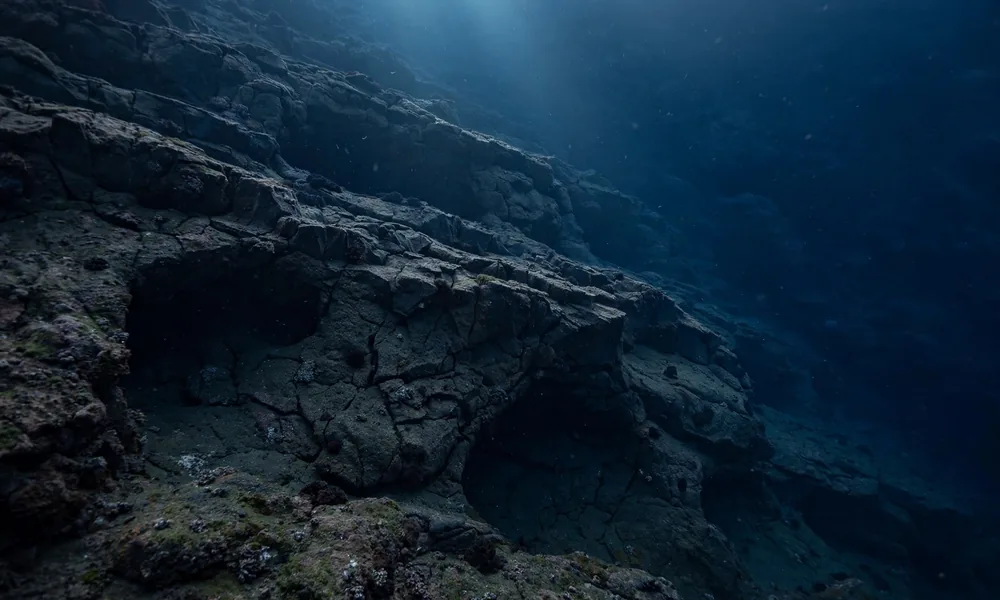
The depth is the first thing to understand. Coelacanths live between about 150 and 700 metres down, though most are found between 150 and 300 metres, where the water is cold, dark and rich in the small fish and squid they eat. By day they rest in caves and under overhangs, sometimes in groups, hanging head-down or drifting slowly in the dark, and at night they rise a little shallower to hunt, following their prey up the slope. The water temperature where they live is usually between 14 and 22 degrees Celsius, far colder than the warm, sunlit water of the coral reef above, and the light at those depths is a dim, blue twilight at best.
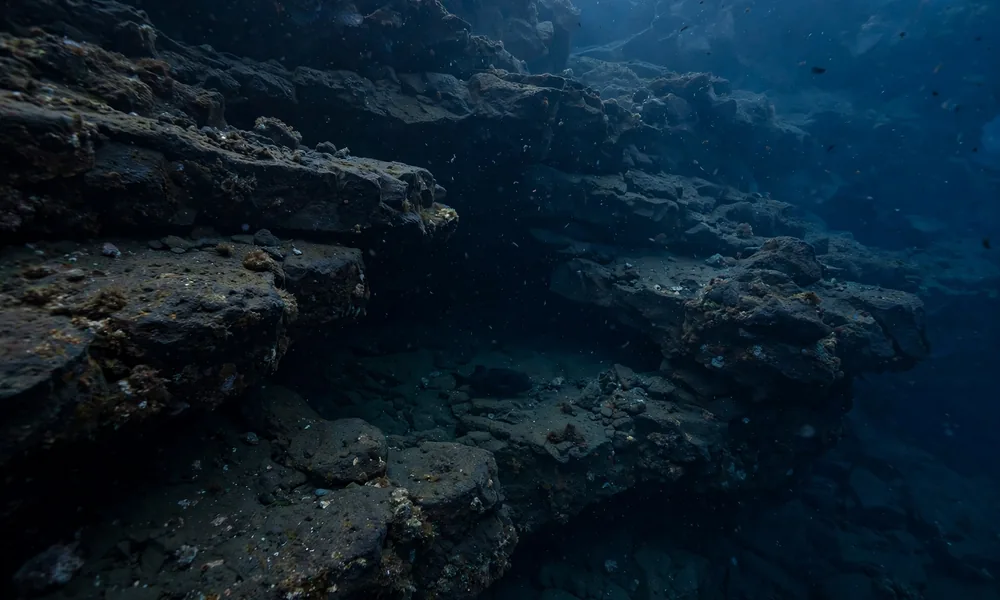
The caves matter more than the depth, and they are the reason the fish are found where they are. A coelacanth needs a cave or an overhang to rest in during the day, and it needs a steep slope nearby, where the currents bring food and where the small fish and squid it hunts gather at night. The volcanic slopes of the Comoros are ideal, with lava tubes and collapsed rock forming a maze of caves, and the same is true of the canyons off Sodwana Bay, where the fish were first filmed in their natural habitat. A slope without caves is a slope without coelacanths, and that is why the fish are so patchily spread: they live only where the rock gives them somewhere to hide.
The range is small, and it is getting no larger. The West Indian Ocean coelacanth is found only in the western Indian Ocean, from South Africa to the Comoros and Madagascar, and the Indonesian species is found only off Sulawesi, thousands of kilometres away. The two populations are separated by the whole width of the Indian Ocean, and they have been separated for millions of years, which is why they are now different species.
What coelacanths eat
Coelacanths are slow, patient hunters, and their diet is the small life of the deep reef. They eat small fish, squid, cuttlefish and octopus, and they take whatever comes within reach in the dark water of the slope. A coelacanth does not chase its prey; it drifts, it hovers, and it waits, and when a small fish or a squid comes close, it opens its large mouth and sucks the animal in with a sudden gulp. The rostral organ in its snout helps it find prey it cannot see, detecting the faint electric fields of animals hiding in the rock or buried in the sand, and its large eyes gather what little light there is at depth.
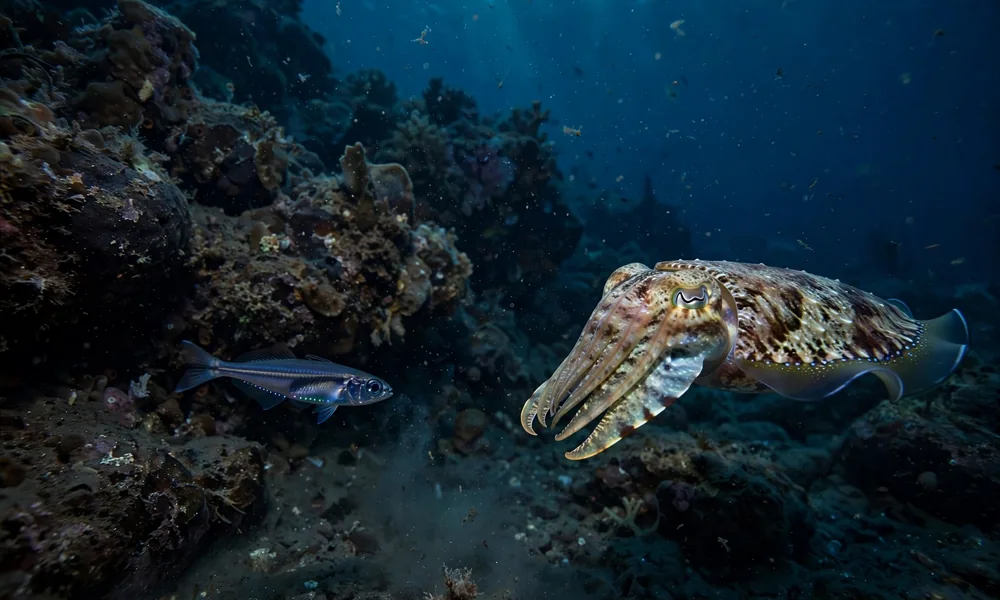
The hunting style is a slow drift, and it is set by the fish’s metabolism. A coelacanth has a very low metabolic rate, which means it needs little food, and it can go for long periods without eating at all. It spends much of its time hovering or drifting, using its lobe fins to hold its place, and it saves its energy for the short burst of a strike. Like the Atlantic cod, a coelacanth is a fish that eats other fish, but the cod is a fast, active hunter of cold northern seas, while the coelacanth is a slow, drifting hunter of deep tropical slopes, and it eats far less, far less often.
Feeding follows the night, and it follows the prey. By day the coelacanth rests in its cave, and at dusk it comes out and rises a little shallower, following the small fish and squid that move up the slope at night. It feeds through the dark hours, taking one animal at a time, and by dawn it is back in its cave, digesting slowly. A coelacanth that is feeding well is a quiet fish, drifting in the dark, and a fish that has stopped feeding is usually a fish in trouble, because a coelacanth that cannot find food in the deep has nowhere else to turn.
How coelacanths behave
Coelacanths are slow, quiet fish, and their behaviour is built around saving energy. They spend the day resting in caves, sometimes alone and sometimes in small groups, hanging head-down or drifting gently in the dark, and they come out at night to hunt. They do not school, they do not chase, and they do not defend a territory in the way a reef fish does. Their life is a slow rhythm of rest and drift, and it has worked for hundreds of millions of years, which is a kind of success that no fast, flashy fish can claim.

The most striking behaviour is the way they swim. A coelacanth moves its lobe fins in an alternating rhythm, the front left fin with the back right fin, and the front right fin with the back left fin, exactly the way a four-legged animal walks. Scientists call this a tetrapod-like gait, and it is a glimpse of how the first land animals may have moved, hundreds of millions of years ago, when their ancestors were still fish. The fish can also do a headstand, hanging vertically in the water with its head down and its tail up, a posture it uses when it is hunting in the rock, and it can drift backwards, using its fins to steer in reverse, a trick that few fish can manage at all.
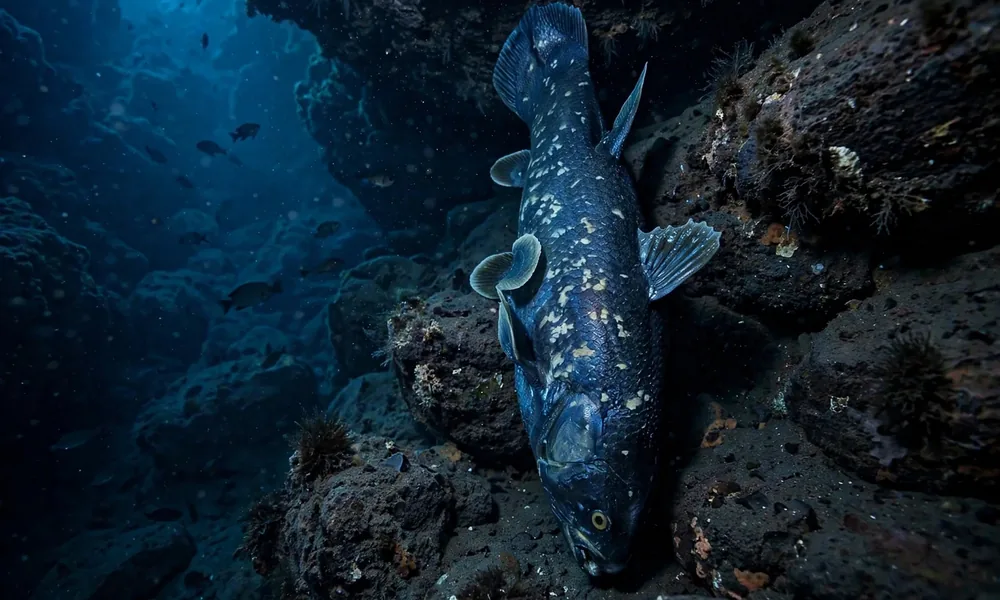
When a coelacanth is threatened, it does not behave like a fish that wants to fight. Its first response is to sink back into its cave, or to drift away slowly into the dark, and it relies on its size, its tough scales and the depth itself to keep it safe. It has no venom, no spines worth fearing and no bite that matters to a person, and its whole defence is built on being hard to find and hard to reach. Like the seahorse, a coelacanth is a slow, gentle fish that survives by being overlooked, but the seahorse hides in shallow seagrass and clings to a stem with its tail, while the coelacanth hides in a cave hundreds of metres down, where almost nothing can follow it.
Breeding and life cycle
Coelacanths give birth to live young, and the details of their breeding are among the strangest in the fish world. The female carries the eggs inside her body, and they hatch there, and the pups are born live, fully formed and already about 35 centimetres long. A litter is usually 5 to 25 pups, though as many as 26 have been recorded, and the pups are born one at a time, over days or weeks. There is no nest, no guarding and no care after birth: the young are on their own from the moment they are born, and they swim away into the deep to fend for themselves.
The pregnancy is thought to last a very long time, possibly three years or more, which would make it one of the longest gestations of any fish. Scientists reached that estimate by studying the size of the pups and the slow growth of the adults, and by comparing the coelacanth with its closest relatives, the lungfish, which also grow slowly and breed late.

Growth is slow, and a coelacanth takes decades to reach its full size. Young fish grow a few centimetres a year, and they reach breeding age only when they are many years old, perhaps in their forties or later. The lifespan is thought to be long, perhaps 60 years or more, and some estimates put it close to a century, which would make the coelacanth one of the longest-lived fish in the sea. That slow life is the key to understanding the coelacanth: it lives slowly, it breeds slowly, and it dies slowly, and a population that loses its adults cannot replace them quickly.
Conservation status
The two coelacanth species have different conservation statuses, and the difference matters. The West Indian Ocean coelacanth, Latimeria chalumnae, is listed as Critically Endangered by the International Union for Conservation of Nature, the highest category of threat short of extinction in the wild, because its population is small, scattered and slow to recover. The Indonesian coelacanth, Latimeria menadoensis, is listed as Vulnerable, a lower category, because its population is thought to be larger and more stable, though it is still rare and still poorly known. Both species are listed in Appendix I of the Convention on International Trade in Endangered Species, which bans all commercial trade in them.
The main pressure is fishing, and it is accidental rather than deliberate. Coelacanths are caught as bycatch in deep-set gillnets, which are set for sharks and other deep-water fish, and a coelacanth caught in a net almost always dies, because it cannot survive the journey to the surface. The nets are set at the same depths where the fish live, and on the same slopes, and a single net can kill several fish in a night. Oil exploration and deep-sea mining are a second pressure, as they damage the slopes and the caves the fish depend on, and a slope that is drilled or mined is a slope that loses its coelacanths.
The most useful conservation work is practical, and it starts with the nets. In the Comoros, where the largest population lives, fishermen are paid for coelacanths caught by accident, so that the fish are brought to scientists instead of being sold, and gillnet fishing is restricted in the areas where the fish are known to live. Marine protected areas, where deep-set nets are banned, give the fish a safe patch to feed and breed in, and research submersibles, which can film the fish in their caves without disturbing them, let scientists count the population without catching a single animal.
Best seasons for coelacanth watching
There is no ordinary watching season for a coelacanth, because the fish lives hundreds of metres down, far below the reach of a snorkeller or an ordinary diver. The only way to see one alive is from a research submersible, or on a technical dive to the edge of its depth range, and both are rare, expensive and strictly controlled. The best time for the expeditions that do go down is the calm season, when the seas are flat and the submersible can be launched safely, and in the Comoros that usually means the dry months from about April to November, when the trade winds are steady and the water is clearest. Off Sodwana Bay in South Africa, the calmest seas come in the southern summer, from about November to March.
For most people, the best way to see a coelacanth is in a museum, and that is a good way to see one. Preserved specimens are held in museums around the world, including the East London Museum in South Africa, where the first fish was identified, and the natural history museums of Paris, London and Tokyo. The museums are open all year round, and a preserved coelacanth, with its blue-grey scales and its three-lobed tail, is a fine sight in its own right, even if it is not swimming.
Staying safe around coelacanths
A coelacanth is not dangerous to people, and there is no safety warning that belongs to the fish itself. It has no venom, it does not bite, and it will not chase or threaten a diver. The safety rules for coelacanths are the rules of deep water: the depth, the pressure and the cold are the dangers, not the fish. A dive to the edge of the coelacanth’s range is a technical dive, far beyond the limits of ordinary scuba, and it needs specialist training, specialist equipment and a support team, and it should never be attempted by a recreational diver.
There are a few practical points for the water itself. Never dive alone, never dive beyond your training, and never chase a deep-water animal into a cave or a crevice, where you can become trapped or run out of air. If you are on an expedition, listen to the scientists and the crew about where to go and how close to get, and keep your lights low and your movements slow, so that you do not frighten the fish. A coelacanth will not hurt you, but the deep sea can, and the sensible approach is to admire the fish from a distance and respect the water it lives in.
Coelacanth watching checklist
A little preparation turns a deep-water expedition, or a museum visit, into a real chance of seeing a coelacanth, the fish that was supposed to be extinct.
- A visit in the calm season, from April to November in the Comoros, when the seas are flat enough to launch a submersible.
- A place on a research expedition or a technical dive, since the fish live hundreds of metres down, far below ordinary scuba.
- A museum visit as a back-up, with preserved specimens on display all year round in East London, Paris, London and Tokyo.
- A slow, quiet approach in the water, with low lights and gentle movements, so that the fish is not frightened from its cave.
- A good pair of binoculars for the surface and a camera with a long lens, for the moments when a coelacanth comes into view.
- Warm clothing and patience, because deep-water expeditions are long, cold and often end without a sighting.
- Respect for the fish and its caves, keeping your distance, never chasing it, and leaving the slope as you found it.
Frequently asked questions
How big do coelacanths get?
Most adult coelacanths measure about 1 to 2 metres from snout to tail, and a large West Indian Ocean coelacanth can weigh 80 to 100 kilograms. The Indonesian coelacanth is a little smaller, growing to about 1.4 metres, and a newborn pup is already about 35 centimetres long. They are large fish by deep-reef standards, and their heavy, muscular body makes them look larger still.
Why was the coelacanth thought to be extinct?
The coelacanth was known only from fossils, and the youngest fossils were about 66 million years old, from the time of the dinosaurs, so scientists assumed the whole group had died out with them. Then, on 22 December 1938, a trawler off South Africa brought up a living coelacanth, and Marjorie Courtenay-Latimer recognised it for what it was. The fish had been living in deep water all along, in places no scientist had looked, and it had simply been overlooked for 66 million years.
What do coelacanths eat?
A coelacanth eats small fish, squid, cuttlefish and octopus, and it hunts by drifting slowly in the dark and sucking its prey in with a sudden gulp. The rostral organ in its snout helps it find prey it cannot see, detecting the faint electric fields of animals hiding in the rock or buried in the sand, and its large eyes gather what little light there is at depth. It has a very low metabolic rate, so it needs little food, and it can go for long periods without eating at all.
Are coelacanths dangerous?
No, coelacanths are not dangerous to people. They have no venom, they do not bite, and they will not chase or threaten a diver. Their whole defence is built on being hard to find and hard to reach, in caves hundreds of metres down, and their first response to a threat is to sink back into the dark. The dangers of coelacanth watching are the dangers of deep water itself: the depth, the pressure and the cold.
How long do coelacanths live?
Coelacanths are thought to live a long time, perhaps 60 years or more, and some estimates put the lifespan close to a century, which would make them one of the longest-lived fish in the sea. They grow slowly, only a few centimetres a year, and they reach breeding age only when they are many years old, perhaps in their forties or later. That slow life is the key to understanding them: they live slowly, they breed slowly, and a population that loses its adults cannot replace them quickly.
How is this guide different from the butterflyfish guide?
This guide covers the coelacanth, a large, slow, deep-water fish of 1 to 2 metres that lives in caves 150 to 700 metres down and was thought extinct for 66 million years, while our butterflyfish guide covers a small, bright reef fish of 12 to 22 centimetres that feeds on coral polyps in pairs on a shallow tropical reef. One is a living fossil of the dark deep; the other is a jewel of the sunlit shallows.
Conclusion
The coelacanth species is a reminder that the sea still keeps secrets, and that a fish can hide for 66 million years in plain sight. A heavy, blue-grey body, fins on fleshy stalks, a three-lobed tail and a life spent drifting in the dark have made Latimeria chalumnae one of the most famous fish in the world, at home in the caves of the Comoros, the canyons of Sodwana Bay and the deep slopes of Sulawesi alike.
If you go looking for one, go in the calm season, go with a research expedition, and be ready to wait, because the coelacanth does not hurry for anyone. Find the cave, keep your distance, and watch for the slow, spotted shape to drift out of the dark, and you will have met the fish that outlived the dinosaurs.