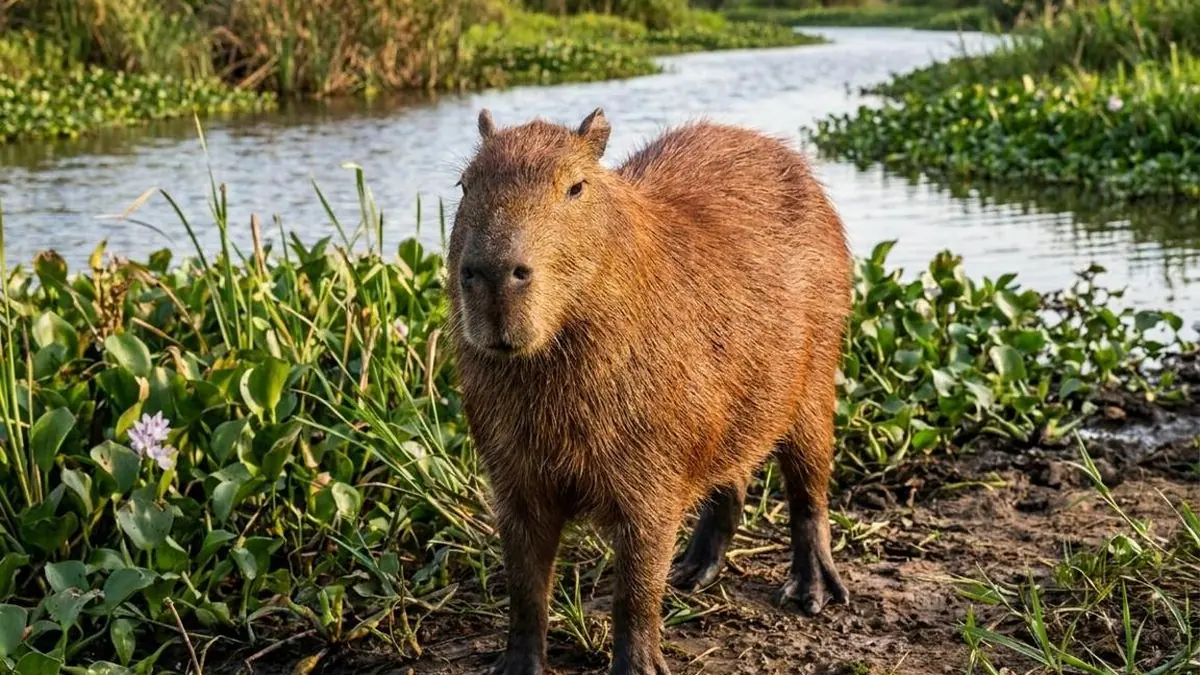
Capybaras are the largest living rodents in the world, but their size is only part of what makes them fascinating. These semi-aquatic mammals spend much of their lives near rivers, ponds, marshes, and flooded grasslands, where they graze on vegetation, socialize in groups, and slip into the water when danger approaches.
Native to South America, the capybara has become an internet favorite thanks to its calm appearance and its habit of resting alongside birds and other animals. Yet behind that relaxed image is a highly adapted herbivore with specialized teeth, efficient digestion, strong swimming abilities, and a social system that helps it survive in the wild.
The capybara (Hydrochoerus hydrochaeris) is the world’s largest living rodent. It is a plant-eater native to much of South America and is especially associated with freshwater habitats. Despite its resemblance to a giant guinea pig, it is a distinct wild mammal with its own ecological role.

Capybara Quick Facts
Scientific name: Hydrochoerus hydrochaeris
Animal group: Mammal · Rodent
Diet: Herbivore
Typical habitat: Rivers, marshes, wetlands
Geographic range: South America
Social behavior: Usually group-living
Conservation status: Least Concern
The Least Concern classification is from the IUCN assessment published in 2016; it does not mean every local population is secure.
What Is a Capybara?
A capybara is a large, semi-aquatic rodent belonging to the family Caviidae, the same family that includes guinea pigs and cavies. Its scientific name is Hydrochoerus hydrochaeris.
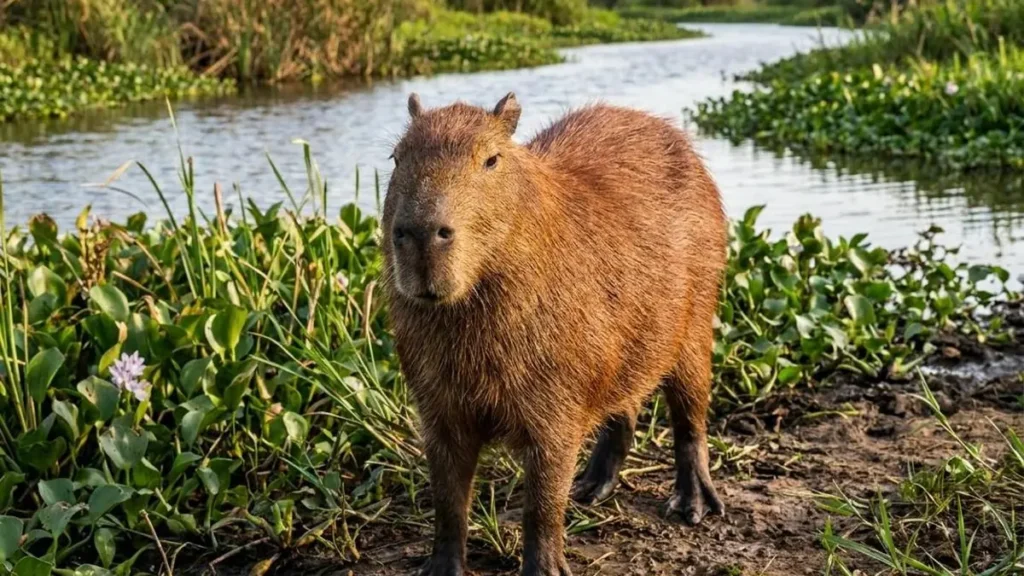
At first glance, a capybara might look like a guinea pig that has grown to an extraordinary size. It has a barrel-shaped body, short legs, coarse brown fur, a blunt muzzle, and small ears. Unlike many rodents, its body is adapted for spending considerable time in and around water.
Capybaras are not pigs, beavers, or oversized guinea pigs. They are a distinct species of rodent that evolved in South America, where wetlands and grasslands provide much of the food and water they need.
Their success comes from a combination of efficient grazing, group living, and the ability to use both land and water to find food and avoid predators.
How Big Is a Capybara?
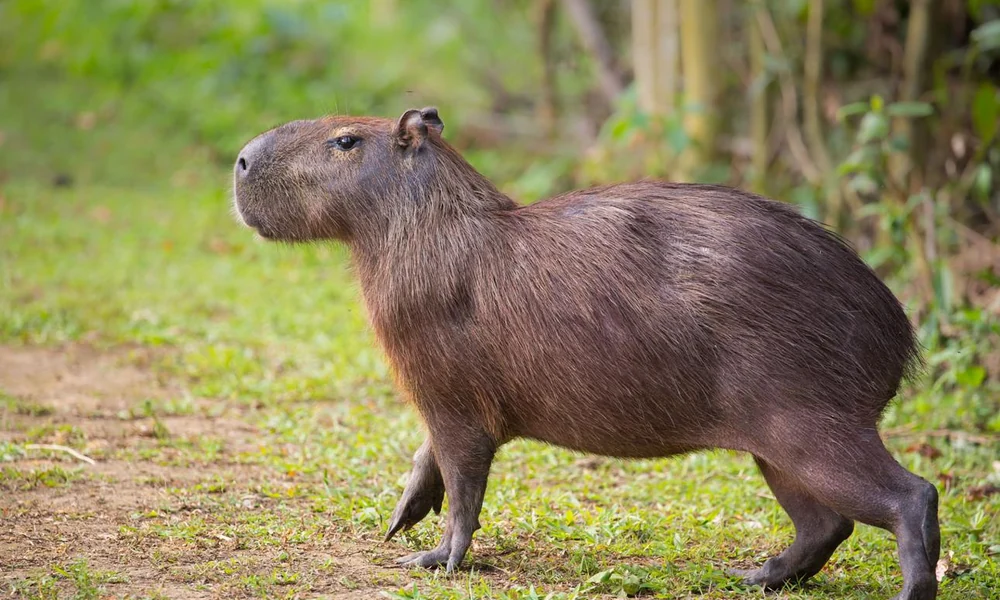
An adult capybara can reach approximately 1.3 metres in body length and weigh around 35–66 kilograms, although size varies between individuals and populations. Some exceptionally large animals can weigh more.
Its sturdy body is supported by relatively short legs, giving it a low profile while grazing. The front legs are slightly shorter than the hind legs, and its partially webbed toes help it move through water.
Females are not always noticeably larger than males, and body size alone is not a reliable way to determine an individual’s sex.
Despite its bulk, the capybara is capable of running quickly over short distances. When threatened, it may sprint toward water, where it can swim away or submerge itself to escape detection.
Where Do Capybaras Live?

Capybaras are native to South America, with a broad distribution across countries including Brazil, Venezuela, Colombia, Argentina, Uruguay, Paraguay, Peru, Bolivia, Ecuador, and Guyana.
They are particularly common in suitable habitats across the Brazilian Pantanal and the seasonally flooded grasslands of Venezuela and Colombia.
Their preferred environments include:
- Wetlands and marshes: These provide water, soft vegetation, and places to escape predators.
- Riverbanks: Grassy edges offer feeding grounds close to safe swimming areas.
- Flooded grasslands: Seasonal flooding can create extensive areas of fresh vegetation.
- Lakes and ponds: Still or slow-moving freshwater provides opportunities for resting, swimming, and feeding.
- Forest edges: Open areas beside woodland can supply both food and protective cover.
Water is a defining feature of capybara habitat. Although these animals feed on land, they depend heavily on nearby freshwater for thermoregulation, escape, and access to aquatic vegetation.
Capybaras are not endemic to one country. They naturally occur across multiple South American countries, and their distribution varies with habitat suitability and local environmental conditions.
What Do Capybaras Eat?
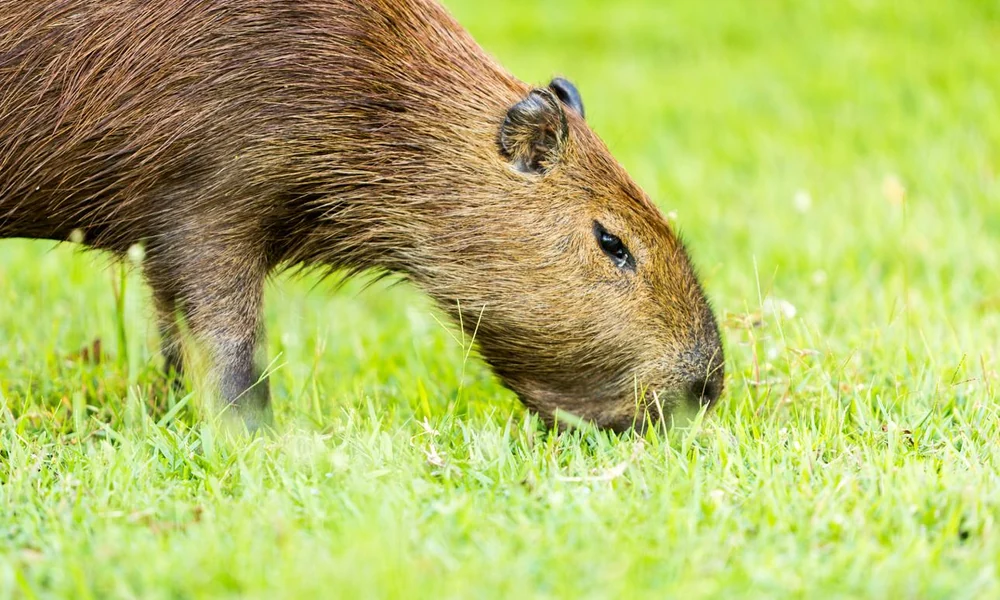
Capybaras are herbivores, meaning their diet consists primarily of plant material. Grasses are particularly important, while aquatic plants and other vegetation provide additional food.
Their diet may include:
- Fresh grasses
- Aquatic plants
- Reeds and sedges
- Leaves and shoots
- Other locally available vegetation
Capybaras are selective grazers rather than indiscriminate plant-eaters. They choose food according to availability, quality, and seasonal conditions.
During periods of abundant rainfall, fresh grasses may be plentiful. In drier periods, they may rely more heavily on the plant species that remain available around water sources.
Why Do Capybaras Eat Their Own Droppings?
One of the capybara’s more surprising behaviors is coprophagy, the re-ingestion of feces.
Plant material contains substantial amounts of fiber, which can be difficult to digest completely. By eating specially produced soft feces, capybaras can obtain additional nutrients and benefit from microbial activity associated with digestion.
This behavior is not unique to capybaras. Other herbivores, including rabbits, also use forms of re-ingestion to improve nutrient absorption.
For capybaras, it is part of an efficient digestive strategy that helps them make better use of a grass-based diet.
Why Are Capybaras Such Good Swimmers?
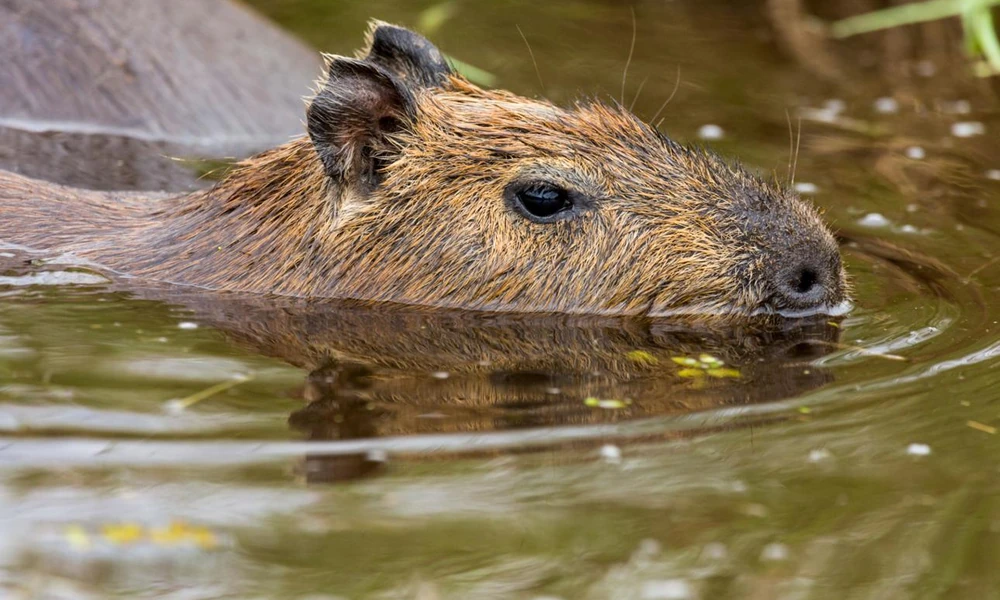
Capybaras are semi-aquatic mammals, meaning they spend time both on land and in water. Their anatomy makes swimming a natural part of everyday life.
Several features help them move efficiently through freshwater:
Partially webbed feet: Skin between their toes helps provide propulsion when swimming.
Eyes, ears, and nostrils positioned high on the head: This arrangement allows a capybara to keep most of its body underwater while monitoring its surroundings.
Strong limbs: Their legs support movement through water and across muddy banks.
Ability to submerge: Capybaras can remain underwater for several minutes, helping them avoid predators when necessary.
Water also helps capybaras cool down in hot weather. Their coarse fur does not provide the same kind of insulation as a thick, dense coat, so access to shade and water is important in warm environments.
Although they are excellent swimmers, capybaras still need suitable land habitat for grazing, resting, and raising young.
Do Capybaras Live Alone or in Groups?

Capybaras are social animals that usually live in groups. A group may contain a dominant male, several females, subordinate males, and young animals.
Group sizes vary with habitat quality, season, and local conditions. Groups of around 10 individuals are common in many settings, while larger gatherings can form when water and food become concentrated in a particular area.
Living together provides several advantages.
- Shared vigilance: More animals can watch for approaching predators.
- Social interaction: Individuals maintain relationships through vocalizations, scent marking, and close contact.
- Reproductive opportunities: Group living helps animals find potential mates.
- Access to resources: Suitable grazing areas and water sources can support multiple individuals.
Capybaras communicate through a range of sounds, including whistles, barks, squeals, and clicks. The precise sound depends on the situation, and vocalizations can help maintain contact between group members.
Their calm reputation should not be mistaken for a lack of social complexity. Capybara groups have social hierarchies, and individuals may chase or display aggression toward rivals.
What Eats Capybaras?
Capybaras are large rodents, but they are not at the top of the food chain.
Their main natural predators include:
- Jaguars: Powerful cats capable of hunting large mammals near forests and wetlands.
- Pumas: Flexible predators that hunt a range of mammals.
- Caimans: Aquatic reptiles that can attack capybaras near or in the water.
- Anacondas: Large constricting snakes that may prey on capybaras, especially younger animals.
Young capybaras are particularly vulnerable because they are smaller and less experienced at avoiding danger.
When a threat appears, adults may give alarm calls and move toward water. Submerging allows a capybara to reduce its visibility, although it does not make the animal completely safe from aquatic predators.
Capybaras also face threats from humans, including hunting and the loss or alteration of wetlands.
Capybara Reproduction and Babies
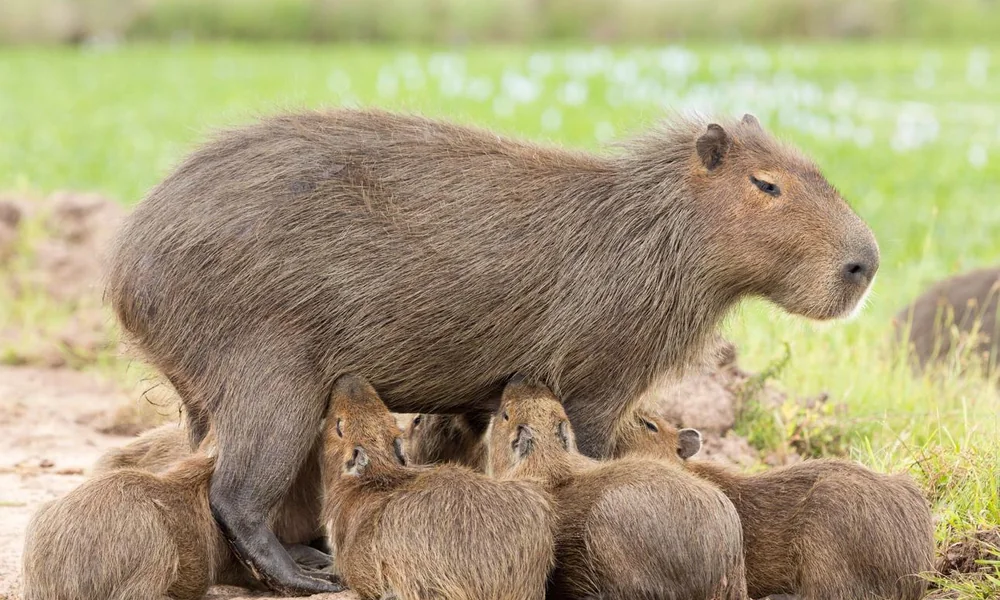
Female capybaras generally give birth after a gestation period of roughly five months. A litter commonly contains several pups, with the number varying between births.
Capybara pups are relatively well developed at birth. They have fur, open eyes, and can move around soon after being born, although they remain dependent on adults for protection and nursing.
The young may begin sampling vegetation early while continuing to receive milk from their mother.
Living in a social group can provide additional protection, as several adults may be present when predators approach. However, not every pup survives to adulthood, and predation is an important source of mortality.
The timing of reproduction varies across the species’ range. In regions with pronounced wet and dry seasons, births may be associated with periods when food is abundant.
How Long Do Capybaras Live?
Capybaras commonly live around six years in the wild, although some individuals survive longer. Lifespan varies with food availability, disease, predation, habitat conditions, and other environmental factors.
Animals under human care may live longer when they receive appropriate veterinary treatment, nutrition, and protection from predators.
Wild capybaras face a different set of challenges. Even when food is plentiful, they must avoid predators, cope with seasonal changes, and find safe places to rest and reproduce.
Are Capybaras Friendly?
Capybaras often appear relaxed around other animals, and individuals accustomed to people may seem unusually calm. Their social behavior and frequent interactions with birds have helped make them popular online.
However, capybaras are wild animals, not naturally domesticated pets.
Their behavior depends on their environment, previous experiences, and perceived threats. A frightened or cornered capybara may bite, charge, or attempt to escape. Adults can also become defensive when protecting young.
They have specialized dietary, social, and environmental needs that are difficult to meet in an ordinary household.
Anyone considering keeping a capybara should check local wildlife laws and animal-welfare requirements. In many situations, observing them in a responsible wildlife setting is a better option than attempting to keep one privately.
Why Do Birds Sit on Capybaras?

Photographs of birds sitting on capybaras are common because the two can share the same open habitats.
Some birds follow grazing mammals and catch insects disturbed by their movement through grass. Others may pick insects or ticks from the surrounding vegetation or from an animal’s body.
These interactions can benefit the bird by providing access to food. The benefit to the capybara depends on the particular interaction and should not be assumed in every case.
The relationship is a useful example of how animals that are not close relatives can influence one another through shared habitat and feeding behavior.
Capybaras are not uniquely associated with one bird species, and not every photograph of a bird on a capybara demonstrates a mutualistic relationship.
Are Capybaras Endangered?
The greater capybara (Hydrochoerus hydrochaeris) is classified as Least Concern on the IUCN Red List, based on an assessment published in 2016. Its wide distribution and occurrence in protected areas support that global classification.
However, this does not mean capybaras face no conservation challenges.
In some areas, they are hunted for meat or leather. Wetland drainage, agricultural expansion, habitat alteration, and conflicts with people can also affect local populations.
A species can remain relatively widespread overall while particular populations decline. Conservation decisions therefore need to consider local conditions as well as the species’ global status.
Protecting freshwater habitats, maintaining natural vegetation along rivers, and managing hunting sustainably can all help support capybara populations.
Capybara vs. Guinea Pig: What Is the Difference?
Capybaras and guinea pigs are related, but they are not the same animal.
| Feature | Capybara | Guinea pig |
| Scientific name | Hydrochoerus hydrochaeris | Cavia porcellus |
| Size | Very large rodent | Small rodent |
| Natural lifestyle | Semi-aquatic and wild | Wild relatives exist; domestic guinea pigs are commonly kept as pets |
| Habitat | Wetlands, rivers, and grasslands | Varies by wild species; domestic animals live under human care |
| Swimming adaptation | Strong swimmer with partially webbed toes | Not specialized for a semi-aquatic lifestyle |
| Social behavior | Usually lives in groups | Social animal that benefits from companionship |
Both belong to the rodent family Caviidae, but their body size, habitat use, and lifestyle differ considerably.
Frequently Asked Questions About Capybaras
Is a capybara a rodent?
Yes. The capybara is a rodent and the largest living member of the group. It belongs to the family Caviidae, which also includes guinea pigs and other cavies.
Where do capybaras live naturally?
Capybaras are native to South America. They inhabit freshwater wetlands, riverbanks, marshes, lakeshores, and flooded grasslands in countries including Brazil, Colombia, Venezuela, Argentina, and Uruguay.
What do capybaras eat?
Capybaras are herbivores that primarily eat grasses and aquatic plants. They also consume other vegetation depending on what is available in their habitat.
Can capybaras swim?
Yes. They are excellent swimmers and can submerge themselves for several minutes. Partially webbed toes and the positioning of their eyes, ears, and nostrils help them move through water and remain alert.
Are capybaras dangerous to humans?
Capybaras generally avoid confrontation, but they are strong wild animals with powerful teeth. They may bite or act defensively if frightened, cornered, or protecting their young. They should be observed without attempting to handle them.
How many babies do capybaras have?
A litter commonly contains several pups, often around four, although litter sizes vary. Females give birth after a gestation period of approximately five months.
Are capybaras found in the United States?
Capybaras are not native to the United States. Individuals may occur outside their natural range through captivity or introduced populations, but their native distribution is in South America.
Why are capybaras so popular online?
Their relaxed appearance, social behavior, and interactions with birds and other animals make them appealing subjects for wildlife photography and videos. Their popularity should not obscure the fact that they remain wild animals with specific habitat and behavioral needs.
Final Thoughts
The capybara is much more than the world’s largest rodent. Its ability to graze efficiently, live socially, and use water for cooling and protection makes it exceptionally well suited to South America’s wetlands and grasslands.
Although the species is globally classified as Least Concern, healthy populations still depend on suitable habitat and responsible management. Protecting rivers, marshes, and seasonally flooded landscapes benefits capybaras as well as the many other species that share their ecosystems.
Understanding how capybaras live offers a wider lesson in wildlife conservation: even familiar and widely distributed animals need functioning habitats to thrive.
Disclaimer: This content is provided for general educational and informational purposes. We are not advertising or promoting any product.