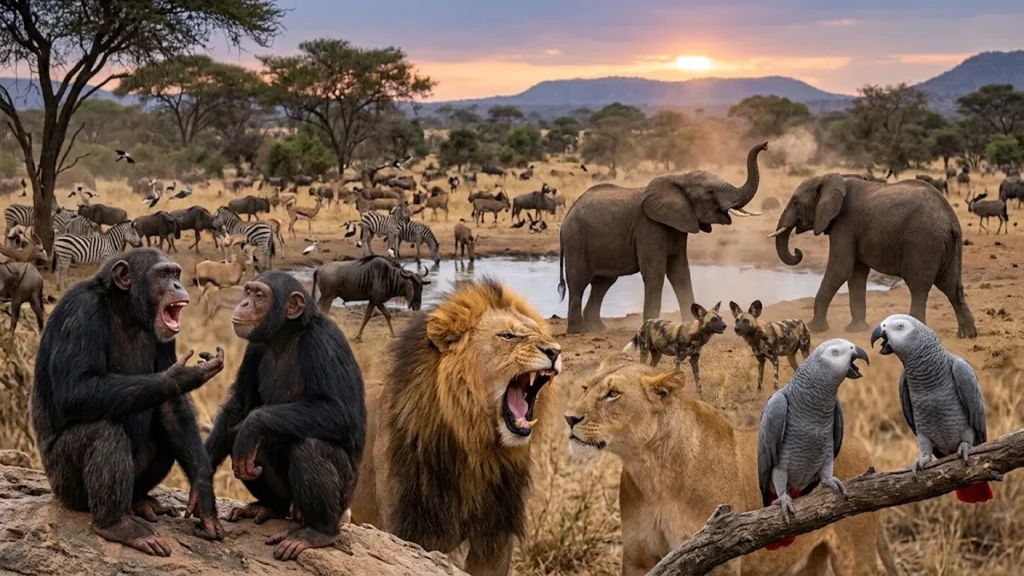
A bird calls from a tree, and another answers from somewhere beyond the garden. A dog lowers its body, wags its tail, and watches your face. A cat flicks its ears toward a sound you barely noticed. Under the surface of a pond, fish respond to signals moving through the water.
In a forest, ants follow invisible chemical trails. Far out in the ocean, whales exchange sounds that travel through the darkness. Animals are communicating all around us. Sometimes the message is loud and impossible to miss. Sometimes it is so sa pond’s surfacebtle that we never realize a conversation is taking place.
Animal communication is the way animals send and receive information through sounds, movements, scents, touch, colors, and other signals. They use it to find mates, warn others of danger, defend territory, coordinate group behavior, care for their young, and navigate their surroundings.
The fascinating part is that animals don’t need words to communicate. They have developed their own ways of making themselves understood.
What Is Animal Communication?

Animal communication happens when one animal produces a signal that influences the behavior or responses of another animal. The signal might be a sound, a movement, a chemical substance, a flash of color, or even a vibration.
A frog calling beside a pond may be advertising its presence to potential mates. A meerkat giving an alarm call may warn its group that a predator is nearby. A dog showing its teeth may be communicating a threat.
A moth releasing pheromones may be helping a potential mate locate it. These messages are not necessarily deliberate in the human sense. Some are instinctive, some are learned, and some involve surprisingly flexible behavior. Communication can be simple or complex, but it always begins with a signal and an animal capable of responding to it.
Why Do Animals Communicate?
Imagine a world where animals could never signal to one another. A bird couldn’t attract a mate with a song. A parent couldn’t easily alert its offspring to danger. Social animals would have greater difficulty coordinating their activities, and many species would struggle to maintain relationships within their groups. Communication helps animals solve everyday problems.
Finding a Mate
For many species, finding a suitable mate is one of life’s biggest challenges. Animals may sing, dance, display bright colors, release chemical signals, or perform elaborate movements.
Male birds of paradise, for example, perform remarkable courtship displays. Some spread their feathers, change their posture, and move through carefully coordinated routines.
To a human observer, the display may look theatrical. To a potential mate, it can carry important information about the displaying animal. In frogs, calling can help females locate males of the same species. In moths, chemical signals can travel through the air and guide potential mates across surprising distances.
Different animals advertise themselves in different ways, but the underlying problem is much the same: finding the right partner.
Warning Others About Danger
Communication can also save lives. A ground squirrel that spots a predator may produce an alarm call. Other squirrels respond by running for cover, freezing, or moving toward shelter, depending on the species and the situation.
Birds may give alarm calls when a predator approaches. Some monkeys produce different calls in response to different types of danger. These signals can help animals react before they have clearly identified the threat themselves.
But alarm calls can carry risks. A noisy animal may draw attention to its own location, including the attention of the predator. In nature, even a warning has a cost.
Defending Territory
A bird singing from a branch may not simply be filling the morning with music. Its song can help advertise territory and discourage rivals. Other animals use scent marks, visual displays, calls, or physical postures to communicate ownership or defend access to resources.
Territorial signals can prevent some confrontations before they become physical. An animal that recognizes a rival’s warning may decide that moving away is safer than fighting. Of course, not every dispute ends peacefully. When signals fail to settle a conflict, animals may escalate to displays or direct aggression.
Keeping Groups Together
For animals that live in groups, communication can help everyone stay coordinated. Elephants use vocalizations, body movements, touch, and chemical cues to maintain social relationships.
Dolphins produce clicks, whistles, and other sounds. Different vocalizations can play roles in communication, navigation, and social behavior. Social insects use chemical signals to coordinate activities that would be impossible for a single individual to manage.
A colony of ants may look chaotic when hundreds of workers move across the ground. Yet chemical trails and other signals help guide them toward food and back toward their nest. What looks like random movement can conceal a remarkably organized system.
Sound: The Language of Calls and Songs
Sound is one of the most familiar forms of animal communication. Birdsong at dawn, frogs calling after rain, wolves howling, and whales vocalizing underwater all remind us that animals use sound in countless ways.
Sounds can travel around obstacles, reach animals outside the sender’s field of vision, and carry information over distances. But producing a sound is only part of the challenge. The receiver must be able to detect and interpret it.
Why Do Birds Sing?
Birdsong can serve several purposes, including attracting mates, defending territory, and communicating with other birds. In many species, males sing to advertise their presence during the breeding season, although singing behavior varies considerably among species and between sexes.
Some birds have relatively simple calls. Others produce elaborate sequences of notes, whistles, trills, and repeated patterns. A song may sound like a beautiful performance to us, but its biological role is more practical. It can help another bird recognize a potential mate, identify a rival, or determine where another individual is located.
Some birds also learn parts of their songs by listening to other birds. In these species, local song patterns can develop, producing recognizable differences between populations.
Why Do Wolves Howl?
A wolf’s howl can carry across a landscape, making it useful for communication when members of a pack are spread out. Howling may help wolves maintain contact, coordinate group activities, and communicate information about their presence.
It is not always a dramatic announcement before a hunt, as films sometimes suggest. Wolves also use body posture, facial expressions, scent marking, and close-range vocalizations to communicate. The howl is only one part of a much larger system.
How Do Whales Communicate?
The ocean is a challenging place to communicate visually over long distances. Sound, however, can travel effectively through water. Many whales produce a wide range of vocalizations. Humpback whales are particularly famous for their complex songs, which can contain repeated patterns and change over time.
Some whale vocalizations are associated with mating, while others play roles in social interactions or maintaining contact. Different whale species communicate in different ways, and scientists are still investigating the meaning and structure of many calls. Listening to whale sounds can feel almost otherworldly. But these are not simply mysterious noises in the ocean. They are part of the social lives of animals that depend on sound in a world where light quickly fades.
Body Language: Messages Without Words
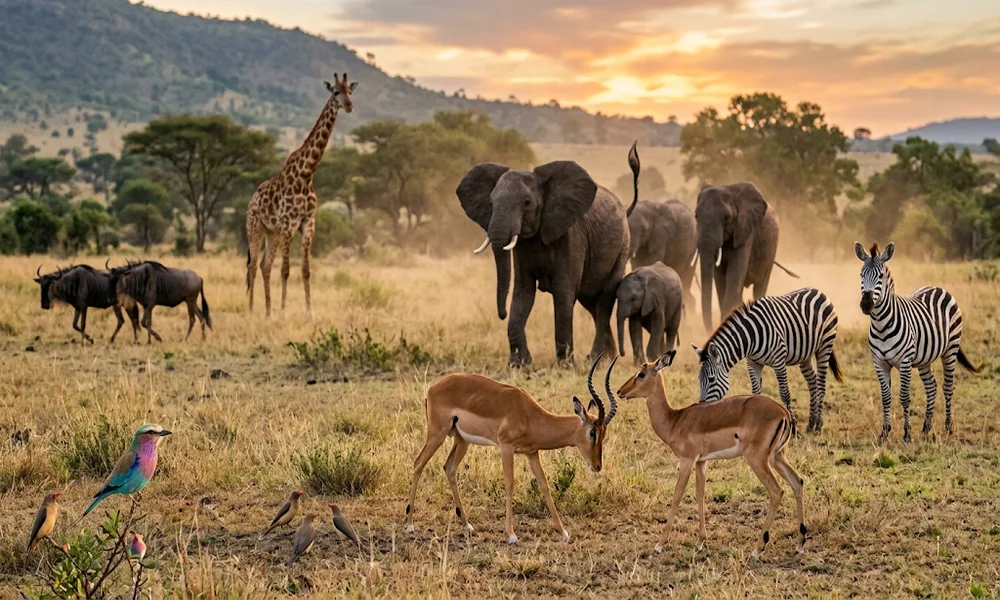
Not all communication makes a sound. Animals often use posture, movement, facial expressions, and the position of their bodies to signal how they are responding to a situation.
A dog that stiffens and stares may be experiencing tension. A relaxed dog may have loose movements and a softer posture. A frightened animal may crouch, retreat, or try to make itself less noticeable.
The meaning of a movement depends on context. A wagging tail does not always mean a dog is happy. Tail movement can accompany excitement, uncertainty, tension, or other emotional states. To understand an animal, it helps to look at the whole body rather than one isolated signal.
What Cats Tell Us With Their Bodies
Cats can communicate through their ears, eyes, tails, posture, and movements.
- A cat with relaxed muscles and a comfortable posture may be at ease.
- A cat with flattened ears, a tense body, and a rapidly moving tail may be uncomfortable or agitated.
- A cat rubbing its face against furniture or a familiar person may be depositing scent from glands around its face.
This behavior can help create familiar scent cues within its environment. Cats also blink slowly, knead with their paws, arch their backs, and change their posture in ways that can provide clues about their state. There is no single gesture that explains every cat. The surrounding situation matters, and individual animals have their own habits.
The Play Bow
If you have watched dogs play, you may have seen one lower its front legs while keeping its rear end raised. This posture is commonly called a play bow. It can signal that the dog is inviting play rather than initiating a serious confrontation.
The dogs may then chase one another, wrestle, pause, and begin again. Their movements can look rough, but changes in posture, pauses, and reciprocal behavior help regulate the interaction. It is a reminder that communication can shape not only whether animals interact, but also how they do it.
Chemical Communication: Messages in the Air
Some of the most important animal signals are invisible. Animals can release chemical substances that other individuals detect through smell or specialized sensory systems. These chemicals may communicate information about reproductive condition, identity, territory, social status, or the presence of danger.
One well-known example is the use of pheromones. Pheromones are chemical signals released by an individual that affect other members of the same species.
How Ants Leave Trails
An ant discovers food and begins returning toward its nest. As it travels, it may deposit a chemical trail. Other ants detect the trail and follow it toward the food source.
As more workers use the route, trail strength can increase, helping the colony concentrate its efforts on productive paths. The result can be a steady stream of ants moving toward a crumb that would otherwise seem insignificant. There is no need for an ant to shout directions. The chemical trail carries the information.
How Moths Find Mates
Some female moths release pheromones that attract males from considerable distances under suitable conditions. The males detect these chemicals using sensitive sensory structures, often located on their antennae.
The signal can be effective even when the animals cannot see each other. Imagine trying to find another individual in darkness, surrounded by countless other smells. A chemical signal suited to your species can make that task much easier.
Visual Communication: Colors, Patterns and Displays
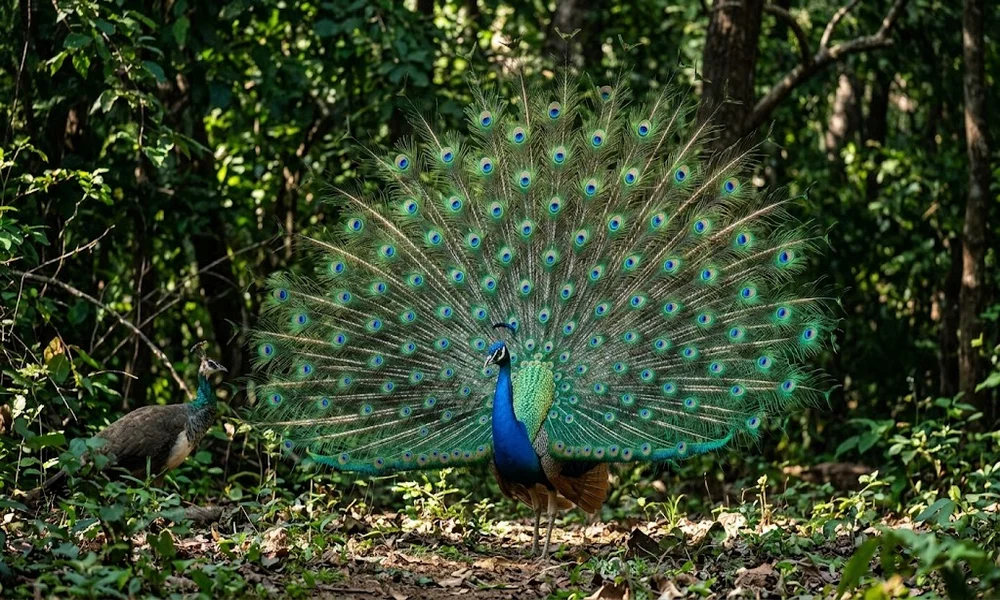
Colors can communicate information long before an animal comes close enough to make contact. Bright plumage, contrasting patterns, changing skin colors, and elaborate displays all play roles in animal behavior.
A peacock spreading its tail is an obvious example. The display reveals an enormous fan of feathers covered in eye-like markings. It can be part of courtship, with females assessing aspects of a male’s display and condition.
Other visual signals are much less dramatic.
- A lizard may perform push-up displays.
- A bird may raise its feathers or open its wings.
- A fish may change its coloration during courtship or conflict.
These signals can help animals identify one another, attract mates, or discourage rivals.
Why Do Some Animals Change Color?
Color changes can serve different purposes. Some animals change color to blend into their surroundings. Others change appearance during courtship or social interactions.
Cephalopods such as octopuses and cuttlefish can produce remarkably rapid changes in skin color and pattern using specialized cells and structures. Depending on the species and situation, these changes can contribute to camouflage, communication, or displays directed at other animals.
A sudden pattern across an octopus’s skin may look like a visual trick. In reality, it is the result of a highly specialized biological system responding to its surroundings.
Touch: Communication at Close Range
Touch is especially important among animals that live in close social relationships. Primates groom one another, removing parasites and debris while also helping maintain social bonds.
Elephants may touch one another with their trunks. Many mammals lick, nuzzle, or rest against familiar individuals. Parent animals use touch to guide, comfort, protect, or maintain contact with their young.
For social animals, physical contact can provide information while reinforcing relationships. Even among insects, touch can matter. Ants use their antennae to make contact with nestmates and gather chemical and other sensory information. A brief touch can be part of a much larger exchange.
Vibrations: Signals We Often Miss
Some animals communicate through vibrations traveling through the ground, plants, or other surfaces. Spiders are especially sensitive to vibrations in their webs. A strand moving after an insect becomes trapped can provide information about the location of potential prey.
But vibrations can also be produced during courtship or territorial interactions in some species. Certain insects generate vibrations that travel through leaves or stems, allowing nearby individuals to detect them.
- For humans, a leaf may simply be a leaf.
- For an insect, it can be a communication channel.
This is one reason the natural world contains so many signals we rarely notice. Our senses are tuned to a limited part of the information available around us.
How Bees Communicate the Location of Food
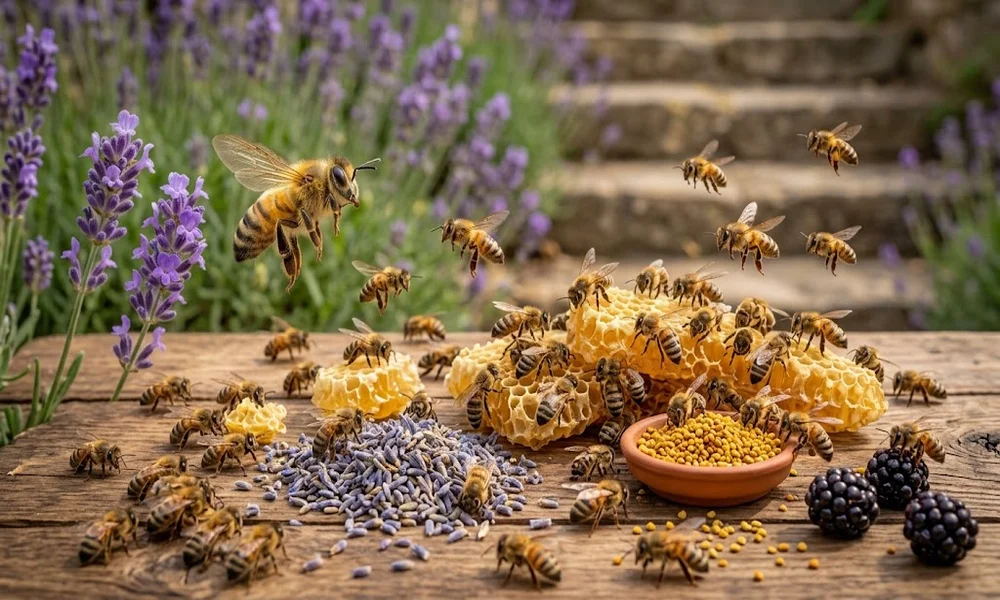
Honeybees have one of the most famous examples of animal communication: the waggle dance. When a worker bee returns to the hive after finding a suitable food source, it may perform a repeated movement pattern that conveys information about the location of that source.
The dance includes a waggle run, during which the bee moves while vibrating its body. The direction of the waggle run in relation to gravity conveys information about the direction of the food relative to the Sun. The duration of the waggle run is related to distance.
Other factors, including the quality of the food source and conditions within the hive, can influence how recruits respond. The dance does not function exactly like a human map, but it provides useful spatial information. Think about what that means.
A bee finds flowers outside the hive, returns home, and performs a movement that helps other bees locate the same general area. The message is encoded in motion.
Do Animals Have Their Own Languages?
This is a more complicated question than it first appears. Animals clearly communicate using structured systems of signals. Some species combine calls or movements in ways that convey different information.
However, animal communication systems vary widely, and they should not automatically be treated as equivalent to human language. Human language can express abstract ideas, refer to events far removed from the present, and generate an enormous range of new meanings through flexible combinations of words.
Some animals show impressive learning, social cognition, and communication abilities, but the extent to which particular species possess language-like structures remains an active subject of scientific research.
The important point is that animal communication does not need to work exactly like ours to be sophisticated. A bee’s dance, a whale’s call, and a dog’s posture can each convey information in ways suited to the animal’s life.
Can Animals Recognize Individual Voices?
Yes, some animals can distinguish between familiar and unfamiliar individuals using vocal signals. Social animals may recognize members of their group by sound. Birds can sometimes identify mates or neighbors through calls.
Elephants can distinguish between vocalizations and respond differently depending on who is calling. Some primates also show abilities to recognize individuals through vocal cues.
Recognition matters because not every message has the same significance. A call from a familiar group member may demand a different response from a sound produced by an unknown animal. Communication is not just about hearing a signal. It is also about knowing something about its source.
How Do Young Animals Learn to Communicate?
Some communication behaviors are largely instinctive. Others develop through learning, practice, and social interaction. Young birds of certain species learn their songs by listening to adults or other models. Their developing songs may begin as imperfect versions before becoming more typical of their species.
- Young mammals also learn through experience.
- Puppies discover how their actions affect other dogs.
- Young primates observe social interactions.
- Many animals learn when to approach, when to retreat, and how to respond to signals from more experienced individuals.
Growing up is not only about developing a body. For many animals, it also means learning how to communicate within the world they inhabit.
When Animal Signals Are Misunderstood
Communication does not always succeed.
- A signal may be missed.
- The receiver may interpret it incorrectly.
- Environmental noise may interfere.
- A warning may arrive too late.
Animals can also respond differently depending on their previous experiences, their condition, and the situation. Human activity can make matters worse. Traffic, construction, shipping, and other sources of noise can interfere with the acoustic environments used by animals.
Artificial lighting can alter the conditions under which some nocturnal animals communicate or behave. Chemical pollution can affect the signals certain aquatic animals depend on.
Communication is only useful when signals can be produced, detected, and responded to effectively.
How Humans Can Affect Animal Communication
The environments we create can change how animals exchange information.
- Noise from roads and machinery can mask bird calls or other sounds.
- Underwater noise from human activities can interfere with the acoustic signals used by marine animals.
- Artificial lights may alter natural patterns of activity for nocturnal species.
- Habitat destruction can remove the places animals use for courtship, nesting, and social interaction.
These effects do not happen in exactly the same way for every species, but they show that protecting wildlife involves more than protecting food and shelter. It can also mean preserving the conditions animals need to communicate.
How to Become Better at Reading Animal Behavior
You don’t need to be a scientist to start noticing animal signals. You simply need to pay attention. Watch the whole animal rather than one movement. Notice what happens immediately before and after a behavior.
Look at the surroundings. Is there food nearby? Another animal? A possible threat? Pay attention to repeated patterns. Does the animal use the same call in a particular situation? Does its posture change when another animal approaches?
Avoid assuming that a signal means exactly the same thing in every context. A dog, cat, bird, or wild mammal is not a puzzle with one simple answer. Its behavior makes more sense when you consider the situation as a whole.
And remember to observe from a respectful distance. Approaching, cornering, or repeatedly disturbing wildlife can change the very behavior you are trying to understand. The more patiently you watch, the more you may notice.
Final Thought
The next time a bird sings outside your window, listen for a moment before moving on.
- Another bird may answer.
- A dog may tilt its head when you speak.
- An ant may follow a trail left by hundreds of others.
- A spider may respond to a vibration passing through its web.
- Somewhere in the ocean, a whale may be calling to another whale beyond your sight.
These animals live in worlds filled with information. They signal, listen, respond, learn, warn, attract, recognize, and sometimes cooperate in ways that are still being explored. Their conversations may not sound like ours.
They may not involve words at all. But communication is woven into the lives of animals, shaping how they find one another, avoid danger, raise their young, and move through the world. Once you start paying attention, the silence of nature begins to sound very different. It was never really silent. We were simply learning how to listen.