Key Takeaways
- Skinks belong to the family Scincidae. They make up over 1,500 described species across about 100 to 170 genera, representing 25% of all known lizard species on Earth.
- Unlike most smooth-looking reptiles, skinks have osteoderms. Osteoderms are tiny bony plates underneath their smooth, glossy scales that act as flexible chainmail armor.
- They can drop their tails (autotomy) when they are grabbed. To distract predators the detached tail jerks using stored energy while the skink escapes.
- About 45% of skink species give live birth, and some species (like Tiliqua and Corucia) form complex placentas to feed their unborn young just like mammals.
- They are harmless to humans and pets. They do not carry poison and act as natural pest controllers by eating garden insects, beetles, and slugs.
What Is a Skink?
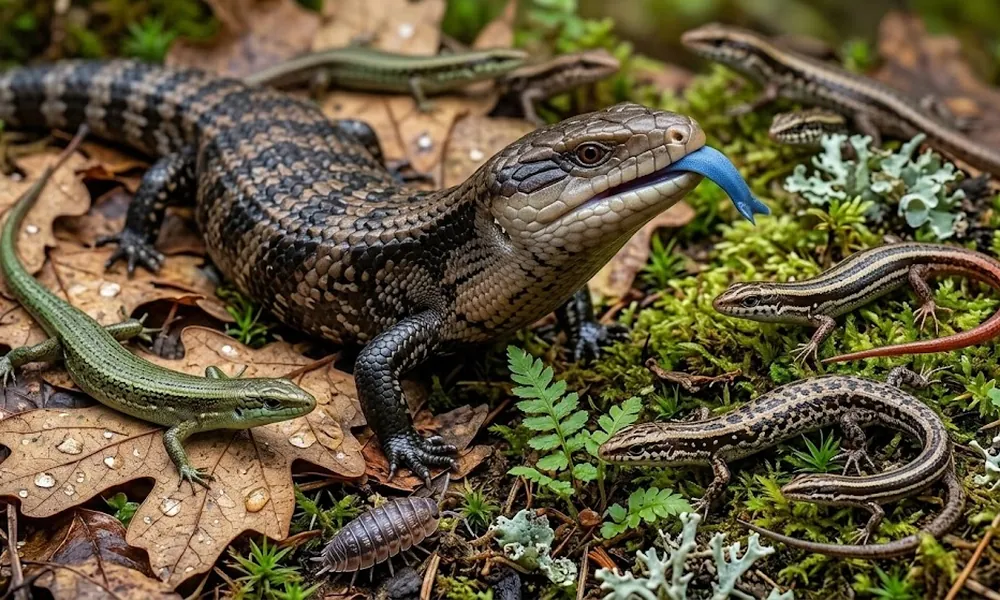
Skinks are secretive, active, and fast-moving reptiles belonging to the family Scincidae under the order Squamata. During field research and observations, the first thing you notice about a skink is its smooth, shiny cylindrical body. They typically have cone-shaped heads that blend seamlessly into their necks and long, tapering tails.
| Biological Feature | Data Details |
| Biological Family | Scincidae |
| Total Species Count | Over 1,500 described species |
| Number of Genera | Roughly 100 to 170 genera (varies due to modern DNA splits) |
| Size Range | 2.3 cm (0.9 in) SVL to 76 cm (30 in) Total Length |
| Average Lifespan | 5 to 12 years in the wild; up to 20+ years in captivity |
| Diet | Primarily insectivorous; large species are omnivorous |
| Habitat Range | Global (deserts, forests, gardens; absent in polar regions) |
| Conservation Status | Mostly stable; several island species are endangered or extinct |
Fixing the Size Confusion
Many articles confuse two different ways scientists measure reptiles, leading to incorrect claims:
- Snout-to-Vent Length (SVL): This measures from the tip of the nose to the digestive vent at the base of the tail. The smallest adult skinks measure around 2.3 cm (0.9 inches) SVL.
- Total Length (TL): This includes the full tail length. The largest living skink, the Solomon Islands Prehensile-Tailed Skink (Corucia zebrata), reaches up to 76 cm (30 inches) in total length. However, its body (SVL) is about 35 cm (13.7 inches) the tail makes up more than half of its total length!
How to Identify a Skink
When you spot a small reptile darting through leaf litter, how do you know if it’s a skink, a gecko, a snake, or a salamander?
Key Physical Features
- Smooth, Polished Scales: They look wet or glossy, but their skin is dry to the touch.
- No Neck Profile: Their heads taper directly into their torso with no pinched neck region.
- Movable Eyelids & Visible Ears: Unlike snakes, almost all skinks have blinking eyelids and external ear holes.
Comparison Table: Skink vs. Lookalikes
| Feature | Skink | Gecko | Fence / Rough Lizard | Salamander (Amphibian) |
| Skin Texture | Smooth, glossy (polished look) | Soft, velvety, bumpy | Rough, keeled, spiky scales | Smooth, moist, scale-less |
| Feet & Toes | Standard clawed toes | Wide sticky pads (toe lamellae) | Sharp, clawed climbing toes | Soft, clawless toes (4 front) |
| Head Shape | Streamlined cone | Broad, triangular | Raised, blocky | Rounded, flat |
| Eyelids | Movable (blinks in most species) | Fixed clear lens (licks eyes) | Movable (blinks) | Movable (blinks) |
| Habitat | Leaf litter, dirt, logs | Walls, trees, roofs | Rocks, tree trunks | Damp logs, moist dirt |
The Exceptions: Limbless & Snake-Eyed Skinks
- Legless Skinks: Some skink species have reduced legs or no legs at all (a process called fossorial evolution or limb loss). You can tell a legless skink from a baby snake because the skink retains external ear openings and movable eyelids.
- Snake-Eyed Skinks (Ablepharus): A few burrowing skinks have lost movable eyelids. Instead, their lower eyelid has fused into a clear, fixed scale called a spectacle, protecting their eyes while swimming through dirt.
Skink Anatomy Secrets
1. The “Window Scale”
Burrowing skinks spend their lives digging through abrasive soil. To see underground without getting dirt in their eyes, many species have developed a transparent, clear scale in the center of their lower eyelid. They can close their eyes and still see through this natural glass window.
2. Sand-Swimming Adaptations
Sand skinks (Scincus scincus, commonly called the Sandfish) live in arid desert dunes. They possess:
- A countersunk lower jaw so sand doesn’t get crammed into their mouth while burrowing.
- Overlapping ear scales that flap shut like valves to block out grains of sand.
- Fringed toes that act like snowshoes to push off loose sand particles.
3. Osteoderm Armor
If you handle a skink gently, it feels firmer than other lizards. Beneath their outer scales lies a network of tiny bones called osteoderms. This armor plates their back, belly, and tail, preventing bird talons and small teeth from penetrating their body.
4. Mysterious Green Blood
Five species of skinks in New Guinea genus Prasinohaema have bright emerald-green blood, tongues, and internal organs. This occurs because high levels of biliverdin (a green bile pigment) build up in their bloodstream. In humans, this causes toxic jaundice, but these skinks thrive with biliverdin levels 40 times higher than human lethal limits!
5. The SENI Foot Index
Herpetologists measure the SENI (Size-Equalized Numeric Index) of skink feet. Ground-dwelling and burrowing skinks have short, stumpy toes to reduce drag in dirt, while tree-climbing (arboreal) skinks have lengthened toes with curved claws for gripping bark.
Subfamilies and Types of Skinks
Taxonomists divide Scincidae into seven recognized subfamilies. Rather than listing hundreds of confusing names, here is how the group is structured:
| Subfamily | Key Character / Identity | Example Species | Primary Region |
| Acontinae | Totally legless, burrowing skinks | Striped Blind Skink | Southern Africa |
| Feylininae | Blind, burrowing tropical skinks | African Legless Skink | Central Africa |
| Lygosominae | Largest group; highly diverse | Blue-Tongued Skink | Global (Oceania / Asia) |
| Scincinae | Traditional Old & New World group | Five-Lined Skink | North America & Asia |
| Sphenomorphinae | Active, slender litter dwellers | Common Garden Skink | Australia & Asia |
| Eugongylinae | Island colonizers & swift runners | Rainbow Skink | Pacific Islands |
| Egerniinae | Social, armored, rock-dwellers | Broad-Headed Skink | Australia |
Spotlight Species
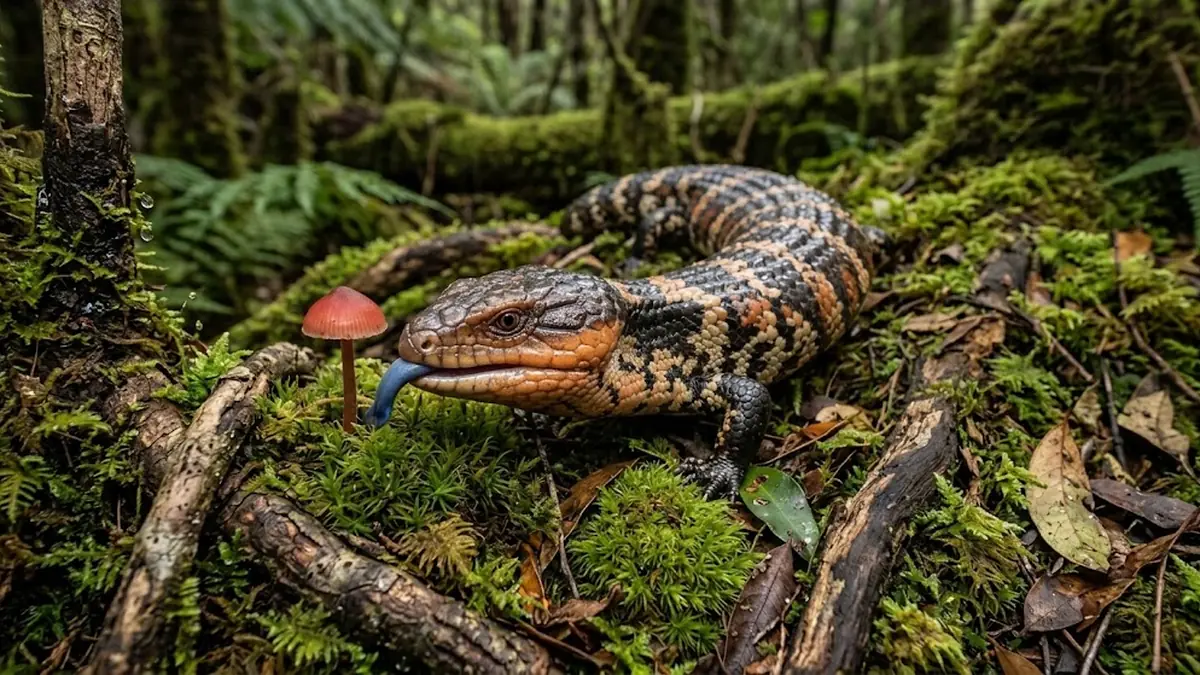
- Blue-Tongued Skink (Tiliqua): Flashes a giant, bright cobalt-blue tongue to startle predators when cornered.
- Five-Lined Skink (Plestiodon fasciatus): Youngsters feature five golden stripes down a jet-black body and an electric-blue tail.
- Broad-Headed Skink (Plestiodon laticeps): Adult males grow wide jaws and bright reddish-orange heads during the spring breeding season.
- Red-Eyed Crocodile Skink (Tribolonotus gracilis): Possesses raised, armor-like scales resembling a crocodile and bright orange rings around its eyes.
Why Skink Species Counts Keep Changing
You might notice older books listing 1,200 skink species, while newer studies list over 1,500. The reason is modern DNA sequencing. For decades, scientists grouped hundreds of lookalike skinks under broad genera like Mabuya or Eumeces. Genetic analysis showed that these “single species” were actually distinct groups, leading taxonomists to split massive historical genera into dozens of smaller, accurate genera.
Where Skinks Live
Skinks are cosmopolitan, meaning they inhabit almost every corner of the Earth:
- North America: Moderate diversity in temperate forests and plains.
- South America: Low diversity, mainly specialized leaf-litter species.
- Africa & Europe: High diversity across deserts, Mediterranean regions, and scrublands.
- Southeast Asia & Australia: Major global diversity hotspots in rainforests and arid zones.
- Polar Regions & Boreal Tundra: Absent due to cold temperatures.
Rafting Across Oceans
How did small lizards reach isolated islands in the Pacific? Skinks are famous for oceanic rafting. During tropical storms, chunks of tangled vegetation and fallen trees tear away from riverbanks and drift into the ocean. Skinks survive weeks on these floating debris rafts, traveling hundreds of miles across seawater to colonize remote islands.
What Skinks Eat
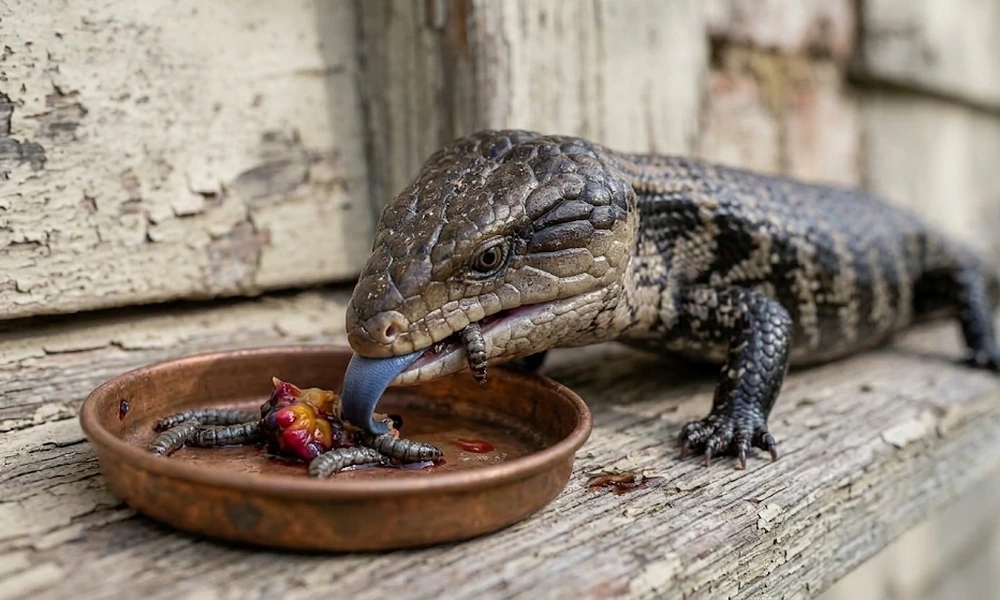
Most skinks are active foragers. Instead of sitting and waiting for prey to walk by, skinks spend their days constantly probing crevices, leaf litter, and soil.
The Chemoreception Secret (Tongue-Flicking)
When you watch a skink, you will see its tongue flick rapidly in and out. The tongue collects airborne scent molecules and transfers them to the Jacobson’s organ (vomeronasal organ) on the roof of its mouth. This lets the skink “smell” prey, predators, and potential mates through the chemical particles in the air.
Diet by Size
- Small Skinks (Under 8 inches): Insects, spiders, crickets, beetles, termites, worms, and garden slugs.
- Large Skinks (Blue-Tongues): Snails, small rodents, nestling birds, berries, mushrooms, and fallen flowers.
- Herbivorous Skinks (Solomon Islands Skink): Eats leaves, vines, and fruits high in forest canopies.
Tail Autotomy: How and Why They Drop Their Tails
One of the most famous defense mechanisms in the animal kingdom is caudal autotomy, the ability to intentionally break off a tail when threatened.
The Mechanism Behind the Snap
A skink’s tail does not simply snap between vertebrae at random. Instead, the tail vertebrae contain pre-formed weakness zones called fracture planes. When a bird or mammal grabs the tail, the skink contracts specialized sphincter muscles around the nearest fracture plane. These muscles snap the bone, clamp blood vessels shut instantly to prevent bleeding, and sever the nerve bundle cleanly.
Why Does the Detached Tail Thrash?
Once detached, the dropped tail wriggles, jumps, and thrashes violently on the ground for up to several minutes. This thrashing is powered by stored energy (glycogen) and involuntary spinal reflex arcs. The thrashing tail distracts the predator (the decoy effect), giving the skink precious seconds to slip away silently under a log.
Bright Blue Decoy Tails
Juvenile skinks of many species feature electric-blue tails. Studies show that bright colors draw a predator’s strike away from the vital head and torso, steering attacks toward the expendable tail instead.
Do Skinks Eat Their Own Tails?
Yes! A skink’s tail stores valuable fat reserves. If a skink escapes a predator without losing its tail entirely, or if it returns to the encounter spot after the predator leaves, it will often eat its own dropped tail to regain the lost fat and nutrients.
Regeneration Costs
Regrowing a tail takes 3 to 4 months and requires enormous energy. The new tail is supported by a flexible cartilage rod rather than original bony vertebrae, and its scales often have a slightly different pattern or texture.
Reproduction: Eggs, Live Birth, and Mammal-Like Placentas
Skinks display an extraordinary variety of reproductive strategies:
- Oviparity (Egg-Laying): About 55% of skinks lay soft, leathery-shelled eggs in damp soil, hollow logs, or under rocks.
- Viviparity (Live-Bearing): About 45% of skinks give live birth to fully formed young. Live-bearing is especially common in cold climates, where soil temperatures are too low for eggs to incubate outdoors.
Mammal-like Placentas (Convergent Evolution)
In live-bearing species like the Blue-tongued Skink (Tiliqua) and African Trachylepis ivensi, mothers form true placental connections with their developing young. Nutrients, oxygen, and waste pass between the mother’s blood vessels and the embryo through complex tissue structures nearly identical to mammalian placentas. This is a prime example of convergent evolution, two distant branches of life evolving the same complex solution independently!
Behavior, Evolution, and Fossils
Chemical Communication
Skinks are mostly diurnal (active during the day), spending mornings basking on warm rocks to raise their core body temperature. They communicate using pheromones left behind in scent trails. Male skinks mark their territories and use scent cues to identify females during breeding season.
Deep Evolution
- 100 Million Years Ago: The oldest known fossil skink, Electroscincus zedi, was discovered remarkably preserved in mid-Cretaceous Burmese amber, proving skinks ran alongside dinosaurs.
- Ancient Genetics: Genetic studies reveal that skinks developed an XY sex-determination system over 80 million years ago, making their genetic sex structure older than many mammalian systems.
- First Genome (2022): In 2022, scientists published the first complete high-resolution genome map of a skink, unlocking new insights into bone regeneration and tail regrowth.
Threats and Conservation
While most continent-dwelling skinks remain common, island skink species are severely vulnerable.
| Threat Category | Major Impact on Skink Populations |
| Invasive Predators | Introduced feral cats, rats, and mongooses wipe out flightless or defenseless island species. |
| Habitat Fragmentation | Deforestation removes leaf litter and decaying logs required for nesting and hunting. |
| Over-Harvesting | Rare species are harvested for the wild pet trade or hunted for food in remote regions. |
Skinks Around Your Home
Are They Harmful to Pets or Humans?
No. Skinks are entirely non-venomous and pose no threat to humans, dogs, or cats. If cornered or picked up roughly, a large skink might give a small pinch with its jaws, but small species cannot break human skin.
- Hygiene Note: Like all wild reptiles, skinks can carry Salmonella bacteria on their skin or in their droppings. Always wash your hands thoroughly after handling wild reptiles.
- Pets: Cats and dogs often hunt skinks. While catching a skink will not poison your pet, the skink will likely drop its tail to escape.
Humane Exclusion Tips
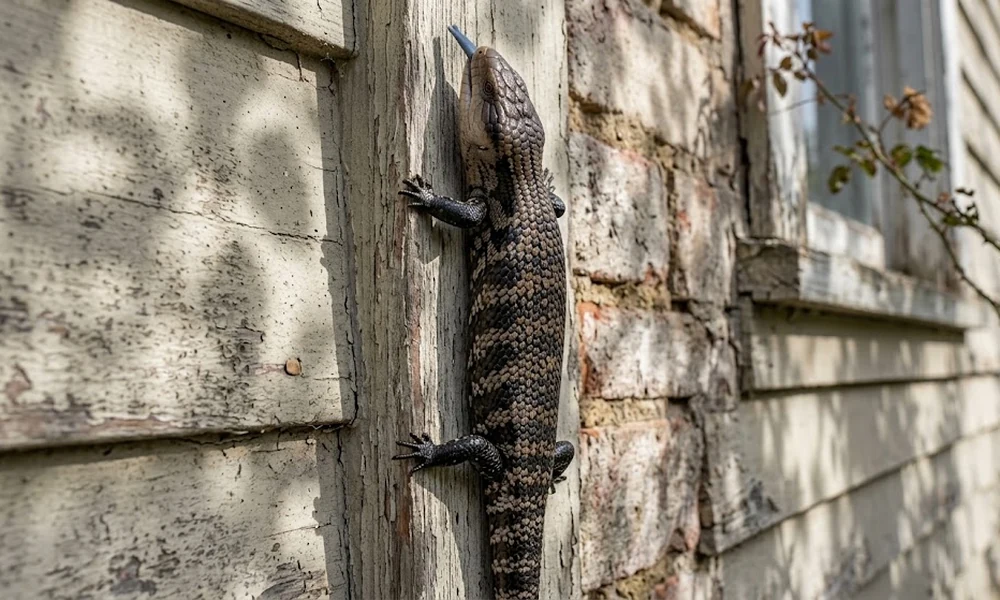
If skinks enter your garage or home, they are simply seeking cool shade or chasing insects:
- Reduce Outdoor Lighting: Lights attract moths and bugs, which in turn attract hungry skinks.
- Clear Debris: Move firewood piles, leaf piles, and dense mulch beds away from your foundation.
- Seal Gaps: Install weatherstripping under doors and repair low screen vents.
Keeping Skinks as Pets
Blue-tongued skinks (Tiliqua) and Pink-tongued skinks are popular reptile pets due to their docile nature.
- Lifespan: Healthy captive skinks can live 15 to 25 years with proper care.
- Enclosure: Requires a large horizontal terrarium with UVB lighting and a designated basking hot spot (~95°F / 35°C).
- Diet Needs: Captive skinks require a balanced mix of 50% greens/vegetables, 40% protein (insects/snails), and 10% fruit.
Frequently Asked Questions (FAQ)
Do skinks really have green blood?
Yes! Five species of skinks in New Guinea (Prasinohaema) have bright green blood caused by high concentrations of the bile pigment biliverdin.
Why do some skinks look like snakes?
Through evolutionary adaptation for burrowing, several skink lineages lost their legs. You can distinguish a legless skink from a snake by its external ear holes and blinking eyelids.
How long does a dropped skink tail keep moving?
A dropped tail can thrash continuously for 2 to 5 minutes. Spinal reflexes and stored muscle glycogen keep it moving to distract predators.
Do skinks eat their own dropped tails?
Yes. If the skink survives an attack and finds its detached tail, it may eat it to reclaim lost energy and nutrient reserves.
Why do young skinks have bright blue tails?
The bright blue tail acts as a visual decoy, encouraging predators to strike the detachable tail instead of the skink’s head or torso.
Can a skink give birth like a mammal?
Yes. Around 45% of skinks bear live young, and select species form placental tissue connections nearly identical to mammalian placentas.
How do skinks get to remote oceanic islands?
They travel across oceans by floating on large rafts of storm debris and tangled roots.
Why do male skinks’ heads turn red in spring?
Surging testosterone levels during the spring mating season cause blood flow and pigmentation changes, turning their heads bright red or orange to attract females and intimidate rivals.
How can I tell a skink from a salamander in your garden?
Skinks have dry, scaled skin, claws, and external ear holes, whereas salamanders are amphibians with moist, scale-less skin, clawless toes, and no external ear openings.
Are skinks beneficial for gardens?
Absolutely. Skinks act as natural pest controllers by eating garden pests like beetles, caterpillars, grasshoppers, and slugs.
