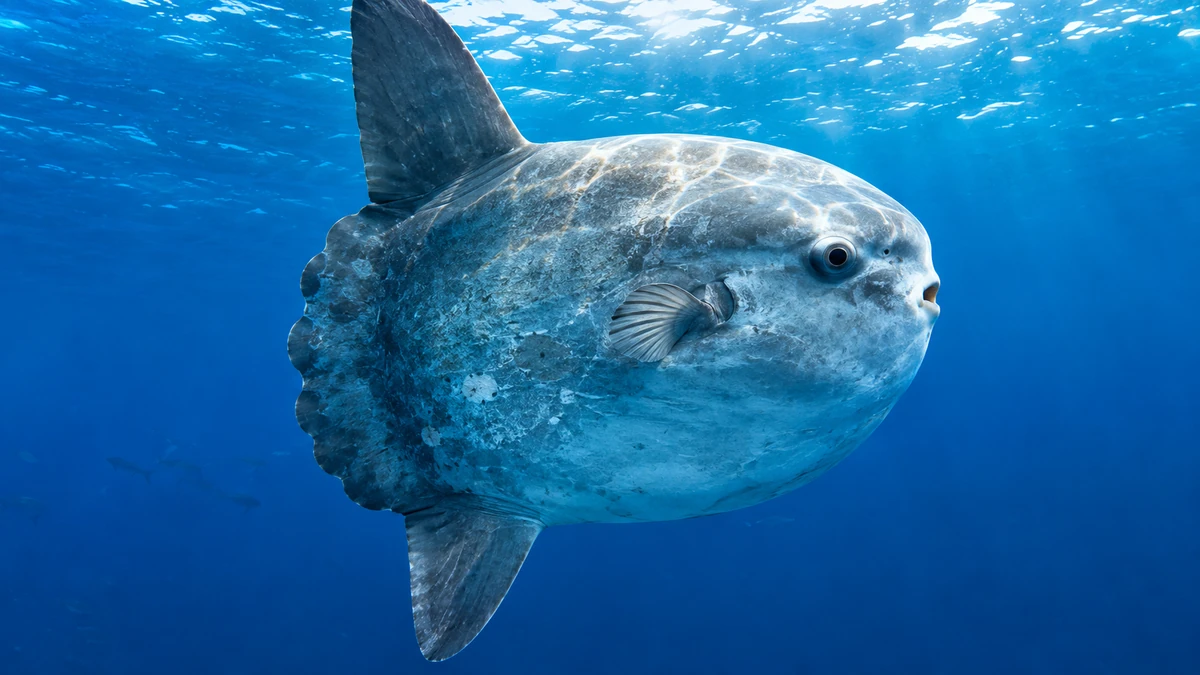
Imagine floating in the ocean and seeing a creature that looks like a giant swimming head without a tail. This strange ocean sunfish is one of the most unusual animals in the sea. The scientific name for the ocean sunfish is Mola mola.
An adult ocean sunfish holds the record as the world’s heaviest bony fish. Wildlife organizations like Viltnemnda monitor aquatic environments and natural habitats. Studying the ocean sunfish helps scientists understand ocean conditions and shifting marine species.
In this article, you will discover giant sunfish size and weight records, explore their global habitats, and learn how their jellyfish-based diet sustains them. You will also compare different sunfish species, uncover surprising facts, and find out if these ocean giants are dangerous to humans.
Quick Snapshot
| Feature | Details |
| Scientific Name | Mola mola |
| Family | Molidae |
| Max Size | Up to 11 feet (3.3 meters) |
| Max Weight | Up to 5,000 pounds (2,300 kg) |
| Primary Diet | Jellyfish, salps, and soft sea creatures |
| Habitat | Temperate and tropical oceans worldwide |
| Lifespan | 10 to 23 years in the wild |
| Conservation Status | Vulnerable |
What Is a Giant Ocean Sunfish?
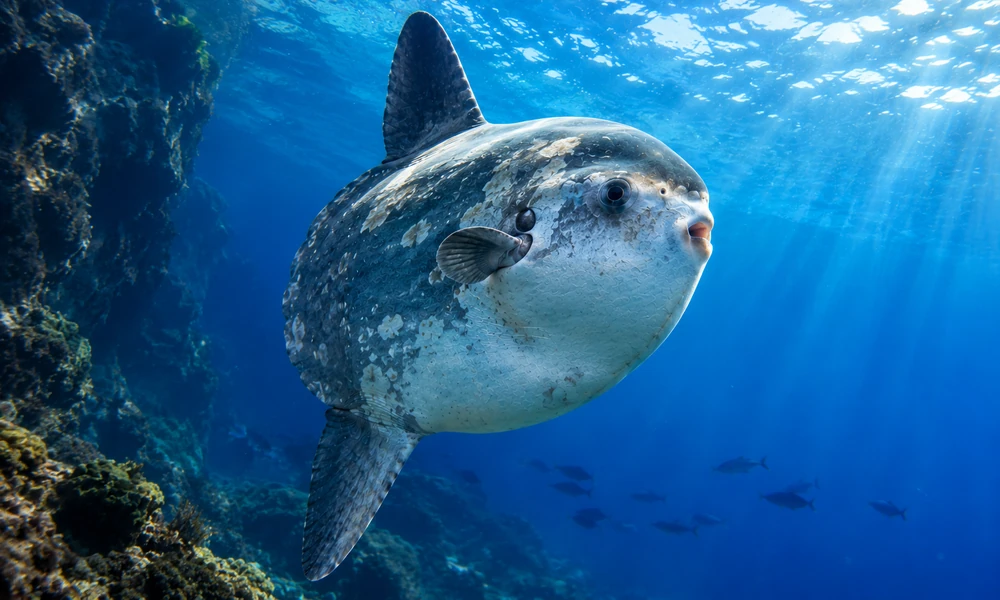
An ocean sunfish is one of the most unusual bony fish swimming in the sea. The common name comes from its habit of floating on its side near the ocean surface, soaking up heat from the sun after diving deep into cold water.
The word mola comes from Latin, meaning “millstone.” This name fits the ocean sunfish perfectly because its round, flattened body, gray color, and rough skin look just like a heavy, circular millstone used to grind grain.
Unique Body Anatomy
- The Clavus: The ocean sunfish has no typical tail. Its dorsal and anal fins fuse at the back to form a smooth, fleshy clavus that acts like a rudder.
- No Swim Bladder: It lacks a swim bladder and relies on thick, firm, gelatinous tissue under the skin to help control buoyancy.
- Thick, Scaleless Skin: It lacks traditional scales. Its thick skin is covered in a dense layer of tough, sandpaper-like cartilage and mucus, up to 3 inches thick.
- Tiny Mouth with a Beak: It has a very small mouth, with teeth fused into four solid plates. Its hard, parrot-like beak is used to crush soft prey.
Taxonomy: The 5 Recognized Sunfish Species
The family Molidae contains five distinct sunfish species.
- Ocean Sunfish (Mola mola): The most famous species, found in temperate and tropical waters worldwide.
- Bump-head (Mola alexandrini): Recognized by its prominent bump. Its larger size can rival or exceed Mola mola.
- Hoodwinker (Mola tecta): Discovered in 2017 and identified by a smooth band splitting the clavus into two halves.
- Sharptail (Masturus lanceolatus): Has a pointed tail-like projection from the middle of the clavus.
- Slender (Ranzania laevis): The smallest species, with a bright, colorful, vertically elongated body.
Why Scientists Once Thought All Giant Sunfish Were One Species
For over two centuries, scientists thought almost all giant sunfish were Mola mola. Ocean sunfish change dramatically in shape from tiny larvae to multi-ton adults, so preserved specimens looked different from live adults.
Additionally, their open-ocean habitat and rapid decay when ashore made adults hard to collect and study. Modern genetic testing and detailed body measurements showed Mola alexandrini and Mola tecta to be distinct species.
Size and Weight
Adult ocean sunfish typically measure 6–10 feet and weigh 550–2,200 pounds. Giant sunfish specimens can weigh 5,000 pounds or more and measure over 11 feet across.
One of the heaviest verified individual ocean sunfish specimens ever recorded weighed approximately 6,049 pounds and measured 10 feet long, caught near Kamogawa, Japan.
Comparison Table: Heavy Bony Fish
| Fish | Weight | Habitat |
| Ocean Sunfish (Mola mola) | 5,000+ pounds | Temperate and tropical open oceans |
| Bump-head (Mola alexandrini) | Up to 6,000+ pounds | Temperate coastal/offshore |
| Giant Oceanic Manta Ray | Up to 6,000+ pounds | Tropical marine |
Extreme Growth Jump
An ocean sunfish hatches at about 2 mm and weighs a fraction of a gram. Its birth weight can multiply up to 60 million times. This makes the species a unique subject for developmental biologists.
Sexual dimorphism is limited. Mature females of certain species like Mola alexandrini are sometimes slightly wider or heavier than males, although individual variation is high.
Habitat and Distribution
Ocean sunfish live in temperate and tropical oceans worldwide, including the Mediterranean, Atlantic, Pacific, and Indian oceans. They use broad pelagic zones, moving between warm surface waters and cold deep water.
- Depth: They can travel several hundred meters deep to hunt prey.
- Temperature: They favor water above 10°C but can plunge into colder currents.
- Hotspots: Nusa Penida in Bali, the Azores, southern California, Japan’s coasts, and the Canary Islands.
Migration and Surface Basking
Ocean sunfish make seasonal movements based on currents and food availability. After spending hours in deep, cold waters, they return to the surface.
They may turn onto their sides while basking near the surface, which helps warm their internal temperature.
Diet and Feeding
Ocean sunfish primarily eat soft-bodied pelagic organisms, with jellyfish forming a main part of their diet. They also consume salps, siphonophores, comb jellies, small fish, crustaceans, squid, algae, and eelgrass.
The Low-Calorie Diet Paradox
Jellyfish and comb jellies are mostly water and contain few calories. To maintain a body weighing more than a ton, ocean sunfish must consume enormous quantities of food.
- Feeding Depth: They use a wide vertical water column and follow the deep-sea vertical migrations of siphonophores and jellyfish.
- Passive Foraging: They slowly cruise through drifting gelatinous zooplankton.
Behavior and Lifestyle
Ocean sunfish are generally solitary, although they sometimes occur in pairs or small groups.
- Swimming Style: Their dorsal and anal fins move synchronously from side to side like dual wings.
- Cleaning Stations: In shallow reefs, cleaner fish and seabirds pick parasites from their thick skin.
- Breaching: They occasionally breach completely out of the water. Researchers believe this may help dislodge stubborn external parasites.
Reproduction and Life Cycle
A mature female ocean sunfish can produce up to 300 million eggs at one time. Larvae are tiny and resemble spiky pufferfish before losing their spikes and developing into disk-shaped adults.
- Survival Odds: Only a tiny fraction survive the larval stage because of heavy predation.
- Lifespan: Ocean sunfish can live 10–23 years in the wild. Captive specimens generally have shorter lifespans because of their specialized care requirements.
Predators and Threats
Adult ocean sunfish predators include killer whales, great white sharks, and California sea lions, which sometimes bite their fins.
Human threats include:
- Bycatch: Gillnets and longlines can accidentally capture ocean sunfish.
- Plastic Debris: Plastic bags can resemble jellyfish, and ingestion can cause fatal digestive blockage.
- Boat Strikes: Their surface-basking behavior makes them vulnerable to collisions.
- Conservation Status: Mola mola is listed as Vulnerable due to declining numbers and accidental fisheries mortality.
Sunfish and Humans
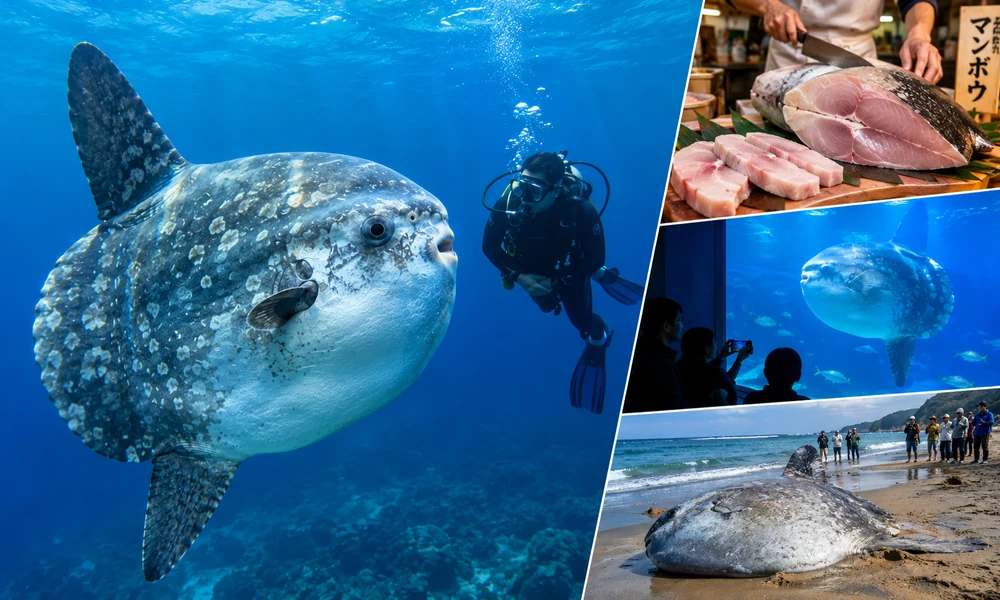
Sunfish are harvested for culinary dishes in East Asia, whereas the European Union strictly regulates the commercial sale of sunfish meat due to toxin accumulation concerns.
- Folklore and Pop Culture: Maritime folklore often portrays sunfish as gentle giants, while beachgoers are fascinated when they wash ashore.
- Where to See Them: Monterey Bay Aquarium, Osaka Kaiyukan, and Okinawa Churaumi Aquarium have occasionally housed sunfish. Divers also seek them around Bali.
- Responsible Diving: Maintain distance, avoid touching them, and avoid bright underwater camera lights.
Secrets You Don’t Know About Sunfish
The 300-Year Hiding Species
The hoodwinker sunfish (Mola tecta) remained undescribed by modern science until 2017, hiding in plain sight near populated coastlines.
A Body Made of Jelly
Much of an ocean sunfish’s internal mass is composed of buoyant, gelatinous tissue rather than dense muscle, keeping it neutrally buoyant.
The Fewest Vertebrae
Ocean sunfish possess fewer vertebrae relative to their body size than almost any other bony fish, contributing to their rigid, compressed spine.
Parasite Capital
A single sunfish can host over 40 different species of parasites, driving their relentless surface-basking and reef-cleaning habits.
Brain-to-Body Mismatch
An adult sunfish weighing thousands of pounds operates with a remarkably small brain, weighing less than a standard human thumb.
A Fish That Wears Its History
Marine biologists analyze tiny skin biopsies and DNA samples to separate lookalike sunfish species that appear identical visually.
Ocean Janitors
Sunfish act as natural population control for gelatinous marine species, helping suppress massive jellyfish blooms in open ecosystems.
Frequently Asked Questions
Do sunfish sleep, and how do they rest?
Ocean sunfish enter low-activity drifting states near the surface or at depth. True neurological sleep in sunfish is still poorly understood.
Can sunfish change color?
Yes. They can rapidly become lighter or darker, often when stressed or at cleaning stations.
Do sunfish get sunburned from basking?
Their thick, mucus-coated skin provides protection from ultraviolet exposure during surface basking.
Why do seagulls peck at sunfish?
Seagulls may land on sunfish and feed on parasitic copepods and isopods. The sunfish tolerates this behavior as part of parasite removal.
Can a sunfish live in a home or small aquarium?
No. Sunfish grow exponentially fast and require massive, specialized open-ocean filtration systems that major public aquariums can provide.
Do sunfish bite or attack divers?
Sunfish are generally harmless and docile. Their tiny mouths are adapted for soft prey, and they may show mild curiosity toward divers.
Can sunfish swim backward?
Not easily. Their unusual body design makes backward movement difficult.
Why do sunfish jump out of the water?
Scientists believe breaching may help dislodge external skin parasites, although the exact trigger remains unconfirmed.
Can a sunfish sink a boat?
Collisions can occur because of their massive weight. Structural damage is typically minor, except in some collisions involving smaller recreational vessels.
How do you tell a Mola mola from a Mola alexandrini?
The differences can involve subtle clavus edges and skin texture. Genetic testing provides the most reliable way to distinguish closely related species.
How can you estimate a sunfish’s age?
Researchers can examine growth rings in vertebrae and otoliths, but directly aging wild ocean sunfish remains difficult because they live in the open ocean.
What happens to sunfish when jellyfish populations change?
Changes in jellyfish populations can directly affect their foraging routes and energy reserves, making sunfish useful indicators of broader marine ecosystem conditions.
