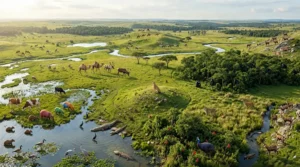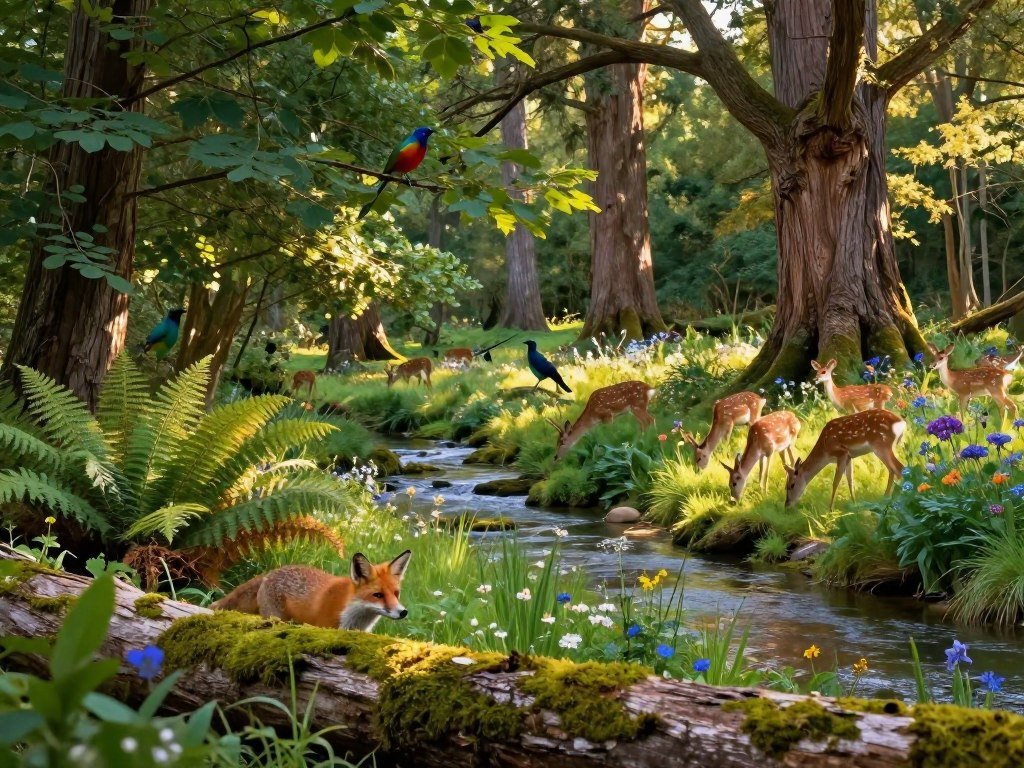
Forests are home to wildlife ranging from tiny insects to large mammals, and each group uses its habitat in a different way. A forest can feel familiar on a trail, yet its animal life may be hard to spot. Some species stay high in trees, while others hide under leaves or move along streams.
This 2000 forest animal list offers representative examples from forests around the world, not a verified count of exactly 2,000 species. You will find mammals, birds, reptiles, amphibians, insects, and other invertebrates, plus aquatic wildlife, track clues, and conservation topics. The examples can help you connect an animal’s habits with the place it lives.
Key Takeaways
- Forest wildlife includes many animal groups, not mammals alone.
- Canopy, subcanopy, understory, and forest floor offer different resources.
- Some animals use forests alongside rivers, ponds, or open ground.
- Track shape and gait can help you narrow down an animal’s name.
- Forest types and regions shape which species may live nearby.
- A useful way to explore the list is to notice not just which animal you recognize, but where it finds food and shelter.
What Counts as a Forest Animal?
A forest animal is wildlife that depends on a wooded habitat for at least part of its life, even if it also uses nearby water or open ground. Forest wildlife can include animals that feed, nest, hide, or travel among trees, shrubs, streams, and leaf litter. A forest layer is a vertical zone of a forest, such as the canopy or forest floor, that offers distinct conditions and resources for wildlife.
Forests are commonly grouped as tropical, temperate, or boreal. Their four familiar layers are the canopy, subcanopy, understory, and forest floor. Many species use more than one layer for nesting, travel, and feeding.
A forest home is a connected habitat, not always a single layer or spot.
The canopy is the tree-top layer, while the subcanopy lies beneath it. The understory holds shrubs and smaller plants, and the forest floor covers the ground. Each layer offers different shelter and food, from leaves and fruit to insects and seeds.
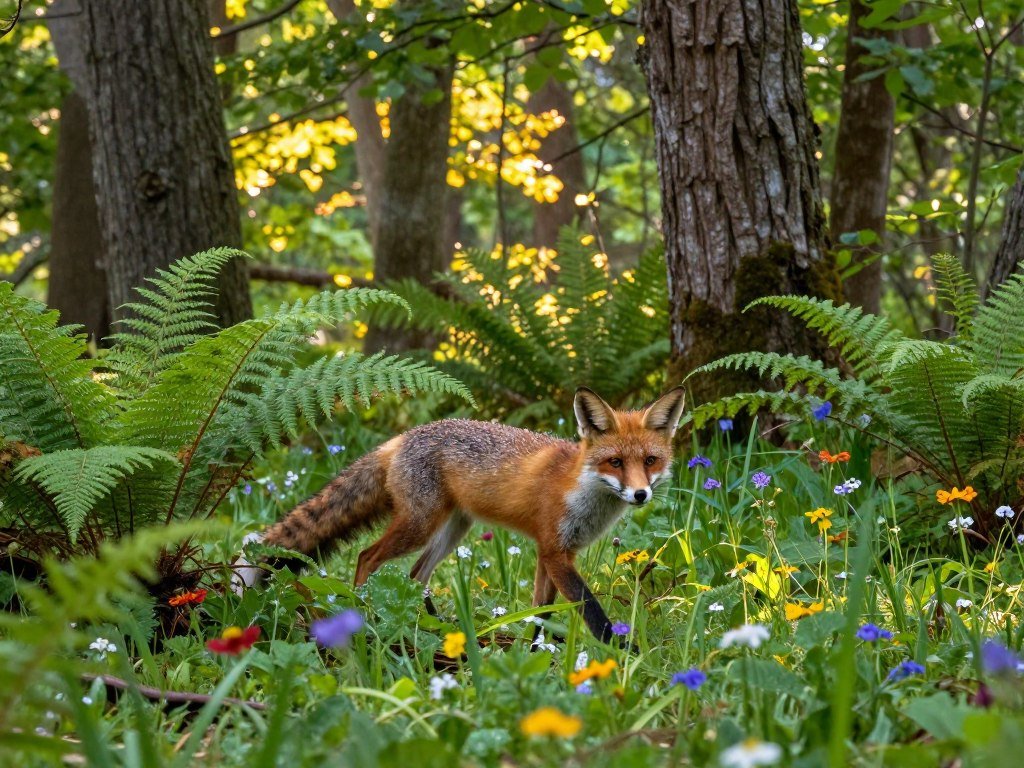
Some animals seen in a forest also rely on nearby rivers, ponds, or clearings. The National Park Service describes how forest layers and wildlife habitat vary across forest types. These types support different resources, even when the same animal group appears in each.
When an animal crosses several layers, its forest home is better understood as a connected habitat than as a single spot.
Which Mammals Appear in a 2000 Forest Animal List?
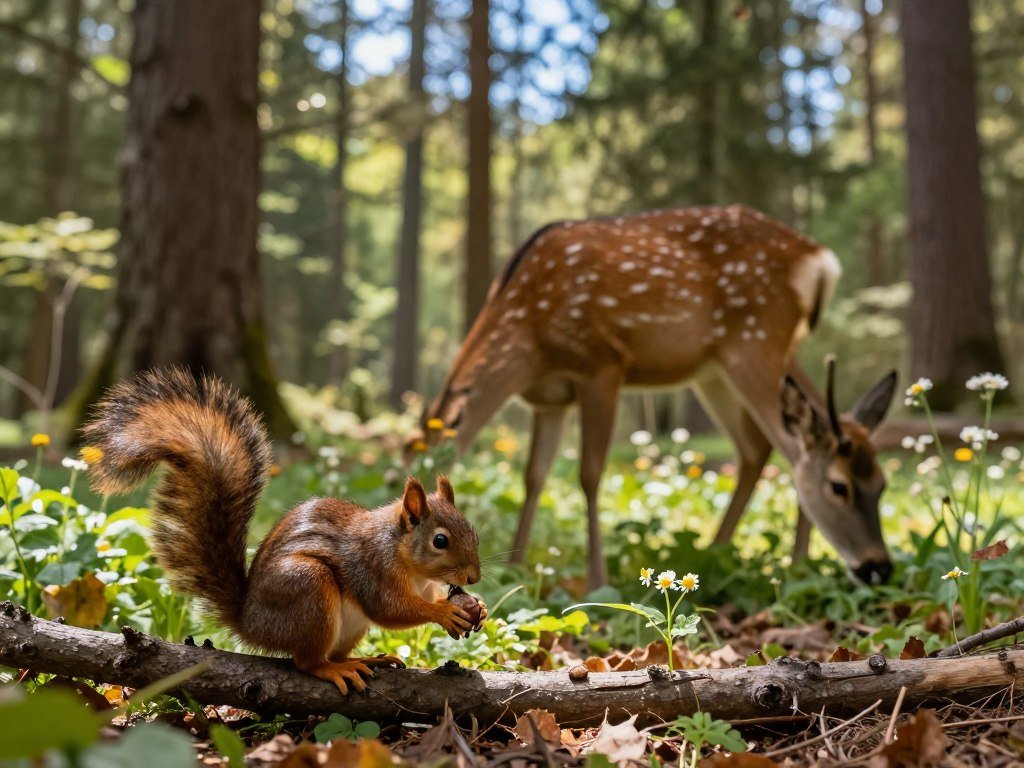
Squirrels, deer, rabbits, black bears, and orangutans show how differently mammals use wooded habitats. Tree-dwelling mammals climb, leap, or travel through branches, while other species stay close to the ground. The range and forest type of each species matter, so no example lives in every forest.
The 2000 forest animal list includes mammals from many regions and families. Their food, body size, and adaptations reflect the habitats they use.
Tree-dwelling mammals
Orangutans spend much of their lives in tropical trees, where long arms help them move between branches. Squirrels climb trunks and gather food among trees. Lemurs are another tree-adapted mammal group, found in Madagascar’s forests.
These species do not share one range or forest type. A squirrel in a temperate woodland and an orangutan in a tropical forest face very different conditions.
Mammals on the forest floor
Deer often forage in the understory, browsing leaves and young plants. Rabbits and mice use ground cover for food and shelter. A small mammal on the forest floor may depend on overhead cover even when it never climbs a tree.
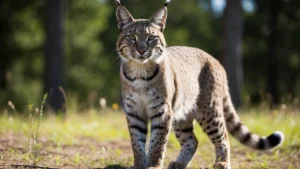
Black bears, bobcats, white-tailed deer, cottontails, and striped skunks are familiar temperate-forest mammals. For more examples by name, see this guide to animals that start with A.
Large forest mammals
Large mammals can use several layers as they search for food and shelter. Black bears travel along the ground, while deer move through woodland openings and understory plants. Their diets and behavior depend on local resources and the season.
| Animal | Typical forest layer | Food | Distinguishing adaptation |
|---|---|---|---|
| Orangutan | Canopy | Fruit and leaves | Long arms help it move through branches |
| Squirrel | Canopy and subcanopy | Seeds and nuts | Sharp claws help it climb trunks |
| Rabbit | Forest floor | Grasses and leafy plants | Strong hind legs support quick hops |
| Deer | Understory | Leaves and young shoots | Long legs help it move through cover |
| Black bear | Forest floor | Plants and animal foods | Strong claws help it dig and climb |
Which Mammals Hunt Other Forest Animals?
A red wolf’s prey includes white-tailed deer, raccoons, rabbits, and other small mammals. Red wolves also live in swamps and coastal prairies, not only forests. As of 2025, 20 to 30 mature red wolves remained in the wild, and the IUCN categorized the species as critically endangered.
The red wolf’s current wild range is limited to North Carolina. This small range makes the species vulnerable, even though its habitat includes several kinds of wooded and wet areas.
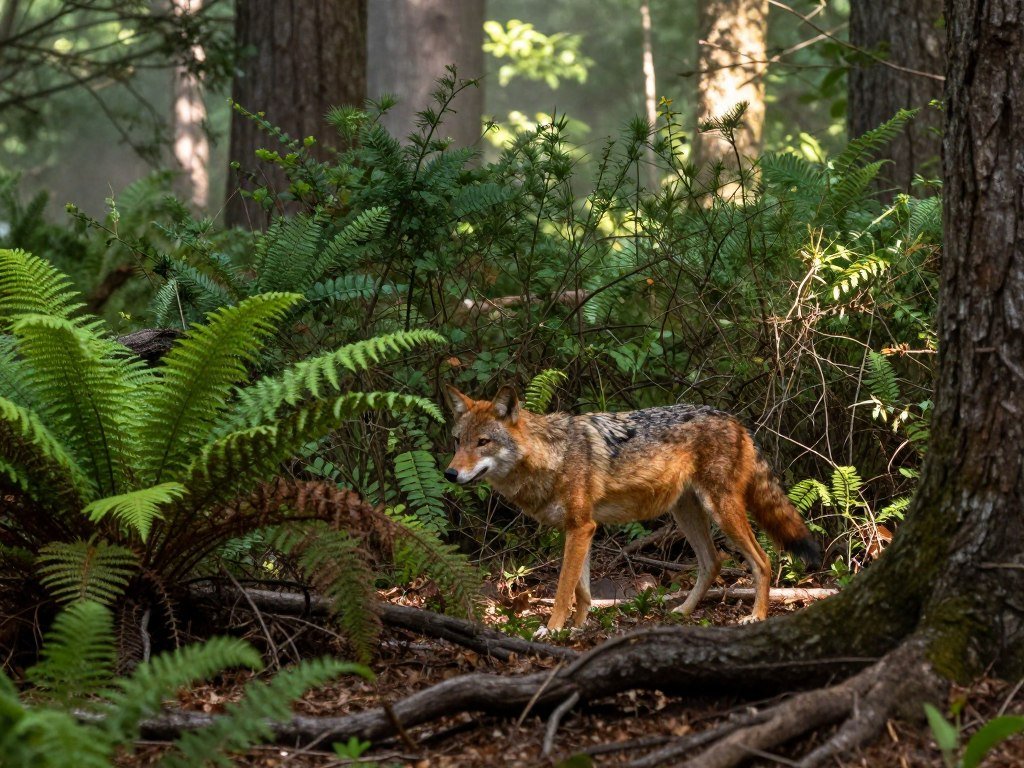
Red wolves hunt a varied mix of prey, including deer and smaller mammals. Foxes and bobcats also hunt forest animals, often taking smaller prey. Their role depends on the species and the animals found in its habitat.
Wolves need space to find food and move through suitable areas. When a range is small, local changes can affect a large share of the wild population. The red wolf’s limited wild range makes it a reminder that a familiar habitat type does not guarantee a secure population.
What Birds Live in Forests?
A pileated woodpecker, a northern cardinal, and a great horned owl represent three very different ways birds use forests. Forest birds find food, nesting sites, and shelter in several layers. Birds use the canopy, subcanopy, understory, and forest-floor resources.
Some birds forage among leaves and branches, while others search trunks or hunt from a perch. Their calls and feeding habits can help you notice them before you see them.
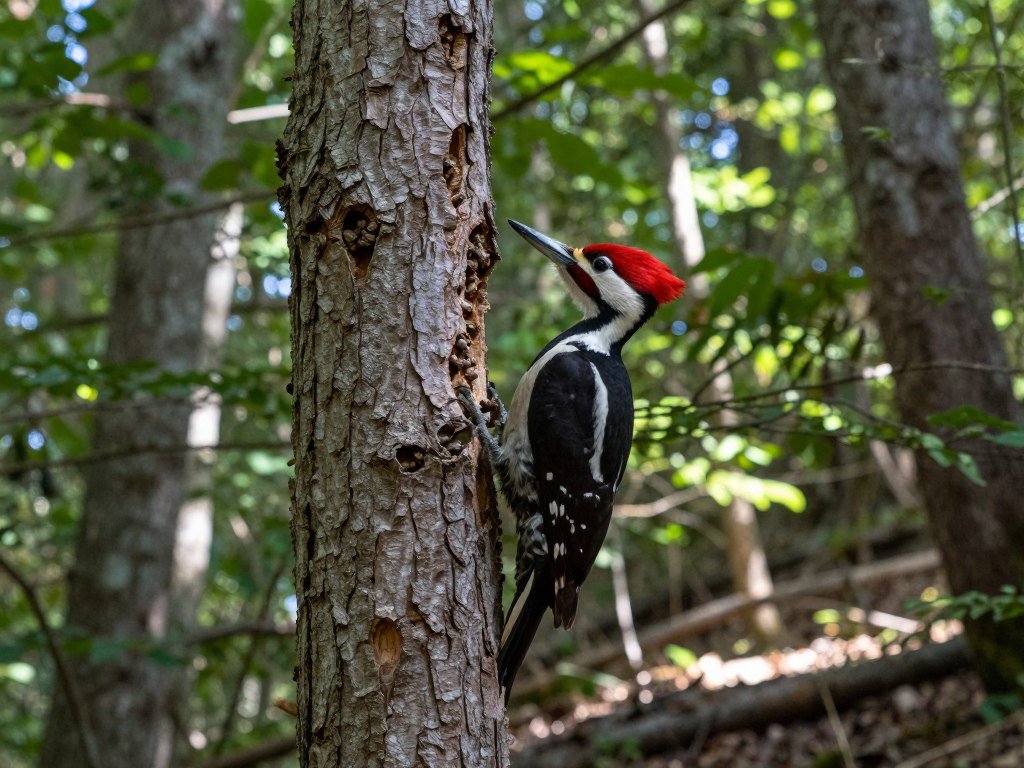
Birds among the canopy and understory
Northern cardinals often move through shrubs and lower branches. American robins forage on the ground and in trees, where they find food. Both show how a bird may use more than one forest layer.
Pileated woodpeckers search tree bark for insects. They also make cavities in trunks, which can later offer shelter or nesting sites for other wildlife. A tree cavity may stay useful after the woodpecker moves on.
Owls and other forest hunters
Great horned owls hunt from perches and are active mainly at night. Other forest birds hunt insects or small animals during daylight. A forest bird’s hunting method often matches the layer where it finds prey.
Scarlet macaws are tropical-forest birds, not typical U.S. woodland birds. Their strong bills help them open hard seeds and nuts. The table compares them with familiar North American species.
| Bird | Forest layer | Food or hunting method | Recognizable behavior |
|---|---|---|---|
| Northern cardinal | Understory and subcanopy | Seeds and fruit | Male has a bright red body |
| American robin | Forest floor and subcanopy | Forages for worms and fruit | Often hops across open ground |
| Pileated woodpecker | Trunks in several layers | Searches bark for insects | Chips large holes in trees |
| Great horned owl | Canopy and subcanopy | Hunts from a perch | Has prominent ear tufts |
| Scarlet macaw | Tropical canopy | Cracks hard seeds and nuts | Has bright red, blue, and yellow feathers |
A bird’s nest location can be as revealing as its call when you are learning which part of the forest it depends on.
Which Reptiles Live in Forest Habitats?
Forest reptiles range from small lizards in vegetation to large snakes in tropical forests and wetlands. Reptiles include snakes, lizards, and turtles, with species using both land and water. Not every reptile in a wooded area stays on dry ground.
Some reptiles hide under plants or fallen wood, while others swim or rest near water. Their body shape and habits vary across forest types.
Snakes and lizards
Anole lizards often live among tropical plants and trees. Emerald tree boas are tropical snakes that rest in branches. Coral snakes also use forest habitats, though their ranges and preferred conditions differ by species.
Green anacondas are associated with tropical wetlands and waterways. They can grow to over 30 feet and weigh over 500 pounds. Learn more about snake habitats and hunting methods.
Turtles and crocodilians
Turtles and tortoises use different settings, from ponds and streams to forest land. Some turtle species move between aquatic and terrestrial habitats during their lives.
Caimans live in tropical rivers and wetlands, often near forest cover. They are crocodilians, not turtles. Komodo dragons can grow over 10 feet and weigh over 350 pounds, and live on Indonesian islands with forest and scrub habitats.
| Reptile | Group | Forest setting | Notable trait |
|---|---|---|---|
| Anole | Lizard | Tropical vegetation | Clings to leaves and branches |
| Emerald tree boa | Snake | Tropical canopy | Often rests coiled on branches |
| Green anaconda | Snake | Tropical wetlands | Can exceed 30 feet long |
| Turtle | Turtle | Ponds and wooded streams | Uses land and water, depending on species |
| Caiman | Crocodilian | Tropical rivers and wetlands | Hunts and rests near water |
Do not assume that every reptile sighting means the animal lives only on dry ground.
Which Amphibians Depend on Forest Moisture?
Forest amphibians often rely on damp cover, and many also depend on water during an early life stage. Moist habitat helps protect their sensitive skin from drying. Many amphibians begin life in water, then move into adult habitats, though life histories vary.
Salamanders, newts, frogs, and toads use forests in different ways. Some stay close to streams, while others shelter in damp soil or leaf litter.
Salamanders and newts
Salamanders often hide under logs, stones, or moist leaves. Eastern newts may use water during one life stage and land during another. Tiger salamanders are another forest-associated example.
A 2004-2005 survey found 15 amphibian species in surveyed U.S. Forest Service Research Natural Areas in southwestern Oregon. That total included nine salamanders and six frogs and toads.
Surveys in 1998 and 1999 detected three amphibians on the U.S. Forest Service sensitive species list: Del Norte salamander, Southern torrent salamander, and Foothill yellow-legged frog. The southwestern Oregon survey totals show the variety found in those study areas.
Frogs and toads
Leopard frogs often use wet areas near woodland, while American toads can shelter in forest cover. The young of many frogs develop in water, but not all amphibians follow the same life cycle.
Some species lay eggs in ponds or streams; others use damp land sites. Adult habits also differ, so a frog or salamander may need more than one kind of habitat over time.
A wet patch of leaf litter can matter even when it looks too small to count as habitat.
Which Insects and Other Invertebrates Live in Forests?
Ants, beetles, butterflies, dragonflies, and termites make the forest floor and vegetation busy with invertebrate life. Insects have six legs and an exoskeleton, a firm outer covering. They feed other wildlife and help break down dead material.
Ants move through soil and plant cover, while butterflies visit flowers. Termites feed on wood, and beetles use many forest habitats. Dragonflies are often found near water, where their young develop.
Insects connect plants to other animals in the food web. Birds, amphibians, and mammals may eat them, while insects also help recycle dead plants and wood. Their small size does not make their work small.
- Ants build trails through soil and leaf litter.
- Butterflies visit flowers for nectar.
- Termites break down wood and other plant material.
- Dragonflies hunt near ponds and streams.
- Beetles fill many feeding roles in trees and soil.
Spiders and earthworms are other invertebrates, but neither is an insect. A common mistake is to call every small animal with many legs an insect. Six legs are a practical first clue for identifying an insect, while spiders and earthworms belong to different groups.
Which Forest Animals Live Near Water?
A forest stream can support wildlife that swims, builds near the bank, or simply visits to drink. Water-linked animals include beavers, North American river otters, and capybaras. Forested rivers and streams can offer both habitat and movement routes for wildlife.
Beavers and otters live in North American settings, where rivers, streams, ponds, and wetlands support their lives. Beavers build near water, while otters swim and hunt in it. American mink also live near rivers and wetlands, and use protected dens near the water’s edge.
Capybaras live close to water in Central and South American forests. They can stay submerged for up to five minutes. Their close ties to water differ from animals that visit a stream only to drink or feed.
Some forest species depend on wet habitats, while others use the water’s edge as one resource among many. For more on a semi-aquatic mammal, read about American mink habitat and behavior.
Look at both the water’s edge and the surrounding cover, since a water-dependent animal may rest away from the open bank.
How Can You Identify Forest Animals by Their Tracks?
A track’s pattern can narrow the possibilities before you compare its size or toe marks. Gait matters because walkers, waddlers, bounders, and hoppers leave different print patterns. Use track size as a clue, not proof.
Perfect walkers, such as deer, moose, foxes, coyotes, and bobcats, tend to place a rear foot where the front foot landed. Waddlers, including bears and skunks, make four-print patterns.
Otters and other mustelids often leave two side-by-side prints as bounders. Rabbits and small rodents hop, with their rear feet landing ahead of their front feet.
Canine tracks show four toes, a concave-bottomed heel pad, and usually visible claws. Feline tracks also show four toes, but the heel pad has three lobes and claws are usually absent. Bears have five toes.
| Animal | Reported track size | Toe or pad clue | Gait pattern |
|---|---|---|---|
| Wolf | About 4 inches long | Four toes; canine heel pad | Walker |
| Coyote | About 2.5 to 3.5 inches wide | Four toes; usually visible claws | Walker |
| Fox | 2 to 3 inches long | Four toes; concave-bottomed heel pad | Walker |
| Bobcat | About 2 inches long | Three-lobed heel pad; claws usually absent | Walker |
| Bear | No size listed | Five toes | Waddler |
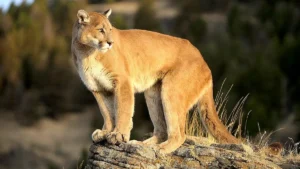
Mud, snow, and the ground beneath a print can blur or enlarge its shape. Other feline tracks include cougar prints greater than 3 inches and house cat prints measuring 1 to 1.5 inches. Treat a single print as a clue, then check for a repeated pattern before naming the animal.
How Do Forest Animals Differ by Forest Type?
A tropical rainforest and a boreal forest can both be dominated by trees yet support very different wildlife. Forest types differ in climate, plants, and available food. The same animal group can include different species in different regions.
Temperature, rainfall, and growing seasons shape the species found in each forest. A bird, mammal, or frog from one region may have no close match in another.
Tropical forests
Tropical forests stay warm and often receive heavy rain. Their wildlife includes jaguars, sloths, toucans, and poison dart frogs. Many species use dense plants and layered tree cover.
The canopy can offer fruit and branches for climbing, while shaded ground supports other life. A tropical forest animal list can change from one continent to another.
Temperate forests
Temperate forests have seasons, with changes in temperature and plant growth through the year. Black bears, squirrels, bobcats, white-tailed deer, and salamanders are examples from these woodlands.
Some animals use the forest year-round, while others move or change their habits as food shifts. Local conditions help explain which species may be present.
Boreal forests
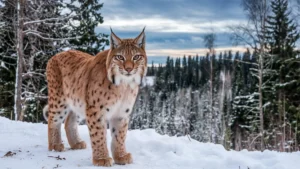
Boreal forests grow in colder regions, where long winters shape the habitat. Beavers, badgers, and lynx are examples associated with these forests.
| Forest type | General climate | Example region | Example animals |
|---|---|---|---|
| Tropical | Warm, often wet | Amazon Basin | Jaguars, sloths, toucans |
| Temperate | Seasonal temperatures | Eastern United States | Black bears, deer, salamanders |
| Boreal | Cold winters, short growing season | Canada | Beavers, badgers, lynx |
| Tropical | Warm year-round | Central America | Poison dart frogs, toucans |
| Temperate | Warm summers, cool winters | Appalachian region | Bobcats, squirrels, deer |
Check the forest type and region before assuming an animal from one list belongs in another.
Which Animals Are Common Across U.S. Forests?
White-tailed deer, raccoons, and red foxes occur across all 48 contiguous states. Widespread species also include bobcats and striped skunks. A range across every contiguous state does not mean an animal lives in every local forest.
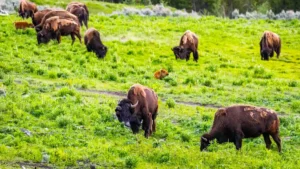
The continental United States has an estimated 432 mammal species. U.S. fauna include more than 800 bird species, 311 reptile species, and 295 amphibian species. The American bison became the national mammal through the National Bison Legacy Act in 2016.
- White-tailed deer
- Bobcat
- Raccoon
- Striped skunk
- Red fox
Muskrats, barn owls, American mink, American beavers, and North American river otters also occur in all 48 contiguous states. Their local presence still depends on suitable habitat and nearby resources.
Species found across the United States may use different habitats in different regions. A national range does not tell you which animals live in a particular local forest.
What Threatens Forest Wildlife and Their Habitat?
Forest wildlife can lose suitable habitat even when trees remain visible across the landscape. Habitat quality depends on more than tree cover. Roads and settlements can split forests into smaller patches and limit wildlife movement.
Development and agriculture can remove forest areas, while forestry practices may change their structure. Black bears and bobcats need connected areas to move and find resources.
Development and fragmented habitat
When roads cut through wooded areas, animals may face barriers between feeding, nesting, and resting places. Settlements can add more breaks between forest patches.
Amphibians and reptiles can face habitat loss, fragmentation, and degradation from development, agriculture, forestry practices, roads, invasive weeds, and climate-related factors. A forest with many trees may still lack varied structure or connected cover.
- Development can replace wooded habitat with buildings and fields.
- Roads can break up movement routes.
- Intensive forestry can change forest structure.
- Climate-related change can shift local habitat conditions.
Climate, fire, and invasive plants
Climate shifts can change the conditions plants and animals rely on. Fire can alter cover and resources, while invasive plants may crowd out native growth.
Some forest management can support wildlife when it keeps a mix of habitat structures. Audubon Pennsylvania discusses how forest age and structure affect birds, with guidance that depends on region and habitat goals.
A global study of threatened species found habitat destruction affected 88.3% of the 20,784 species assessed. It was the leading threat for 71.3% of that sample, as reported in research on threats to species.
Look for connected cover and varied forest structure, not just the presence of trees, when considering habitat quality.
How Do Habitat Maps and Roadless Protections Help Wildlife?
A habitat map can show where wildlife conditions have changed, while a land protection rule can limit some pressures on those places. Maps track change over time, but they do not stop habitat loss by themselves. Roadless protections address some development pressures on national forests.
Map findings are most useful when you keep the species, place, and period together. Habitat conditions can change sharply within a region.
Mapping habitat change
Southern Sierra Nevada fisher reproductive habitat stayed stable from 1985 to 2011. It then declined by 48% between 2012 and 2022, with most of the loss inside fire perimeters.
In 2020, Mexican spotted owl nesting and roosting habitat was lower than in the mid-1980s across most southwestern National Forests. A map can show where habitat changed, but protection and management decisions require action beyond mapping.
The U.S. Forest Service describes Living Maps for at-risk species, which track habitat and may help show where management and wildlife needs can fit together.
Roadless areas and wildlife
Roadless areas contain habitat for 57% of vulnerable wildlife. The Roadless Rule protects roughly one-quarter of national forests from road construction and commercial timber harvest.
A proposed rescission of the rule could remove protections in national forests in 36 states. The proposed change concerns those protections, not a claim that every roadless area has the same wildlife.
Keep the species, map area, and time period together when interpreting any habitat-change figure.
What Roles Do Forest Animals Play in the Food Web?
A forest food web links animals to plants, prey, predators, and the material that returns nutrients to the soil. Each role connects with others, from seed movement to hunting. One species can take part in more than one food-web role.
A jay may cache acorns, and some buried seeds later grow into trees. Deer eat plants, while woodpeckers feed on insects. Foxes hunt smaller animals and may also scavenge.
- Seed dispersal: jays can spread acorns by caching seeds.
- Plant eating: deer browse leaves and other plant growth.
- Insect feeding: woodpeckers search bark for insects.
- Predation or scavenging: foxes hunt smaller animals and may feed on carrion.
Insects and earthworms help break down dead material. This work returns nutrients to the soil, where plants can use them again.
Food-web roles describe what an animal does in a given setting, not a fixed label for its whole life.
One animal can fill more than one role, so avoid labeling a species only as predator or prey.
How Can You Observe Forest Animals Without Disturbing Them?
A quiet observer using binoculars is more likely to notice wildlife without pushing it away. Dawn and dusk are common periods of animal activity. Stay at a distance and let wildlife keep its shelter.
Owls, foxes, and salamanders can be hard to spot because of their habits or use of cover. Listen and scan quietly instead of chasing an animal.
- Stay on established paths.
- Observe from a distance.
- Avoid feeding or handling wildlife.
- Take litter home.
Follow local posted guidance, which takes precedence. Leave an animal’s shelter undisturbed, even when it is hidden under logs or leaves.
Conclusion
Forest wildlife becomes easier to understand when you connect an animal’s identity to the place and resources it uses. A species list is a starting point, not a complete count of every animal in the world’s forests.
Forest type and region help explain which animals may be present. The same kind of habitat can support different species in different places.
Choose one local species and learn which habitat clues match its needs. On your next walk, choose one local species and note the habitat clues that help it live there.
FAQ
Are all forest animals mammals?
No, forests also support birds, reptiles, amphibians, insects, and other invertebrates. You can find animals in trees, shrubs, streams, and leaf litter. These groups use different food sources and shelter. A forest is not defined by mammals alone, and tiny invertebrates can support larger animals through the food web.
What is the difference between a forest reptile and an amphibian?
Reptiles have scales, while many amphibians have aquatic larval stages and rely on moist conditions. A snake or lizard may live in a forest without needing a pond for its young. Many frogs and salamanders use water during early life, though their life histories vary by species.
Are forest animals active at night?
Some forest animals are nocturnal, including many owls, while others are active by day or at dusk. Activity also depends on the species and its habits. A quiet walk at dawn may reveal animals that stay hidden during busier hours, though many species remain hard to spot.
Do forest animals stay in one forest layer?
Some forest animals specialize in one layer, while many birds and mammals use several layers for food, movement, or shelter. A bird may nest in a tree and forage lower down. A mammal can travel through the understory and forest floor as it moves through its habitat.
Can I identify an animal from one track?
Use toe marks, gait, size, and repeated prints together, since one track alone may be misleading. Soft mud can blur edges, while snow can change the print’s outline. A line of tracks can show whether an animal walked, hopped, bounded, or waddled, helping you narrow the possibilities.
Why are forests important to amphibians?
Moist cover and nearby water can support adult amphibians and species with aquatic young. Damp leaves, logs, and soil can provide shelter from drying conditions. Some amphibians move between land and water during their lives, so a healthy habitat may need both wet and wooded places.