A small shadow moves across the floor, pauses near the edge of a rug, and suddenly darts beneath a cabinet. You catch a glimpse of eight legs and a sturdy, hairy body. For a moment, you wonder whether it is the kind of spider that builds a web—or something that hunts in a completely different way.
It might be a wolf spider.
Wolf spiders are among the most interesting spiders people encounter around homes, gardens, lawns, and wooded areas. They do not rely on large, elaborate webs to catch their meals. Instead, they search, stalk, and chase small prey with the kind of quick movement that makes them surprisingly easy to notice once you know what to look for.
Despite their sometimes intimidating appearance, wolf spiders are generally shy animals that prefer to avoid people. Understanding how they look, where they live, and how they behave makes these ground-dwelling hunters much less mysterious.
What Is a Wolf Spider?
A wolf spider is a hunting spider belonging to the family Lycosidae. The family includes many species found in a wide range of environments, from forests and grasslands to deserts, gardens, and residential neighborhoods.
Wolf spiders are named for their active hunting behavior. Rather than depending on a prey-catching web, most species move across the ground in search of insects and other small animals. Some wait quietly for an opportunity, while others pursue prey when they detect movement.
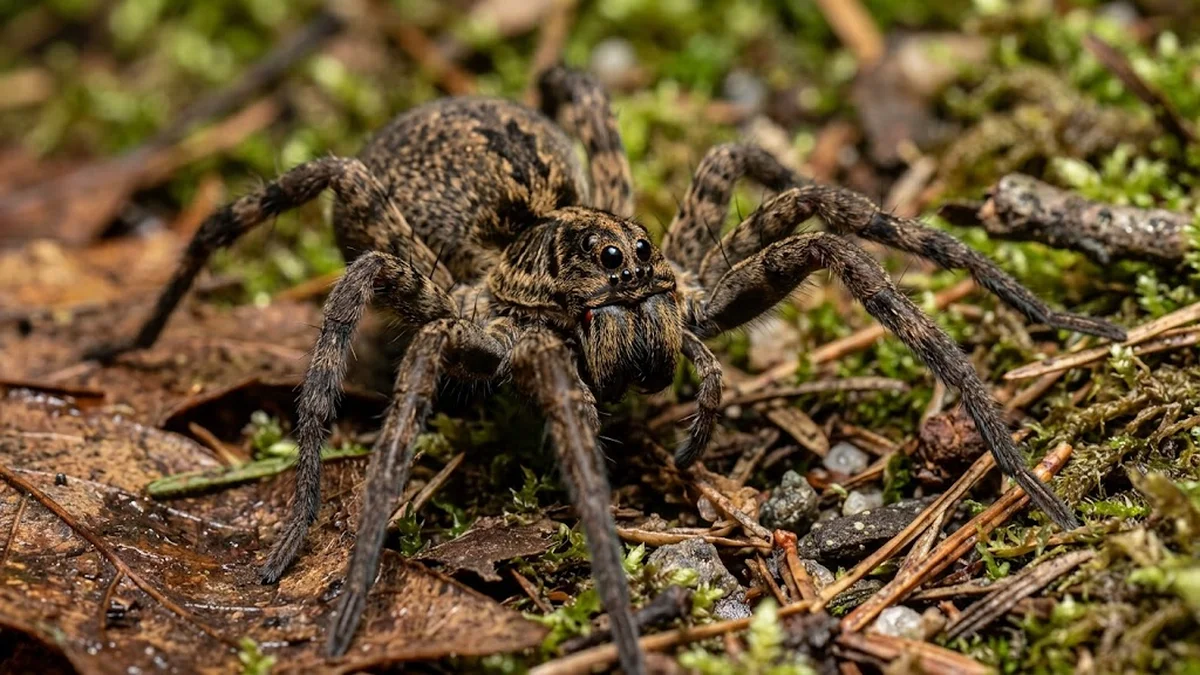
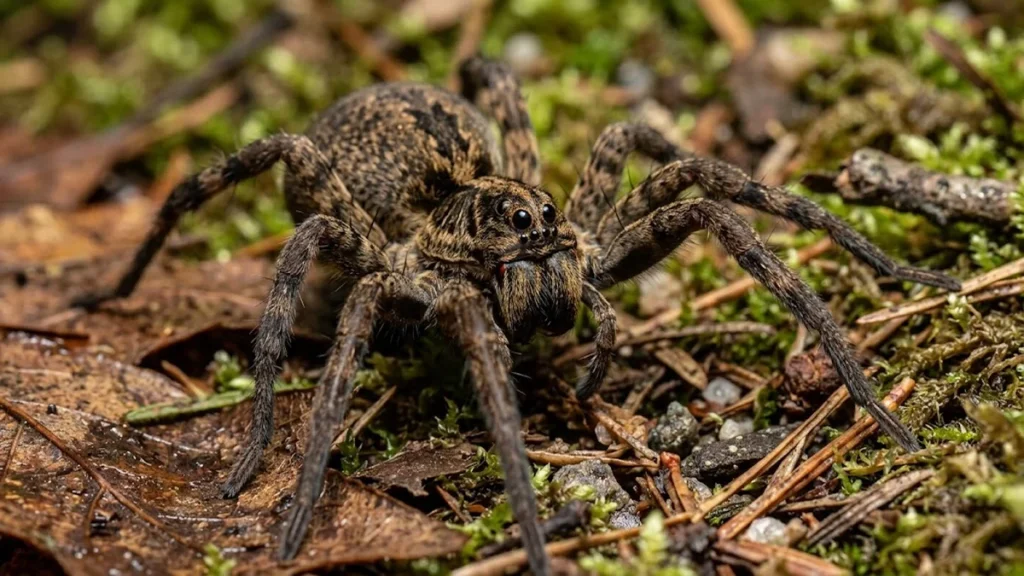
Their appearance varies by species, but many have brown, gray, black, or tan bodies, often marked with stripes or mottled patterns. These earthy colors help them blend into soil, dead leaves, stones, and other parts of their surroundings.
A wolf spider may look formidable up close, but its everyday role is simple: find food, avoid becoming food itself, and produce the next generation.
How to Identify a Wolf Spider

The first clue is often its build. Compared with the delicate legs and relatively narrow bodies of some web-building spiders, wolf spiders usually look sturdy and compact. Their legs are designed for moving over the ground, and their coloring often resembles the places where they hunt.
Eight eyes arranged in distinctive rows
Wolf spiders have eight eyes arranged in three rows. The arrangement is one of their most useful identifying characteristics. The two large eyes in the middle row are particularly noticeable in many species, while the remaining eyes occupy the upper and lower rows.
Their eyesight is relatively good for spiders, helping them detect movement and locate prey. At night, a flashlight may reveal reflections from spiders’ eyes in suitable conditions, although this technique does not identify every spider reliably.
Hairy bodies and patterned markings
Many wolf spiders have a visibly hairy appearance. Their bodies may feature pale stripes, darker bands, or irregular markings along the abdomen and cephalothorax the front body section that carries the legs and eyes.
Color alone is not enough to confirm an identification. Other spiders can be brown, hairy, and ground-dwelling too. Looking at the eye arrangement, body proportions, behavior, and location together provides a much stronger clue.
Fast movement across the ground
Wolf spiders are active hunters, so they are often seen running rather than sitting in the center of a large web. They may dash between grass blades, disappear under a stone, or shelter in a small burrow.
Some species create retreats in the soil, while others spend much of their time moving across the surface. Their habits differ depending on the species and environment.
Where Do Wolf Spiders Live?

Wolf spiders are found across much of the world, and many species occur throughout the United States. Their ability to live in different habitats helps explain why people encounter them in such varied places.
Common habitats include:
- Gardens and lawns: Grass, leaf litter, garden beds, and spaces beneath stones provide shelter and access to insects.
- Forests and woodland edges: Fallen leaves, decaying wood, and loose soil offer places to hide and hunt.
- Fields and grasslands: Open ground provides plenty of opportunities to find small invertebrates.
- Deserts and dry regions: Some species are adapted to arid environments and shelter from harsh conditions.
- Homes and outbuildings: A wolf spider may wander indoors while searching for prey or shelter, especially when outdoor conditions change.
Finding one inside does not necessarily mean a home is infested. A spider may have entered through a gap beneath a door, an opening around a window, or another small access point. In many cases, it is simply an individual that has wandered away from its usual habitat.
What Do Wolf Spiders Eat?
Wolf spiders are predators that feed mainly on insects and other small invertebrates. Depending on their size and species, their prey may include flies, crickets, grasshoppers, beetles, and other spiders.
They locate potential meals through a combination of vision, vibrations, and sensory information gathered through their legs and body. Once close enough, a wolf spider can rush toward its target and seize it with its legs and mouthparts. Spiders also use vibrations and body movements to send signals to one another, which is one of many forms of animal communication.
Like other spiders, wolf spiders use venom to subdue prey. They also release digestive fluids that help break down the food before it is consumed.
Their hunting makes them part of the natural system that regulates insect populations. They are not a complete solution to household pests, but they do contribute to the complex relationships between predators and prey in gardens and other habitats.
Do Wolf Spiders Build Webs?
Wolf spiders are not known for building the large, prey-catching webs associated with many familiar spiders. Their defining strategy is active hunting.
That does not mean they never use silk. Wolf spiders can produce silk for purposes such as lining retreats, protecting eggs, or creating structures associated with shelter and reproduction. The important distinction is that they generally do not wait in a large capture web for insects to become trapped.
This difference is one of the easiest ways to understand their lifestyle. A web-building spider often lets the structure do much of the work. A wolf spider goes looking for its next meal.
Are Wolf Spiders Dangerous to Humans?
Wolf spiders are generally not considered dangerous to people. They may bite if handled, trapped against the skin, or threatened, but they typically prefer to escape rather than confront a much larger animal.
A bite can cause localized pain, redness, itching, or swelling. The reaction varies from person to person, and a suspected bite should not automatically be attributed to a wolf spider simply because one was seen nearby.
If you find a wolf spider indoors, avoid grabbing it with your bare hands. You can often guide it into a container and release it outside, provided you can do so safely. If you are unsure what kind of spider you have found, avoid handling it until it can be identified.
Seek medical advice if a bite causes severe or worsening symptoms. Difficulty breathing, faintness, or swelling involving the face or throat requires emergency medical attention.
How can you reduce unwanted encounters?
A few practical measures can make indoor encounters less likely:
- Seal gaps around doors, windows, pipes, and other entry points.
- Repair damaged screens and use door sweeps where needed.
- Reduce clutter near floors, particularly in storage areas and garages.
- Keep outdoor vegetation and leaf litter from accumulating directly against the building.
- Avoid leaving doors open for long periods when spiders are active nearby.
These measures reduce opportunities for spiders to enter, though they cannot guarantee that one will never find its way indoors.
Wolf Spider vs. Brown Recluse: What’s the Difference?
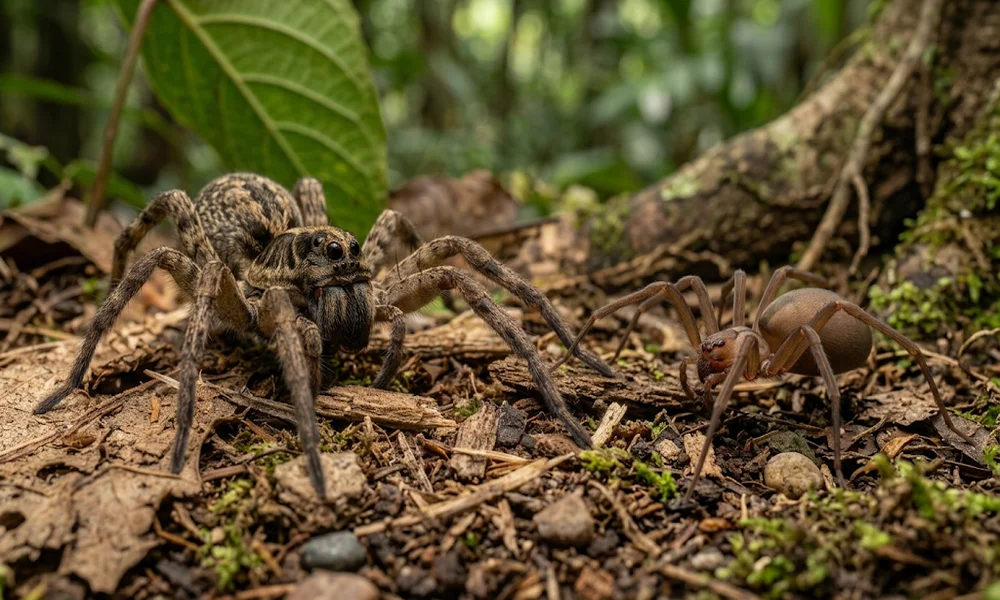
Wolf spiders and brown recluse spiders can be confused because both may appear brown and can turn up in homes. However, they belong to different spider families and have different identifying features.
| Feature | Wolf spider | Brown recluse |
| Body appearance | Often robust and hairy, with patterned markings | Usually more uniformly brown, with fine hairs |
| Eyes | Eight eyes arranged in three rows | Six eyes arranged in pairs |
| Hunting style | Actively hunts prey | Hunts and forages without a prey-catching web |
| Human health concern | Bites can cause local symptoms but are generally not medically serious | Bites can occasionally cause significant tissue injury |
| Identification | Body pattern, eyes, and behavior help | Requires careful attention to its defining features |
Neither spider should be identified by color alone. Brown spiders are common, and many harmless species resemble one another. The violin-shaped marking often associated with brown recluses is not, by itself, reliable confirmation.
Brown recluse spiders are established primarily in parts of the central and southern United States, although isolated reports outside their usual range can occur. Geography can help with identification, but it should not replace examination of the spider’s features.
How Do Wolf Spiders Reproduce?
Wolf spiders have a fascinating approach to parenting, particularly compared with the image of spiders as solitary hunters that simply leave their eggs behind.
After mating, a female typically produces an egg sac made of silk. In many wolf spider species, she attaches the sac to her spinnerets and carries it with her. The sac travels wherever she goes, protected beneath her abdomen.
When the spiderlings hatch, many species display another remarkable behavior: the tiny young climb onto their mother’s back and remain there for a period before dispersing.
This behavior varies across species, but maternal egg-sac carrying and spiderlings riding on the mother’s back are well-known characteristics of wolf spiders. It is a striking reminder that even small predators can have surprisingly involved life histories.
Do Wolf Spiders Make Good Pets?
Wolf spiders can be kept by experienced invertebrate enthusiasts, but they are not typical handling pets. Their natural behaviors are best observed with minimal disturbance, and an enclosure must provide suitable space, ventilation, substrate, hiding places, and appropriate moisture for the particular species.
Care requirements vary, so identifying the species matters before attempting to keep one. Wild spiders should not be collected or transported without considering local rules and the animal’s welfare.
For most people who find a wolf spider in the garden, leaving it in its natural habitat is the simplest option. If one has entered a home, a careful outdoor relocation is often sufficient.
Why Wolf Spiders Matter in Nature
A wolf spider crossing a patch of bare soil might appear insignificant, but it occupies a useful place in its ecosystem. It feeds on small animals, becomes prey for larger predators, and participates in the constant movement of energy through food webs.
Birds, reptiles, amphibians, and other predators may eat spiders. Meanwhile, wolf spiders help control populations of insects and other small invertebrates.
Their presence also reflects the variety of small habitats that can exist in an ordinary garden. A patch of leaf litter, a sheltered gap beneath a stone, or a stretch of unmowed grass can support a busy community of creatures that often goes unnoticed.
The more closely we pay attention to these small hunters, the more complicated and interesting the ground beneath our feet becomes.
Frequently Asked Questions
Do wolf spiders jump at people?
Wolf spiders are capable of quick bursts of movement, but they do not normally jump at people to attack them. When startled, they are more likely to run for cover.
Can wolf spiders climb walls?
Some wolf spiders can climb certain rough or textured surfaces, while their climbing ability varies with the surface and species. They are generally associated with ground-level hunting.
Do wolf spiders come out at night?
Many species are active at night, when they hunt or search for prey. Others are active during the day, so their activity patterns depend on the species and local conditions.
Should I kill a wolf spider in my house?
Usually, there is no need. If you can do so safely, you can move it outside using a container and a piece of stiff paper. Avoid handling unfamiliar spiders directly.
Are wolf spiders good for gardens?
Yes. Wolf spiders prey on insects and other small invertebrates, contributing to the natural balance of garden ecosystems.
A Small Hunter Worth Understanding
Wolf spiders are easy to misunderstand. Their hairy bodies, prominent eyes, and sudden movements can make them look more threatening than they are. Yet they are mostly solitary hunters, built for finding prey on the ground rather than bothering people.
The next time a spider races across a garden path or disappears beneath a flowerpot, take a closer look from a safe distance. It may be a wolf spider doing exactly what it has evolved to do: hunting quietly in the busy, miniature world beneath our feet.