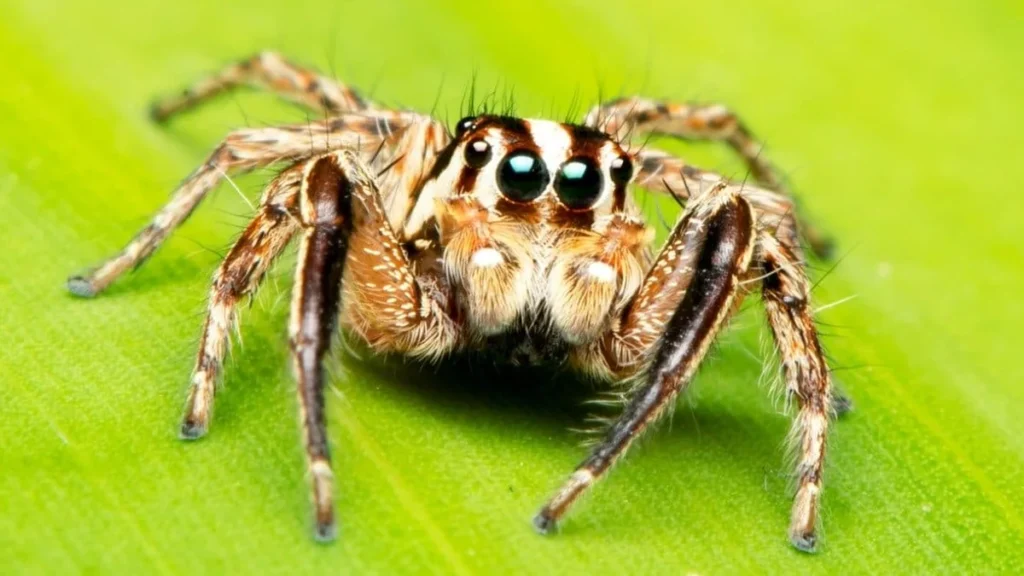
A tiny spider sits on the edge of a windowsill. Instead of disappearing into a corner or waiting in a web, it turns toward you. Its front legs shift slightly. Its body moves as if it is studying the situation, and then, in a sudden burst, it leaps across the surface and vanishes from view.
That little movement is part of what makes jumping spiders so fascinating. They do not look or behave quite like the spiders many people expect to find around a home or garden. They have compact bodies, remarkable eyesight, and an active hunting style that makes them seem almost curious about the world around them.
Jumping spiders belong to the family Salticidae, one of the largest spider families, with thousands of described species worldwide. They are small predators that rely on vision, careful movement, and powerful jumps to catch prey. Once you learn how to recognize them, an ordinary garden wall or sunny windowsill can become a place to watch some surprisingly sophisticated animal behavior.
What Is a Jumping Spider?
A jumping spider is a spider that hunts primarily by sight and captures prey by leaping toward it. Unlike spiders that depend on large webs to trap insects, jumping spiders usually explore their surroundings, locate potential prey, and approach it before making a carefully timed jump.
Most are small, although their size varies considerably among species. Some have muted brown or gray coloring that blends into bark and stone. Others display bright green, orange, red, blue, or iridescent markings.
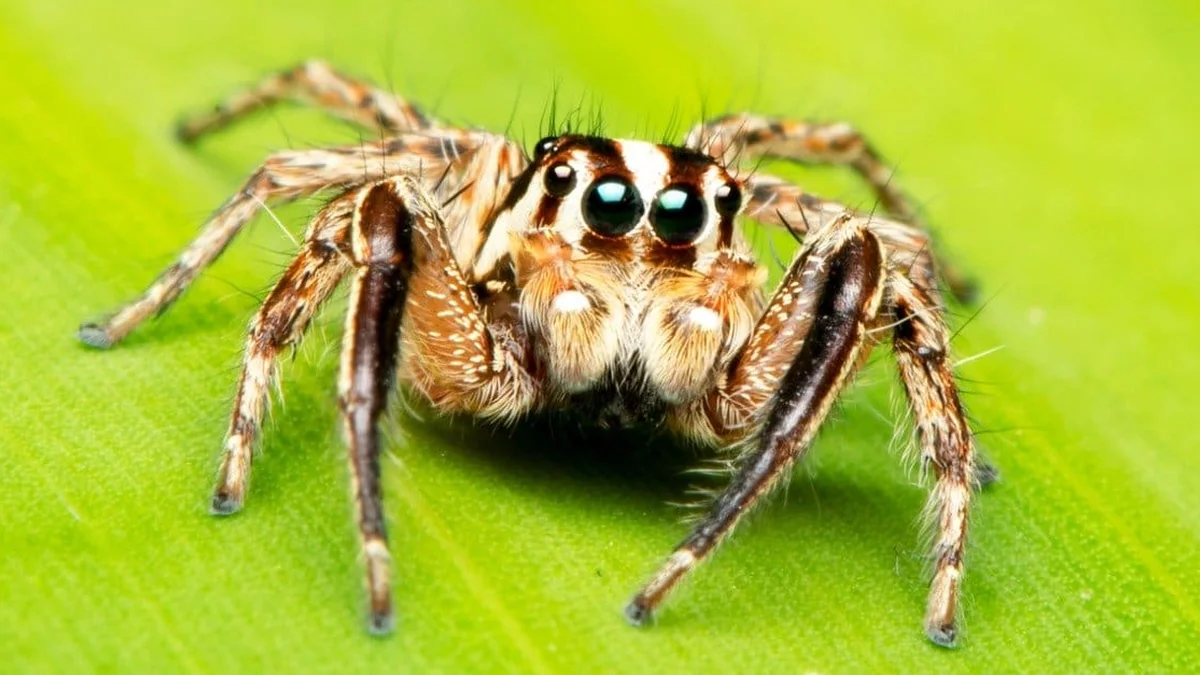
Their distinctive eyes are often the first feature people notice. Two large eyes face forward, giving many jumping spiders a striking, almost expressive appearance. Their compact bodies and alert movements add to the impression that they are paying attention to everything nearby.
Despite their reputation as excellent jumpers, they do not spend every moment leaping. Much of their hunting involves pausing, looking, turning, and moving slowly toward a target.
How to Identify a Jumping Spider
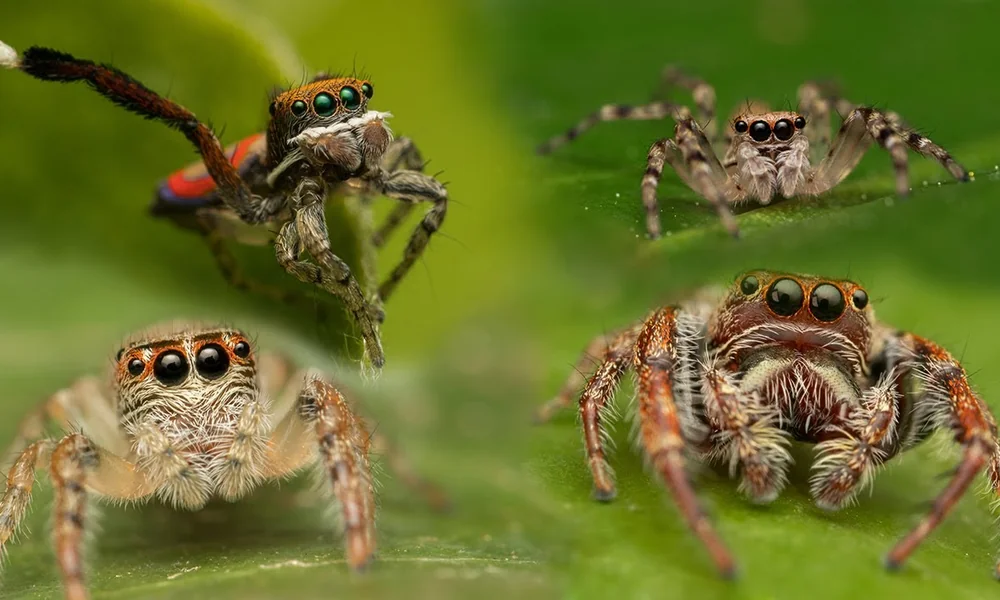
Jumping spiders can be identified by a combination of their body shape, eye arrangement, movement, and hunting behavior.
Large forward-facing eyes
The most recognizable feature is the pair of large principal eyes on the front of the head region. These eyes provide detailed vision and help the spider judge distances when approaching prey or preparing to jump.
Jumping spiders have eight eyes in total, arranged in a distinctive pattern. The other eyes provide additional visual information, including awareness of movement around them.
This visual system is unusual among spiders. Many species rely heavily on vibrations and touch, but jumping spiders use their vision to make precise decisions about where to move and when to leap.
Compact, often hairy bodies
Many jumping spiders have short, sturdy bodies and relatively strong legs. Some look fuzzy because of the fine hairs covering their bodies. Their colors and patterns vary widely.
Common appearances include:
- Brown or gray bodies with darker markings.
- Black bodies with contrasting white stripes or spots.
- Brightly colored faces or legs in some species.
- Iridescent green, blue, or other shimmering colors in certain species.
Color alone cannot confirm the identity of a jumping spider. Different species can look similar, and appearance can vary with age and sex.
Quick, deliberate movements
A jumping spider often moves in short bursts, stopping between movements to look around. It may turn toward a moving object, follow an insect across a surface, or retreat behind an edge before approaching again.
This stop-and-start movement is a useful clue. Rather than drifting passively through a web, the spider behaves like a small visual hunter, adjusting its position as it gathers information.
Why Can Jumping Spiders Jump So Far?
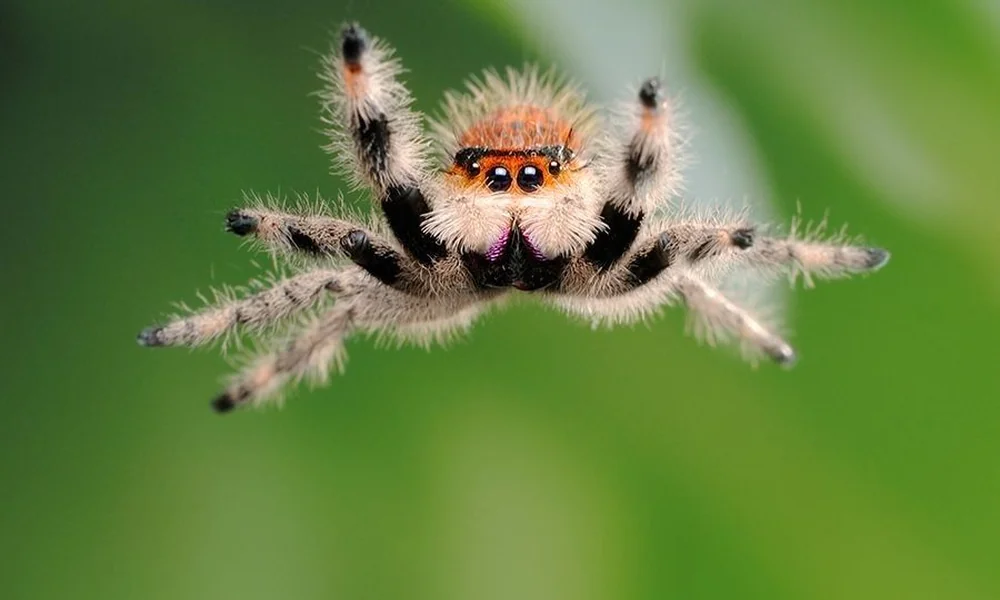
Jumping spiders can leap several times their own body length, with the exact distance depending on the species and circumstances. For an animal only a few millimeters long, even a short leap can cover an impressive gap.
Their jumping ability depends on specialized leg mechanics and changes in hydraulic pressure within the body. Spiders do not have the same arrangement of large extensor muscles in their legs that many jumping insects possess. Changes in internal pressure help extend the legs during movement.
Before jumping, a jumping spider often attaches a silk dragline to the surface. This safety line can help prevent a fall and allow the spider to recover if the leap does not end as planned.
The spider does not leap randomly. It uses its vision to judge the target, position itself, and make a controlled movement. A successful jump may carry it onto prey, across a gap, or away from a threat.
How Good Is a Jumping Spider’s Eyesight?
Jumping spiders have some of the most sophisticated vision known among spiders. Their large front eyes are particularly important for resolving detail, recognizing objects, and judging distance.
They can detect movement and use visual cues to navigate their surroundings. Research on certain species has also shown impressive abilities in visual discrimination and prey recognition.
Their eyes do not work exactly like human eyes, and the world probably does not look to a jumping spider the way it looks to us. Still, vision plays such a central role in their behavior that watching one can feel strangely interactive.
A jumping spider may turn toward a nearby movement or pause before approaching an unfamiliar object. That does not prove it understands a person in a human sense. It does show that the spider is responding to visual information rather than simply moving without direction.
What Do Jumping Spiders Eat?
Jumping spiders are predators. Their diet mainly consists of insects and other small arthropods, including flies, mosquitoes, small moths, and other spiders.
They generally locate prey visually, approach it with care, and leap when they are close enough. Their strong legs help them grab a target, while their mouthparts and venom help subdue it.
Some species are specialized hunters. A few jumping spiders, for example, are known for preying on ants, a challenging target because ants can bite or sting in defense. Others feed on a wider range of small animals.
Jumping spiders are not dependent on catching prey in a web, but they do use silk for other purposes, including making retreats and safety lines.
In a garden, they contribute to the wider predator community by feeding on small invertebrates. Their presence is one part of the natural balance between insects and the animals that hunt them.
Where Do Jumping Spiders Live?
Jumping spiders occur on every continent except Antarctica and inhabit a wide variety of environments. Their small size and hunting style allow them to use places that larger predators might ignore.
You may find them in:
- Gardens: On leaves, stems, fences, flowerpots, and garden furniture.
- Homes: Around windowsills, walls, and other areas where small insects appear.
- Forests: On tree trunks, branches, bark, and foliage.
- Grasslands: Among grasses and low vegetation.
- Rocky areas: On stones and sunlit surfaces where they can watch for prey.
- Tropical habitats: In environments with a remarkable diversity of jumping spider species.
Many jumping spiders prefer warm, bright conditions, although their habitat preferences vary by species. Some live close to people, while others are associated with particular plants, trees, or natural environments.
Finding one indoors does not necessarily indicate a problem. It may simply have wandered inside or followed an insect.
Are Jumping Spiders Dangerous?
Jumping spiders are generally harmless to people and are not considered medically significant in the way that certain more medically important spiders can be.
They may bite if squeezed, trapped against the skin, or handled roughly, but they usually try to escape. A bite can cause temporary pain, redness, or localized swelling.
The best approach is to observe them without picking them up. If one is inside your home and you want it outside, use a container and a piece of stiff paper to guide it safely without direct contact.
Do not assume that every small spider with prominent eyes is a jumping spider. If you cannot identify a spider confidently, avoid handling it.
If a suspected bite causes severe or worsening symptoms, seek medical advice. Symptoms such as difficulty breathing, faintness, or swelling of the face or throat require emergency care.
Jumping Spider vs. Wolf Spider: What’s the Difference?
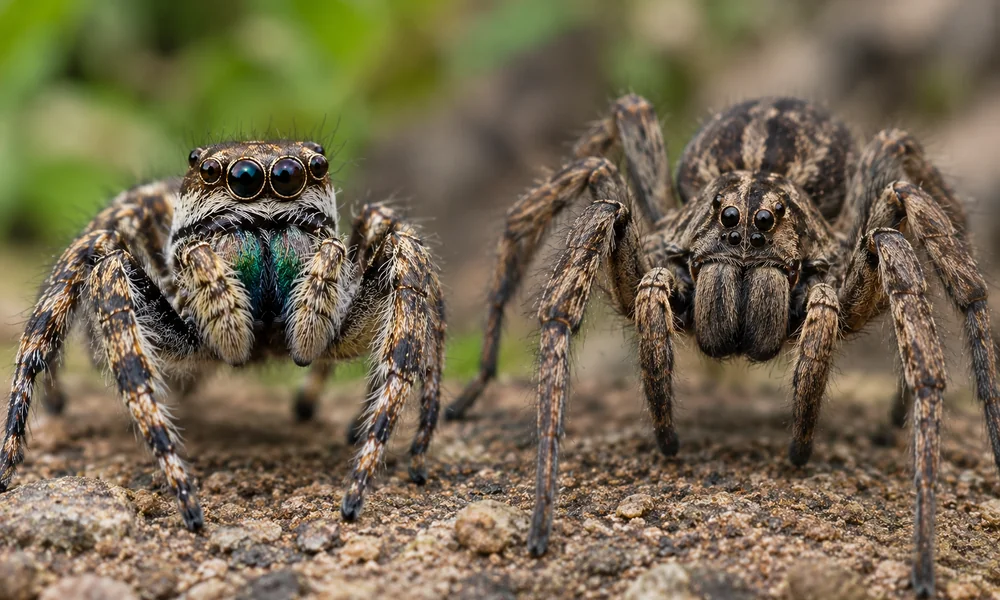
Both jumping spiders and wolf spiders are active hunters, but they differ in appearance, hunting style, and typical body shape.
| Feature | Jumping spider | Wolf spider |
| Family | Salticidae | Lycosidae |
| Eyes | Prominent forward-facing principal eyes | Eight eyes arranged in three rows |
| Typical build | Often compact and relatively small | Often more robust and ground-dwelling |
| Hunting style | Relies heavily on vision and leaps toward prey | Searches for or pursues prey on the ground |
| Jumping | Specialized, precise jumps are a defining feature | Can move quickly, but jumping is not its defining hunting strategy |
| Common places | Leaves, walls, windowsills, bark, and other surfaces | Soil, grass, leaf litter, gardens, and burrows |
Both groups can be useful predators in natural environments. The most reliable identification combines several features rather than relying on size or color alone.
Do Jumping Spiders Make Webs?
Jumping spiders do produce silk, but they generally do not build large webs designed to catch flying insects.
Instead, silk has several practical uses. A spider may attach a dragline while moving, create a small retreat for resting or molting, or construct a protected space for eggs.
Their hunting method depends on actively finding and approaching prey. This makes them different from many familiar web-building spiders, which use silk structures to intercept animals moving through the environment.
A jumping spider’s lack of a large capture web does not mean it has no need for silk. The material remains important for safety, shelter, and reproduction.
How Do Jumping Spiders Mate and Raise Their Young?
Jumping spider courtship can be surprisingly elaborate. Depending on the species, males may perform movements involving their legs, body posture, and colorful markings. Some raise or wave their front legs, while others use patterned body parts to attract attention.
These displays help communicate with a potential mate. These displays are a form of animal communication, where movement and color carry signals between individuals. They can also reduce the risk of being mistaken for prey, although courtship behavior differs among species and can carry risks for the male.
After mating, a female typically lays eggs in a silk-lined retreat or protected shelter. She may remain close to the eggs and guard them until the young emerge.
Spiderlings begin life very small and eventually disperse, growing through a series of molts. Their colors and markings may change as they mature. Not every jumping spider follows exactly the same routine. The family contains a huge range of species, and details of courtship, egg care, and development vary.
Can You Keep a Jumping Spider as a Pet?
Some people keep jumping spiders in carefully prepared enclosures because they are interesting to observe. Their hunting behavior and visual responses make them appealing to invertebrate enthusiasts.
However, they are not miniature toys, and they should not be treated as animals that automatically enjoy being handled. They can be delicate, may escape through very small gaps, and require suitable temperature, ventilation, shelter, and moisture.
Their diet should consist of appropriately sized live prey, and enclosure conditions must suit the particular species. Wild collection should also take local regulations and the animal’s welfare into account.
For a casual observer, watching a jumping spider in a garden or on a windowsill is often the simplest way to appreciate it.
Frequently Asked Questions
Do jumping spiders recognize humans?
Jumping spiders can respond to visual cues and movement, but this does not establish that they recognize individual humans in the way people recognize one another. Their behavior is best understood through their visual abilities and responses to their surroundings.
Can jumping spiders jump onto people?
A jumping spider could land on a person accidentally if it leaps nearby, but it does not normally jump at people to attack them. It is generally trying to reach a surface, catch prey, or escape a perceived threat.
Do jumping spiders bite?
They can bite if threatened or restrained, but bites are uncommon and are generally not medically serious. Avoid handling unfamiliar spiders directly.
How long do jumping spiders live?
Lifespan varies by species, sex, temperature, food availability, and other conditions. Many small species live for months to around a year, while some may live longer under suitable conditions.
Why does a jumping spider look like it is staring at me?
Its large forward-facing eyes make its gaze especially noticeable. The spider may be responding to movement or gathering visual information about an object nearby. That behavior can look like curiosity, even though we cannot assume it is thinking about the situation as a human would.
A Tiny Spider With a Big View of the World
A jumping spider does not need a giant web or a large body to be an effective hunter. It relies on sharp vision, careful positioning, and a leap that can cross a gap many times its own length.
Look closely at one moving along a leaf or a sunlit wall, and you begin to notice that its world is full of decisions: where to step, when to stop, whether to approach, and when to jump.
It is a small animal, but its way of navigating the world is anything but simple.