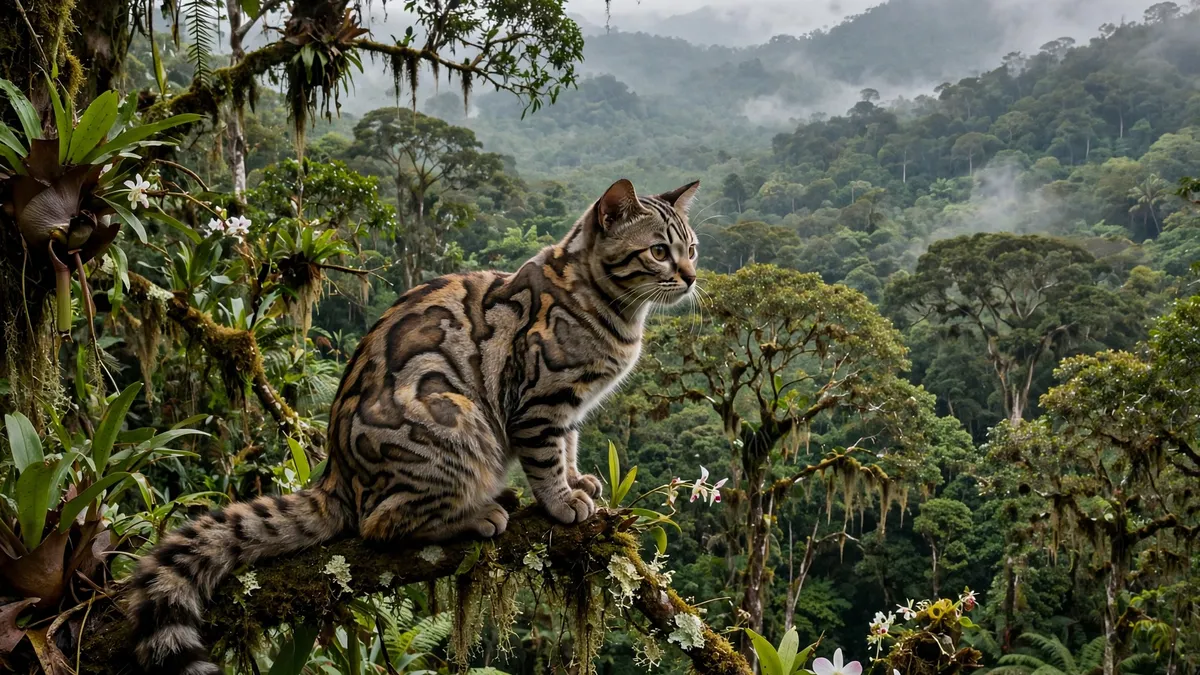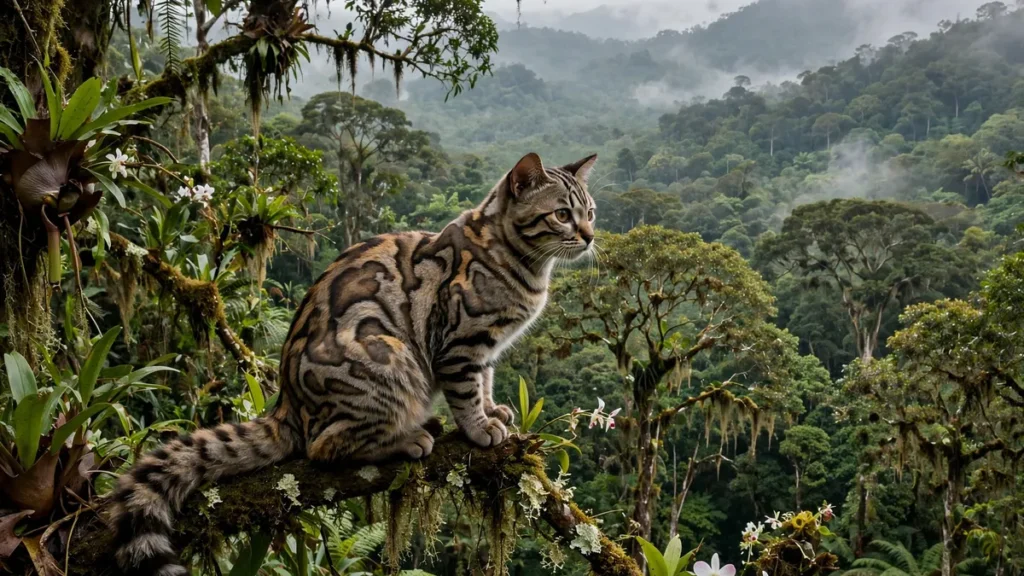
The marbled cat species is a single species, Pardofelis marmorata, a small wild cat that lives in the trees of South-east Asian rainforests. If you are asking how many marbled cat species there are, the answer is one.
The marbled cat is one of the least seen cats in the world, about the size of a large house cat and weighing roughly two to five kilogrammes. Its coat of swirling blotches looks like a miniature version of the clouded leopard’s pattern, and it is rarely spotted and still little understood.
Key takeaways
- There is only one marbled cat species, Pardofelis marmorata, the only living member of its genus.
- Marbled cats live in the trees of South-east Asian rainforests, with a long tail and large paws for climbing.
- The marbled coat, with its swirling blotches and stripes, gives the cat its name and its camouflage.
- A marbled cat weighs two to five kilogrammes and measures roughly 45 to 62 centimetres in head and body length.
- The marbled cat is listed as Near Threatened, mainly because its rainforest home is shrinking.
What makes a marbled cat a marbled cat
A marbled cat is a small, long-bodied cat with a coat unlike any other small cat in Asia. Its grey-brown fur is covered with large, irregular dark blotches edged in black, swirling across the back and flanks like the veining in marble. The belly is pale and spotted, the legs striped, and dark lines run back from the eyes.
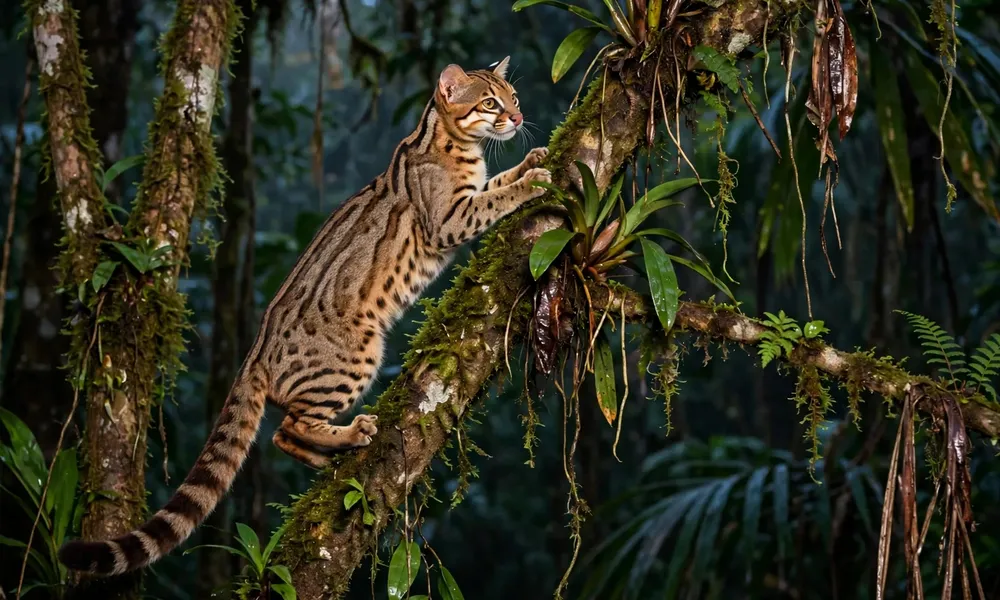
The cat’s build is made for the canopy. Its tail is nearly as long as its body, about 35 to 55 centimetres, and works as a balance beam as the cat moves along branches. Its paws are broad, with sharp claws that grip bark, and its hind legs are long and strong, letting it leap between branches and climb down a trunk head first.
What sets the marbled cat apart is how completely it lives in the trees. Most small cats hunt on the ground and climb only when they must, but the marbled cat is thought to spend much of its life above the forest floor, resting by day and moving through the canopy at night. Few people have ever watched one for long, so much of its behaviour is still guesswork.
The marbled cat species and its relatives
Pardofelis marmorata is the only marbled cat species and the only living member of the genus Pardofelis. A handful of subspecies have been described, but they are all the same species. It sits in the cat family, Felidae, and its closest living relative is thought to be the clouded leopard, whose coat it resembles in miniature.
The clouded leopard is the marbled cat’s larger lookalike, a much bigger cat that also climbs well but hunts more often on the ground. The leopard cat is a smaller, spotted ground hunter that shares its range, the fishing cat works the wetlands below the forest, and the Asian golden cat and the bay cat hunt in the same forests. The ocelot and the margay are its tree-climbing counterparts in the Americas.
| Type | Animal | Where it lives | Best-known food | Length |
|---|---|---|---|---|
| Species | Marbled cat (Pardofelis marmorata) | Rainforests of South-east Asia | Birds, rodents and squirrels | 45 to 62 cm body |
| Close relative | Clouded leopard | Forests from the Himalayan foothills to South-east Asia | Birds, monkeys and small deer | 68 to 106 cm body |
| Close relative | Leopard cat | Forests and farmland across Asia | Rodents, birds and small mammals | 45 to 75 cm body |
| Close relative | Fishing cat | Wetlands of South and South-east Asia | Fish, crabs and frogs | 57 to 78 cm body |
| Close relative | Asian golden cat | Forests of South-east Asia | Rodents, birds and small deer | 66 to 105 cm body |
| Close relative | Bay cat | Rainforests of Borneo only | Rodents, birds and small mammals | 53 to 67 cm body |
| Close relative | Ocelot | Central and South America | Small mammals and birds | 55 to 100 cm body |
| Close relative | Margay | Forests of Central and South America | Birds, small mammals and fruit | 48 to 79 cm body |
How marbled cats live
Marbled cats are solitary and largely nocturnal. Each adult is thought to hold a home range in the canopy, moving quietly through the branches at night and resting in a dense crown by day. Like other nocturnal animals, they use the dark for cover.
Birds, squirrels, rats and other small tree-dwelling animals are thought to make up most of the diet, along with the occasional lizard or frog. The cat is believed to stalk along a branch until it is close, then spring onto its prey, steadying itself with its long tail. Almost everything known about its hunting comes from a handful of sightings and camera traps.
Very little is known about breeding in the wild. In zoos, marbled cats have given birth to one or two kittens after a gestation of about 66 to 82 days, and the kittens stay with their mother for many months. In the forest, a female probably raises them in a tree hollow or a tangle of branches, well above the ground.
Where marbled cats live
The marbled cat lives in the rainforests of South-east Asia, from the Himalayan foothills of India and Nepal, through Myanmar, Thailand, Laos and Vietnam, south through the Malay Peninsula to Sumatra and Borneo. It is one of the most striking rainforest animals of the region, and is found nowhere else on Earth.
Within that range it needs tall, unbroken forest with a connected canopy, and is most often recorded in lowland and hill rainforest up to about 2,500 metres. It avoids cleared land, plantations and forest fragments, because gaps in the canopy force it to the ground, where it is far less at ease.
The species is listed as Near Threatened, and its numbers are believed to be falling. The main pressure is the loss of rainforest to logging, farming and palm oil plantations, which breaks the forest into pieces too small for a canopy cat. It is also caught in snares set for other animals and hunted in some places for its fur, so it needs large tracts of protected forest, the same habitat that shelters so many other forest animals, to survive.
Best seasons for marbled cat watching
Marbled cats are active all year, so there is no season when they vanish, but the dry season is usually the best time to look for them. Trails are passable, leeches are fewer, and the thinner canopy makes a cat easier to spot. In Borneo and Sumatra, the drier months from June to September are the most comfortable for long nights in the forest.
The wet season has its own rewards. Fruit is plentiful, so squirrels and birds gather in the canopy and marbled cats may follow them, but heavy rain and thick foliage make a sighting harder, and flooded trails can cut off the best forest. The best hours are the first two after dark and the last two before dawn.
Good places to try include the rainforests of Sabah in Malaysian Borneo, such as Danum Valley and the Kinabatangan, and the forests of Thailand and Sumatra. A local guide makes a real difference, because marbled cats are quiet and quick to vanish, and are most often found by a guide who knows which fruiting trees draw their prey.
Staying safe around marbled cats
A marbled cat is a wild cat with sharp teeth and strong claws, and although far too small to be a danger to people, it should always be treated with respect. Keep your distance, never try to touch or feed it, and never block its escape route, because a cornered cat can bite hard. If one comes close, stay still and let it move away.
The real safety issues in marbled cat country come from the forest itself. Leeches, mosquitoes and biting flies are common, and trails can be steep and slippery after rain, so wear long sleeves, sturdy boots and insect repellent. Any bite or scratch should be washed at once and checked by a doctor without delay.
The other safety issue is the pet trade. Marbled cats are sometimes caught for the exotic pet trade, but they make poor pets: they are shy and restless in a cage, need tall trees to climb, and can injure a person badly when frightened. Keeping one is illegal in most places, and many rescued marbled cats cannot be released.
Marbled cat watching checklist
A little preparation turns a night in the rainforest into a real chance of seeing a marbled cat, so pack for the canopy and for long, quiet waits.
- Binoculars with good low-light performance, for picking a marbled cat out of the canopy.
- A red-filtered torch, which lets you scan the trees without startling night animals.
- Neutral-coloured clothing in dark green or brown, which blends into the rainforest at night.
- Leech socks, insect repellent and sturdy boots, because marbled cat country is wet and steep.
- A booked local guide who knows the fruiting trees and the marbled cat territories.
- A plan to be out after dark, when marbled cats leave their resting trees.
- Patience and silence, because marbled cats are shy animals and a noisy group will send them away.
Frequently asked questions
How many marbled cat species are there?
There is one marbled cat species, Pardofelis marmorata, the only living member of the genus Pardofelis. A handful of subspecies have been described, but no second marbled cat species is recognised.
Why is it called a marbled cat?
It is named for its coat. The large, swirling dark blotches on its grey-brown fur look like the veining in polished marble, and the pattern breaks up the cat’s outline in the dappled light. The effect is like a miniature version of the clouded leopard’s coat.
How big is a marbled cat?
A marbled cat weighs about two to five kilogrammes, with a head and body length of roughly 45 to 62 centimetres and a tail of about 35 to 55 centimetres. It is about the size of a large house cat, but longer in body and tail, and far lighter than the clouded leopard.
What do marbled cats eat?
Marbled cats are thought to eat birds, squirrels, rats and other small animals that live in the trees, along with the occasional lizard or frog. They hunt in the canopy, stalking along branches and springing onto prey.
How is this guide different from the clouded leopard species guide?
This guide covers the single marbled cat species, a small tree-dwelling cat of South-east Asian rainforests that weighs only two to five kilogrammes and lives in the canopy, while our clouded leopard species guide covers the clouded leopard, a much larger cat that hunts more often on the ground. The two are close relatives with similar coats, but they differ greatly in size and in how they use the forest.
Are marbled cats endangered?
Marbled cats are listed as Near Threatened, so they are not classed as endangered, but their numbers are believed to be falling. The loss of rainforest to logging, farming and palm oil plantations is the main pressure, along with snares and the pet trade. Protecting large tracts of unbroken forest is their best hope.
Conclusion
The marbled cat species shows how much life one small cat can hold: Pardofelis marmorata, with its marbled coat, long balancing tail and broad climbing paws, a cat built for the rainforest canopy of South-east Asia. It hunts in the branches and rests in the treetops, and is rarely seen by anyone.
If you go looking for one, go after dark, go with a guide, and go quietly. Watch a marbled cat moving through the branches above you, and you will understand why this little canopy hunter has earned its place in the rainforest, and why keeping its forest standing matters.