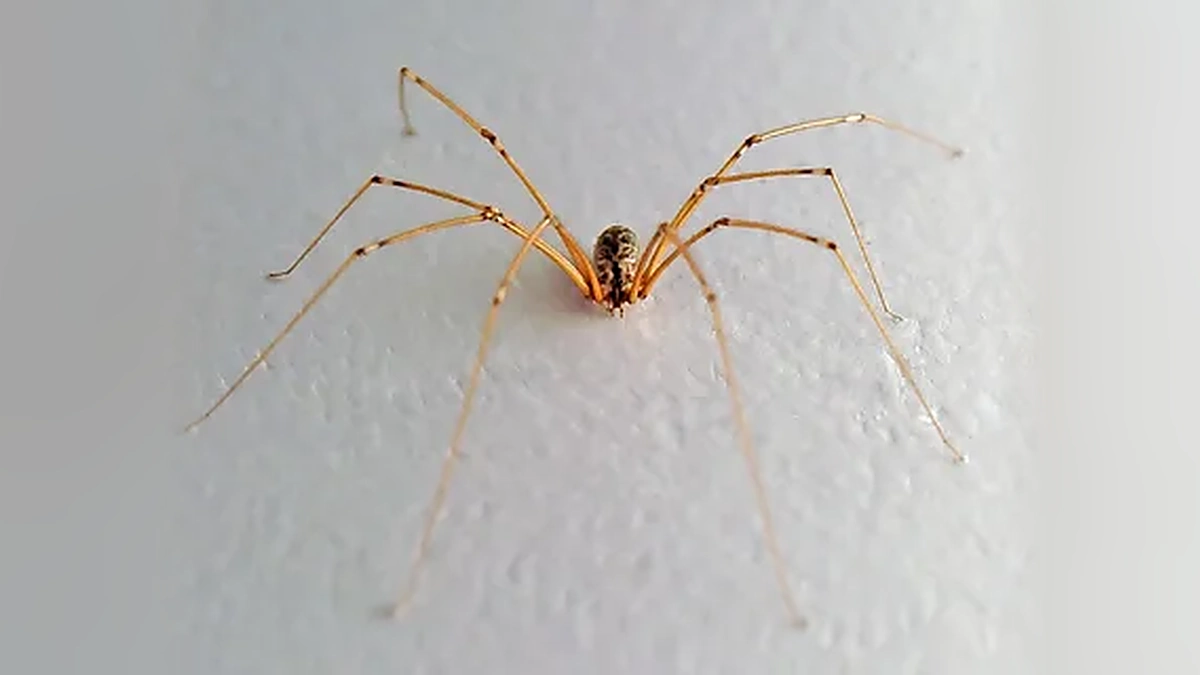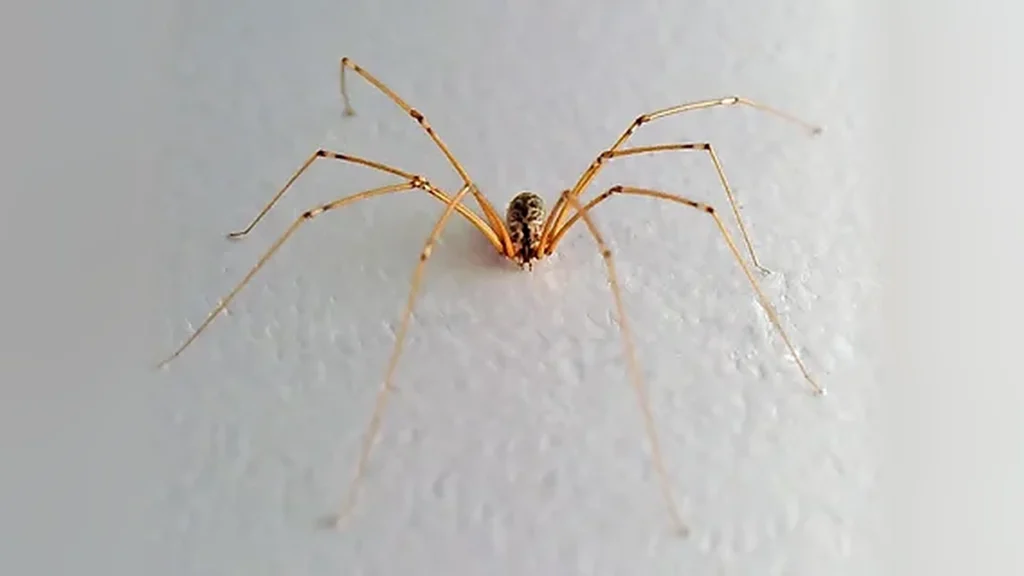
You spot a tiny body hanging beneath a basement shelf, supported by legs so long and thin that they almost disappear against the wall. Touch the shelf, and the creature begins to wobble, swinging like a loose piece of thread.
Most people call it a daddy long legs. But that familiar name hides a surprising fact: daddy long legs can refer to different animals, and not all of them are spiders. Understanding which creature you are looking at helps explain its behavior, what it eats, and whether you need to worry about it.
The name “daddy long legs” can also confuse with other spiders, including jumping spiders and wolf spiders, but these are different groups with their own body shapes, hunting styles, and behaviors.
What Is a Daddy Long Legs?

In the United States, “daddy long legs” commonly refers to two different animals: harvestmen and cellar spiders. The name is also used for crane flies in some places.
Although they look similar at a glance, these animals belong to different groups.
- Harvestmen: Arachnids with a compact body that appears to be one rounded section.
- Cellar spiders: True spiders with two distinct body sections, extremely long legs, and the ability to produce silk webs.
- Crane flies: Flying insects with long legs, often mistaken for giant mosquitoes.
When someone finds a long-legged creature crawling on the ground, it may be a harvestman. When it hangs upside down in a messy web in a basement corner, it is more likely a cellar spider.
That distinction matters because their anatomy, feeding habits, and behavior are different.
Are Daddy Long Legs Spiders?
Some are, but not all. Cellar spiders are true spiders belonging to the family Pholcidae. They have two main body sections connected by a narrow waist, eight legs, and silk-producing organs used to build webs.
Harvestmen belong to the order Opiliones. They are arachnids, like spiders, but they are not true spiders. Their body appears as one compact oval because the main body regions are broadly joined together. They do not build prey-catching webs.
Crane flies, meanwhile, are insects with six legs and wings.
If you want to identify the creature in your home, look at its body shape and where you found it. A long-legged animal sitting in a web is likely a cellar spider; one walking freely across the floor may be a harvestman.
What Do Daddy Long Legs Look Like?
The most obvious feature is their exceptionally long, delicate legs. But the rest of the body can reveal which animal you have found.
- Cellar spiders usually have a small body, very long legs, and a loose web in a dark corner. Their color can range from pale tan to gray or brown.
- Harvestmen generally have a compact, rounded body with long legs attached around it. They may be found beneath rocks, in leaf litter, on tree trunks, or wandering through gardens.
- Crane flies look more like delicate, oversized mosquitoes, with wings and six long legs. Adult crane flies do not bite people.
Despite their fragile appearance, these animals are adapted to very different environments. Some spend their lives in webs, while others roam across vegetation or the forest floor.
Are Daddy Long Legs Dangerous to Humans?

The daddy long legs commonly found in homes and gardens are generally harmless to people. Cellar spiders can bite under unusual circumstances, but bites are uncommon, and they are not generally considered medically significant. Harvestmen do not have the venom-delivering fangs associated with true spiders, and they are not known to pose a significant danger to people.
One widespread myth claims that daddy long legs are among the world’s most venomous animals but cannot bite humans because their fangs are too small. This is not a reliable explanation. Cellar spiders do have venom, but there is no sound basis for describing them as secretly deadly to people.
There is little reason to handle them, though. If you are unsure which species you have found, avoid picking it up with bare hands.
What Do Daddy Long Legs Eat?
Their diet depends on which animal the name refers to.
Cellar spiders are predators that catch small insects and other arthropods in their webs. Their prey can include flies, mosquitoes, and other spiders.
Harvestmen often feed on tiny insects, other invertebrates, decaying plant material, fungi, and other available organic matter. Many are opportunistic feeders rather than specialized web-building hunters.
Crane flies have different feeding habits depending on the species and life stage. Some adults feed on nectar or other liquids, while others feed little or not at all. Their larvae commonly live in soil or other moist environments and feed on plant material or decaying organic matter, depending on the species.
So, a daddy long legs in a web may be catching insects, while one walking through the garden may be searching for food among leaves and soil.
Why Do Daddy Long Legs Gather in Houses?
If you keep seeing long-legged creatures in a basement, garage, or bathroom, the location may offer the conditions they need.
Cellar spiders often favor quiet spaces where they can build webs undisturbed. Basements, garages, sheds, and ceiling corners can provide shelter and access to small insects.
Harvestmen are more commonly associated with outdoor habitats, including gardens, leaf litter, and shaded areas. They may occasionally wander indoors, particularly when searching for shelter.
To reduce unwanted sightings:
- Remove webs when you do not want spiders living in a particular corner.
- Seal gaps around doors, windows, and utility pipes.
- Reduce clutter in storage areas.
- Fix persistent moisture problems.
- Limit other insect activity around the home.
Finding a daddy long legs does not automatically mean you have an infestation. An occasional visitor may simply have found a convenient place to rest or hunt.
Why Do Daddy Long Legs Shake in Their Webs?
If you have ever disturbed a cellar spider’s web and watched it vibrate rapidly, you have seen a behavior known as bobbing or whirling.
The spider moves its body and web quickly, making its outline harder to follow. This movement may help it respond to threats, although its exact function can vary with the situation.
The result is an almost ghostlike blur of legs and silk. Once the disturbance stops, the spider often settles back into its web.
Harvestmen can also move their bodies or legs in response to disturbance, but they do not perform this behavior from a prey-catching web because they do not build those webs.
Daddy Long Legs vs. Cellar Spiders vs. Harvestmen

| Feature | Cellar spider | Harvestman | Crane fly |
| Animal group | True spider | Arachnid, not a true spider | Insect |
| Legs | Eight | Eight | Six |
| Body | Two distinct sections | Compact, broadly joined body | Three insect body regions |
| Builds prey-catching webs | Yes | No | No |
| Common habitat | Buildings, corners, basements | Gardens, leaf litter, sheltered outdoor areas | Vegetation, gardens, moist habitats |
| Danger to people | Generally harmless | Generally harmless | Harmless to people |
This comparison is a useful starting point, but not every species can be identified from a quick glance. Color, size, and habitat vary.
Should You Kill Daddy Long Legs?
Usually, there is no need. If you find a cellar spider in an unwanted location, you can remove its web and carefully relocate the spider using a container and stiff paper. Avoid grabbing it by the legs, which are delicate and can break.
If the animal is a harvestman outdoors, leaving it alone is generally the simplest choice. Harvestmen are part of the natural food web and may feed on small invertebrates or decaying organic material. For indoor spiders, occasional web removal and sealing entry gaps may be enough to reduce sightings. Widespread pest problems may require a more thorough inspection, but one long-legged visitor is rarely a reason to panic.
Frequently Asked Questions
Are daddy long legs poisonous?
The term covers several animals. Cellar spiders produce venom to subdue prey, but they are generally not dangerous to people. Harvestmen are not true spiders and do not deliver venom through spider-like fangs.
Can daddy long legs bite humans?
Cellar spiders can bite, but bites are uncommon and generally cause limited symptoms. Harvestmen are not known to pose a significant biting threat to people.
Do daddy long legs eat mosquitoes?
Cellar spiders may catch mosquitoes and other small insects in their webs. Harvestmen have a broader diet that can include small invertebrates and organic material.
Why are daddy long legs in my basement?
Cellar spiders often use quiet corners and sheltered spaces to build webs and catch insects. Basements can provide suitable shelter and prey. Cellar spiders use their webs and sensitive legs to detect movement and vibrations around them. These signals are part of how they respond to their surroundings and can be considered a simple form of animal communication.
Do daddy long legs have eight legs?
Cellar spiders and harvestmen have eight legs. Crane flies, which are sometimes called daddy long legs, are insects and have six.
Should I remove daddy long legs from my house?
If one is in an inconvenient place, you can relocate it carefully or remove its web. They are generally harmless, so killing them is usually unnecessary.
A Familiar Name for Three Very Different Creatures
The next time you see a delicate body balanced on impossibly long legs, take a second look before deciding what it is. It could be a spider waiting for its next meal, a harvestman exploring the garden, or a crane fly resting near a window. Each has its own place in the natural world, despite sharing a common nickname.
Their appearance may be startling, but the truth is much less frightening than the myths. Most daddy long legs are simply small animals trying to find food, shelter, and a safe place to survive.