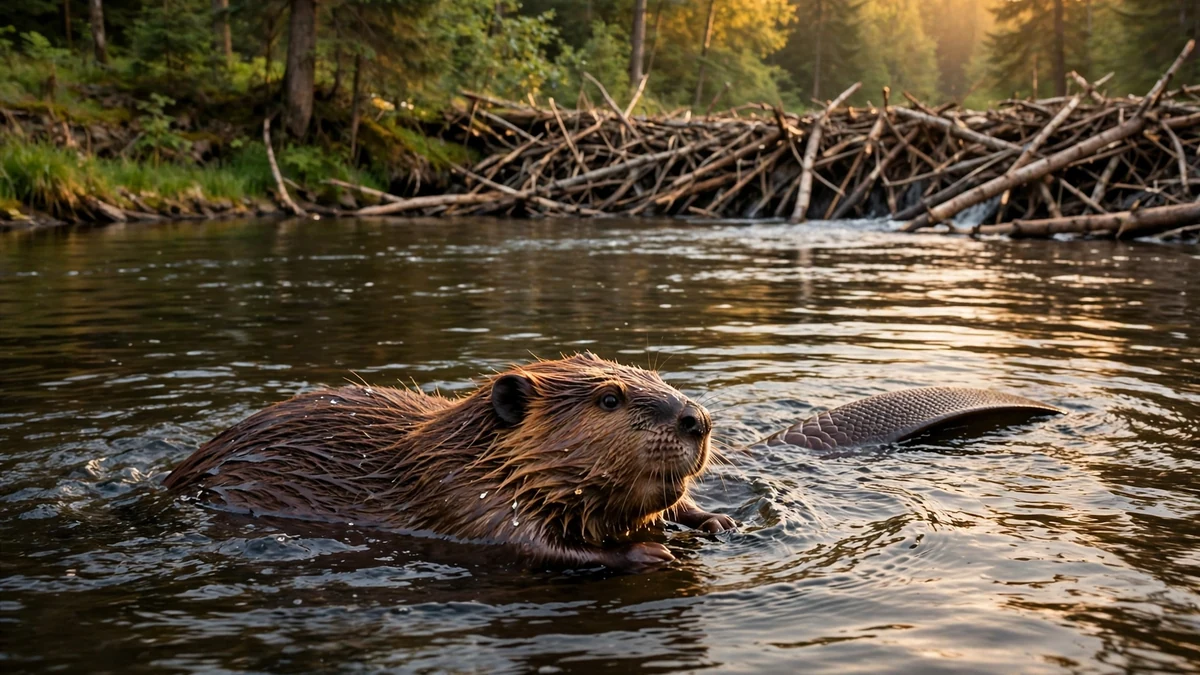
Beaver species are the great engineers of the animal world, and there are only two of them: the North American beaver and the Eurasian beaver. If you are wondering how many beaver species exist, the short answer is this: two living beaver species share the work of felling trees, building dams and raising wetlands, shaping rivers and forests across North America, Europe and Asia.
Key takeaways
- There are only two living beaver species: the North American beaver and the Eurasian beaver.
- Beavers are the largest rodents in the northern hemisphere, weighing up to around 30 kilograms.
- Beavers build dams, lodges and canals from sticks, mud and stones, creating wetlands that support hundreds of other species.
- A beaver can stay underwater for up to 15 minutes, and its flat, scaly tail works as a rudder and an alarm.
- Beavers were hunted almost to extinction for their fur, but both species have recovered strongly and are returning to rivers where they had vanished.
Two species, one remarkable engineer
Both beaver species belong to the genus Castor, the only living members of the beaver family. The North American beaver, Castor canadensis, lives across Canada, the United States and northern Mexico. The Eurasian beaver, Castor fiber, lives across Europe and northern Asia, from Scandinavia and Britain to Siberia and Mongolia. The two look very similar at a glance, and both do the same extraordinary work of damming streams and building lodges.
Look closely and the differences appear. The North American beaver is usually heavier, with a rounder head and a broader, more oval tail, while the Eurasian beaver is a little slimmer, with a narrower head and tail. Their skulls differ slightly too, and the two species cannot interbreed.
Each species also has its own subspecies, which differ mainly in size and fur colour.
Beavers are rodents, and they are the largest rodents in the northern hemisphere. An adult beaver measures around a metre long including its tail and weighs between 11 and 32 kilograms, with some very large North American beavers reaching more than 40 kilograms. Their bodies are built for the water: dense, waterproof fur, webbed hind feet, nostrils that close underwater and transparent eyelids that work like swimming goggles.
How beavers build dams and lodges
A beaver dam is one of the most impressive structures any animal builds. Beavers choose a narrow stretch of stream, then pile sticks, branches, stones and mud across it, weaving the material together until the water behind it rises into a pond. The pond gives the beaver deep, still water around its home, where it can swim safely from predators and where the entrance to its lodge stays hidden below the surface.
The lodge is the beaver’s home, a dome of sticks and mud built in the pond or against the bank. Inside, above the waterline, is a dry chamber lined with shredded bark, where the family sleeps and raises its young. The only way in is through an underwater tunnel, which keeps out most predators.
Beavers also dig canals, sometimes tens of metres long, to float timber from felled trees back to the pond, moving heavy logs through shallow water with far less effort than dragging them over land. Some dams are enormous: the longest known, in Wood Buffalo National Park in Canada, stretches for around 850 metres and can be seen from space.
Beaver dams change whole landscapes. The ponds they create slow rivers, store water through dry summers and create wetlands where frogs, dragonflies, fish and water birds thrive. Scientists call beavers a keystone species, because so many other animals depend on the wetlands they build.
What beavers eat and how they fell trees
Beavers are strict herbivores. They eat the inner bark and cambium of trees, along with twigs, leaves, roots and water plants. In summer they graze on grasses, water lilies and pondweed, and in autumn they stockpile branches underwater near the lodge, wedging them into the mud so the family has food through the winter.
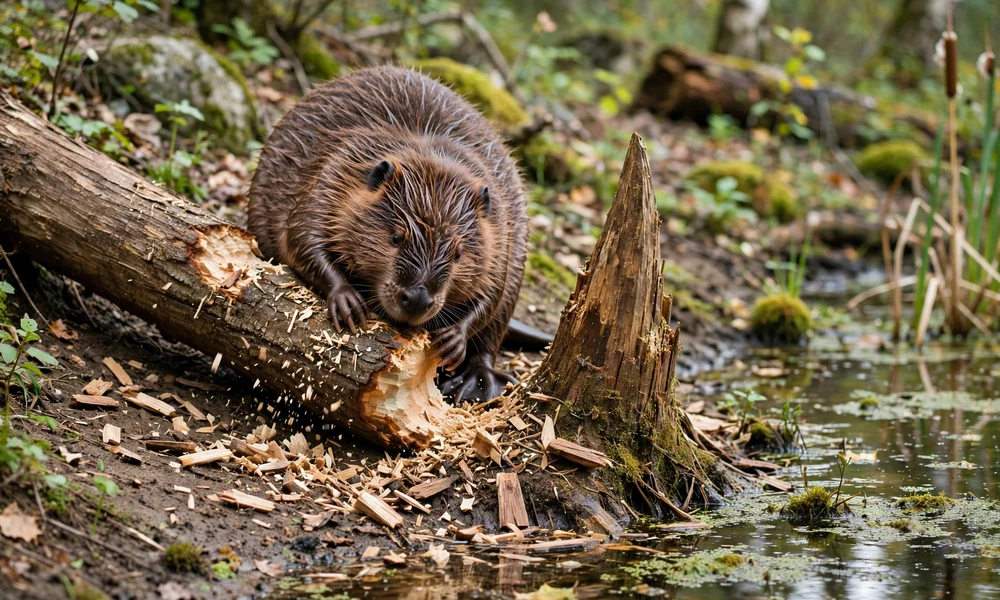
The beaver’s teeth are its most famous tools. Its four front teeth grow throughout its life, and the front of each is coated in hard orange enamel rich in iron, which keeps the edge sharp as the softer back wears away. A beaver can fell a tree several centimetres thick in a few minutes, gnawing a neat hourglass shape around the trunk until it topples.
Beavers prefer soft, fast-growing trees such as aspen, willow, birch and poplar, which are easy to chew and rich in bark. They drag the branches back to the pond to eat and use the rest for building. A fallen tree is rarely wasted: the bark feeds the beaver, the branches build the dam, and the stump sends up new shoots for the next generation.
Beavers do not eat fish, and they do not eat wood for its own sake. They eat the soft, nutritious layer just beneath the bark, chewing wood mainly to reach it and to wear down their ever-growing teeth. The flat, scaly tail works as a rudder when swimming, a prop when the beaver sits upright to gnaw, and a warning signal, slapped hard on the water to alert the family to danger.
Where beavers live
Beavers live wherever there is slow-moving fresh water and trees to eat. The North American beaver ranges from the Arctic tundra of Alaska and Canada to the deserts of northern Mexico, living in streams, rivers, lakes and marshes. The Eurasian beaver ranges from the rivers of Scandinavia and France to the forests of Russia and Mongolia, and has been returned to many countries where it had disappeared.
The river animals of slow streams and quiet backwaters include the beaver, and the wetland animals of marshes and ponds owe much of their habitat to beaver dams. The forest animals of the riverside woods live alongside beavers too, feeding on shoots from beaver-felled stumps.
Beavers were once far more widespread. The Eurasian beaver lived across almost all of Europe before it was hunted to the edge of extinction, and the North American beaver was trapped in huge numbers across the continent. Reintroduction has brought Eurasian beavers back to Scotland, England, Wales, the Netherlands and Belgium, and North American beavers have been restored across much of their old range.
Beavers and people
People and beavers have a long and complicated history. For centuries, beavers were hunted for their fur, made into felt hats, and for castoreum, a scented substance from glands near the tail used in perfume and medicine. By the early 1900s, the Eurasian beaver had been reduced to a few hundred animals in scattered refuges, and the North American beaver had been trapped out of many rivers.
Protection and reintroduction turned the story around. Both species are now listed as of least concern, and their numbers have grown into the millions in North America and the hundreds of thousands in Europe. Beavers are now released into rivers as part of rewilding projects, because their dams slow floods, store water, improve water quality and create homes for other wildlife.
Beavers can also cause problems: their dams flood farmland, roads and gardens, and their felling can damage orchards and riverside trees. Wildlife managers now use flow devices in dams to control water levels and wrap valuable trees in wire mesh, so people and beavers can share the same rivers. The beaver’s return is, on balance, one of the great wildlife recovery stories of the modern age.
| Beaver | Type | Where it lives | Weight |
|---|---|---|---|
| North American beaver | Species | Canada, United States, northern Mexico | 11 to 32 kilograms |
| Eurasian beaver | Species | Europe and northern Asia | 11 to 30 kilograms |
| Canadian beaver | Subspecies | Canada and Alaska | Up to 40 kilograms |
| Pacific beaver | Subspecies | Pacific coast of North America | 15 to 30 kilograms |
| Mexican beaver | Subspecies | Northern Mexico and the south-western United States | 11 to 25 kilograms |
| Scandinavian beaver | Subspecies | Norway, Sweden and Finland | 15 to 30 kilograms |
| Elbe beaver | Subspecies | Elbe river valley in Germany | 15 to 28 kilograms |
| Mongolian beaver | Subspecies | Rivers of Mongolia and northern China | 15 to 28 kilograms |
Best seasons for beaver watching
Spring and autumn are the finest seasons for beaver watching. In spring, beavers repair winter damage to their dams and lodges, and the year’s young, called kits, appear at the water’s edge. In autumn, beavers are at their busiest, felling trees and dragging branches to the pond to build their winter food store, working through the late afternoon and into the dusk.
Summer evenings are also rewarding, when beavers swim out to feed on water plants in the long light. In winter the pond may freeze and the beavers stay inside, living on the branches they stored in autumn.
Staying safe around beavers
Beavers are wild animals, and they deserve respect. Never approach a lodge or a dam, never try to touch a beaver, and never leave food or rubbish where wild animals can reach it. Watch with binoculars or from a hide rather than walking closer: a disturbed beaver may abandon its lodge, so the best view is always the distant one. Keep dogs on a lead near beaver ponds, and stay on marked paths.
Beaver watching checklist
- Look for a dam of sticks and mud across a slow stream.
- Watch the pond at dawn and dusk, when beavers swim out to feed and build.
- Look for pointed stumps and gnawed trees, the surest sign of beavers.
- Listen for the loud slap of a tail on the water, the beaver’s alarm signal.
- Never approach a lodge, never feed a beaver, and keep dogs on a lead.
- Leave no trace: take your rubbish home and keep to marked paths.
Frequently asked questions
How many beaver species are there?
There are only two living beaver species: the North American beaver and the Eurasian beaver. Both belong to the genus Castor, and each has several subspecies, including the Canadian and Pacific beavers in North America and the Scandinavian and Elbe beavers in Eurasia.
How is this guide different from the river animals guide?
This guide covers only the two beaver species, in depth, from dam building and tree felling to reintroduction and watching. The river animals guide covers the whole community of animals that live in and around rivers, from fish to otters and herons.
How long can a beaver stay underwater?
A beaver can stay underwater for up to 15 minutes. Its heart slows and its nostrils and ears close, letting it swim to the lodge and gather food without surfacing.
Do beavers eat fish?
No, beavers do not eat fish. They are strict herbivores that eat tree bark, twigs, leaves, roots and water plants. A beaver pond may be full of fish, but the beaver shares the water with them rather than hunting them.
How big is the biggest beaver dam?
The longest known beaver dam is in Wood Buffalo National Park in Canada, and it stretches for around 850 metres. It was built up over many years by several generations of beavers, and it is so large it can be seen in satellite photographs.
Where is the best place to see a beaver?
Beavers are best at dawn and dusk on a quiet pond behind a beaver dam, in spring and autumn when they are building and storing food. Look for pointed stumps and gnawed trees along the bank, then settle downwind with binoculars and wait quietly.
Conclusion
Beaver species may number only two, but no other animal reshapes its landscape the way beavers do: felling trees with iron-hard teeth, damming streams into ponds, and building wetlands that feed frogs, fish and birds.
The next step is to find a beaver pond near you — a quiet stream at dusk, a dam of sticks and mud, a pointed stump on the bank — and watch the water until the builder itself appears.