
Hedgehog species range from the European hedgehog of British gardens to the African pygmy hedgehog of the savanna, the desert hedgehog of the Sahara and the long-eared hedgehog of Asian steppes. If you are wondering which hedgehog species exist and what makes a hedgehog different from other small mammals, the short answer is this: hedgehogs are small, nocturnal animals covered in thousands of sharp spines, among the most familiar wild mammals on Earth, living in gardens, grassland and deserts across Europe, Africa and Asia.
Key takeaways
- Hedgehog species number 17 in total, and this guide profiles eight of them.
- The European hedgehog is the hedgehog of British and European gardens, and it hibernates through winter.
- The African pygmy hedgehog is the small, pale-bellied hedgehog of the African savanna and the most common pet hedgehog.
- A hedgehog carries around 5,000 spines and rolls into a tight ball when threatened.
- Gardens, hedgerows and grassland at dusk are the best places to see hedgehogs in spring and autumn.
What makes a hedgehog a hedgehog
A hedgehog is a small mammal with a coat of sharp spines, a pointed snout, small dark eyes and short legs. Hedgehogs belong to the family Erinaceidae, 17 species worldwide, living across Europe, Africa and Asia. No hedgehog species is native to the Americas or Australia, though African pygmy hedgehogs are kept as pets in many countries.
The spines are the hedgehog’s defining feature. An adult European hedgehog carries around 5,000 spines, each a hollow, keratin-coated hair about 2–3 cm long. When a hedgehog feels threatened, a ring of muscle beneath the skin pulls the spiny coat tight, and the animal rolls into a ball with no soft part exposed. Foxes, badgers and dogs soon learn to leave a rolled hedgehog alone.
Hedgehogs have a keen sense of smell and hearing, and they use their long snouts to snuffle through leaf litter for food. Their eyesight is poor, but they do not need sharp eyes: hedgehogs are animals of the night, finding food by scent and sound, with small sharp teeth suited to crunching beetles, slugs and other invertebrates.
The hedgehogs of Europe and Africa
The European hedgehog is the hedgehog most people in Britain and western Europe know best: a brown, spiny animal about 20–30 cm long, with a pale face and a short tail hidden beneath its spines. European hedgehogs live in gardens, hedgerows, woodland edges and parkland, most active at dusk and through the night, snuffling through the grass for beetles, slugs, worms and caterpillars.
The northern white-breasted hedgehog is the European hedgehog’s close cousin, living in eastern Europe and western Asia. It looks very similar, but it has a white patch on its chest and belly and is slightly larger. The southern white-breasted hedgehog lives further south and east, in the Balkans, Turkey and the Caucasus, and it too carries the pale chest that gives it its name.
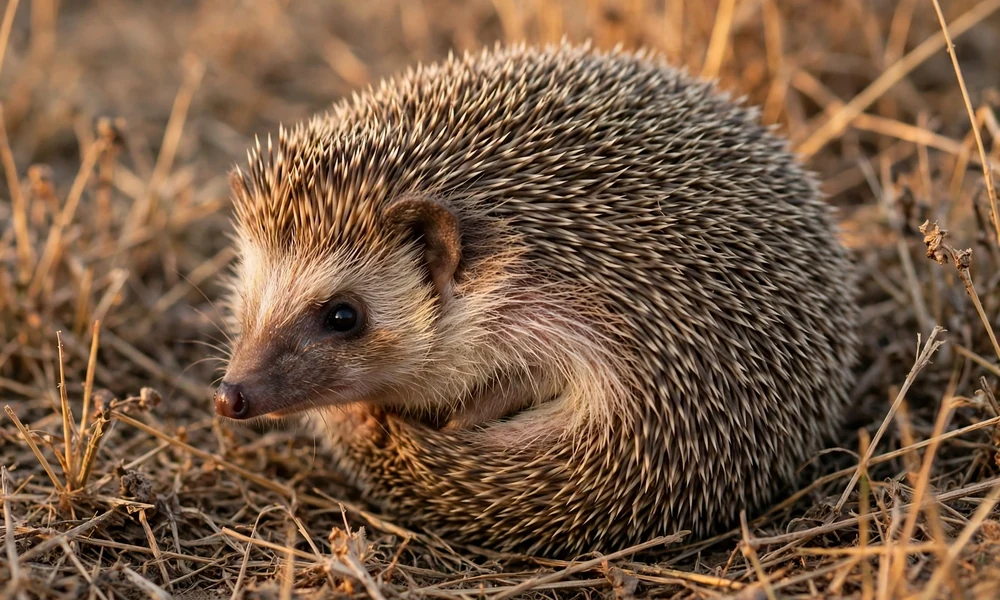
The African pygmy hedgehog is the smallest of the hedgehogs in this guide, a pale-bellied animal about 15 to 25 centimetres long that lives in the grasslands and savannas of central and eastern Africa. It has shorter spines than the European hedgehog, a white face and a light brown back, and it does not hibernate, since the African savanna never grows cold enough. African pygmy hedgehogs are the hedgehogs most often kept as pets.
The Amur hedgehog lives in the forests and grasslands of north-eastern China, Korea and the Russian Far East. It is similar in size to the European hedgehog, with brown spines and a pale face, and it hibernates through the long, cold winters of its home range.
Desert hedgehogs and long-eared hedgehogs
The desert hedgehog is the hedgehog of the Sahara and Arabian deserts, a small, pale animal with short spines and large ears that help it lose heat in the desert sun. It lives in dry, rocky country, feeds on insects, scorpions and small lizards, and can go for long periods without drinking, taking most of its water from its food. Desert hedgehogs are nocturnal, hiding in burrows or under rocks during the heat of the day.
The long-eared hedgehog is the hedgehog of the steppes and deserts of Central Asia, from Iran and Afghanistan to Mongolia and northern China. It has ears much longer than other hedgehogs, a pale, sandy coat and a habit of running fast across open ground, faster than any other hedgehog species. Long-eared hedgehogs hunt insects and small vertebrates at night, and can hear a beetle moving in the dark from several metres away.
The Indian long-eared hedgehog is a close relative in the dry grasslands and deserts of India and Pakistan. It is similar to the long-eared hedgehog, with long ears and a pale coat, and it feeds on insects, worms and small snakes. Among the desert animals of the world, hedgehogs are unusual in surviving on so little water, and in hunting by night when the desert is cool.
Spines, hibernation and feeding
A hedgehog’s spines are its armour, but they are not its only defence. Hedgehogs sometimes chew strong-smelling things, such as toad skin or rotting plants, and spread the frothy saliva over their spines — a habit called self-anointing that may disguise their scent or make them taste unpleasant to predators.
Hibernation is the European hedgehog’s great winter strategy. In autumn, hedgehogs eat as much as they can, building up a layer of fat, then find a sheltered nest of dry leaves, often under a hedge or a log pile, and fall into a deep sleep. Their body temperature drops to a few degrees above freezing, their breathing slows to a few breaths a minute, and they stay asleep until spring. A hedgehog that has not put on enough fat before winter may not survive the cold months.
Hedgehogs feed mainly on invertebrates: beetles, earwigs, caterpillars, slugs, snails and earthworms. They also eat birds’ eggs, fallen fruit, mushrooms and carrion, and they visit garden feeding stations for cat food and mealworms. A hedgehog can eat a third of its body weight in a single night, wandering up to two kilometres in search of food.
Where hedgehogs live
Hedgehogs live in gardens, hedgerows, woodland edges, grassland and deserts across Europe, Africa and Asia. European hedgehogs favour gardens and parkland, where leaf litter and log piles give shelter and food, and they are common in towns and villages too. Desert hedgehogs live in the Sahara and Arabian deserts, long-eared hedgehogs on the steppes of Central Asia, and African pygmy hedgehogs on the savannas of central Africa.
The nocturnal animals of the garden include the hedgehog at the top of the list, and the urban animals of city gardens include the European hedgehog too, snuffling through flower beds after dark. Hedgehogs need connected gardens: a small hole in a fence, called a hedgehog highway, lets them wander from garden to garden for food and mates.
Hedgehogs and people
The European hedgehog’s numbers have fallen sharply in Britain, from an estimated 30 million in the 1950s to fewer than a million today. Roads, tidy gardens with no leaf litter, fences without hedgehog holes and pesticides that kill their food have all played a part. Conservation groups ask gardeners to leave a wild corner, put a hole in the fence and avoid slug pellets, and rescue centres care for thousands of underweight young hedgehogs each autumn.
| Species | Where it lives | Best-known food | Body length |
|---|---|---|---|
| European hedgehog | Gardens and hedgerows of western Europe | Beetles, slugs, worms | 20–30 cm |
| Northern white-breasted hedgehog | Eastern Europe and western Asia | Beetles, worms, caterpillars | 20–30 cm |
| Southern white-breasted hedgehog | Balkans, Turkey and the Caucasus | Beetles, slugs, snails | 20–30 cm |
| African pygmy hedgehog | Grasslands of central and eastern Africa | Insects, worms, small snails | 15–25 cm |
| Desert hedgehog | Sahara and Arabian deserts | Insects, scorpions, small lizards | 15–25 cm |
| Long-eared hedgehog | Steppes and deserts of Central Asia | Insects, small vertebrates | 15–25 cm |
| Indian long-eared hedgehog | Dry grasslands of India and Pakistan | Insects, worms, small snakes | 15–25 cm |
| Amur hedgehog | Forests of north-east China, Korea and Russia | Beetles, worms, caterpillars | 20–30 cm |
Best seasons for hedgehog watching
Spring and autumn are the finest seasons for hedgehogs, when European hedgehogs are out every night, feeding hard after hibernation or building up fat before winter. In spring they wake from their winter sleep and wander widely for mates and food, and in autumn they are at their fattest and most active.
Summer is best for young hedgehogs, when the first hoglets leave the nest and follow their mother through the garden at dusk. Winter is quiet, since European hedgehogs are asleep in their nests, though desert and African pygmy hedgehogs stay active all year.
Staying safe around hedgehogs
Hedgehogs are wild animals, and they deserve respect. Never pick up a hedgehog unless it is clearly sick or injured, and if you find one out in daylight or badly underweight in late autumn, call a local hedgehog rescue centre. Never give a hedgehog milk or bread, which can make it ill, and never use slug pellets or pesticides where hedgehogs feed. Watch quietly from a distance, with a red-filtered torch rather than a bright white light.
Hedgehog watching checklist
- Watch gardens and hedgerows at dusk, when hedgehogs leave their nests.
- Listen for rustling and snuffling in the leaf litter, the sure sign of a hedgehog at work.
- Look for dark, shiny hedgehog droppings with beetle cases on lawns and paths.
- Leave a wild corner with log piles and dry leaves, and a hole in the fence as a hedgehog highway.
- Never give a hedgehog milk or bread, never use slug pellets, never disturb a nest.
- Leave no trace: take your rubbish home and keep to marked paths.
Frequently asked questions
How many hedgehog species are there?
There are 17 hedgehog species in the family Erinaceidae, across Europe, Africa and Asia. This guide profiles eight of them: the European, northern white-breasted, southern white-breasted, African pygmy, desert, long-eared, Indian long-eared and Amur hedgehogs.
How is this guide different from the nocturnal animals guide?
This guide covers hedgehog species, from European garden hedgehogs to desert and long-eared hedgehogs, with their spines, hibernation and feeding. The nocturnal animals guide covers the whole community of the night, from owls and bats to moths and foxes, with hedgehogs as only one part of it.
Do hedgehogs really roll into a ball?
Yes. When a hedgehog feels threatened, a ring of muscle beneath the skin pulls its spiny coat tight, and the animal rolls into a ball with no soft part exposed. A hedgehog carries around 5,000 spines, and most predators soon learn to leave it alone.
What should I feed a hedgehog in my garden?
Put out a shallow dish of water and a little cat food or specialist hedgehog food, with mealworms as an occasional treat. Never give a hedgehog milk or bread, which can make it ill, and never use slug pellets where hedgehogs feed.
Do all hedgehogs hibernate?
No. European, Amur and white-breasted hedgehogs hibernate through the winter. African pygmy and desert hedgehogs do not hibernate, since their homes never grow cold enough, though desert hedgehogs may sleep through the hottest part of the day.
Where is the best place to see a hedgehog?
European hedgehogs are best in gardens and hedgerows at dusk in spring and autumn, when they feed every night. Look for rustling in the leaf litter and dark, shiny droppings on lawns and paths, sitting quietly with a red-filtered torch.
Conclusion
Hedgehog species are the quiet gardeners of the night: European hedgehogs in British gardens, African pygmy hedgehogs on the savanna, desert hedgehogs in the Sahara and long-eared hedgehogs on the steppes of Central Asia.
The next step is to pick one species and one season — a spring evening in the garden for European hedgehogs, or a summer night on the savanna for African pygmy hedgehogs — and plan around it.














