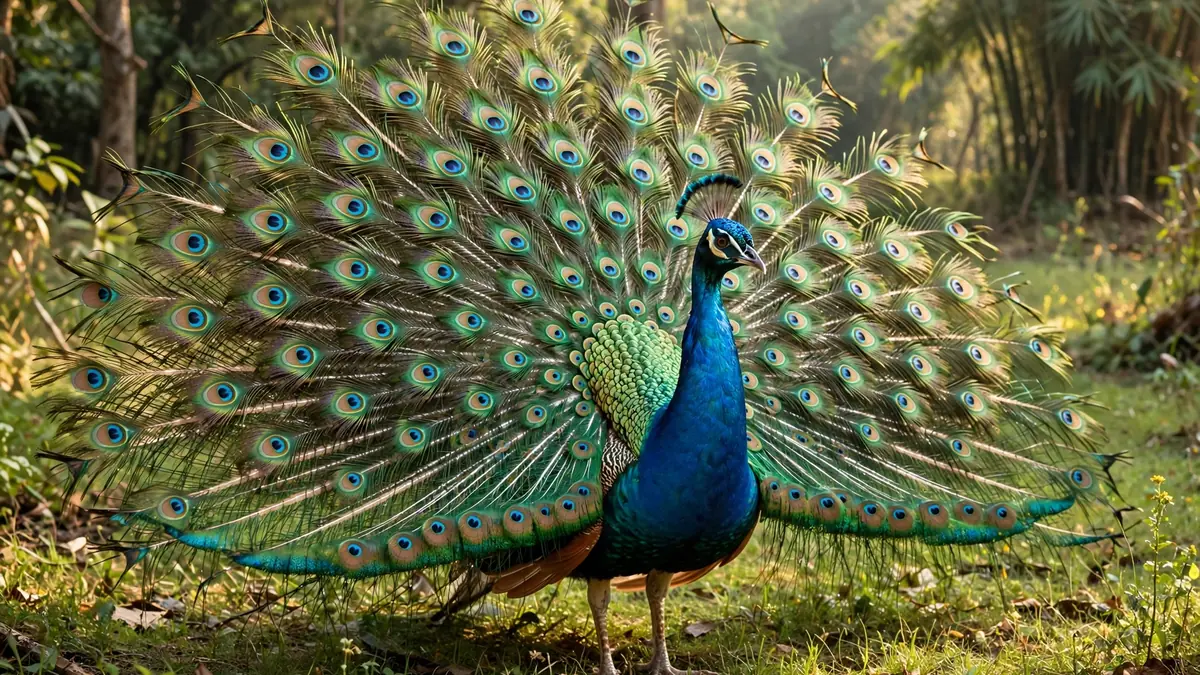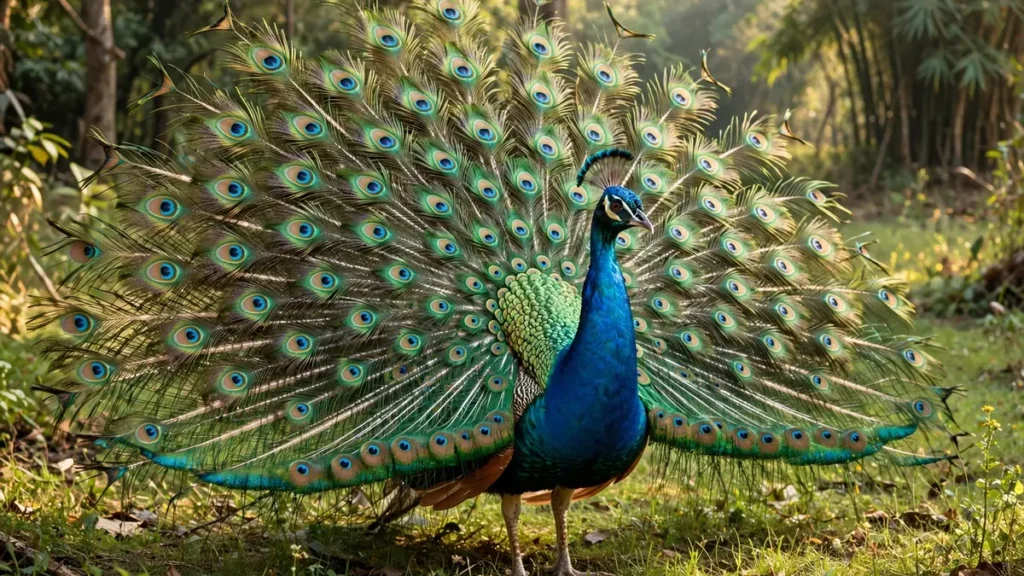
The Indian peafowl species is a single species, Pavo cristatus, the blue-necked pheasant of South Asia and one of the most recognisable birds on Earth. If you are asking how many Indian peafowl species there are, the answer is one, a monotypic species with no recognised subspecies, famous for the male peacock’s enormous train of eyespotted feathers.
On a spring morning in India you may hear a peacock before you see it, a loud, harsh scream rolling out of the trees at dawn. Then the male steps into a clearing, raises his train into a fan, and turns slowly in the sunlight.
Key takeaways
- The Indian peafowl species is Pavo cristatus, a single monotypic species with no recognised subspecies, in the pheasant family Phasianidae.
- Males, called peacocks, measure 100 to 120 centimetres in body length and up to 200 to 230 centimetres including the train, weighing 4 to 6 kilogrammes.
- It lives in India, Sri Lanka, Nepal, Bangladesh and Pakistan, in forest, scrub and farmland, and has been introduced to many parts of the world.
- Indian peafowl are omnivores, eating seeds, grains, berries, fruit, shoots, insects and small reptiles, foraging on the ground.
- Listed as Least Concern, with a population of more than 100,000 birds and a stable or increasing trend in India, where it is the national bird.
What makes an Indian peafowl an Indian peafowl
An Indian peafowl is a large ground-dwelling pheasant with extreme differences between the sexes. The male, the peacock, has a glossy metallic blue neck and breast, a green and bronze back, and a fan-shaped crest of wire-like feathers tipped with blue on the crown. His body is 100 to 120 centimetres long, and his train adds another 1.3 to 1.6 metres, so a displaying male can measure 200 to 230 centimetres in total. He weighs 4 to 6 kilogrammes, with a wingspan of 140 to 160 centimetres.
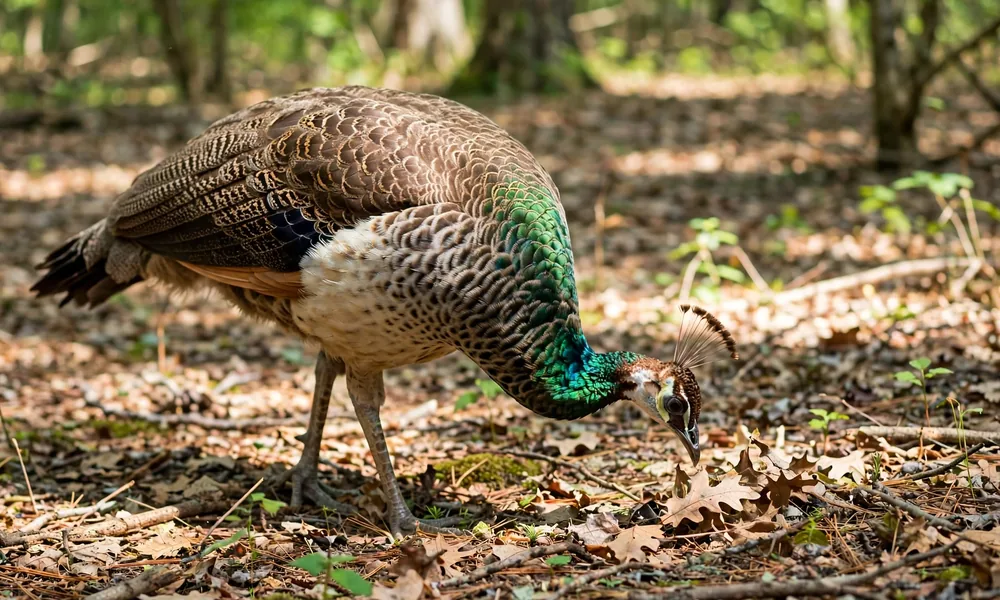
The female, the peahen, is smaller and far duller, about 97 centimetres long and weighing 2.7 to 4.1 kilogrammes, with mottled brown and buff plumage, a metallic green neck and a cream belly, but no train at all. Both sexes carry the crest, and both can fly in short, noisy bursts, rising into trees to roost at night despite the male’s heavy train.
The Indian peafowl species and their relatives
The Indian peafowl belongs to Pavo, a small genus of peafowl in the pheasant family Phasianidae, described by Carl Linnaeus in 1758. The species is considered monotypic: no subspecies are recognised by the IOC World Bird List, and most other authorities agree. The birds of Sri Lanka have been suggested as a possible second subspecies, but this has not been accepted, so the Indian peafowl remains a single, undivided species.
The black-shouldered colour form was once treated as a subspecies, or even as a separate species, but it is now known to be a domestic colour mutation seen in captive birds. Its two close relatives are the green peafowl, Pavo muticus, of South-East Asia, classified as Endangered, and the Congo peafowl, Afropavo congensis, of Central Africa. The wider pheasant family also holds the common pheasant, the junglefowl and the grouse.
| Type | Animal | Where it lives | Best-known food | Length or Weight |
|---|---|---|---|---|
| Family | Pheasants (Phasianidae) | Europe, Asia, Africa and the Americas | Seeds and insects | About 30 to 230 cm long |
| Genus | Peafowl (Pavo) | South and South-East Asia | Seeds and insects | About 90 to 230 cm long |
| Species | Indian peafowl (Pavo cristatus) | South Asia | Seeds and berries | About 100 to 230 cm, 2.7 to 6 kg |
| Species | Green peafowl (Pavo muticus) | South-East Asia | Seeds, fruit and insects | About 180 to 300 cm, 3.8 to 5 kg |
| Species | Congo peafowl (Afropavo congensis) | Central Africa | Fruit and seeds | About 64 to 70 cm, 1.1 to 1.5 kg |
| Species | Common pheasant (Phasianus colchicus) | Europe and Asia | Seeds and grain | About 60 to 89 cm, 0.9 to 1.7 kg |
How Indian peafowl live
Indian peafowl are omnivores that forage on the ground, scratching through leaf litter with strong clawed toes. Plant food dominates much of the year: wild grains, grass seeds, fallen figs, berries and tender young shoots. Animal prey supplies protein, especially for growing chicks and egg-laying females, and peafowl eat insects, worms, small lizards and even small snakes. They feed mostly in the early morning and late afternoon, often in small groups.
They are diurnal, active in daylight, and they roost in tall trees at night, safe from ground predators. A peacock’s train is not his true tail: it is made of about 150 to 200 greatly elongated upper tail coverts, each tipped with a concentric eyespot, or ocellus, of deep blue, green and copper. The colours come not from pigment but from microscopic structures in the feathers that reflect light, and the male raises the train into a fan during courtship, shaking the feathers so they rustle.
Breeding begins before the monsoon, when each male defends a display area and fans his train for visiting females. The male is polygynous, mating with several females, and the female alone builds the nest, a shallow scrape hidden in vegetation. She lays four to eight eggs and incubates them alone for about 28 days, and the chicks, called peachicks, follow her soon after hatching and feed themselves within hours. Young males take two to three years to grow a full train, and the train is moulted each year after breeding. Indian peafowl live for 15 to 20 years in the wild, and some for up to 25 years.
Where Indian peafowl live
Indian peafowl are native to the Indian subcontinent: India, Sri Lanka, Nepal, Bangladesh and Pakistan. They thrive in deciduous forest, scrub, thorny shrubland and open grassland, especially where dense undergrowth meets sunlit clearings and reliable water. They are also common on farmland and around villages, where they are tolerated and often fed, and they have been introduced to many parts of the world, including Florida, California, Hawaii, Australia and South Africa.
Indian peafowl are the national bird of India, a title held since 1963, and they are protected there under Schedule I of the Wild Life Protection Act of 1972, the highest tier, with prison terms of up to seven years for killing one. They are widespread and common across their range, and they adapt well to human-altered landscapes, feeding on crops and roosting in park trees. Like the snow goose and the sandhill crane, the Indian peafowl thrives in open country near people.
The Indian peafowl is listed as Least Concern on the IUCN Red List, with a conservative estimate of more than 100,000 birds and a trend that is stable or increasing in India. No reliable global count exists, but the species is not thought to be declining, and its numbers in India have risen strongly in recent decades. Its main threats are habitat loss, hunting in some areas, and the feather trade, though its protected status in India gives it strong legal shelter.
Best seasons for Indian peafowl watching
Indian peafowl are easiest to watch from March to May, before the monsoon, when the males are displaying their trains and calling loudly at dawn. In India, look for them in national parks such as Ranthambore and Keoladeo in Rajasthan, where they are seen on almost every outing, especially near water at first light. Displays are most frequent in the morning, when the males fan their trains in open clearings. Outside the breeding season they are present all year, but the males lose their trains in the late-summer moult.
Staying safe around Indian peafowl
An Indian peafowl is a shy, harmless bird, and the main risk is to the bird rather than to you. Never approach a displaying male closely, since he may abandon his display ground, and keep your distance from a peahen with chicks, since she will lead them away. Watch from a distance with binoculars, and stay on paths rather than trampling the undergrowth where nests are hidden. Like the red-tailed hawk, the Indian peafowl is a wild bird that should be watched, not fed by hand.
Do not feed peafowl, because food from people makes them bold around traffic and dogs, and can spread disease between birds. Keep dogs on a lead near peafowl, since a dog can kill a peahen on her nest, and give roosting birds room at dusk, when they are flying up into the trees for the night.
Indian peafowl watching checklist
A little preparation turns a morning in an Indian forest clearing into a real chance of watching a peacock display.
- A visit from March to May, before the monsoon, when the males are displaying and calling at dawn.
- An early-morning start, when peafowl feed in clearings and the males fan their trains.
- Binoculars, since a displaying peacock may be some way off across a clearing.
- A scan of forest clearings and waterholes, where peafowl gather to feed and display.
- A look up into tall trees at dusk, where peafowl roost for the night in loose groups.
- An ear for the loud, harsh scream, which carries far through the forest.
- Respect for nests and display grounds, keeping to paths and never approaching a displaying male or a peahen with chicks.
Frequently asked questions
How many Indian peafowl species are there?
There is one Indian peafowl species, Pavo cristatus, and it is considered monotypic: no subspecies are recognised by the IOC World Bird List or by most other authorities. The birds of Sri Lanka have been suggested as a possible second subspecies, but this has not been accepted.
What is the difference between a peacock and a peahen?
A peacock is the male Indian peafowl, with a metallic blue neck, a fan-shaped crest and a huge train of eyespotted feathers that can measure 200 to 230 centimetres in total length. A peahen is the female, smaller and mottled brown, with a green neck and no train. Only the male displays the famous fan.
What does an Indian peafowl eat?
An Indian peafowl is an omnivore. It eats seeds, grains, berries, fruit, shoots and flower petals, along with insects, worms, small lizards and small snakes. It forages on the ground, scratching through leaf litter, mainly in the early morning and late afternoon.
Is the peacock’s train its tail?
No. The train is made of about 150 to 200 greatly elongated upper tail coverts, each tipped with a concentric eyespot, raised over a shorter, stiff brown true tail that acts as a prop. The male moults the whole train each year after breeding, and young males take two to three years to grow a full one.
Are Indian peafowl endangered?
Not officially. The Indian peafowl is listed as Least Concern on the IUCN Red List, with a population of more than 100,000 birds and a trend that is stable or increasing in India. Its close relative the green peafowl is classified as Endangered.
How is this guide different from the great blue heron guide?
This guide covers the Indian peafowl, a ground-dwelling pheasant of South Asia whose male fans a shimmering train of eyespotted feathers in a forest clearing, while our great blue heron guide covers a tall, grey-blue wading bird that hunts fish in marshes and nests in tree-top colonies. One displays on dry land; the other stands in the shallows.
Conclusion
The Indian peafowl species needs no introduction once you have seen it: one species, Pavo cristatus, a blue-necked pheasant of South Asia, with a male whose train is one of the most spectacular sights in the bird world and a female whose quiet brown plumage hides her well.
If you go looking for one, go in the spring, go early, and listen first. Find a male fanning his train in a sunlit clearing, and you will see why the peacock has been admired for thousands of years.