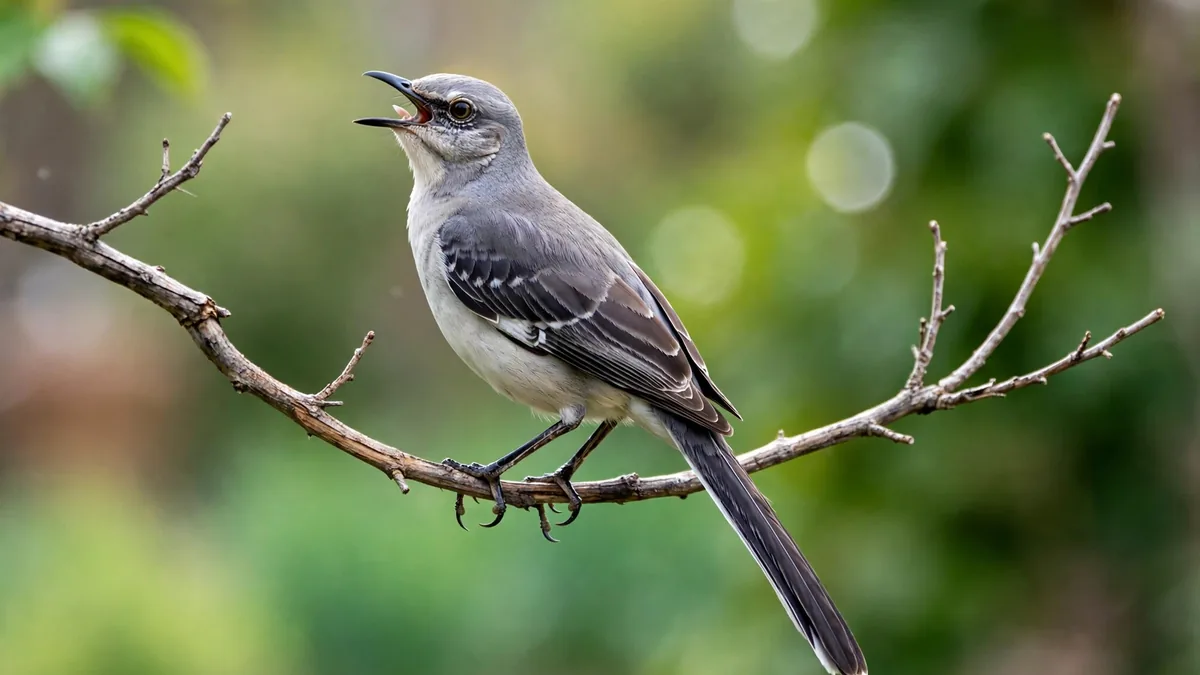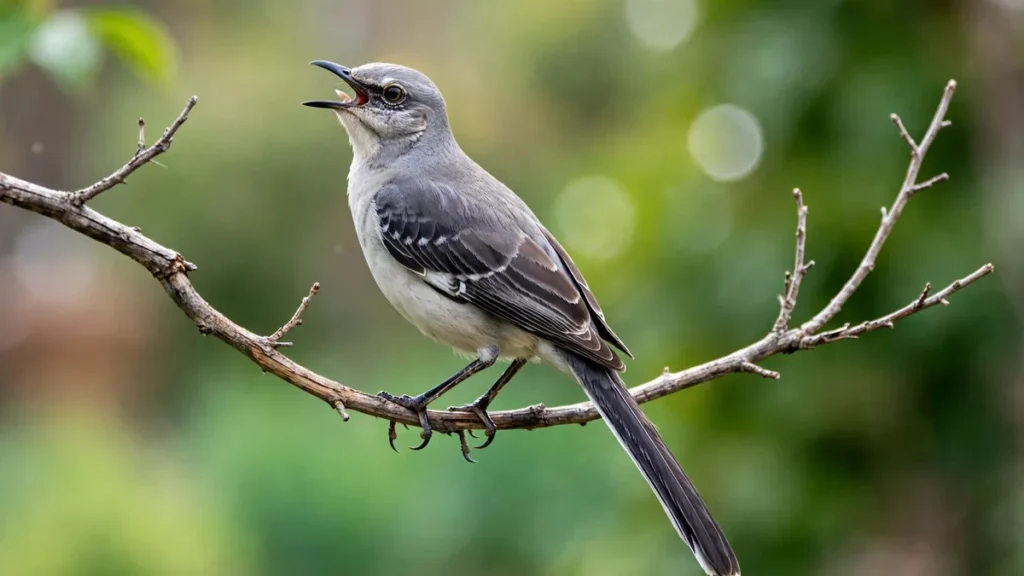
The northern mockingbird species is a single species, Mimus polyglottos, the grey songbird that copies the songs of more than 200 other birds. If you are asking how many northern mockingbird species there are, the answer is one, a slim, long-tailed bird with three recognised subspecies and a voice that can fill a whole garden with borrowed songs.
On a summer evening you can hear a northern mockingbird before you see it, singing from a treetop or a rooftop, running through the songs of other birds one after another. It is the bird of Harper Lee’s famous novel, and the state bird of five states.
Key takeaways
- The northern mockingbird species is Mimus polyglottos, a single species with three recognised subspecies, although some authorities recognise only two.
- Adults are grey above and pale below, with a long dark tail, white patches on the wings that flash in flight, and a thin dark bill.
- It lives in open country, gardens, parks and scrub across North America, from south-eastern Canada through the United States and Mexico to the Greater Antilles.
- Northern mockingbirds eat insects in summer and fruit in winter, nest in shrubs, and defend their nests fiercely, dive-bombing cats, hawks and people.
- Listed as Least Concern, with about 43 million mature birds, and it is the state bird of five states.
What makes a northern mockingbird a northern mockingbird
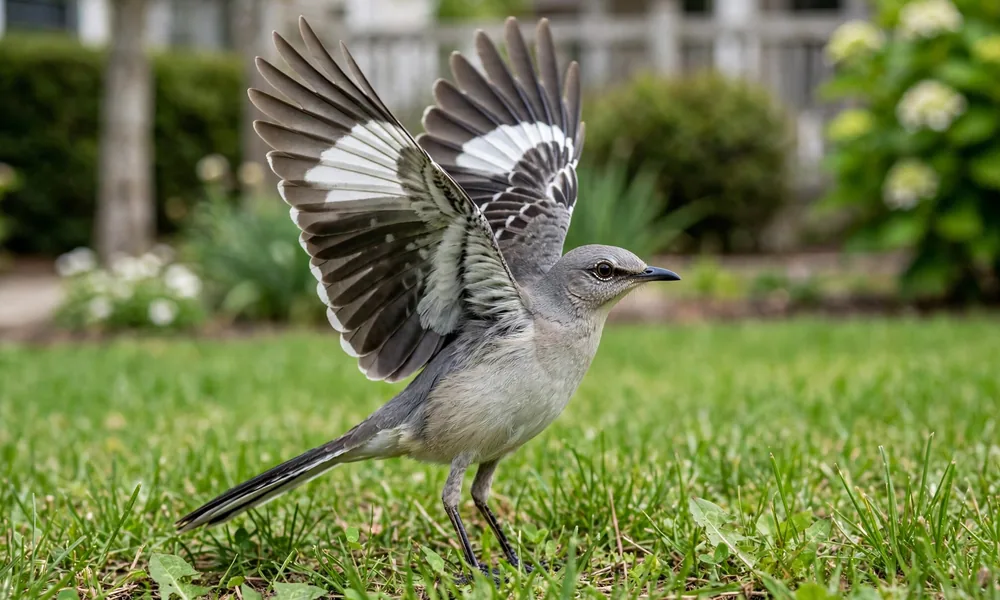
A northern mockingbird is a medium-sized songbird, about 20 to 28 centimetres long, with a wingspan of 31 to 38 centimetres and a weight of 40 to 58 grammes. It is a slim bird with long legs and a long tail, grey above and pale grey-white below, with a thin dark bill and a pale eye. The field marks are the two white wing bars and the large white patches on the wings, which flash when the bird flies, and the white outer feathers of the long dark tail. Males and females look alike.
The song is the best way to know one. A northern mockingbird copies the songs and calls of other birds, and even frogs, dogs, car alarms and mobile phones, stringing the stolen phrases together in a long performance. Each phrase is usually repeated three to five times before the bird moves on, and a single male may know from about 40 to more than 200 song types. The scientific name says it all: polyglottos means many-tongued. Unmated males sometimes sing through the night, especially under a full moon.
The northern mockingbird species and their relatives
The northern mockingbird belongs to Mimus, a genus of about a dozen mockingbird species in the family Mimidae, and it is a single species with three generally recognised subspecies. The nominate race, M. p. polyglottos, is the bird of eastern North America, from Nova Scotia to Nebraska and south to Texas and Florida. The western race, M. p. leucopterus, is larger and paler, and lives from the western United States south through Mexico to the Isthmus of Tehuantepec. The Caribbean race, M. p. orpheus, is smaller and paler still, and lives in the Bahamas and the Greater Antilles.
The taxonomy is not settled. Some authorities recognise only two subspecies, folding leucopterus into polyglottos, and the Caribbean orpheus has at times been treated as a separate species, close to the Bahama mockingbird, Mimus gundlachii; the birds of Hispaniola have also been given the name dominicus. Its closest relatives are the other Mimus mockingbirds of the Americas, including the tropical mockingbird, and the grey catbird, a fellow member of the family that mews like a cat.
| Type | Animal | Where it lives | Best-known food | Length or Weight |
|---|---|---|---|---|
| Family | Mockingbirds and thrashers (Mimidae) | The Americas | Insects, fruit and berries | About 21 to 30 cm long |
| Genus | Mockingbirds (Mimus) | North, Central and South America | Insects and fruit | About 20 to 28 cm long |
| Species | Northern mockingbird (Mimus polyglottos) | North America to the Greater Antilles | Insects in summer, fruit in winter | About 20 to 28 cm, 40 to 58 g |
| Species | Bahama mockingbird (Mimus gundlachii) | The Bahamas, Cuba and Jamaica | Insects and fruit | About 23 to 28 cm, about 57 g |
| Species | Tropical mockingbird (Mimus gilvus) | Central and South America | Insects and fruit | About 23 to 26 cm, 52 to 65 g |
| Species | Grey catbird (Dumetella carolinensis) | North America | Insects and fruit | About 21 to 24 cm, 23 to 57 g |
How northern mockingbirds live
Northern mockingbirds feed mostly on the ground and in low shrubs, running across lawns and hopping through the leaf litter after insects, spiders, earthworms and other small creatures. In summer they eat mainly arthropods, including grasshoppers, beetles, ants, wasps and caterpillars. In autumn and winter they switch to fruit and berries, including holly, blackberry and mulberry, and defend a fruiting shrub against other birds as fiercely as they defend a nest. They are famous for their wing-flashing display, raising both wings to show the white patches, which startles insects into moving.
They are diurnal, active in daylight, though unmated males sing at night, and they are one of the most territorial songbirds in North America. A pair holds its territory all year, and both birds will dive-bomb anything that comes near the nest, including cats, crows, hawks, snakes and people, sometimes striking with their feet. Studies have shown that mockingbirds can recognise individual humans and remember people who have threatened their nests.
Breeding birds nest in a shrub or low tree, usually one to three metres above the ground, in a bulky cup of twigs lined with grass, dead leaves and moss, built mostly by the male while the female watches. The female lays three to five eggs, usually four, pale blue or greenish with red or brown blotches, and incubates them alone for 11 to 14 days. The chicks hatch naked and helpless, are fed by both parents, and leave the nest after about 12 days. A pair usually raises two to four broods a year.
Where northern mockingbirds live
Northern mockingbirds live across North America, from the Maritime provinces of south-eastern Canada west to southern Oregon, south through practically the whole continental United States, and through Mexico to eastern Oaxaca and Veracruz, and in the Greater Antilles. They favour open country with scattered shrubs and trees, gardens, parks, roadsides and farmland, anywhere with low cover to nest in and open ground to hunt on, and they have spread northwards over the past century as towns and suburbs gave them the habitat they love. They were introduced to Hawaii in the 1920s, where they are now common. Like the American robin and the eastern bluebird, it is a bird that thrives where people live.
They are the state bird of five states, Arkansas, Florida, Mississippi, Tennessee and Texas, second only to the northern cardinal among state birds. Northern birds are partly migratory, moving south in winter, while southern birds stay put all year.
The northern mockingbird is listed as Least Concern on the IUCN Red List, with about 43 million mature birds, but the population trend is decreasing, falling by an estimated 13 to 18 per cent over three generations. The main pressures are the loss of open, shrubby habitat to building and intensive farming, and window strikes and cats.
Best seasons for northern mockingbird watching
Northern mockingbirds are easiest to watch from spring to early summer, when the males sing from the tops of trees and rooftops and the pairs are busy around their nests. In the north, look for them from April to July, when the migrants return and the song is at its best. In the southern United States, Mexico and the Caribbean they are present all year.
Staying safe around northern mockingbirds
A northern mockingbird is not dangerous to people, but it is one of the few songbirds that will attack you. Never approach a nest closely, since the parents will dive-bomb you, sometimes striking your head, and will keep attacking until you leave. Watch from a distance with binoculars, and if a mockingbird starts swooping at you, walk away calmly and take a different path. Like the red-tailed hawk and the snow goose, the northern mockingbird is protected by law in the United States under the Migratory Bird Treaty Act.
Keep cats indoors during the nesting season, because mockingbirds nest low in shrubs and are easy prey. If a mockingbird sings all night outside your window, it is probably an unmated male: he will usually find a mate and quieten down within a few weeks.
Northern mockingbird watching checklist
A little preparation turns a spring morning in the garden into a real chance of hearing and seeing a northern mockingbird.
- A visit from spring to early summer in the north, or at any time of year in the south.
- An early-morning start, when the song carries furthest.
- Binoculars, since a mockingbird on a rooftop or treetop is often some way off.
- An ear for the borrowed songs, each phrase repeated three to five times.
- A scan of treetops and rooftops, where the males perch to sing and watch their territories.
- A watch for the white wing patches flashing in flight, and the wing-raising display on the lawn.
- Respect for nests and territories, keeping your distance if a bird starts to swoop at you.
Frequently asked questions
How many northern mockingbird species are there?
There is one northern mockingbird species, Mimus polyglottos, with three generally recognised subspecies: M. p. polyglottos of eastern North America, M. p. leucopterus of the west and Mexico, and M. p. orpheus of the Bahamas and the Greater Antilles. Some authorities recognise only two, folding leucopterus into polyglottos.
How many songs can a northern mockingbird copy?
A single male northern mockingbird may know from about 40 to more than 200 song types, copying the songs of other birds and even frogs, dogs, car alarms and mobile phones. Each phrase is usually repeated three to five times, and females prefer males with larger repertoires.
What does a northern mockingbird eat?
A northern mockingbird eats insects and other arthropods in summer, including grasshoppers, beetles, ants, wasps and caterpillars, plus earthworms. In autumn and winter it switches to fruit and berries, including holly, blackberry and mulberry.
Why do mockingbirds attack people?
Northern mockingbirds attack people who come too close to their nests, dive-bombing the intruder until the person leaves. Both parents defend the nest, and studies have shown they can recognise individual humans and remember people who have threatened their nests.
Are northern mockingbirds endangered?
Not officially. The northern mockingbird is listed as Least Concern on the IUCN Red List, with about 43 million mature birds. The population is decreasing, by an estimated 13 to 18 per cent over three generations, as open, shrubby habitat is lost.
How is this guide different from the northern cardinal guide?
This guide covers the northern mockingbird, a slim grey songbird that copies the songs of more than 200 other birds and defends its nest by dive-bombing intruders, while our northern cardinal species guide covers a bright red songbird of North American gardens that sings its own clear whistle all year round. One borrows every song in the garden; the other sings only its own.
Conclusion
The northern mockingbird species needs no introduction once you have heard it: one species, Mimus polyglottos, a slim grey bird with white wing patches and a voice that borrows from every bird in the garden.
If you go looking for one, go on a spring morning, go early, and listen first. Find one singing from a rooftop above the lawn, and you will hear a whole garden of birds in a single throat.