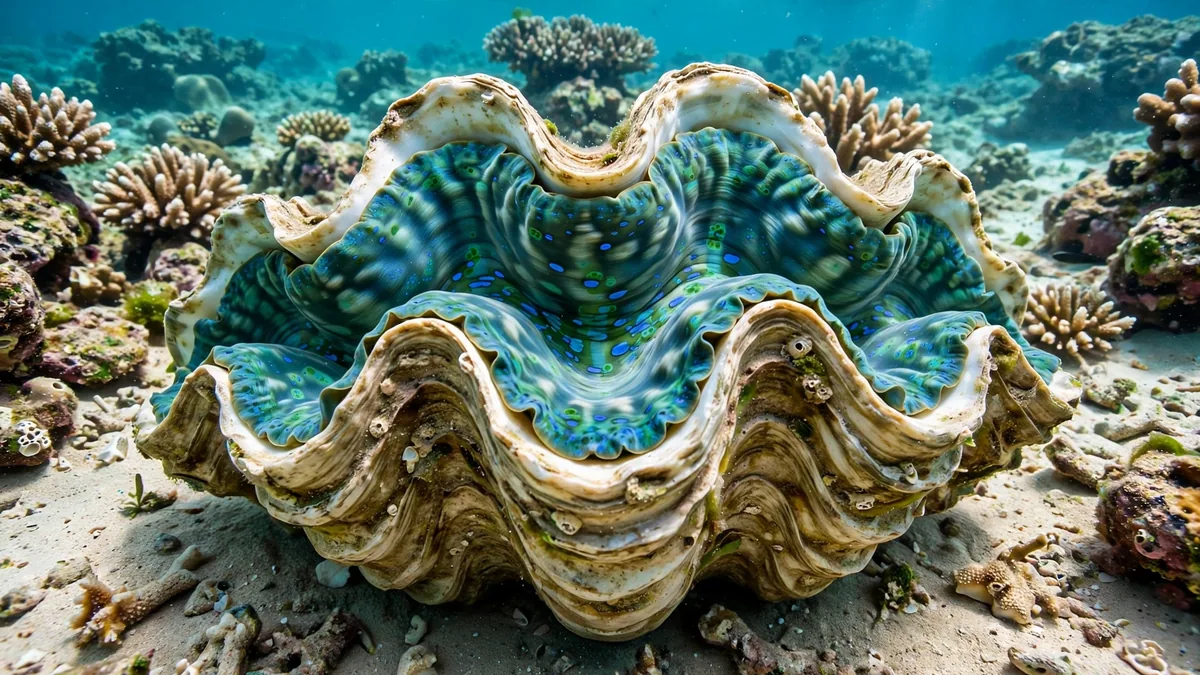
The giant clam species are the largest living bivalves on Earth, and the biggest of them, the true giant clam, Tridacna gigas, is a shell a metre across that sits on a coral reef for a century. If you are asking what a giant clam is, the short answer is a huge, two-shelled mollusc, usually up to 120 centimetres across and weighing more than 200 kilograms, that lives fixed to the sand and rubble of shallow Indo-Pacific reefs, opens its shell by day to show a brightly coloured mantle, and feeds mostly on the sugars made by tiny algae living in its own flesh. It is not a man-eater, whatever the old stories say: no human death by a giant clam has ever been proved, and its shell closes far too slowly to trap a swimmer.
What makes the giant clam so remarkable is that it is, in effect, a solar-powered animal. It does not chase food, and it barely moves at all once it has settled, yet it grows to the size of a bathtub and outlives the people who find it, because the algae in its mantle turn sunlight into food for it, day after day, for more than a hundred years. Its shell is heavy enough to need two people to lift, its mantle glows blue, green and purple, and it can release more than 500 million eggs in a single spawning. Yet the same animal that seems so indestructible is now in serious trouble: it was reassessed as Critically Endangered in October 2024, after an estimated 84 per cent fall in its population, because people have harvested it for food, for its shell and for aquariums.
Key takeaways
- The giant clam species are led by the true giant clam, Tridacna gigas, the largest living bivalve, growing to 120 centimetres across and weighing more than 200 kilograms, with the largest known shell measuring 137 centimetres.
- Giant clams live fixed to flat coral sand and broken coral on shallow Indo-Pacific reefs, in warm, clear water, usually at depths of 2 to 20 metres, from the Philippines and the South China Sea to the Great Barrier Reef.
- They feed mostly on the sugars and proteins made by symbiotic algae called zooxanthellae living in the mantle, which supply 65 to 70 per cent of their food, and they filter plankton from the water for the rest.
- Each adult is a hermaphrodite that cannot fertilise itself, and it broadcast-spawns, releasing eggs and sperm into the water, with a single adult able to release more than 500 million eggs at a time.
- Tridacna gigas was reassessed as Critically Endangered by the International Union for Conservation of Nature in October 2024, after an estimated 84 per cent population decline, and it is listed on Appendix II of the Convention on International Trade in Endangered Species of Wild Fauna and Flora.
The giant clam species and their relatives
Giant clams belong to the family Cardiidae, the cockle family, in the order Cardiida, and they sit in the class Bivalvia, the two-shelled molluscs. They are marine molluscs, soft-bodied animals that carry two shells hinged together, and they share the features that make a life of sitting still on a reef possible: a muscular foot for gripping the reef as a young clam, a pair of siphons for drawing water in and out, and a fleshy mantle that holds the algae that feed them. Within the family, the giant clams of the genus Tridacna are the group this guide covers, a genus of large, heavy-shelled clams that ranges from a small clam 15 centimetres across to the true giant clam at 137 centimetres, and every one of them farms algae in its mantle.
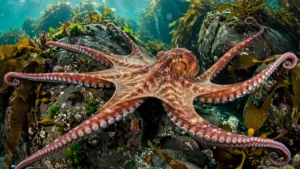
The true giant clam, Tridacna gigas, is the lead species of this guide, and it is the giant clam that defines the whole group in most people’s minds, largely because it is the largest, the heaviest and the longest-lived of them all. It lives in the South Pacific and Indian Oceans, on the shallow coral reefs of the Indo-Pacific, from the Philippines and the South China Sea to Malaysia and the Great Barrier Reef, in flat coral sand and broken coral at depths of up to 20 metres, and it grows to 120 centimetres across, weighing more than 200 kilograms, with the largest known shell measuring 137 centimetres. It is listed as Critically Endangered by the International Union for Conservation of Nature, and its shell is heavy and thick, with four or five vertical folds, and a mantle of brownish-yellow, blue, green and purple. Like the octopus, the giant clam is a soft-bodied mollusc, but the octopus is a fast, intelligent hunter that grabs prey with eight arms and a beak, while the giant clam is a slow, sessile animal that sits in one place for a century and lets the sun feed it.
| Type | Animal | Where it lives | Best-known food | Length or Weight |
|---|---|---|---|---|
| Family | Giant clams (Cardiidae) | Indo-Pacific reefs | Plankton and algae sugars | About 15 cm to 137 cm across |
| Genus | Giant clams (Tridacna) | Indo-Pacific reefs | Plankton and algae sugars | About 15 cm to 137 cm across |
| Species | True giant clam (Tridacna gigas) | Indo-Pacific reefs | Algae sugars and plankton | Up to 120 cm across, over 200 kg |
| Species | Southern giant clam (Tridacna derasa) | Indo-Pacific reefs | Algae sugars and plankton | Up to about 60 cm across |
| Species | Fluted giant clam (Tridacna squamosa) | Indo-Pacific reefs | Algae sugars and plankton | Up to about 41 cm across |
| Species | Small giant clam (Tridacna maxima) | Indo-Pacific reefs | Algae sugars and plankton | Up to about 35 cm across |
The closest relatives of the true giant clam are the other giant clams of the genus Tridacna, a genus of large, heavy-shelled clams that live on Indo-Pacific reefs. The southern giant clam, Tridacna derasa, is the second largest, a smooth-shelled clam that grows to about 60 centimetres across, with six or seven vertical folds in its shell, and a colourful mantle of brown, turquoise blue and green. The fluted giant clam, Tridacna squamosa, grows to about 41 centimetres across, and it is easy to recognise by the broad, leaf-like scales on the folds of its shell. The small giant clam, Tridacna maxima, grows to about 35 centimetres across, and it has the widest distribution of any giant clam. The boring clam, Tridacna crocea, is the smallest of all, growing to only about 15 centimetres across, and it bores into rock and coral.
What giant clams look like
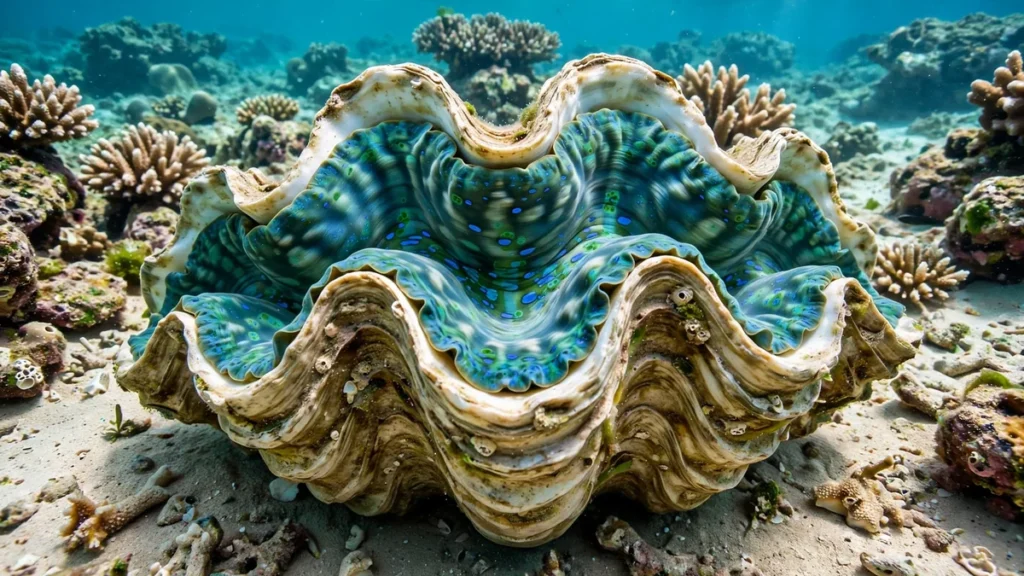
A giant clam looks like a piece of the reef that has learned to glow. The shell is a heavy, thick pair of valves, hinged at the bottom, with four or five vertical folds running from the hinge to the wavy edge, and the two valves sit upright in the sand, open at the top like a bowl. The shell is grey and brown on the outside, rough with growth lines and the scars of a century on the reef, and it is so heavy that a large one can weigh more than 200 kilograms. The largest known shell, found around 1817 on the north-western coast of Sumatra, measured 137 centimetres across, and its two shells alone weighed 230 kilograms when dead, which suggests the live animal weighed about 250 kilograms. A heavier shell, found off the Japanese island of Ishigaki in 1956, was 115 centimetres long, and its shells and soft parts weighed 333 kilograms when dead, with the live weight estimated at about 340 kilograms.
The size of a giant clam depends on the species. The smallest giant clams are only about 15 centimetres across, no bigger than a dinner plate, while the true giant clam grows to 120 centimetres across, about 4 feet, and most large adults are 80 to 120 centimetres across. The southern giant clam reaches about 60 centimetres, the fluted giant clam about 41 centimetres, and the small giant clam about 35 centimetres. The weight grows with the shell: a large true giant clam weighs more than 200 kilograms, about 440 pounds. A newly settled giant clam is only about 0.2 millimetres long, a speck of shell on the reef, and it grows fast for a clam, about 12 centimetres a year in laboratory rearing.
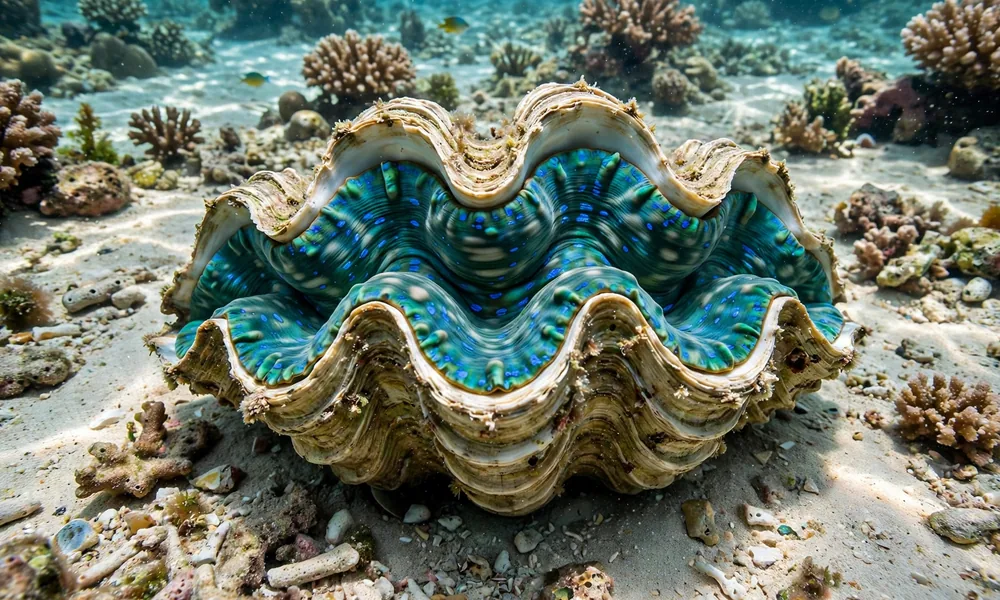
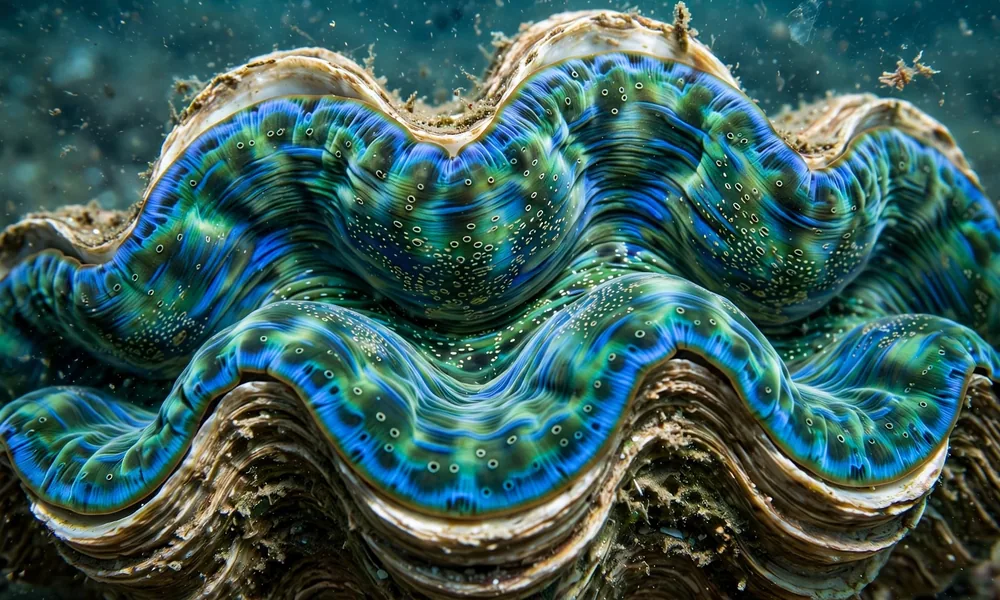
The mantle is the part of the clam that everyone remembers, and it is the best way to tell a giant clam from any other shell on the reef. The mantle is the fleshy tissue that lines the shell, and in a giant clam it is thick, rippled and brightly coloured, in blues, greens, purples and browns, with patterns of spots, stripes and swirls that are different on every clam. The colour comes from the algae living in the mantle, and from pigments in the tissue itself, and it is brightest in sunlight, when the clam is open and the mantle is spread wide to catch the light. The edge of the mantle is packed with light-sensitive spots that can sense a shadow passing over the clam, and when something moves above it, the clam closes its shell, slowly, as a warning, not as a trap.
Adult true giant clams are the only giant clams that cannot close their shells completely, and even when the shell is shut, part of the brownish-yellow mantle stays visible through the gap. That is one of the ways to tell a true giant clam from the southern giant clam, which has six or seven folds in its shell where the true giant clam has four or five.
Where giant clams live
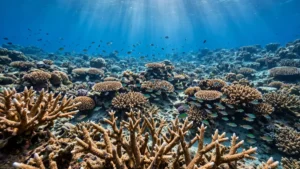
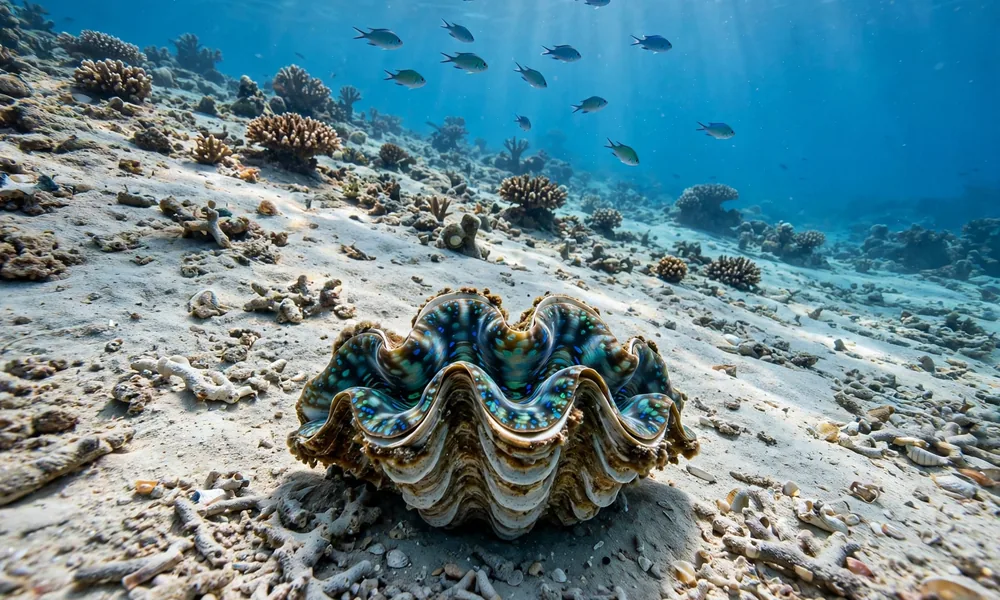
Giant clams live in warm, shallow, clear water, and they are found nowhere cold or murky in the wild. Their range centres on the Indo-Pacific, from the South Pacific and Indian Oceans across to the Philippines, the South China Sea, Malaysia and the Great Barrier Reef, with the true giant clam living on the shallow coral reefs of that whole region. They live on flat coral sand and broken coral, in lagoons and on reef flats and reef slopes, and they need warm, clear, sunlit water and a firm bottom to sit on, because without sunlight the algae in their mantle cannot feed them, and without a firm bottom the shell will sink into the sand. They are found at depths of 2 to 20 metres, and they are most common in the shallows, where the light is strongest.
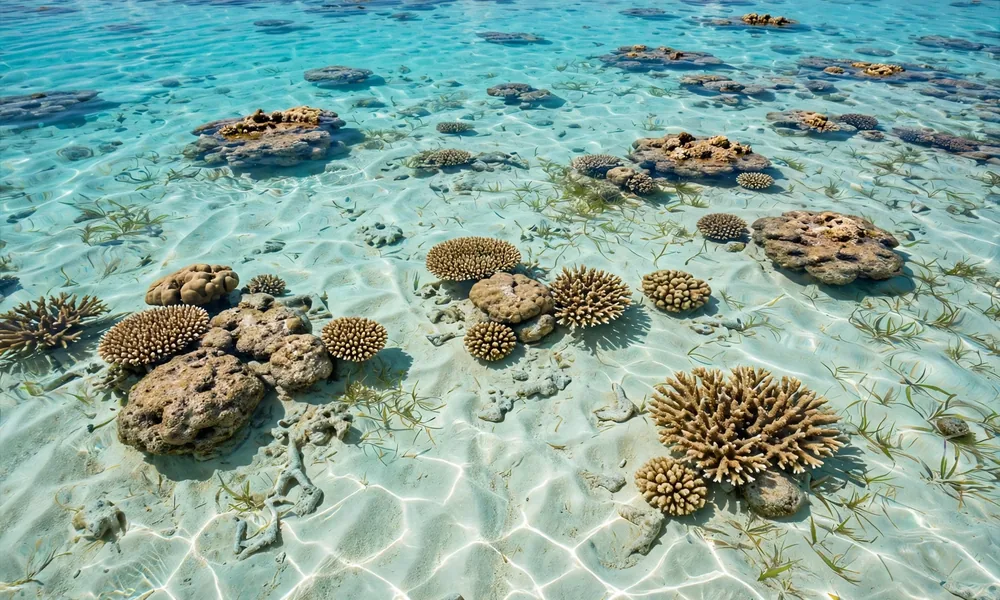
The range of the true giant clam has shrunk badly in living memory. It was once common across the whole Indo-Pacific, but it has become extinct in many areas where it was once common, picked clean for food and for its shell, and it is now rare or gone in the Philippines and the South China Sea, where it was once fished heavily. On the Great Barrier Reef it is doing better, because giant clams have never been allowed to be collected from the wild in Australian waters, and the reef there still holds healthy numbers.
What giant clams eat
Giant clams are feeders, not hunters, and their diet is written in the sunlight itself. The everyday food comes mostly from the algae, single-celled dinoflagellates called zooxanthellae, that live in the mantle tissue, and the algae make sugars and proteins by photosynthesis, and the clam takes most of its food from them. About 65 to 70 per cent of the clam’s nutritional needs are supplied by the zooxanthellae, and the rest comes from filter feeding: the clam draws water in through a siphon, filters out the tiny plankton in it, and pumps the water out again.
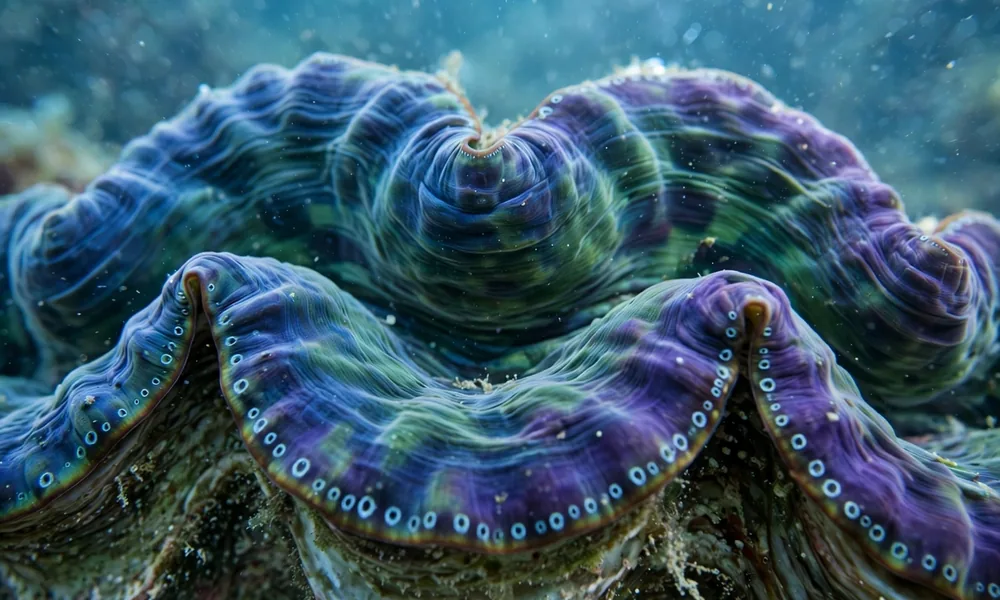
The partnership with the algae is the most extraordinary part of the diet, and it is what makes the giant clam possible at all. The algae live in the mantle, safe from grazers, with regular access to sunlight, and in return they give the clam the sugars and proteins they make, and the clam gives them carbon dioxide, phosphates and nitrates from its own waste. It is a bargain that has lasted for millions of years, and it is so efficient that scientists study it as a model for highly efficient bioreactors. The clam is not born with its algae: each new generation takes up the tiny algae from the sea water after the larva hatches, so every clam must find its own partners, and a young clam that fails to find them will starve.
How giant clams behave
Giant clams are still animals, and their day is split cleanly in two: open by day, closed by night. They spend the daylight hours with the shell open and the mantle spread wide, basking in the sun, and they are so still and so well camouflaged that a person can swim straight past a giant clam and not see it, taking it for a piece of coral. As night falls they close the shell and rest, and they stay closed until the morning sun returns. They are solitary, though several clams may settle on the same rich reef flat, and each clam keeps to its own spot, because it cannot move.
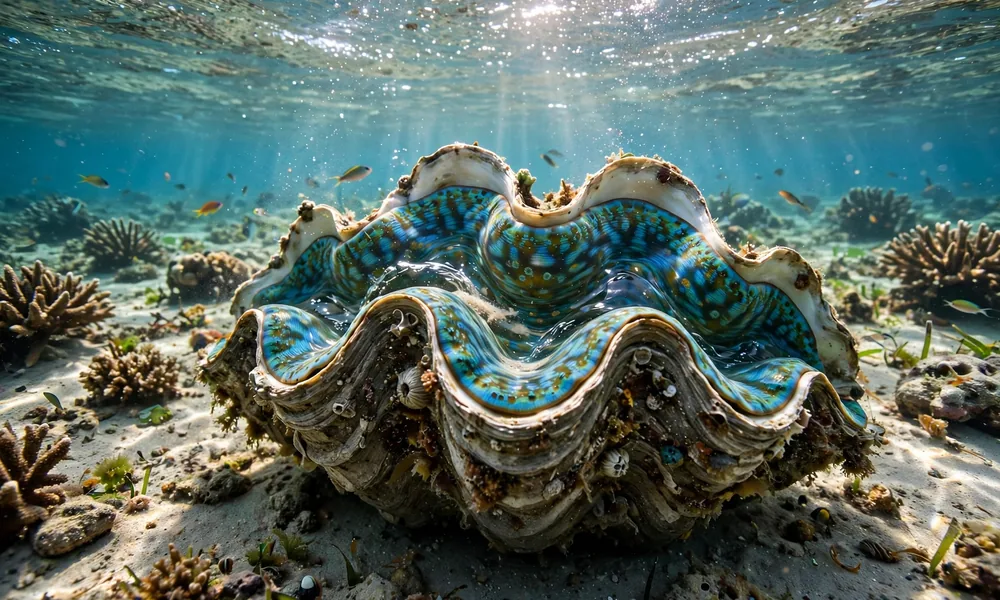
The most famous behaviour in the giant clam is the closing of the shell, and it works because the clam is so good at sensing danger first. When a shadow passes over the mantle, the light-sensitive spots on its edge sense it, and the clam closes its shell, slowly, with the big adductor muscle that holds the two valves together. The closing is slow, far too slow to trap a swimmer, and it is a warning, not a weapon. A giant clam will also close if it is touched, and it will stay closed until the danger has passed.
Giant clams have no brain, and they have no eyes in the usual sense, and they live by light and by touch. The spots on the mantle can tell light from dark, and they can tell when a shadow moves, and that is enough to keep the clam safe from most of the animals that would eat it. It is not aggressive, and it will not chase or threaten a person, because it cannot move, but a foot that steps on a clam, or a hand that reaches into its shell, will find the shell closing on it.
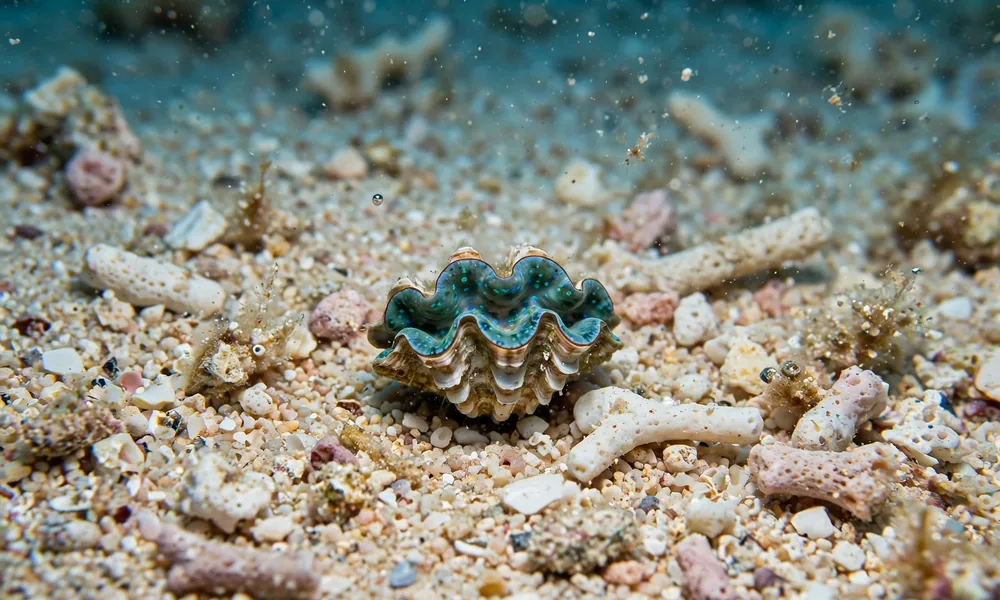
The man-eater myth is the most famous story about the giant clam, and it is false. South Pacific legends describe clams that lie in wait to trap unsuspecting swimmers or swallow them whole, and the stories have been retold in books and films for a century. No account of a human death by a giant clam has ever been substantiated, and scientists say the adductor muscles, used to close the shell, move far too slowly to take a swimmer by surprise. A diver who puts a foot in a clam may find it held, and may need help to pull free, but the clam is not hunting, and it is not trying to eat anyone.
Breeding and life cycle
Giant clams breed in the warm months, when the water is at its warmest and food is plentiful. Each adult is a hermaphrodite, carrying both male and female reproductive organs, but it cannot fertilise itself, so any two adults can mate, and because adults are fixed in place, they broadcast-spawn, releasing eggs and sperm into the water. A chemical signal, released through the excurrent siphon, synchronises the clams nearby, and spawning coincides with incoming tides near the full and new moons.
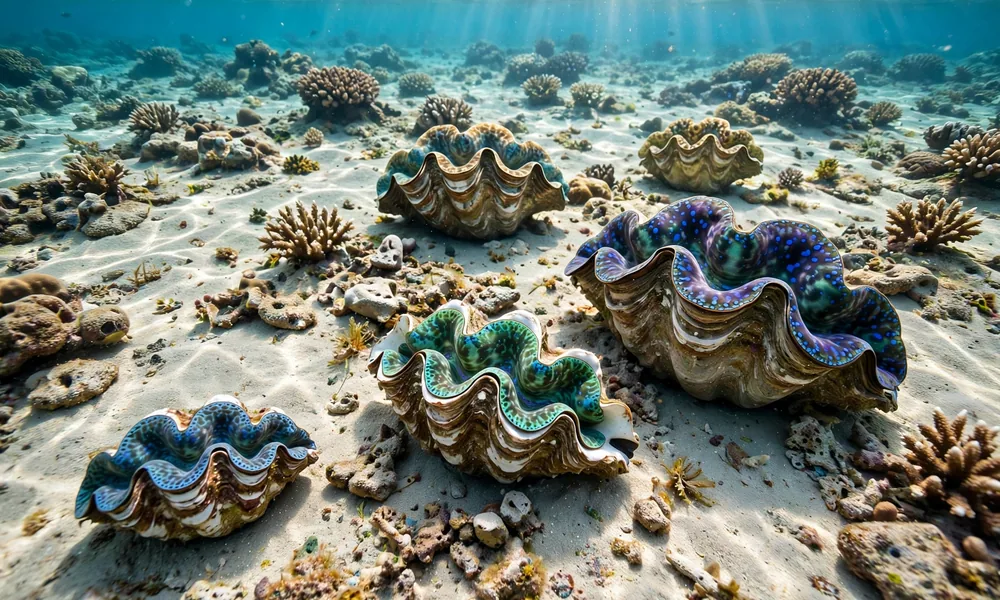
Under normal conditions a single adult can release more than 500 million eggs at a time, each about 100 micrometres across, one of the largest egg counts of any animal, and the eggs are fertilised in the open water. The fertilised egg floats for about 12 hours before a trochophore larva hatches, and within two days the larva is 160 micrometres long and secretes a calcium carbonate shell, then develops a foot and searches for a place to settle. It settles after roughly a week, at about 0.2 millimetres long, without symbionts, so it depends completely on plankton until it takes up zooxanthellae from the water. A clam is considered a juvenile when it reaches 20 centimetres long, and it first breeds at about 25 to 35 centimetres long.
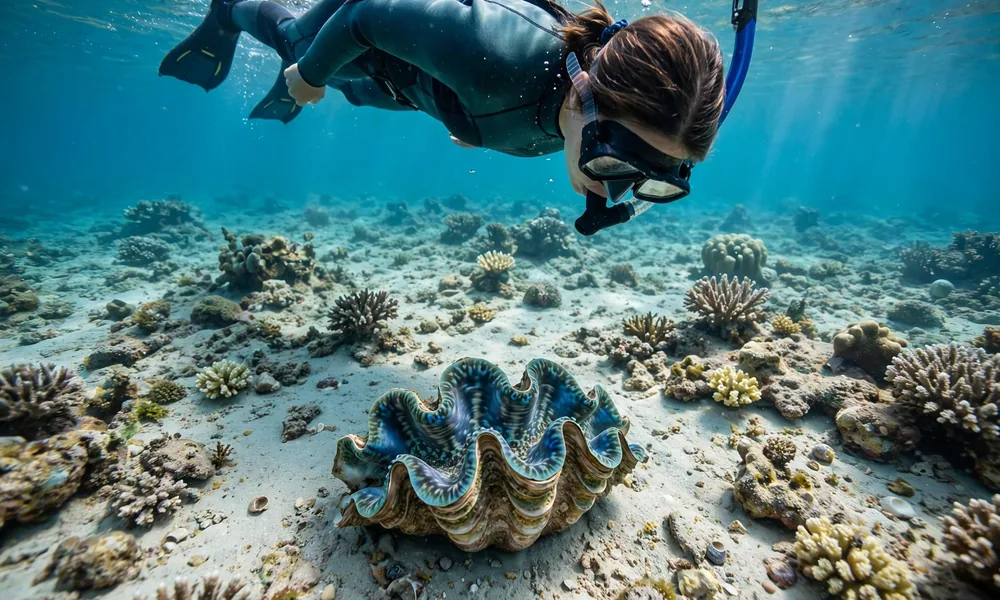
The young clam grows by adding to the edge of its shell, laying down new shell material as its body grows, and the mantle grows with it, so that the colour of an adult clam is the record of a whole life on the reef. A giant clam that survives its first year on the reef has a good chance of seeing many breeding seasons, and the largest clams on a reef are the oldest animals there. How long a giant clam lives in the wild is well measured: an average lifespan of more than 100 years, and some clams are thought to live longer still.
Conservation status
The conservation status of the giant clam is, on paper, a grave one. The true giant clam, Tridacna gigas, was reassessed as Critically Endangered by the International Union for Conservation of Nature in October 2024, after an estimated 84 per cent fall in its population, and it is listed on Appendix II of the Convention on International Trade in Endangered Species of Wild Fauna and Flora, which controls international trade in the species. National Geographic still lists it as Vulnerable, the older category it held before the 2024 reassessment, but the current listing is Critically Endangered. It is common on some reefs, above all on the Great Barrier Reef, but across its whole range it is in serious trouble.
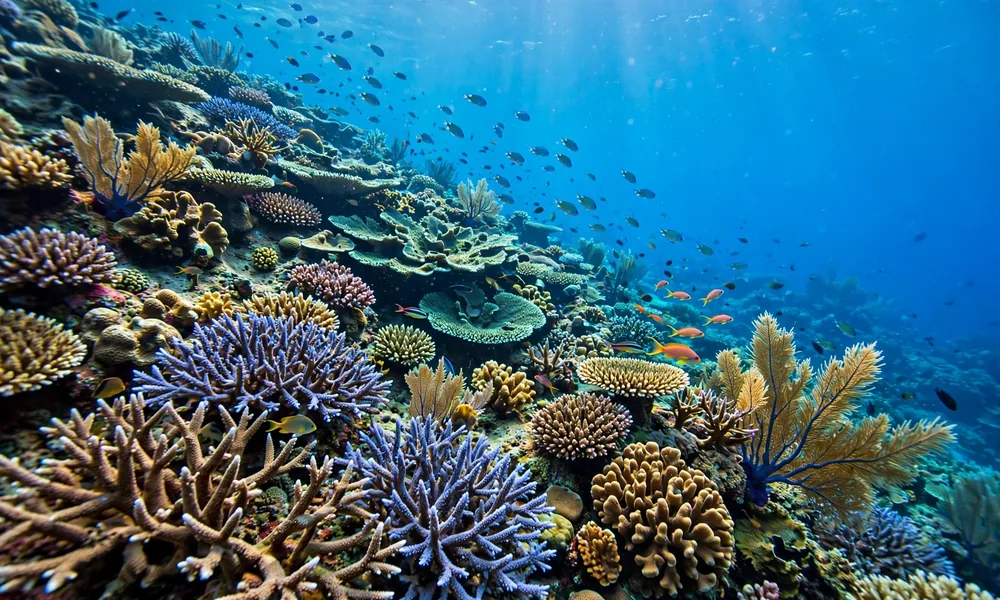
The main pressure is harvesting. The adductor muscle of the giant clam is considered a delicacy in some regions, and the clams have been taken for food, for their shells, which are made into carvings, ornaments and jewellery, and for the aquarium trade, where the colourful smaller species are in demand. In the 1970s much of the Asia-Pacific region was picked clean of giant clams for their meat, and then came the aquarium trade in the 1980s, and now the shells are in vogue in China for carvings and ornaments. The second pressure is the loss of the reef itself. When a reef is damaged by bleaching, by pollution, by destructive fishing or by coastal building, the sunlight the clam needs is lost, and a clam that lives its whole life in one spot has nowhere to go when that spot is ruined.
There is hope, and it comes from farming. The University of the Philippines has been cultivating giant clams in captivity for several decades, in an effort to restock the species in the region, and other hatcheries across the Indo-Pacific are doing the same, raising young clams in tanks and settling them on reefs where the wild clams are gone. The clams grow slowly, and it takes years for a farmed clam to reach adult size, but the work is showing results, and reefs that were picked clean are seeing clams again. The Great Barrier Reef is the bright spot: giant clams have never been allowed to be collected from the wild in Australian waters, and the reef there still holds healthy numbers.
Best seasons for giant clam watching
The best time to look for giant clams is the warm, calm season, when the water is at its warmest and clearest and the clams are open in the shallows, though no season will show you one from a beach towel. The clams are present on the reef all year round, but the warm, calm months are the time when the water is clearest and the clams are most open, and a visit then will show you clams with their mantles spread wide in the sun. In rough weather the water turns cloudy, the clams close, and they are harder to find.
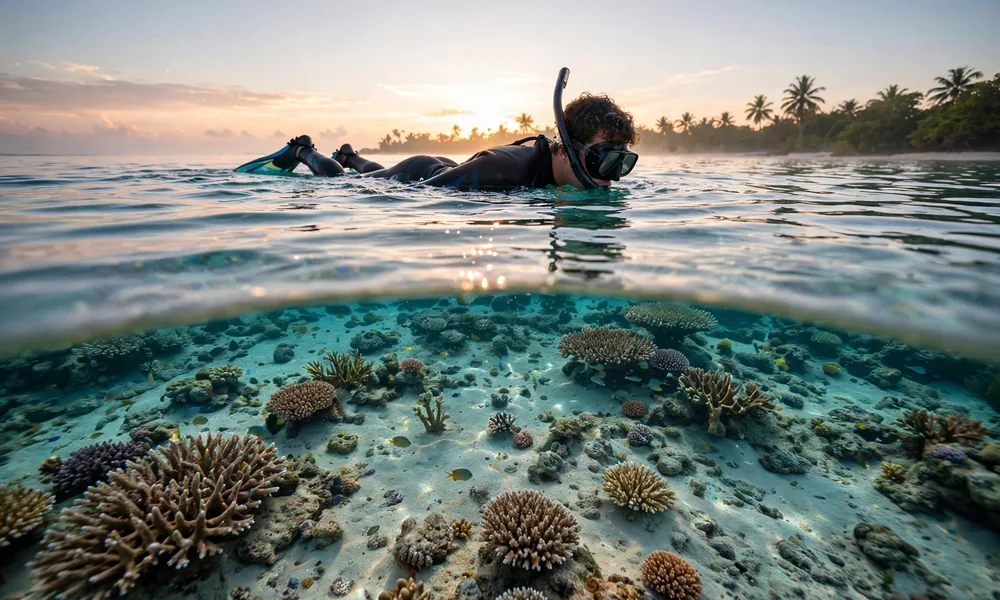
The best hours are the middle of the day, when the sun is high and the clams are open widest, and the best tide is a low tide in daylight, when the reef flat is shallow and the clams are close to the surface. From late morning until mid-afternoon, the clams are at their most open, basking, feeding and filtering, and they are at their most visible then, their mantles glowing in the sunlight. A guided snorkel with a local guide, in the warm season, is the best way to see one in the wild, and the guide will know the reef flats where the clams sit.
Staying safe around giant clams
A giant clam is not dangerous to people who leave it alone, and there is a safety warning that belongs to the reef itself, and it is a simple one: never put your foot or your hand into a giant clam, never stand on a reef, and never touch the mantle. The shell closes slowly, far too slowly to trap a swimmer, but a large clam can hold a foot firmly enough to need help to get free, and a diver who panics in that moment is in more danger from the panic than from the clam. The real danger is to the clam, not to you: a touched mantle can be damaged, a stepped-on shell can be cracked, and a clam that is handled may close and stay closed, losing a day of feeding. Giant clams are protected in many places, and collecting them is illegal, so look, take photographs, and leave the clam exactly as you found it.
Giant clam watching checklist
A little preparation turns a day on a reef into a real chance of seeing a giant clam at its best, glowing on the sand in the warm shallows.
- A guided snorkel with a local guide in the warm, calm season, when the water is clear and the clams are most open.
- A midday snorkel in sunlight, when the clams are open widest and their mantles glow blue, green and purple.
- A low tide in daylight, when the reef flat is shallow and the clams are close to the surface.
- Sturdy reef shoes for walking the shore, so you can reach the reef without cutting your feet on coral.
- A mask, snorkel and fins that fit well, so you can watch the reef flat without kicking up the bottom.
- A field guide to the giant clams of the Indo-Pacific, so you can tell a true giant clam from a southern giant clam.
- Respect for the clams and the reef, keeping your hands off every shell, keeping your distance, and leaving the reef as you found it.
Frequently asked questions
How big do giant clams get?
Giant clams range from about 15 centimetres to 137 centimetres across, and the true giant clam, Tridacna gigas, is the largest of them all, growing to 120 centimetres across, about 4 feet, and weighing more than 200 kilograms, about 440 pounds. The largest known shell measured 137 centimetres across, found around 1817 on the north-western coast of Sumatra, and its two shells alone weighed 230 kilograms when dead, which suggests the live animal weighed about 250 kilograms. The southern giant clam reaches about 60 centimetres, the fluted giant clam about 41 centimetres, and the small giant clam about 35 centimetres.
What do giant clams eat?
A giant clam eats mostly the sugars and proteins made by symbiotic algae called zooxanthellae, single-celled dinoflagellates that live in its mantle tissue and make food by photosynthesis. About 65 to 70 per cent of the clam’s nutritional needs are supplied by the zooxanthellae, and the rest comes from filter feeding: the clam draws water in through a siphon, filters out the tiny plankton and particles in it, and pumps the water out again. The young clam has no algae at all when it settles, and it depends completely on plankton until it takes up zooxanthellae from the water, and as it grows, the algae take over more and more of the feeding.
Are giant clams dangerous to people?
No, giant clams are not dangerous to people, and the man-eater stories are false. South Pacific legends describe clams that lie in wait to trap swimmers or swallow them whole, but no account of a human death by a giant clam has ever been substantiated, and scientists say the adductor muscles, used to close the shell, move far too slowly to take a swimmer by surprise. A diver who puts a foot in a clam may find it held, and may need help to pull free, but the clam is not hunting, and it is not trying to eat anyone. The real danger is to the clam, not to you: a touched mantle can be damaged, and a stepped-on shell can be cracked.
Where do giant clams live?
Giant clams live in warm, shallow, clear water on the coral reefs of the Indo-Pacific, from the South Pacific and Indian Oceans across to the Philippines, the South China Sea, Malaysia and the Great Barrier Reef. They live on flat coral sand and broken coral, in lagoons and on reef flats and reef slopes, and they need warm, clear, sunlit water and a firm bottom to sit on, because without sunlight the algae in their mantle cannot feed them. They are found at depths of 2 to 20 metres, and they are most common in the shallows, where the light is strongest. A giant clam spends nearly its whole life in the same spot, open by day and closed by night.
Can you keep a giant clam as a pet?
You can, in places where it is legal, but you should think hard before you do, and you must never take one from the wild. Giant clams are protected in many places, and collecting them is illegal, and the true giant clam is Critically Endangered, so a pet clam should come only from a licensed hatchery. They are also difficult to keep, needing warm, clear salt water, strong light for the algae in their mantle, and a large tank, because even a small species grows to 35 centimetres across, and a true giant clam grows to 120 centimetres.
How is this guide different from the giant centipede guide?
This guide covers the giant clam, a still, sun-fed bivalve a metre across, Tridacna gigas and its relatives, that sits fixed to a coral reef for more than a hundred years, opens its shell by day to show a brightly coloured mantle, and feeds mostly on the sugars made by algae living in its own flesh, while our giant centipede guide covers a fast, venomous land hunter a foot long, Scolopendra gigantea, that runs across the forest floor at night in South America, hunts frogs, lizards, mice and bats with venom claws, and bites hard enough to put a person in hospital. One is a sessile reef animal you meet by snorkelling over it in daylight; the other is a nocturnal forest predator you meet by torchlight on the leaf litter, and the two could hardly be more different in where they live, how they feed, and how you meet them.
Conclusion
The giant clam species are a reminder that an animal does not need to move, or hunt, or fight to be unforgettable. A heavy shell a metre across, a mantle that glows blue, green and purple, a partnership with algae that turns sunlight into food, and a life of more than a hundred years in a single spot have made the giant clam the most famous still animal of the reef, at home in the warm, shallow seas from the Philippines to the Great Barrier Reef.
If you go looking for one, go on a guided snorkel in the warm, calm season, go at midday when the sun is high, and drift slowly over the reef flat with your eyes on the sand. Find the patches of coral sand beside the coral heads, watch for a heavy ridged shell with a bright mantle spread wide to the sun, and wait for the clam to close, slowly, at your shadow, and you will have met the giant clam that turns a quiet stretch of reef into a place of sudden, beautiful colour. Look, and do not touch.